
Reviewed · CASTLE TOURS
Tokyo Castle, Imperial Palace, Shogun & Garden Walking Tour
Tokyo’s Imperial Palace is less about grand palace rooms than about what has disappeared. The East Gardens occupy the former site of Edo Castle, where massive stone walls, gates, gardens, and a surviving foundation let you picture the power center of shogun-era Japan.
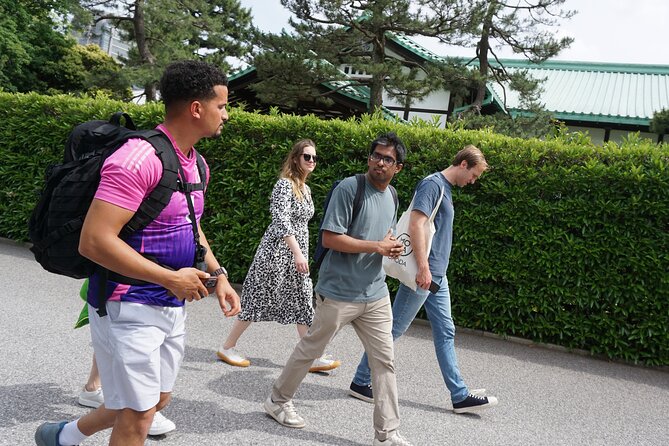
I like the guide-led route because the grounds are large and the remaining structures can be hard to interpret alone. I also like the relaxed two-hour pace, small group size, and practical touches such as help finding photo spots or taking group pictures.
The main thing to understand is that you will not enter the Emperor’s palace. Much of the old castle was destroyed, so this is a history and garden walk rather than a palace-interior visit.
Key points to know before booking
- See Edo Castle’s stone foundations: The former castle site gives the tour its strongest historical focus.
- Enter through Ōtemon Gate: This imposing entrance and its guardhouse ruins help explain how the castle was protected.
- Walk through Ninomaru Garden: Expect koi, carefully arranged greenery, and a quiet break from central Tokyo.
- Hear the shogun-to-emperor story: Guides connect the Edo period, samurai rule, imperial power, and modern Tokyo.
- Keep the group small: The advertised limit varies between 10 and 15 people, which still allows questions and photographs.
- Know what is not included: The Inner Palace is closed to the public, and the tour does not provide access to it.
What this Imperial Palace walk really shows you
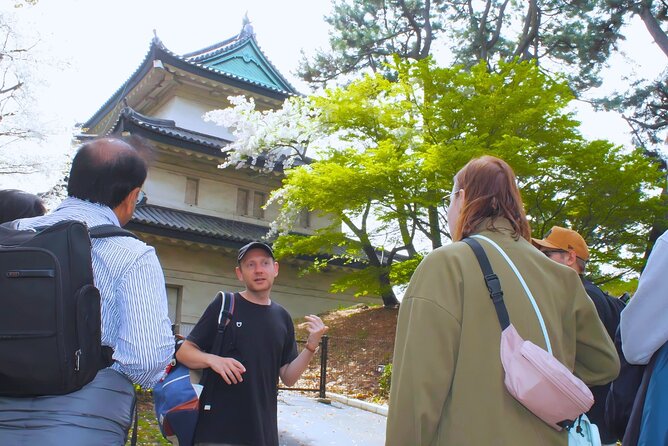
The name can create the wrong picture. You are not touring a lavish royal residence room by room. Instead, you are walking through the East Gardens of the Imperial Palace, an area that preserves the former heart of Edo Castle.
That distinction matters. If you want elegant palace interiors, this is not the right choice. If you want to understand how Tokyo became the seat of Japanese power, the grounds offer far more than a casual stroll, especially with a guide explaining what used to occupy each open space.
The tour lasts about two hours and costs $31.84 per person. Admission to the garden area is free, so you are paying mainly for the guide, the route, the historical explanation, and the convenience of having someone lead you through a huge complex.
That is fair value if you would otherwise see stone walls and garden paths without knowing their purpose. It is less appealing if you already have a strong grasp of Edo history or prefer to explore independently.
More Castle Tours in Tokyo
- Tokyo Castle & Imperial PalaceーShogun Walking Tour
★ 4.7 · 1,068 reviews - Tokyo Castle & Imperial PalaceーShogun Walking Tour
★ 5.0 · 724 reviews - Imperial Palace East Garden and Edo Castle Walking Tour in Tokyo
★ 5.0 · 510 reviews
Meeting at Wadakura Fountain Park
The tour begins at the Starbucks Coffee in Wadakura Fountain Park, at 3-1 Kōkyogaien in Chiyoda City. This gives you a clear, public meeting place near the Imperial Palace grounds and close to public transportation.
Arrive with enough time to find the café and locate your guide. The tour ends back at the same meeting point, which makes planning the rest of your day easier. You are not left at an unfamiliar gate on the far side of the palace complex.
The route is outdoors, so your comfort depends heavily on the weather. The grounds can be exposed, and the walk may feel demanding in summer heat or cold weather. Wear comfortable shoes, bring water, and check the forecast before setting out. The activity requires good weather, and poor conditions can lead to a different date or a full refund.
Entering through Ōtemon Gate

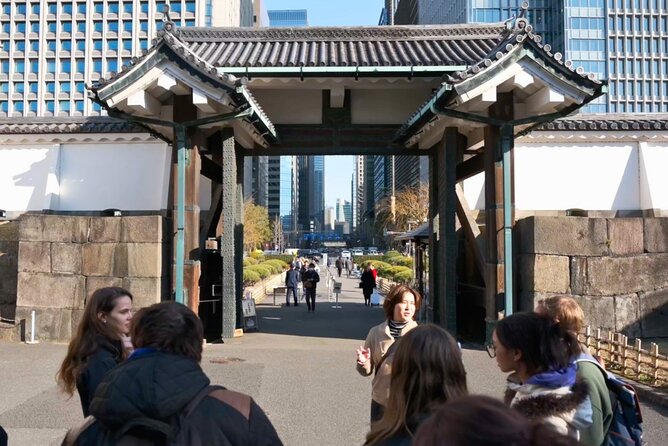
From the meeting point, the group walks toward Ōtemon Gate, the grand main entrance to the East Gardens. This is a strong beginning because you do not simply appear inside a garden. You approach the former castle as people once approached a fortified center of government.
The gate and nearby guardhouse remains help you understand the practical side of castle life. This was not only a residence. It was a carefully controlled compound, with entry points, defenses, officials, and layers of protection.
Your guide may explain how the castle’s layout worked and point out details that are easy to miss. One useful part of a guided visit is learning why a wall, slope, or gate was placed where it was. Without that context, the site can seem like a pleasant park with scattered masonry.
The walk is not described as physically strenuous, but it is still a walking tour. The pace is intended to allow time for questions and pictures. That makes it a good fit for families, including older children and teenagers who may lose interest during a long lecture indoors.
Reading the Edo Castle ruins
The central historical stop is the former Edo Castle site. The castle was destroyed, and the original palace buildings were not rebuilt. In several places, what remains is mainly the stone base or foundation.
This is the tour’s greatest strength and its main limitation. The open spaces can feel underwhelming if you expect towers and palace halls. At the same time, the absence of reconstructed buildings gives the guide room to explain the site rather than simply point at restored architecture.
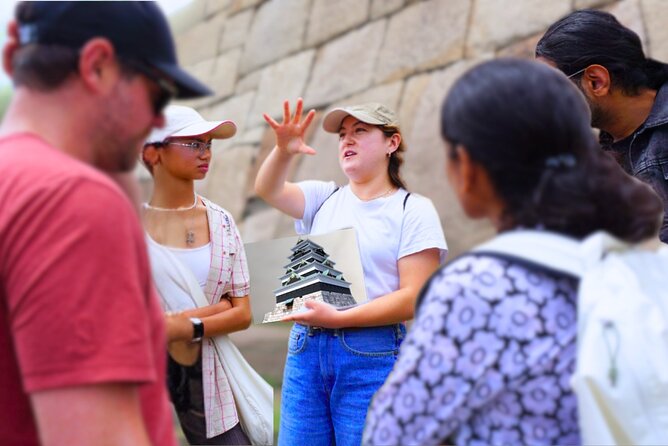
A good guide uses maps, images, and comparisons to help you picture the castle that once occupied the grounds. Mika has been praised for using visual material to explain the layout and historical importance. Natsumi has been noted for connecting the buildings and gardens to the changing roles of shoguns and emperors.
The historical story is unusually useful for first-time visitors to Japan. During the Edo period, the shogunate governed from Edo, the city that later became Tokyo. The emperor remained an important figure, but political power operated through the shogun’s government. The modern imperial center developed from that earlier power base.
You will not receive every detail of Japanese history in two hours, but the tour can give you a framework for later visits to temples, shrines, museums, and former samurai districts.
More Garden Tours in Tokyo
- Tokyo: Imperial Palace East Gardens Walking Tour
★ 4.8 · 353 reviews - Tokyo: Edo Castle & East Garden of the Imperial Palace Tour
★ 4.7 · 112 reviews - Tokyo: Tsukiji Market and Hama-rikyu Gardens Guided Tour
★ 4.8 · 73 reviews - Tokyo: Pvt. Tour – Edo Castle & Imperial Palace East Gardens
★ 4.8 · 63 reviews
Ninomaru Garden and the calmer side of central Tokyo
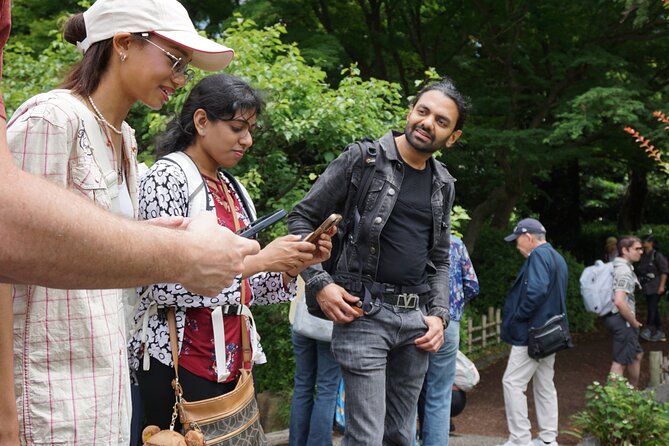
Ninomaru Garden brings a different mood. After the gates and castle foundations, you move into a more peaceful setting with greenery, ponds, and koi. The garden offers a welcome change from Tokyo’s dense streets and rapid pace.
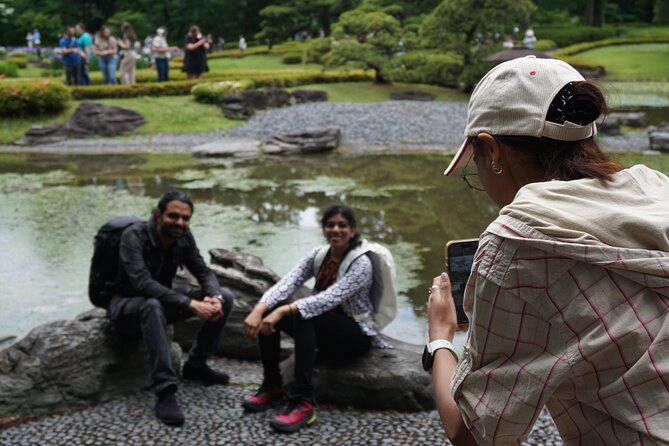
This part works well for photographs. Guides such as Natsumi and Nicolas have been praised for finding attractive viewpoints and helping with pictures. Ask if you want a group photo or need help choosing a good angle.
The garden is not a separate attraction requiring another ticket. It forms part of the East Gardens route, so the guide can connect its design to the castle grounds rather than treating it as a disconnected park.
The seasonal character of the garden is another reason to consider the tour at different times of year. Cherry blossoms can add color in spring, while winter brings a quieter, more open feel. Rain does not necessarily ruin the walk, but it can make the paths and photo stops less comfortable. Bring suitable clothing and do not expect the tour to move indoors.
The guide makes the difference
The quality of this experience depends more on the individual guide than on the basic route. The strongest guide names in the supplied information include Mika, Natsumi, Lakki, Nicolas, and Fonz, though the person leading your departure will vary.
Mika has been praised for engaging children aged 11, 13, and 15 with historical references and clear explanations. That makes her style especially appealing to families. Natsumi is often associated with Edo-period history, the relationship between shoguns and emperors, garden details, and local suggestions for restaurants and shrines.
Lakki, also written as Lakky in some material, is noted for his shogun history and ability to keep the walk lively in rainy weather. Nicolas has been praised for bringing meaning to the gardens and helping visitors notice the koi, plants, and surviving structures.
Most comments are very positive, but the experience is not perfectly uniform. One person found a guide difficult to understand and not sufficiently well informed. That is worth keeping in mind when booking any tour that depends on spoken explanation, particularly if you are sensitive to accents or need very clear English.
The group limit is described in two ways: up to 15 people in the main description and up to 10 in the additional information. Either way, this is intended to be a small-group walk rather than a large procession. Confirm the current group size if that detail matters to you.
How the two hours are best used

Two hours is enough for a focused introduction, not a full study of the Imperial Palace complex. The guide leads you from the meeting point to Ōtemon Gate, through the East Gardens, past the castle remains and guardhouse ruins, and into Ninomaru Garden before returning to the starting area.
The pace leaves space for photographs and questions. That is important because the value of the walk comes from interpretation. Rushing from one site to another would make the foundations feel like a checklist.
I would choose a morning departure if you have the option, especially in warmer months. The information describes the tour as a calm walk, but Tokyo’s weather can change how comfortable an outdoor route feels. In winter, the open grounds may feel crisp and quiet. In cherry blossom season, the gardens can be especially photogenic.
No special dress code applies, and tattoos are welcome. Most people can participate, but you should be ready to walk outdoors for the full period.
Who will get the most from this tour
This tour suits you if you want a clear introduction to Japanese political history without spending half a day in a museum. It is also a good choice if you are visiting Tokyo with children or teenagers and want a guide who can turn stone foundations into a story about samurai, shoguns, emperors, and castle defenses.
It works particularly well on a second Tokyo visit. On a first trip, you may prefer to prioritize places with more visible architecture, such as major temple districts or observation decks. Several comments point to the same practical truth: the East Gardens are beautiful, but the site can feel sparse if you do not already care about the history.
Independent visitors can walk through the gardens without paying for a guide. The $31.84 price makes sense when you want help with orientation, historical context, and photographs. It makes less sense if you plan to stroll quickly, take a few pictures, and move on.
The tour is also useful for anyone who finds large palace grounds confusing. The Imperial Palace area is broad and divided into different sections. A guide helps you understand which part you are seeing and keeps you from wasting time wandering without a plan.
Important expectations about palace access
The Inner Palace is not part of this experience and is not open to the public. The tour takes place in the East Gardens and former Edo Castle grounds, not inside the Emperor’s residence.
This point deserves attention because the tour title includes Imperial Palace and Tokyo Castle. You will see palace grounds, historic gates, garden areas, guardhouse ruins, and castle foundations. You will not see the private palace interiors.
That limitation is not a flaw in this particular tour. It is simply the nature of the site. The imperial family occupies the Inner Palace, and ordinary sightseeing access is restricted. Book this walk for the gardens and historical setting, not for an indoor palace tour.
Price, booking, and cancellation
At $31.84 per person, the cost is moderate for a two-hour guided walk in central Tokyo. You receive a mobile ticket, a local guide, and a small-group route through an important historic site. There is no separate garden admission charge listed.
The best value comes when your guide is active about explaining the site, answering questions, and showing you places you might miss alone. The weakest value comes if the commentary is brief or difficult to follow, since the physical route itself is free.
You can cancel up to 24 hours before the start time for a full refund. Changes or cancellations made within 24 hours are not accepted for a refund. If poor weather causes the operator to cancel, you are offered another date or a full refund.
Should you book the Imperial Palace East Gardens walk?
Book it if you want the story behind the stones. The tour is especially worthwhile for families, first-time students of Japanese history, and anyone who prefers a guide to explain castle defenses, Edo politics, and the shift from shogun rule to imperial Tokyo.
Think twice if you expect grand palace rooms, reconstructed castle towers, or a long list of indoor sights. You will mainly see gardens, gates, ruins, stone foundations, and open grounds.
For the price, I would book this as a focused history walk, not as a complete Imperial Palace visit. Go with realistic expectations, prepare for the weather, and ask your guide for photo help and local suggestions. If you do that, the two hours can turn an otherwise quiet garden stroll into a much clearer picture of how Tokyo became Japan’s political center.
FAQ
How long does the Tokyo Imperial Palace walking tour last?
The tour lasts approximately two hours.
Where does the tour begin?
It begins at Starbucks Coffee in Kokyo Gaien Wadakura Fountain Park, at 3-1 Kōkyogaien, Chiyoda City, Tokyo 100-0002, Japan.
Where does the tour end?
The activity ends back at the meeting point.
Does the tour enter the Imperial Palace building?
No. The Inner Palace is not open to the public. The tour visits the East Gardens and the former Edo Castle grounds.
What places are included on the route?
The route includes Ōtemon Gate, guardhouse ruins, Edo Castle remains, and Ninomaru Garden.
How many people can join the tour?
The information gives two group limits, up to 15 people in one description and up to 10 in the additional details. Confirm the current limit when booking if group size is important to you.
Is admission to the gardens included?
The guided walking tour includes access to the listed grounds, and the admission ticket is described as free.
Is there a dress code?
No. There is no dress code, and tattoos are welcome.
What happens if bad weather cancels the tour?
If the activity is canceled because of poor weather, you can choose a different date or receive a full refund. You can also cancel at least 24 hours before the start time for a full refund.
More Walking Tours in Tokyo
- Tokyo Tsukiji Fish Market Food and Culture Walking Tour
★ 5.0 · 3,184 reviews - Tokyo: Shinjuku Local Bar and Izakaya Guided Walking Tour
★ 4.9 · 1,794 reviews - Tokyo: Tsukiji Fish Market Food and Walking tour
★ 5.0 · 1,724 reviews - Tokyo: Asakusa Walking Tour with Sensoji Temple Visit
★ 4.8 · 1,583 reviews
More Historical Tours in Tokyo
- Tokyo: Imperial Palace and Shogun Historical Walking Tour
★ 5.0 · 2,251 reviews - Tokyo: Imperial Palace Japanese History Walking Tour
★ 4.9 · 987 reviews - Tokyo: Imperial Palace and Shogun Walking Tour
★ 4.9 · 935 reviews - Yanaka Walking Tour: Historic and Traditional District of Tokyo
★ 5.0 · 530 reviews
Just added around Tokyo
- Kawagoe Japanese Food Tour : Unagi Kaiseki and Sake near Tokyo★ 5.0 · 30 reviews
- Kawagoe 4hr Private Tour with Licensed Guide (Kawagoe Dep)★ 5.0 · 13 reviews
- Little EDO Sushi Making workshop in Kawagoe★ 5.0 · 18 reviews
- 【R34】Tokyo:Private Daikoku tour in Modified R34★ 4.9 · 92 reviews
- :Tokyo,Shibuya/ Pro Photography in Kimono / English-Friendly★ 5.0 · 26 reviews
- Tokyo:Celebrate Unique Japanese New Year Tradition Festivity★ 3.9 · 20 reviews
- Tokyo: Allstar Food Tour★ 4.7 · 29 reviews
- Tokyo: West-Side Cycling and Food Tour with Guide★ 5.0 · 37 reviews
Castle Tours, compared.
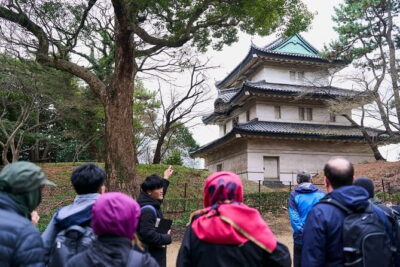
Tokyo Castle & Imperial PalaceーShogun Walking Tour
Our verdict →
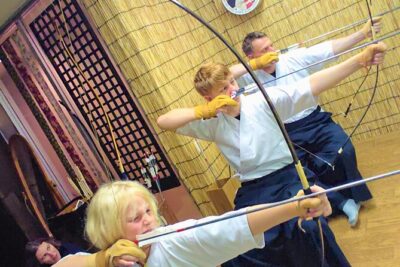
Japanesel Archery Experience HIROSHIMA CASTLE SHARAKU
Our verdict →
Browse the lists this tour appears in