
Reviewed · TRADITIONAL CRAFTS
Authentic knife making experience at a blacksmith in Kyoto
The memorable part here is simple: you turn a red-hot piece of steel into a usable Japanese kitchen knife with your own hammer blows. This is not a quick demonstration. You handle the tools, feel the strain in your arm, and watch a rough piece of metal take shape.
I especially like the practical souvenir and the patient instruction from Mao, Taka, and the rest of the team. You also get a rare look at Japanese blacksmithing without leaving Kyoto. The main drawback is the physical work and heat, and the two-studio setup means you must confirm the correct location before setting out.
Key things to know before you book
- You forge a 13 to 15 cm knife: The finished blade is intended for everyday use, gifting, or display.
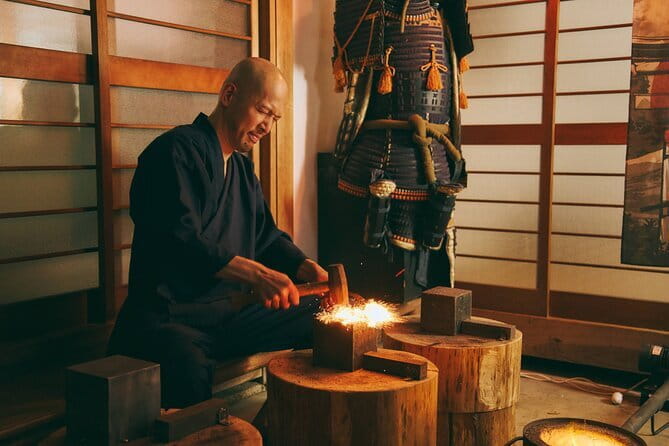
- You do the hammering yourself: Expect repeated strikes, careful positioning, and real physical effort.
- Mao leads the instruction: He has more than 10 years of knife-making experience, with other staff members helping during the session.
- The workshop lasts about three hours: The knife-making format is shorter than the five-plus hours needed for larger knives.
- You work near very hot steel: The furnace can reach roughly 800 to 900 degrees Celsius, so safety instructions matter.
- The location is outside central Kyoto: The meeting point is near the Yase-Hieizan Exit of the Eizan Electric Railway, with a second studio used on some dates.
Turning hot steel into a Japanese knife
The attraction of this class is that it gives you a real task, not just a photo opportunity. You begin with raw material and finish with a blade that carries the marks of your own work. The instructors step in when needed, but the process still feels hands-on.
You can expect a small-group setting, which matters here. Blacksmithing requires close attention. You need to see where the hammer lands, hear corrections, and get help quickly when handling hot metal. A smaller class gives the team more time to watch your technique.
The finished knife is about 13 to 15 centimeters long. It is a sensible size for a kitchen knife and easier to transport than a large blade. This workshop does not attempt the full process for a large chef’s knife, which would take more than five hours and cost over $400. That limitation keeps the session within a manageable three-hour format.
At $154 per person, this is not a cheap souvenir-making class. You are paying for specialist instruction, materials, equipment, protective clothing, staff assistance, and a finished knife. The value is strongest if you care about making the object yourself. If you only want to buy a Japanese knife, Kyoto has easier and cheaper options.
More Craft Workshops in Kyoto
- Roketsu dyeing experience: M course Roketsu Dyeing Experience
★ 5.0 · 163 reviews - Kyoto Michelin Ramen Workshop or Painting Ramen Essentials
★ 4.9 · 100 reviews - Kyoto: Ramen Bowl Painting and Michelin Cooking Class
★ 4.9 · 96 reviews
Arrival at the Sakyo-ku studios
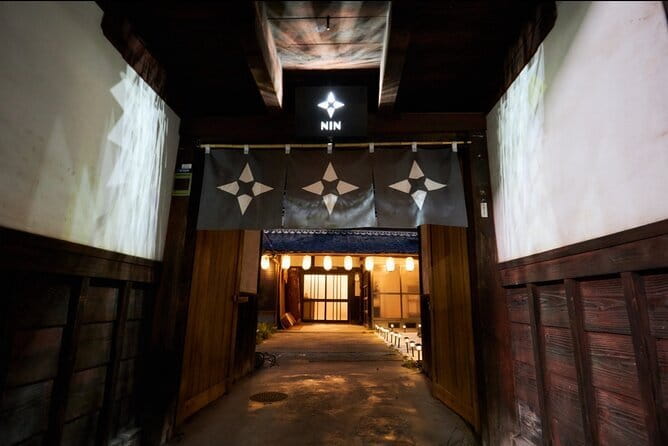
The stated meeting point is Studio Shinobi YASE, at 168-1 Yase-no-secho in Sakyo-ku. It is listed as a one-minute walk from the Yase-Hieizan Exit of the Eizan Electric Railway, and the train is the sensible choice.
There are two workshop spaces, Studio NIN Yase and Studio NIN Kendo. The staff sends a message before your visit to confirm which one you should use. Pay close attention to that message. One booking instruction has directed people to one studio while the knife-making session took place at the other, creating avoidable confusion.
The transport time also deserves care. The meeting point is described as very close to the station, but one participant found the walk closer to 15 minutes. Give yourself extra time, especially if you are carrying luggage or arriving on a tight schedule. Taxis are also available.
The setting outside central Kyoto can be part of the appeal. You are not stepping into a generic city classroom. You are heading to a quieter part of the city for a craft session, but that means you should not treat this as an activity you can squeeze between two central sightseeing stops.
Changing into a blacksmith’s uniform
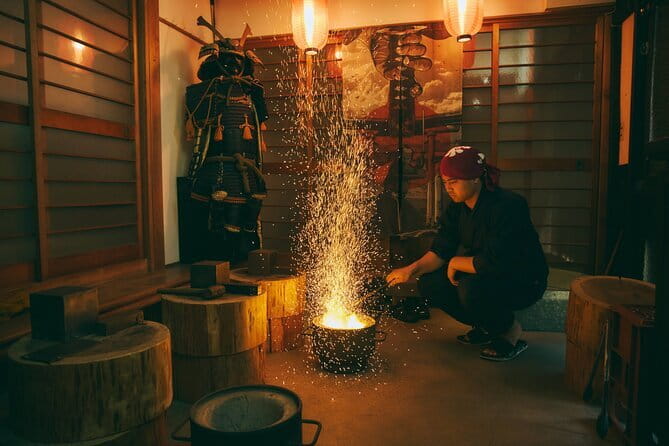
Once you arrive, you meet the instructor and change into traditional blacksmith attire. This is a small step, but it changes the mood at once. You are no longer simply watching a craftsman at work. You are preparing to take part.
Bring socks. The costume, towel, water, tools, materials, box, and bag are included. Wear something comfortable underneath, since the workshop involves bending, gripping, and repeated hammering.
The team has a friendly teaching style. Mao is identified as the main knife professional, with more than a decade of experience. Other instructors, including Taka, Daiki, Mits, and Atsushi, have also helped lead sessions. The names may vary by date, but the teaching approach is consistent: explain the step, show you how to do it, then correct you while you work.
Learning the tools and safety rules
Before the furnace gets hot, you receive an introduction to the hammers, tongs, grinders, and other tools. This part is not filler. You need to understand how to hold the metal and where to place your hands before the work begins.
The steel reaches roughly 800 to 900 degrees Celsius. That makes clear safety instructions essential. The team explains how to handle the tools and stays close while you work. You are responsible for your own safety under the activity terms, so listen carefully and follow directions without trying to rush.
The class is suitable for beginners because the instructors guide each stage. Still, beginner-friendly does not mean effortless. You will be working with heat, metal, and heavy tools. The physical side is real, and several participants found the hammering more tiring than expected.
Take the warning seriously, but do not let it put you off if you are reasonably comfortable with hands-on work. Stretching before the class is useful advice. In hot weather, the furnace makes the room warmer, though the team has used air conditioning, frozen neck coolers, and cooling towels to help.
Same trip, a completely different kind of day:
- PERFECT KYOTO 1-Day Bus Tour
★ 5.0 · 13,518 reviews - Kyoto: Fushimi Inari, Kinkakuji, Bamboo Grove 1 Day Bus Tour
★ 4.8 · 4,316 reviews - Kyoto: Tea Ceremony in a Traditional Tea House in Kiyomizu
★ 4.9 · 3,519 reviews - Kyoto Geisha Walking Tour: Gion District & Hidden Gems
★ 4.7 · 3,273 reviews
The furnace and the first hammer blows
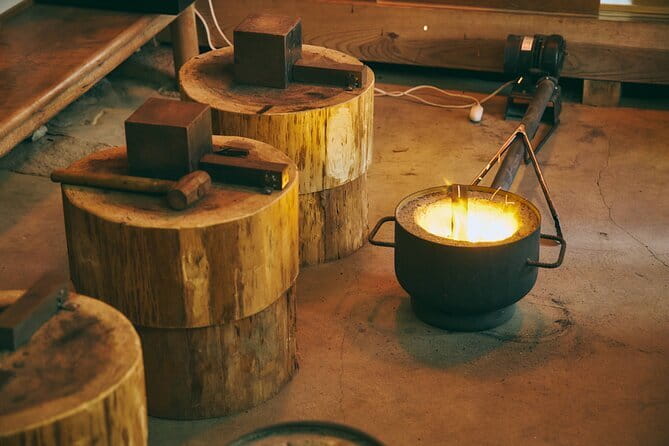
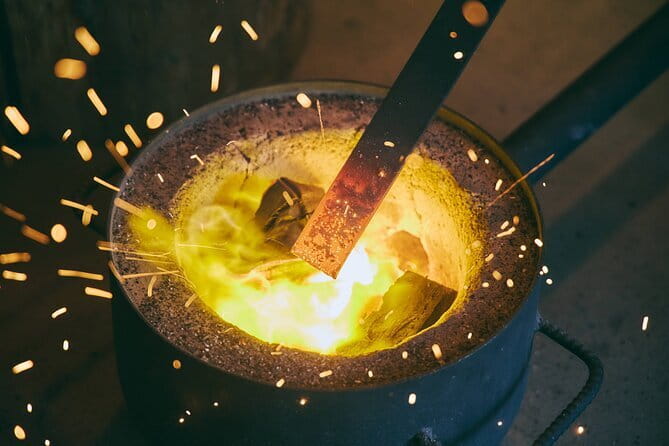
The raw iron goes into the furnace until it glows red. This is the moment when the workshop becomes more than a craft lesson. You can see the material change before you begin shaping it.
Under close guidance, you strike the glowing steel with a hammer. The instructor shows you the angle, rhythm, and force. Your job is not simply to hit as hard as possible. You need to place the blows correctly and keep the work under control.
This is the part children and adults often find most exciting, but the age rule matters. Children under 15 cannot attend, and anyone under 15 must not be treated as an exception without checking directly. The activity is not suitable for people over 95 according to the booking information.
You may find that the instructors take over briefly to correct the shape. That does not cancel out your work. Forging a blade requires skill, and a completely unsupervised beginner could easily damage the material or create a safety problem. The best balance is that you do the meaningful steps while the staff protects the final result.
Shaping, cooling, and refining the blade
After the main forging, the metal is cooled and checked. You work on rough edges and help prepare the blade for sharpening. This is less dramatic than striking hot metal, but it is where the rough shape begins to look like a knife.
The class gives you a basic introduction rather than full professional training. You learn how the sequence works and gain respect for the amount of work behind a finished Japanese kitchen knife. Some people may wish for more time to refine the blade, but the three-hour schedule has to keep moving.
The final surface may retain a rustic Kurouchi finish. This is a dark, raw-forged appearance rather than a bright, polished silver blade. It is part of the character of the knife and helps preserve the handmade look. If you expect a factory-smooth finish, adjust that expectation before booking.
Sharpening and polishing your finished knife
Next comes sharpening with stones and grinders. Here, precision matters more than strength. The team shows you how to create a functional edge and helps prevent common beginner mistakes.
This stage is one reason the experience feels worthwhile. You are not just shaping an ornament. The goal is a practical knife that can be used at home. The instructors check the work and help fix problems, so your blade should come out usable even if your hammering was uneven.
Polishing brings the process to its final form. You see the contrast between the rough steel from the furnace and the finished blade in your hands. The result will not look identical to a mass-produced kitchen knife, and that is part of the appeal. Small irregularities show that you made it during a real workshop.
The knife is packed into a box and bag for the journey home. Photos and videos are welcome throughout the session, and the team may help capture key moments while you work. That is useful because your hands will be occupied during the best parts.
How hard is the three-hour session?
You should expect real physical work, especially during repeated hammering. It is not an all-day blacksmith apprenticeship, but you may feel it in your shoulders, wrists, and back. Stretch before you arrive and drink the water provided.
The heat varies by season. Summer sessions can be particularly warm near the furnace. Cooling items and air conditioning have been provided during hot periods, but you are still working beside a fire. Comfortable clothes and a willingness to sweat are sensible.
The pace is generally well controlled. You learn the steps, perform them, receive help, and move on before fatigue takes over. If you want to spend a long time experimenting with the blade shape, this format may feel short. If you want a focused craft activity that fits into a day of sightseeing, the timing works better.
Who will enjoy this knife-making class?
I would choose this for couples, families with older teenagers, solo visitors, and anyone who prefers making something to simply looking at it. It also makes a strong gift experience, especially for someone interested in cooking, Japanese craft, metalwork, or unusual souvenirs.
It worked especially well for families because everyone can share the task. A teenager aged 15 or older can take part, and the finished knife gives the group a lasting reminder of the day. The activity also suits solo visitors because a small group provides an easy way to meet people from different countries.
You do not need previous blacksmithing experience. You do need patience, basic physical stamina, and respect for safety instructions. If heat, noise, repetitive movement, or sharp tools make you uncomfortable, choose a quieter Kyoto activity instead.
Some sessions may offer knives with handles for an extra charge. One participant reported a 5,000 yen supplement, payable by cash or card, but confirm the current options before arrival because the standard information describes the included knife rather than every upgrade.
Price, timing, and cancellation flexibility
The listed price is $154 per person for three hours. That includes the costume, towel, water, tools, materials, packaging, instruction, and the finished knife. It is a fair price for a specialist workshop if you value the process and not just the object.
The activity is offered in English and Japanese. The staff can explain the safety steps and guide beginners in English, though the amount of historical detail may vary by instructor and group. If Japanese craft history is your main interest, ask questions during the closing discussion. The team can explain techniques, knife care, and the background of the work.
Free cancellation is available up to 24 hours before the start time, with a full refund. You can also reserve and pay later, which helps if your Kyoto schedule is still changing. Check available start times when booking, since the exact departure time is not fixed here.
Should you book the Kyoto knife-making experience?
Book it if you want a useful souvenir that you helped create, and if you are happy to put in some effort. The strongest parts are the hot-steel forging, the supportive instructors, the small-group feel, and the satisfaction of taking home a real knife.
Skip it if you want a polished factory-perfect blade, dislike heat, or prefer a short demonstration with little participation. Also leave extra time for the journey and confirm the correct studio before you go.
For me, the best reason to book is that the knife keeps the memory alive. Every uneven mark connects it to the afternoon you spent hammering steel in Kyoto. That is worth more than another ordinary souvenir, provided you are ready to work for it.
FAQ
How long does the knife-making activity last?
The scheduled duration is three hours. The workshop uses a refined format of about two and a half hours for the knife work, with the full visit described as three hours.
How large is the knife?
The finished handmade knife is about 13 to 15 centimeters long.
Can I take the knife home?
Yes. The finished knife is packed in a box and bag for you to take home.
Is the knife suitable for everyday use?
The knife is designed to be practical and can be used as an everyday kitchen knife, though the final result has a handmade, rustic character.
Is instruction available in English?
Yes. Instruction is available in English and Japanese.
What should I bring?
Bring socks. The workshop provides the costume, towel, water, tools, materials, box, and bag.
Where is the meeting point?
The stated meeting point is Studio Shinobi YASE, at 168-1 Yase-no-secho, Sakyo-ku, Kyoto. It is near the Yase-Hieizan Exit of the Eizan Electric Railway, but staff will confirm which of the two studios you should attend.
Can children join the workshop?
Children under 15 cannot take part. Participants under 15 must be accompanied by a guardian, and the activity is not suitable for people over 95.
Just added around Kyoto
- Sekka Cotton Furoshiki Class★ 5.0 · 19 reviews
- Kyoto Sword Experience – includes Museum Ticket/Ninja Experience★ 4.5 · 149 reviews
- Scenic Green Tea Fields of Hidden Kyoto & Local Tea Exp (Private)★ 5.0 · 32 reviews
- Secret Eastern Kyoto Biking Adventure★ 5.0 · 44 reviews
- Private Sake Tasting in Central Kyoto with Sake Sommelier★ 5.0 · 32 reviews
- Samurai School in Kyoto: Samurai for a Day★ 5.0 · 202 reviews
- SHIRAKAWA Japanese Culture Experiences with private English staff★ 5.0 · 16 reviews
- A Privately Guided Photoshoot in Beautiful Kyoto by a Pro★ 5.0 · 18 reviews
Traditional Crafts, compared.
Tokyo Sumo Experience: Chanko & Mochi with a Former Pro
Our verdict →
Kintsugi Experience: Art of Golden Joinery in Tokyo
Our verdict →

Matcha Making Experience with Mochi Sweets in Asakusa
Our verdict →
Roketsu dyeing experience: M course Roketsu Dyeing Experience
Our verdict →
Browse the lists this tour appears in