
Reviewed · GEISHA & MAIKO EXPERIENCES
Guided Gion Tour: Explore Kyoto’s Historic Geisha District
Gion is most rewarding when you understand what you are seeing. A private guide leads you through old lanes, shrine grounds, temple gates, and teahouse streets, pointing out the places where a geisha or maiko might pass. The walk also includes Yasaka Shrine, Maruyama Park, Chion-in Temple, and Hanamikoji Street.
I like the private format, which gives your group room to ask questions and adjust the pace. I also like the range of sights: this is not only a search for geisha, but a compact tour of Kyoto’s religious buildings, performing arts, gardens, and traditional wooden streets.
The main caution is simple: a geisha or maiko sighting is not guaranteed, and the tour does not include private time with one. On very hot days, the pace may feel demanding, especially for families or anyone who needs regular rests.
Key points to know before you book
- Private groups of up to eight: The $350 price covers the group, so the value improves when shared by several people.
- Geisha sightings are possible, not promised: Your guide can take you to likely spots, but no meeting or photograph is arranged.
- Six compact stops: The walk combines Gion streets with Chion-in, Yasaka Shrine, Maruyama Park, and a kabuki landmark.
- Guides can shape the experience: Ahmed and Mat are named guides associated with the tour, and the private setup lets you ask plenty of questions.
- Choose your time with care: Early morning should be quieter, while evening lets you see Gion under its streetlights.
- Plan for walking and weather: The tour lasts about two hours, requires good weather, and can feel strenuous in extreme heat.
What this Gion walk is really about
Gion is often treated as a stage for spotting geisha, but that is only one part of the experience. The district is also a preserved slice of old Kyoto, with traditional wooden machiya houses, teahouses, shrines, temple buildings, and streets that still carry the shape of an earlier city.
I see this tour as a useful introduction rather than a full study of Kyoto’s geisha culture. In two hours, you get orientation, local explanation, and a chance to ask questions that are hard to answer from a guidebook. The private guide matters because customs in Gion are easy to misunderstand, and the right explanation gives the streets more meaning.
The route includes several free-admission sights, so you are paying mainly for the guide’s time and the convenience of a private walk. That makes the $350 group price easier to justify for a larger party. For two people, it is a costly short tour. For six or eight people, it becomes a more reasonable way to share a local guide.
The published rating is 4.6 out of 5, with 94 percent recommending the experience. The strongest praise centers on the guides’ explanations, punctuality, and considerate approach. Ahmed is specifically praised for making local customs clearer, while Mat is described as informative and ready with answers.
Still, the experience depends heavily on the guide assigned to your group. One low rating describes a guide who was not present or informative enough, so the quality may not feel identical on every departure. That is worth keeping in mind when you are paying a premium for a private walk.
More Historical Tours in Kyoto
- Kyoto Gion: 2-Hour Geisha Culture & History Walking Tour
★ 5.0 · 1,186 reviews - Kyoto: Nijo-jo Castle and Ninomaru Palace Guided Tour
★ 4.7 · 1,020 reviews - Kyoto: Imperial Palace & Nijo Castle Guided Walking Tour
★ 4.7 · 453 reviews
Starting in Gion’s old streets
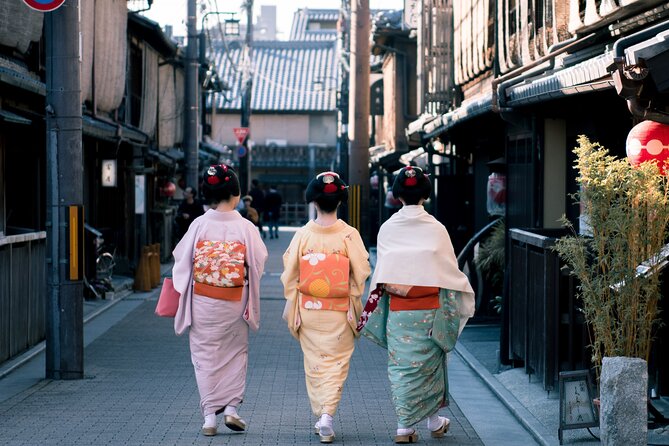
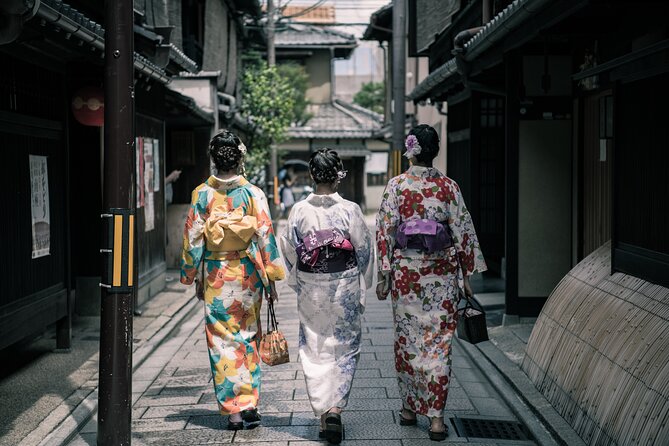
The opening hour focuses on the Gion area itself. This is the part of the tour most closely tied to the district’s reputation, with old architecture and the possibility of seeing a geisha or maiko on Hanami Street.
The key word is possibility. The guide can bring you to places where sightings are more likely, but the tour cannot control who appears or when. A real maiko was spotted during one outing, but that was a fortunate moment rather than a promised feature.
You should also be careful about your expectations. This is not a scheduled performance, tea ceremony, or arranged introduction. You will not receive private time with a geisha or maiko as part of the tour. The goal is to look respectfully, learn about the district, and perhaps see one passing between appointments.
That distinction makes the tour more suitable for someone who wants cultural context than for someone seeking a guaranteed photograph. Gion is a working district, not an attraction built solely for sightseeing. A guide can help you observe without treating the people who work there as a photo opportunity.
The private format is especially useful here. You can ask why certain streets look the way they do, how the tea houses fit into local culture, or what separates a maiko from a geisha. The supplied information does not promise a fixed script, so your questions can help shape this portion of the walk.
The Izumo no Okuni statue and Kyoto’s performing arts
The next stop is the Statue of Izumo no Okuni, with about 15 minutes set aside for it. The statue honors the figure credited with founding kabuki theater, making this a useful reminder that Kyoto’s entertainment culture is broader than the geisha world.
This is a small stop, but it adds a different angle to the tour. Gion is associated with music, dance, tea houses, and refined performance, while the Izumo no Okuni statue points to the development of kabuki and Japanese stage arts.
Because admission is free and the visit is brief, do not expect an extended museum-style explanation. Its value comes from the connection it makes between Kyoto’s streets and the performing arts. If you are interested in theater, ask your guide to spend a little extra time on the story of Izumo no Okuni.
Chion-in’s massive gate
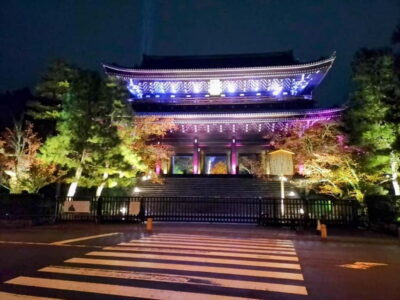
Chion-in Temple is represented by its impressive gate, with roughly 15 minutes planned for the stop. The gate is a strong visual contrast to Gion’s narrower wooden streets. Its scale and carved wooden details give you a quick sense of the importance of the temple complex beyond the district.
You are not paying a separate entrance fee for this stop, according to the tour details. The visit is primarily about seeing the gate and hearing about the temple’s place in Kyoto. The short timing means you should think of it as an architectural pause, not a complete temple visit.
This is one reason the tour works well as an orientation walk. You move between different kinds of Kyoto sights in a short period: old entertainment streets, a performing arts memorial, a major Buddhist temple entrance, a Shinto shrine, a park, and a traditional lane. The tradeoff is that no single stop receives a long, unhurried exploration.
More Geisha Experiences in Kyoto:
- Kyoto Geisha Walking Tour: Gion District & Hidden Gems
★ 4.7 · 3,273 reviews - Kyoto: Gion Magical Night Walking Tour with Geisha Trivia
★ 4.9 · 2,393 reviews - Kyoto: Gion Geisha District Walking Tour – Stories of Geisha
★ 4.7 · 2,187 reviews - Best of Kyoto: Gion, Geisha, Pagodas & Cobblestones
★ 4.9 · 2,058 reviews
Yasaka Shrine and its lantern-lit approach
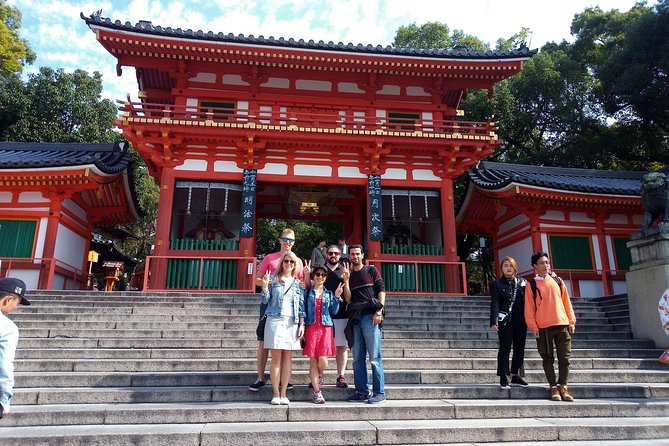
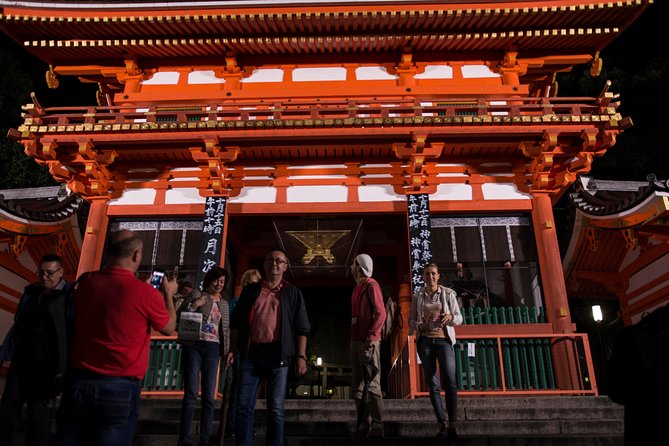
Yasaka Shrine is another brief stop, listed at about 10 minutes. It is known for its festivals and lantern-lit paths, and it offers a clear change in mood from the surrounding streets.
The shrine is an important spiritual center in Kyoto, not just a photogenic backdrop. Your guide can help connect the building and pathways with local religious life, which is valuable if you are unfamiliar with the difference between a Shinto shrine and a Buddhist temple.
The short visit should be enough for photographs and a basic explanation, but it may feel rushed if you want time to wander on your own. If Yasaka Shrine matters to you, tell the guide early. Since this is a private tour, you have a better chance of discussing how to use the available time.
Photography is one of the clear strengths of the route. Yasaka Shrine, the old Gion streets, Chion-in’s gate, and Maruyama Park all offer different settings. Early morning may be the best choice if you want a quieter walk, while an evening departure gives the shrine and lanes a different look as the lights come on.
Maruyama Park for a slower pause
Maruyama Park takes about 10 minutes and provides a green break from the built-up streets. Its paths, ponds, and seasonal cherry blossoms make it one of the more relaxed sections of the route.
The park is also a practical place to slow down. One family found the heat difficult and needed a rest during the tour. That experience is a useful warning: the walking distance may not look intimidating on paper, but Kyoto’s summer temperatures can make a two-hour outing feel much longer.
If you are traveling with children, older family members, or anyone sensitive to heat, choose your timing carefully and tell the guide if you need a pause. The tour can be taken throughout the day, so you are not locked into the hottest part of the afternoon.
Maruyama Park may be especially pleasant during cherry blossom season, although the tour information does not promise blossoms on any particular date. Treat the seasonal scenery as a bonus rather than a guaranteed feature.
Hanamikoji Street and the final stretch
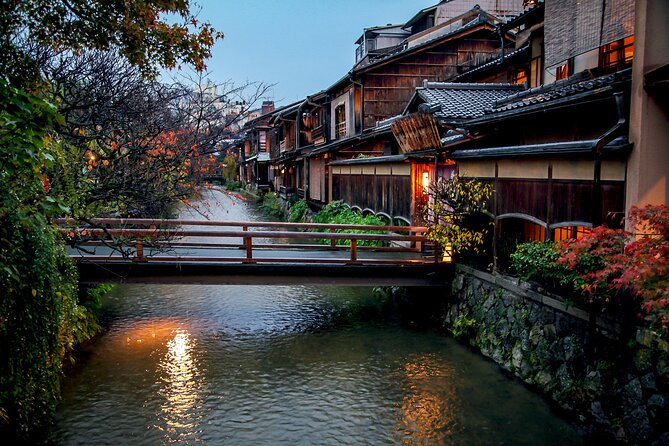
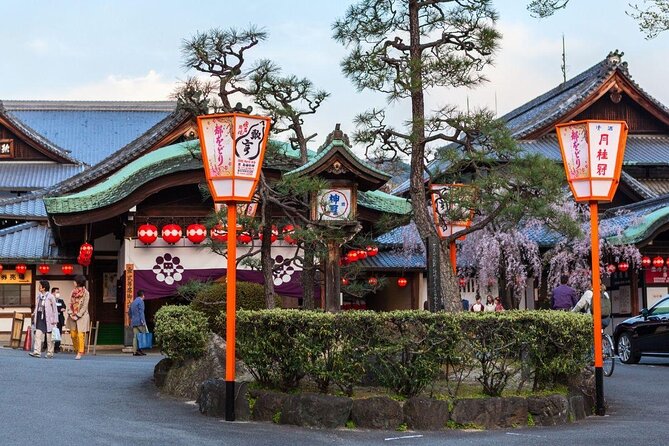
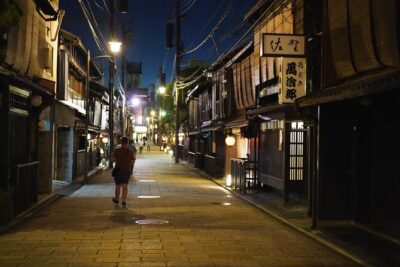
Hanamikoji Street is the final listed stop and one of the most recognizable parts of Gion. Traditional teahouses and wooden machiya houses line the street, giving you the classic Kyoto setting many people hope to see.
This is where the tour’s different threads come together. You have already heard about performing arts, visited religious sites, and walked through the district where geisha and maiko work. Hanamikoji gives that background a physical setting, with architecture that makes the past feel close at hand without turning the area into a theme park.
It is also a place to behave with care. The tour information emphasizes the chance to spot geisha or maiko, but it does not promise access to them. Your guide can help you identify likely routes and explain local customs, yet respectful distance remains important.
The ten-minute estimate is short for such a famous street. You may want to ask whether the schedule allows a little flexibility, especially if you are taking photographs or want more explanation about the wooden houses. A private tour gives you a better chance of making that request than a large scheduled group would.
Morning quiet or evening atmosphere
The tour is available throughout the day, and timing will shape the experience. Early morning should offer a calmer Gion, which can make the narrow streets easier to appreciate and may help you avoid some of the daytime foot traffic.
An evening tour has a different appeal. As the streetlights come on, Gion takes on a more atmospheric look, and the lanterns around Yasaka Shrine become especially appealing for photographs. The tradeoff is that you may have less daylight for architectural details.
The information provided does not promise a specific time for seeing a geisha or maiko. Do not choose an evening departure solely because you expect a sighting. Pick morning for a quieter walk, or evening for the lights and mood.
Good weather is required for the experience. If poor weather causes a cancellation, you can choose another date or receive a full refund. Changes or cancellations made less than 24 hours before the start time are not refundable, so keep that deadline in mind.
Is $350 a fair price for two hours?
The price is $350 per group for up to eight people. That is the most important figure to assess in context. You are not paying admission to a major attraction, and the listed stops are free. You are paying for a private guide, route planning, local explanation, and the ability to ask questions without a large group around you.
For eight people, the cost works out to $43.75 per person. For four people, it is $87.50 each. For only two people, the price is $175 per person, which is hard to defend unless you place a high value on private guiding and personal attention.
The tour is a better buy for families or friend groups who want an introduction to Gion and would otherwise struggle to understand the district on their own. It is less attractive if you only want to stroll Hanamikoji Street, take photographs, or see a shrine. You can do those things without a private guide.
The value also depends on the guide. Ahmed and Mat are singled out for clear explanations and helpful answers, while another experience had a less satisfying guide. Since the strongest reason to book is the human guidance, that variation matters.
Who should book this private Gion walk?
I would recommend it to first-time Kyoto visitors who want a quick, organized introduction to Gion. It suits you especially well if you enjoy asking questions, want context for local customs, or prefer a private outing over a large group.
Families can benefit from the flexibility, but should be honest about walking ability and heat. The tour lasts about two hours and includes several stops, yet one hot-day outing required a rest and caused some family members to miss parts of the explanation.
Photography-minded visitors will appreciate the mix of shrine paths, park scenery, temple architecture, wooden houses, and evening lights. Culture-focused visitors will get more from the tour if they ask about kabuki, tea houses, geisha traditions, and the difference between religious sites.
I would not choose it if your main goal is guaranteed contact with a geisha or maiko. You might see one, but that is luck. I also would not book it for a long, detailed visit inside each temple or shrine, since the route uses short stops and covers several places.
Should you book the Guided Gion Tour?
Book this tour if you want a private, question-friendly walk that places Gion in a wider Kyoto setting. The combination of old streets, Yasaka Shrine, Maruyama Park, Chion-in’s gate, Hanamikoji Street, and the Izumo no Okuni statue gives you more than a simple geisha-spotting route.
The strongest reason to go is the guide’s local explanation. The most important warning is that the quality depends on the assigned guide, and no geisha or maiko encounter is guaranteed. Share the $350 cost with a larger group, choose morning for a calmer walk or evening for the lights, and avoid the hottest part of the day if anyone in your party struggles with heat.
FAQ
How long does the Guided Gion Tour last?
The tour lasts approximately two hours.
How much does the tour cost?
The price is $350 per group for up to eight people.
Is this a private tour?
Yes. Only your group participates, with a maximum of eight people.
Does the tour include a geisha or maiko meeting?
No. A meeting is not included, and seeing a geisha or maiko is not guaranteed. The guide takes you to places where a sighting may be more likely.
Can I choose the tour time?
Tours are available throughout the day. Early morning and evening are both options, depending on availability.
What places are visited?
The route includes Gion, the Izumo no Okuni Statue, Chion-in Temple Gate, Yasaka Shrine, Maruyama Park, and Hanamikoji Street.
Are admission tickets included?
The listed stops have free admission. The included service is the guiding and management fee.
Is pickup available?
Pickup is offered, and the tour is near public transportation. One outing included meeting the guide at Kyoto Station and taking a bus to Gion.
What happens if the weather is poor?
The experience requires good weather. If it is canceled because of poor weather, you can select a different date or receive a full refund.
What is the cancellation policy?
You can cancel up to 24 hours before the start time for a full refund. Cancellations or changes made less than 24 hours before the start time are not accepted or refunded.
Just added around Kyoto
- Sekka Cotton Furoshiki Class★ 5.0 · 19 reviews
- Kyoto Sword Experience – includes Museum Ticket/Ninja Experience★ 4.5 · 149 reviews
- Scenic Green Tea Fields of Hidden Kyoto & Local Tea Exp (Private)★ 5.0 · 32 reviews
- Secret Eastern Kyoto Biking Adventure★ 5.0 · 44 reviews
- Private Sake Tasting in Central Kyoto with Sake Sommelier★ 5.0 · 32 reviews
- Samurai School in Kyoto: Samurai for a Day★ 5.0 · 202 reviews
- SHIRAKAWA Japanese Culture Experiences with private English staff★ 5.0 · 16 reviews
- A Privately Guided Photoshoot in Beautiful Kyoto by a Pro★ 5.0 · 18 reviews
Geisha & Maiko Experiences, compared.
Kyoto Geisha Walking Tour: Gion District & Hidden Gems
Our verdict →

Dinner with Maiko in a Traditional Kyoto Style Restaurant Tour
Our verdict →
Browse the lists this tour appears in