
Reviewed · SAMURAI EXPERIENCES
Best Samurai Experience in Tokyo
The best part of this Tokyo samurai experience is that you do not simply watch a demonstration. You put on a kimono and hakama, learn how to draw and swing a sword, then perform a short staged fight with music and sound effects. The setting is designed like an Edo-period dojo, with armor, swords, spears, and other weapons around you.
I like the small group size of up to 10 people, which gives the instructors room to help beginners. I also like that photos and videos are allowed, and the staff help capture them, even if you come alone. The main consideration is time: at about one hour, this is a lively introduction rather than a long lesson in samurai history or swordsmanship.
Key points to know before booking
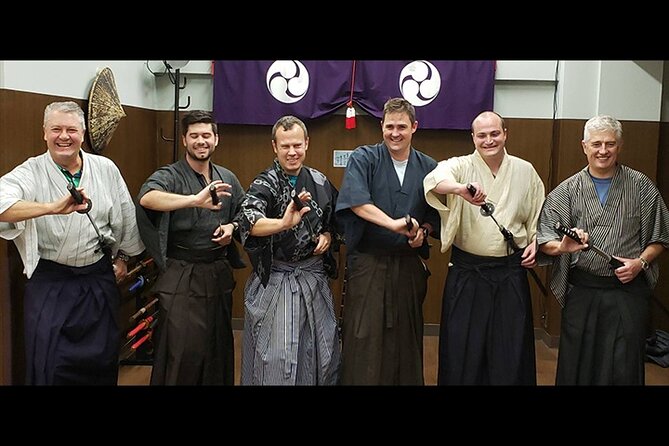
- Choose your own samurai outfit: Select a kimono and hakama before changing for the session.
- Learn five basic sword actions: Practice drawing, holding, swinging, and returning the sword under close instruction.
- Perform a staged sword fight: The final scene uses choreography, music, and sound effects rather than real combat.
- See a dojo-style weapons display: Armor, swords, and spears help give the room an old-Japan feel.
- Good for families and solo visitors: Children, teenagers, adults, and solo participants are all accommodated.
- A practical one-hour activity: At $65 per person, you are paying for costumes, instruction, an unusual setting, and photo opportunities.
Entering the Edo-style dojo in Shinjuku
Samurai Theater Tokyo is at 40 Yokoteramachi in Shinjuku City. The venue sits along side roads, so you may wonder for a moment if you have taken a wrong turn. Look for the flag that points you toward the venue, and allow a little extra time to find it.
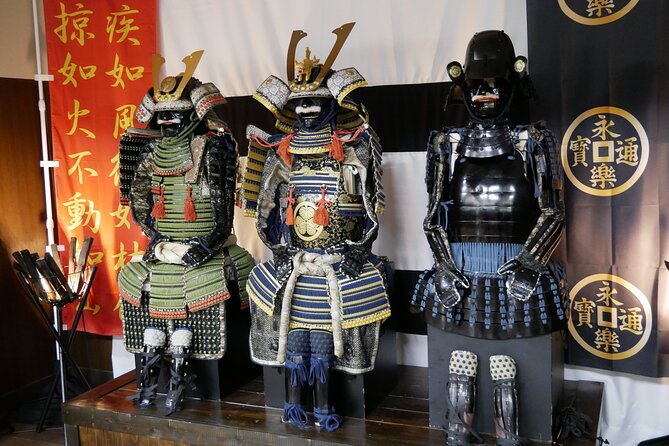
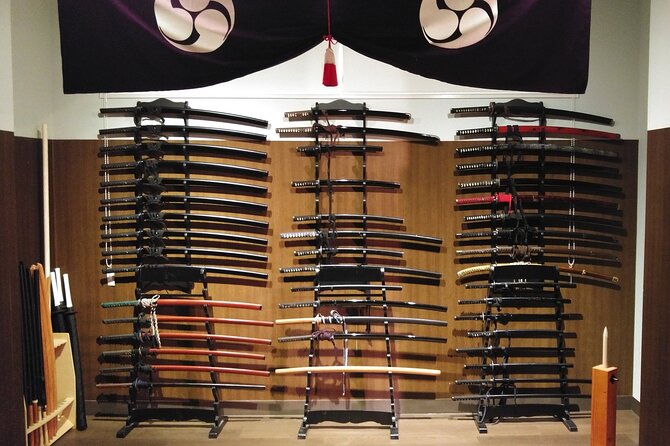
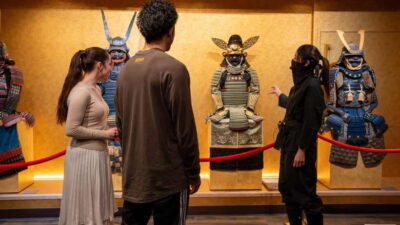
Inside, the modern city falls away quickly. The space is made to resemble a dojo from the Edo period, with armor and weapons displayed around the room. It is not a functioning historical dojo from 400 years ago, but the setting gives the activity much more character than a plain studio.
That display matters because it gives you something to look at before and during the lesson. You see swords and spears close up, and the armor helps explain the visual world the costumes are meant to recreate. The room is part museum display, part performance space, and part beginner-friendly training area.
The experience is also convenient if you are fitting it between other Tokyo plans. It lasts about one hour and ends where it begins. There is no private transportation, so you make your own way to the Shinjuku meeting point by public transport or on foot.
More Samurai Experiences in Tokyo
- Tokyo: Samurai Restaurant Show Ticket with 2 Drinks
★ 4.5 · 1,307 reviews - Tokyo: Samurai Ninja Museum Guided tour and Experience
★ 4.6 · 1,010 reviews - Tokyo: Samurai Sword & Archery Class from Samurai Descendant
★ 5.0 · 603 reviews
Choosing a kimono and hakama
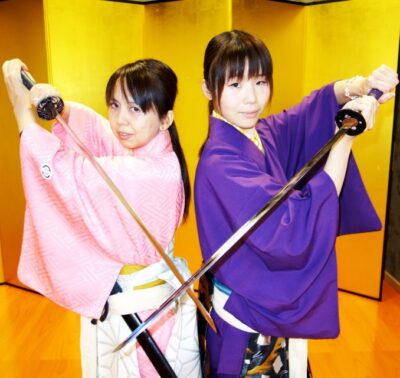
The first hands-on step is choosing your costume. You select a kimono and hakama, then change into the samurai clothing with help from the staff.
This is more than a quick photo prop. The formal clothing changes how the activity feels, and it gives the final performance a clear visual style. The hakama also helps you look the part when you take your photos and video. Several people find the clothing more comfortable than expected, which is useful if you are worried about spending the session in stiff theatrical costume.
The staff guide you through the process, so you do not need to know how to dress in Japanese formal wear. The emphasis is on getting you ready for the lesson without making the changing process stressful.
Families get a lot from this part. Children can choose an outfit, see themselves transformed, and begin participating before any sword work starts. Adults usually enjoy the same chance to play a role, which keeps the experience from feeling like an activity designed only for children.
If you are visiting alone, you do not miss out on the photo opportunity. Staff can take pictures and film you during the activity. That small detail makes a real difference for solo visitors, who otherwise might leave with only a few mirror shots.
Learning the katana basics safely
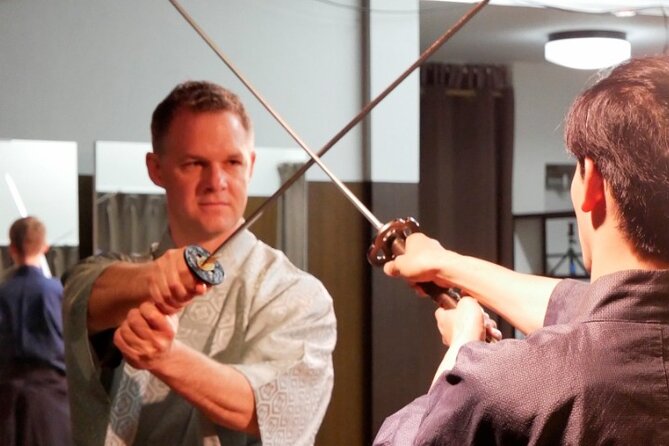
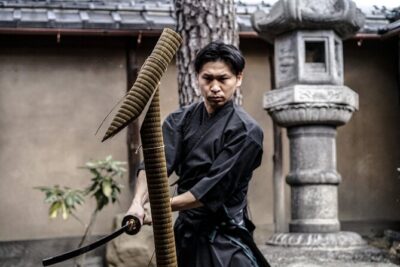
Once dressed, you learn the basic movements of handling a Japanese sword. The lesson covers how to draw the sword, how to hold it, how to swing it, and how to return it to its scabbard.
The teaching is aimed at beginners. You are not expected to arrive with martial arts experience, and the instructors break the actions into simple steps. One person described learning around five basic sword moves before practicing the final choreography, which gives you a useful sense of the level.
The instructors are presented as professional teachers who have appeared in major Japanese dramas and films. That background helps explain the polished demonstrations and the theatrical quality of the final scene. They are teaching safe, controlled movement for performance, not preparing you for actual combat.
Pay attention to the details of posture and timing. The sword work is not just waving a prop around. You learn how to draw it cleanly, keep control through the swing, and return it in a coordinated way. Even a short lesson feels more rewarding when you understand what your hands and feet are meant to do.
The instructors also bring plenty of energy. That is helpful because sword choreography can feel awkward at first. Patient correction and a little humor keep the mood light, especially when children or first-time participants need extra help.
You should still treat the sword work seriously. Follow the instructor’s directions, keep your movements controlled, and remember that this is a group activity. The aim is a safe performance, not speed or force.
Practicing the choreographed showdown
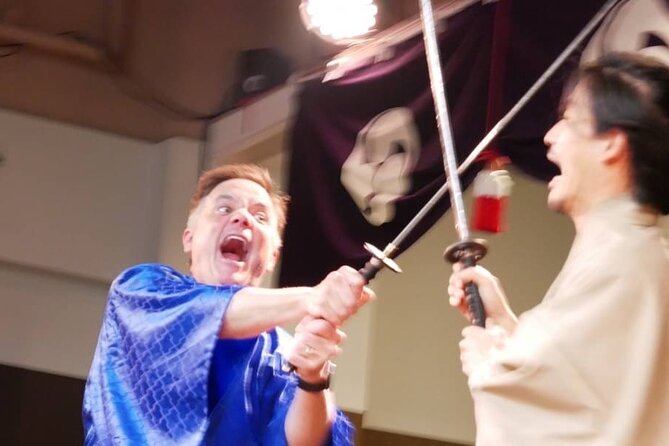
After the basic lesson, you practice a simple chambara scene. Chambara is Japanese sword-fighting cinema, so the final activity is built around performance and timing rather than actual contact.
You learn a short sequence, then use it in a staged battle. The staff add music and sound effects, and the scene is designed to look good on video. The phrase about defeating bad guys is part of the playful setup, not a promise of serious martial arts training.
This is where the earlier instruction pays off. Drawing the sword, taking your stance, swinging, and putting the sword away now become part of a connected routine. You get the satisfaction of performing something you could not have done at the start of the hour.
The final scene is suitable for families, but adults should not assume it is merely a children’s show. The instructors keep older participants involved, and the activity works well for groups of friends, couples, and families with teenagers. A family with children from about six years old through young adults found the format especially enjoyable, although the supplied information does not give a formal minimum age.
Music and sound effects add a comic movie quality. If you enjoy Japanese period dramas, you will recognize the appeal immediately. If you prefer quiet historical interpretation, this may feel more like theater than cultural study.
That distinction is important. You will learn something about sword movements and samurai presentation, but the focus is active entertainment. The historical setting supports the performance rather than replacing it with a lecture.
Same trip, a completely different kind of day:
- 1-Day Tokyo Bus Tour
★ 5.0 · 14,250 reviews - Tokyo: TOKYO SKYTREE® Admission ticket
★ 4.5 · 11,192 reviews - Tokyo: teamLab Planets TOKYO Digital Art Museum Entry Ticket
★ 4.6 · 9,779 reviews - Tokyo: Sumo Show Experience with Chicken Hot Pot and a Photo
★ 4.8 · 6,678 reviews
Photos, videos, and the value of the setting
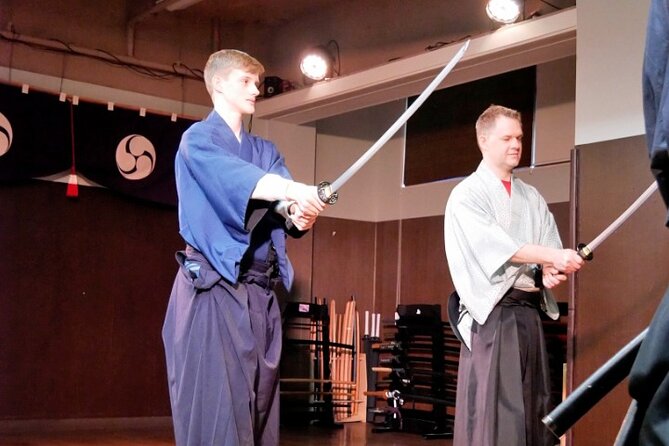
Photography and video recording are allowed inside the museum-style space. You can use your own smartphone, and the staff are happy to help take photos or film sections of the activity.
I consider this one of the strongest parts of the experience. The costumes, weapon displays, and dojo-style room give your photos more atmosphere than a standard studio backdrop. The final choreography also gives you something to record, rather than just a posed portrait.
If you are in a family or group, take turns filming so everyone gets a chance to appear in the action. If you are alone, tell the staff at the start that you want photos and video. Solo participation is specifically accommodated, and the staff can help document the session.
Do not expect a professional edited film to be included. What you get is the chance to record your own memories with a smartphone, supported by staff during the activity. That is enough for most people, especially when the goal is a fun travel keepsake rather than a polished production.
The setting also makes this a good rainy-day option. The provided information does not promise a weather policy, but because the activity takes place indoors, it can fit well into a Tokyo day when outdoor plans are less appealing.
Who will enjoy this most
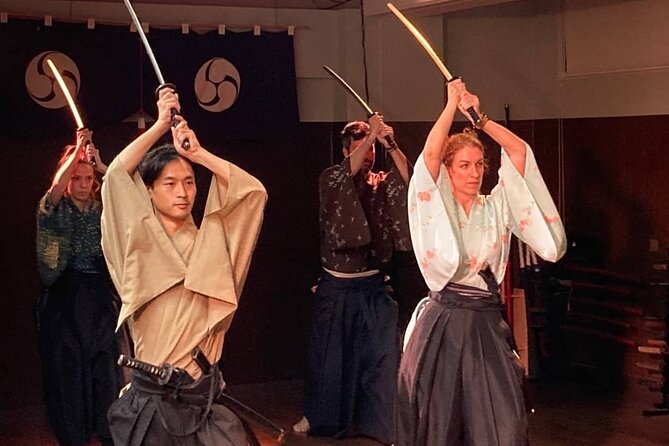
This experience is a strong choice if you want an active cultural activity rather than another observation-only museum visit. You get dressed, handle a sword under instruction, practice a routine, and perform at the end.
It suits:
- Families with children and teenagers
- Adults who enjoy Japanese films and period dramas
- Couples or friends looking for unusual Tokyo photos
- Solo visitors who want staff-assisted photos and video
- Beginners with no previous sword experience
- Visitors with only a short free period
The family appeal is especially clear. Children enjoy the costumes and action, while adults can appreciate the presentation and the chance to learn a small set of controlled movements. The instructors’ patience is important here, since the quality of the experience depends as much on teaching as on the costumes.
Solo visitors are also well served. Many group activities quietly assume that everyone arrives with a partner to take photos. This one does not. Staff can film and photograph you, which makes the session feel complete even when you book one place.
You may want to choose another activity if your main goal is a long, academic account of samurai history, a visit to a genuine historical battlefield, or serious martial arts training. This is a staged cultural performance with instruction, not a full history course or combat class.
Is $65 a fair price for one hour?
At $65 per person, the experience is not the cheapest one-hour activity in Tokyo. Its value depends on how much you care about the complete package.
The fee includes all taxes and fees, a professional guide or instructor, and the samurai costumes. You also get access to the decorated venue, sword instruction, the choreographed scene, and staff help with photos and video. Add the convenience of a short duration and a central Tokyo location, and the price becomes easier to justify for a special trip activity.
You are not paying simply for 60 minutes of talking. The staff must prepare costumes, dress participants, organize the sword lesson, manage a group of up to 10, and coordinate the final performance. The small maximum group size helps protect the personal attention that makes beginner instruction work.
The value is strongest for families who would otherwise pay separately for several photo opportunities and a child-friendly activity. It also works well for solo visitors because the staff support with photos is part of the experience rather than an afterthought.
For a visitor on a strict budget, the price may feel high for an hour. In that case, book it because you specifically want to dress as a samurai and perform the sword scene, not because you are looking for the cheapest cultural stop in Tokyo.
Timing, reservations, and cancellation
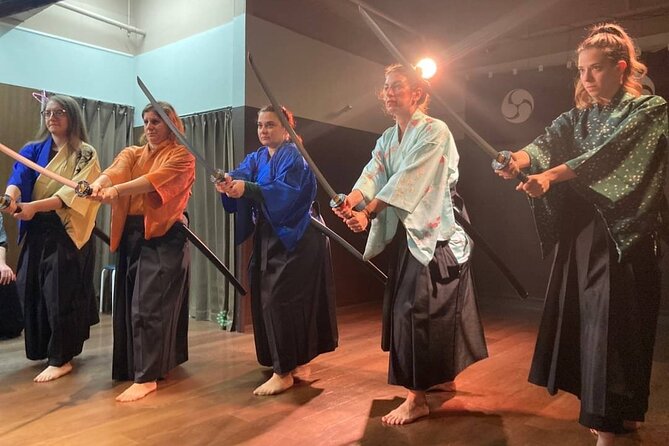
The session lasts approximately one hour and ends back at the meeting point. Same-day reservations may be possible, and one person can join without needing to form a private group, but availability can change.
The maximum group size is 10 people. That is small enough to make instruction practical, though the precise feel of the session will depend on how many people attend your time slot.
Confirmation is provided when you book, and the ticket is mobile. The venue is near public transportation, but private transportation is not included. Keep the meeting address, 40 Yokoteramachi, Shinjuku City, handy, and watch for the flag if the side streets make the location hard to spot.
Free cancellation is available if you cancel at least 24 hours before the start time. Cancellations or changes made less than 24 hours in advance are not accepted for a refund, and the cut-off follows local Tokyo time.
What to bring and how to prepare
Bring a smartphone if you want your own photos and video. Recording is allowed, and the staff can help capture the action, so clear some storage space before you arrive.
Wear clothing that is easy to change out of. The experience provides the costume, but you will still appreciate simple travel clothes underneath. The supplied information does not state whether bags or luggage can be stored, so avoid arriving with more than you need.
Arrive with a playful attitude and a willingness to follow direction. Sword choreography looks easy when an instructor demonstrates it, but the sequence becomes much more enjoyable when you focus on control, timing, and clear movements instead of trying to swing hard.
If you are bringing children, explain that the sword fight is staged and that everyone must follow the teacher’s safety instructions. The staff are described as friendly and patient with children, but a parent should still help younger participants stay attentive.
Final verdict: should you book the samurai experience?
Book it if you want hands-on fun, strong photos, and a short taste of samurai performance in Tokyo. The costumes, Edo-style room, patient instructors, and final choreographed battle give the hour a clear beginning, middle, and end.
I would recommend it most to families, first-time visitors, solo photographers, and anyone who enjoys Japanese cinema. The 4.9 rating from 458 reviews and 100 percent recommendation figure match the experience’s strongest qualities: friendly staff, good organization, accessible instruction, and a memorable final performance.
Skip it if you want serious sword training or a detailed historical lecture. For everyone else, $65 is a reasonable price for a compact activity that gives you something to learn, something to perform, and something tangible to remember.
FAQ
Where does the samurai experience take place?
It takes place at Samurai Theater Tokyo, 40 Yokoteramachi, Shinjuku City, Tokyo 162-0831, Japan.
How long does the activity last?
The experience lasts approximately one hour and ends back at the meeting point.
What is included in the price?
The price includes all fees and taxes, a professional guide or instructor, and samurai costumes.
Can I join if I am traveling alone?
Yes. One person can join the activity, and staff can take photos and video for solo participants.
Can I take photos and videos?
Yes. Photography and video recording are allowed inside the museum-style venue. You can use your smartphone, and the staff can help capture photos and video.
How many people can join the session?
The activity has a maximum of 10 participants.
What is the cancellation policy?
You can cancel for a full refund if you cancel at least 24 hours before the scheduled start time. Cancellations or changes made less than 24 hours before the start time are not accepted for a refund.
Just added around Tokyo
- Kawagoe Japanese Food Tour : Unagi Kaiseki and Sake near Tokyo★ 5.0 · 30 reviews
- Kawagoe 4hr Private Tour with Licensed Guide (Kawagoe Dep)★ 5.0 · 13 reviews
- Little EDO Sushi Making workshop in Kawagoe★ 5.0 · 18 reviews
- 【R34】Tokyo:Private Daikoku tour in Modified R34★ 4.9 · 92 reviews
- :Tokyo,Shibuya/ Pro Photography in Kimono / English-Friendly★ 5.0 · 26 reviews
- Tokyo:Celebrate Unique Japanese New Year Tradition Festivity★ 3.9 · 20 reviews
- Tokyo: Allstar Food Tour★ 4.7 · 29 reviews
- Tokyo: West-Side Cycling and Food Tour with Guide★ 5.0 · 37 reviews
Samurai Experiences, compared.
Browse the lists this tour appears in