
Reviewed · SAMURAI EXPERIENCES
Kyoto: Samurai Sword Class by Experts in Traditional Arts
This Kyoto experience is less about waving a sword like a movie hero and more about learning controlled movement, ceremony, and the graceful art of Kenbu, or samurai sword dance. You’ll bow to the sword, practice drawing and returning it to its scabbard, learn stylized strikes, and finish with a short performance by trained instructors.
I like two things right away. First, the class gives you real hands-on practice instead of leaving you in the audience. Second, the costume, photo session, certificate, and traditional tenugui towel turn a short lesson into a keepsake-filled activity. The main consideration is that this is a structured class, not a free-form sword fight, and children under four cannot take part.
Key points at a glance
- Practice the full ritual: Learn how to bow, draw the sword, strike with control, and return it to its scabbard.
- Wear traditional samurai clothing: You choose an outfit before taking photos and practicing the movements.
- See Kenbu performed properly: The included performance shows the difference between stylized sword dance and simple combat technique.
- Small groups help: The class is limited to 10 participants, with instructors giving individual corrections when time allows.
- Good value at $64: You receive a lesson, costume use, photographs, a tenugui towel, a certificate, and either a 10-minute or 30-minute performance, depending on the option selected.
- Bring the right clothes: Wear something suitable for exercise and changing. A single hoodie, tights, large bags, and luggage are not suitable.
Entering the Kyoto dojo near Gion
The class takes place at the Samurai Kembu Theater, at 35-7 Sanchome in Higashiyama-ku, in the B1F Gozan Building. The location is close to the Sanjo-Hanamikoji area, so it fits neatly into a day spent around Gion and eastern Kyoto.
This is a working dojo and theater rather than a large visitor center. There is no waiting room, and people without appointments cannot wait inside. I would arrive with only what you need for the class, since large bags and travel luggage have no place in the room.
The small-group format is useful here. With no more than 10 participants, the instructor can watch your stance and hand position instead of simply calling out instructions to a crowd. At quieter times, the class may feel almost private. One participant even received a one-to-one lesson, though you should treat that as a lucky possibility rather than a promised feature.
The activity lasts between 90 minutes and two hours, depending on the option and performance length. Check the available start times carefully, especially if you are fitting the class between temple visits, meals, or a booked evening show.
More Samurai Experiences in Kyoto
- Kyoto Samurai Experience
★ 5.0 · 1,294 reviews - Kyoto: Kendo and Samurai Experience with Uniform and Gear
★ 4.9 · 815 reviews - Skip the lines Basic Ticket at SAMURAI NINJA MUSEUM KYOTO
★ 4.5 · 632 reviews
A four-minute introduction before the sword work
The session begins with a short film of about four minutes covering the basics of the samurai. This is a sensible opening because many visitors arrive with a movie version of samurai culture in mind.
The class then gives you a short introduction to the samurai warrior class and the discipline behind Kenbu. You will not become a trained swordsman in one visit. Instead, you get a clear first look at how movement, posture, timing, and respect work together.
That distinction matters. Kenbu is not simply a lesson in attacking an opponent. The motions are formal, choreographed, and controlled. A short demonstration later in the session makes this even clearer, showing how the same sword can be part of a graceful performance rather than a practical fight.
The history section is brief, so do not book this expecting a full lecture on Japanese political or military history. Its purpose is to give meaning to the physical lesson that follows.
Choosing a costume and learning the formal bow
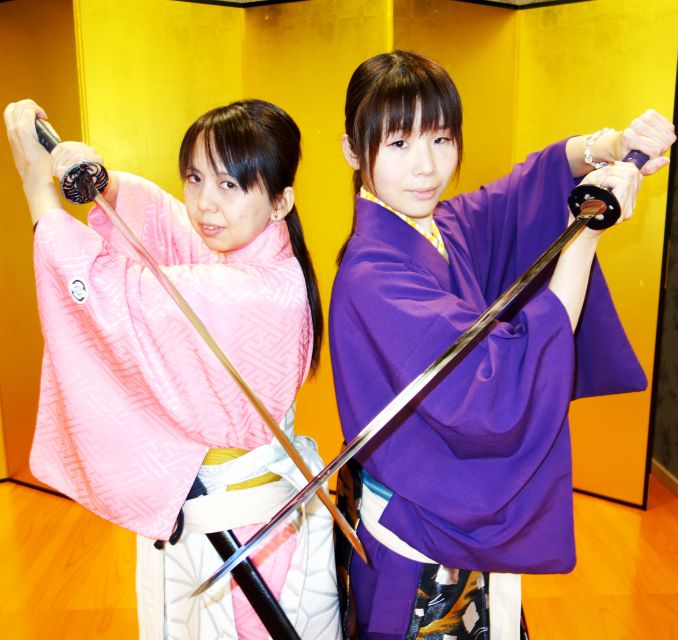
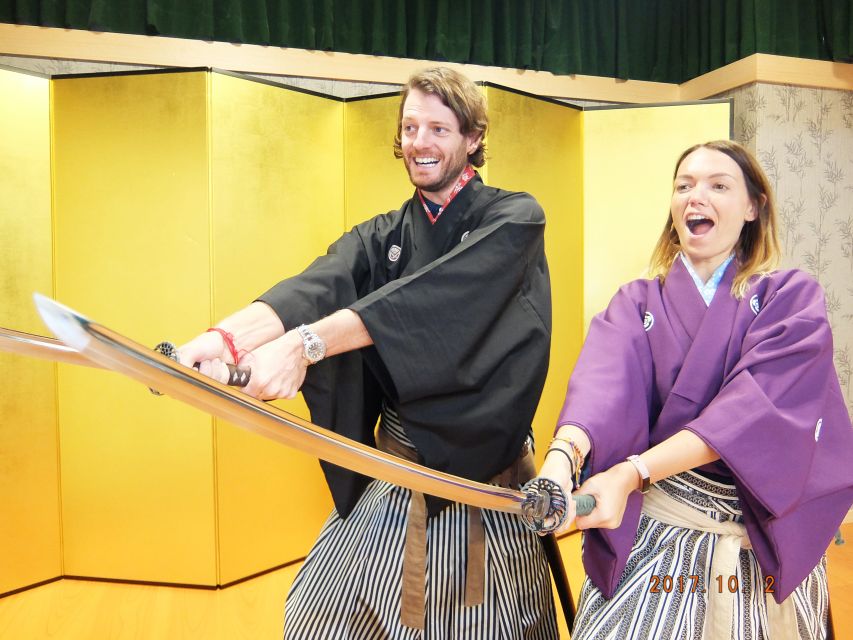
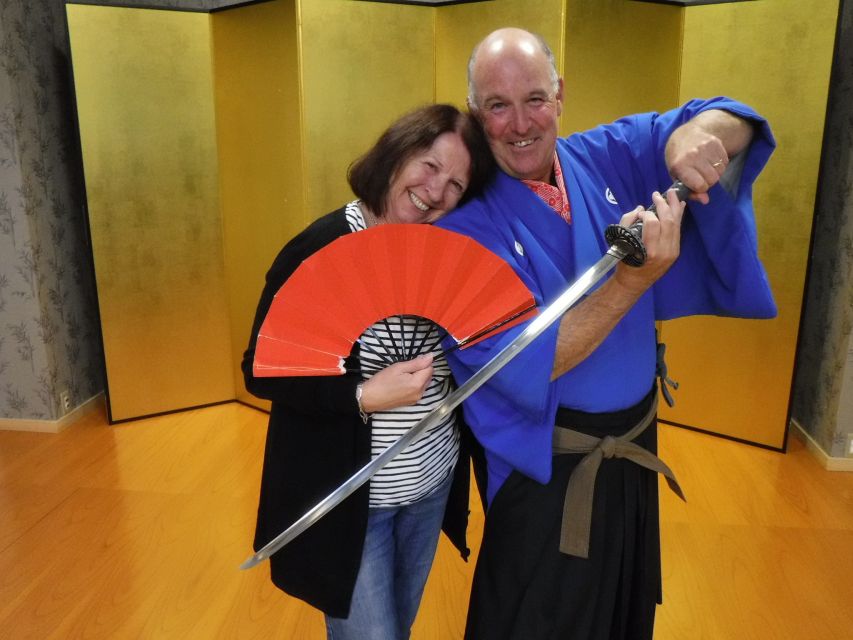
After the introduction, you change into samurai clothing. The outfit is one of the strongest parts of the experience because it makes the activity feel like more than a basic exercise class.
The clothing also helps you see how posture and movement fit together. Participants receive guidance on the different pieces, and the costume gives the photo session a proper setting. Some sessions may include small gifts or items you can keep, such as a tenugui towel, and the included towel is a useful traditional souvenir rather than a disposable trinket.
Before touching the sword, you learn how to bow. This is an important detail. The lesson presents the sword as an object treated with respect, and the bow establishes the tone for everything that follows.
You also learn how to show respect to an opponent. That etiquette keeps the class grounded in the discipline of Kenbu. The experience is playful, but it is not careless.
Drawing, striking, and returning the katana
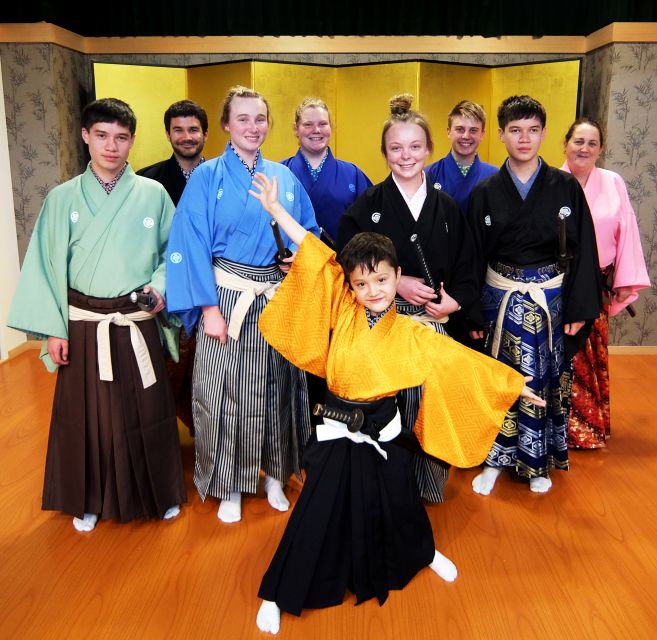
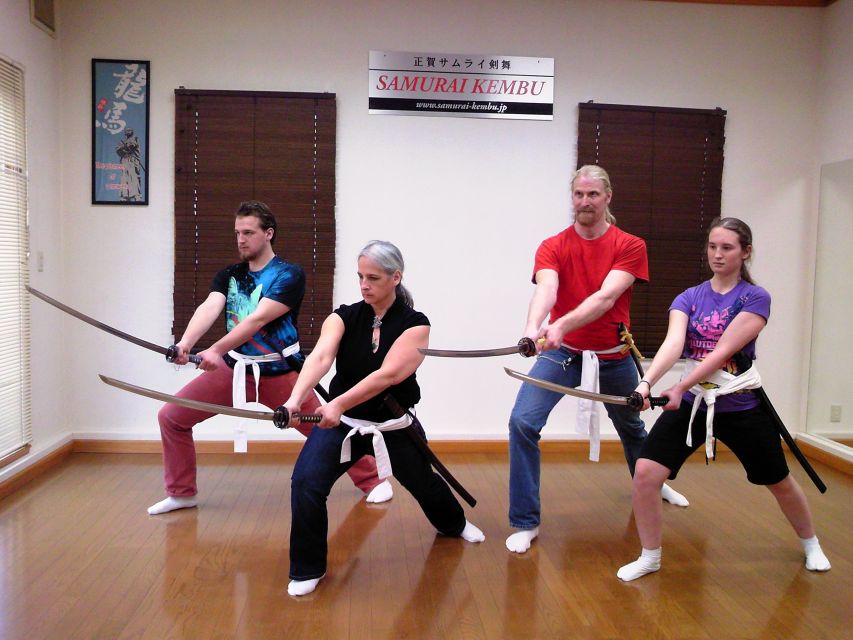
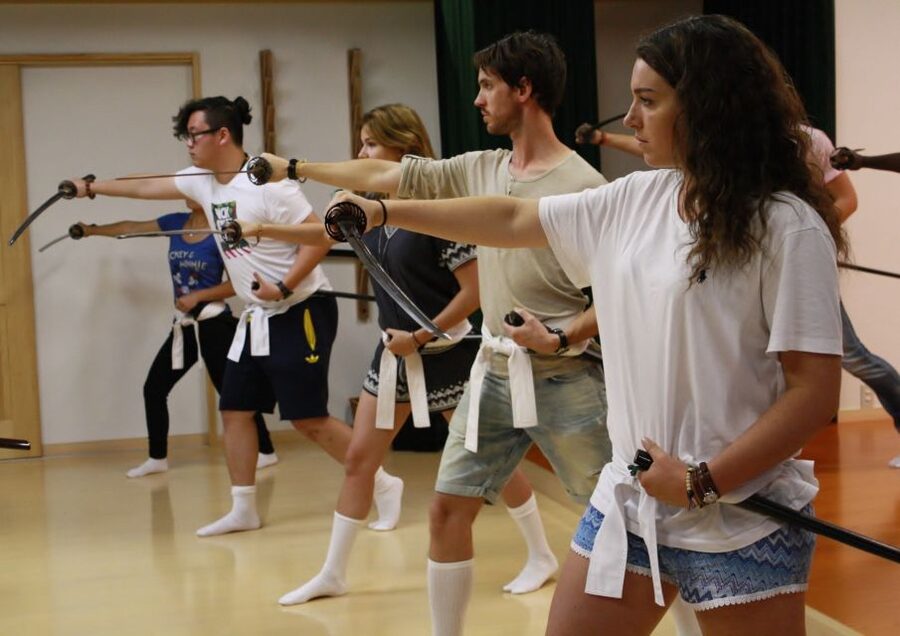
The practical lesson moves through a set sequence. You learn how to hold the sword, draw it from its protective scabbard, perform basic stylized strikes, and return it safely.
The instructor demonstrates each movement before asking you to repeat it. This is where patience matters, since the actions can feel less natural than they look. The challenge comes from coordinating your feet, hands, shoulders, and timing at once.
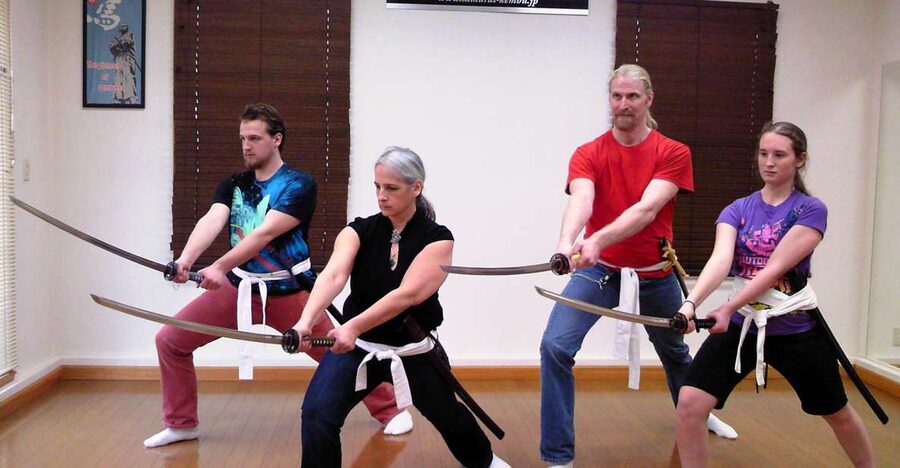
You will practice several basic sword movements and rehearse a short Kenbu sequence. The activity is designed for beginners, but it still asks you to concentrate. You are not simply swinging a prop from side to side.
Instructors such as Kazu, Hoga, Kashin, Rui, and Hisyo have been praised for being patient, funny, and clear in their demonstrations. Instructor names can vary by session, but the teaching style is built around careful instruction rather than intimidation.
A useful point for families: children from about five to ten can participate, but the organizers say it is best if younger children have some martial arts or similar learning experience. The class is conducted with adults, so a young child who needs constant playtime may struggle with the pace. Children under four are not suitable for the activity.
The sword used in class is for the lesson, and participants must follow the instructor’s safety directions. Sharp objects and weapons from outside are not allowed. Do not arrive under the influence of alcohol, and do not bring food, drinks, or prohibited items into the room.
Same trip, a completely different kind of day:
- PERFECT KYOTO 1-Day Bus Tour
★ 5.0 · 13,518 reviews - Kyoto: Fushimi Inari, Kinkakuji, Bamboo Grove 1 Day Bus Tour
★ 4.8 · 4,316 reviews - Kyoto: Tea Ceremony in a Traditional Tea House in Kiyomizu
★ 4.9 · 3,519 reviews - Kyoto Geisha Walking Tour: Gion District & Hidden Gems
★ 4.7 · 3,273 reviews
Why the Kenbu performance matters
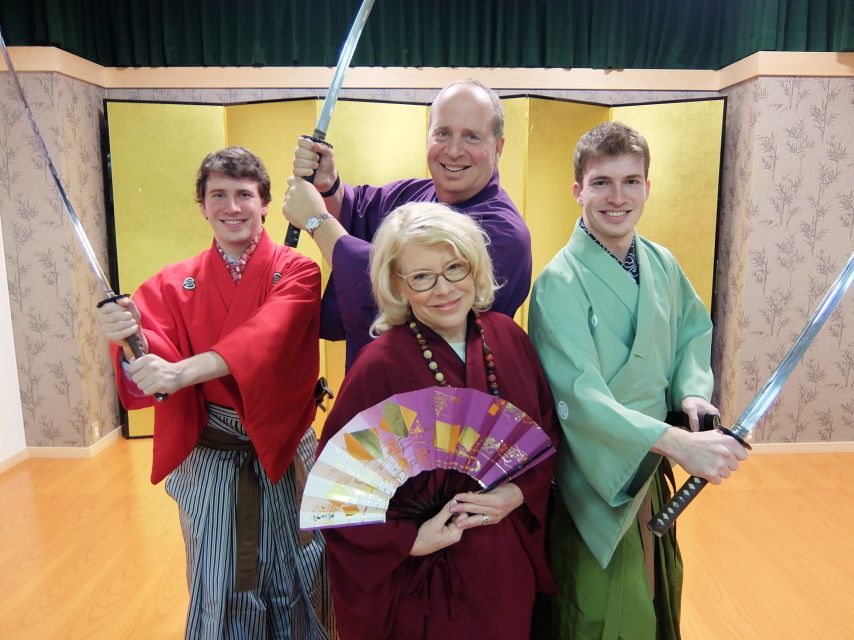
The performance is not just an extra show tacked onto the end. It helps you understand what you have been trying to learn.
Depending on your selected option, you watch a 10-minute or 30-minute performance before or after the class. A sword dance instructor provides commentary, explaining the technique and giving context for an art passed down through generations.
The contrast is striking. In the class, you concentrate on one bow, one draw, and one strike at a time. In the performance, trained practitioners combine those elements into flowing patterns with sharper timing and much more confidence.
This is also where the activity separates itself from a simple sword-handling workshop. The performance presents Kenbu as an art form, with controlled gestures and expressive movement. You can see why several participants described the show as beautiful and even calming.
If you have a choice between the shorter and longer option, the 30-minute performance gives you more time to watch the art in finished form. The 10-minute version still adds value, especially if your Kyoto schedule is tight.
The photo session and certificate
The photo session comes after you have had time to practice in costume. This timing works well because you already know how to hold the sword and stand in a formal pose.
Staff organize photographs and videos for individual groups. You should have time for several keepsake images, though the exact number of photos is not specified. If photographs matter to you, make sure your phone or camera is ready and charged.
The costume photos are a major reason this works well for families and first-time visitors. Teenagers in particular can enjoy the activity without needing prior martial arts experience, and the pictures give everyone something concrete to remember.
At the end, you bow respectfully to the instructor and receive a completion certificate. You also receive a traditional Japanese tenugui towel. The certificate may feel playful, but it marks the sequence you learned and gives the class a satisfying finish.
The $64 price and what you receive
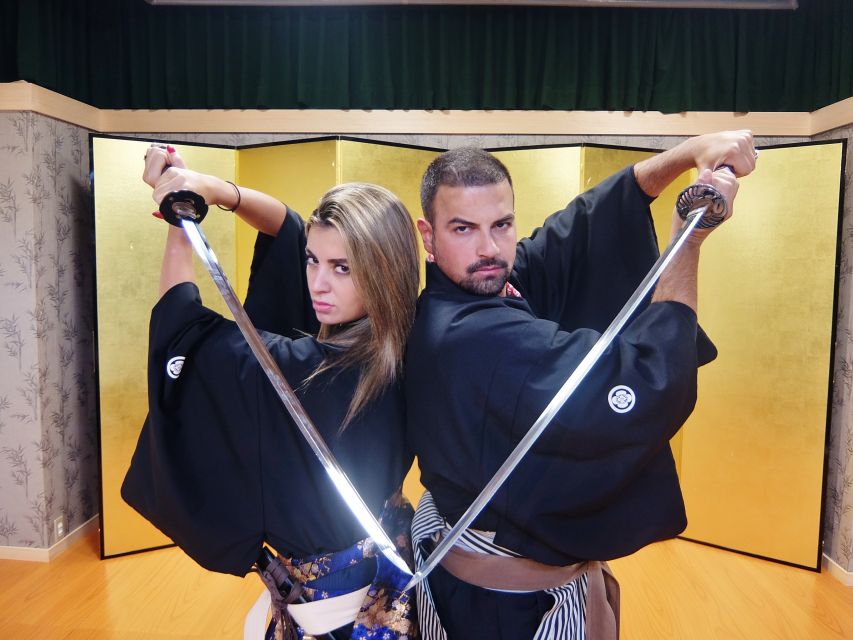
At $64 per person, the experience is not the cheapest short activity in Kyoto. It is also not just a 90-minute demonstration. Your fee covers an English-speaking instructor, costume use, sword practice, a photo session, a tenugui towel, a completion certificate, and a performance based on the option you choose.
That combination makes the price reasonable for visitors who want an organized cultural activity with several parts. You are paying for instruction and staff time, not only admission to a show.
The value is strongest if you take part fully. There is no observation-only option, so everyone booked must join the class. That rule keeps the group focused, but it means this is not a good choice for someone who only wants to watch.
The price also works better for families or small groups that want a shared activity. Everyone can learn the same basic movements, take costume photos, and watch the demonstration together.
I would compare it with the cost of a separate performance and a costume photo studio. Here, those elements are combined with instruction. If your main goal is serious martial arts training, however, one short class cannot replace regular practice.
Who will enjoy this most
I would recommend the class to you if you want a hands-on Kyoto activity that combines culture, movement, and photographs. It suits couples, families with older children, teenagers, and solo visitors who like trying something unusual.
It is also a good choice if you are interested in Japanese performance arts but are not sure about martial arts. The lesson is beginner-friendly, and the performance shows the artistic side of Kenbu.
You do not need to arrive with sword skills. Patience and a willingness to follow instructions matter more. The class involves standing, moving, changing clothes, and repeating movements, so wear practical clothing underneath the costume.
The activity may not suit you if you dislike group instruction, have limited mobility for exercise and moving around, or want a quiet historical talk. It is also unsuitable for children under four, and younger children between five and ten may need extra preparation because they learn alongside adults.
Practical advice before you book
Reserve the correct number of participants. The venue cannot admit more people than the number booked, and an extra chaperone must be discussed in advance.
Use the free cancellation policy as a planning cushion. You can cancel up to 24 hours beforehand for a full refund, and the reserve-now-pay-later option allows you to secure a place without paying immediately.
Wear clothes that make changing easy. A single hoodie or tights are specifically unsuitable for the costume change. Avoid large bags because there is no room for luggage or travel cases.
Arrive ready to participate. Observation-only attendance is not available, and the instructor’s safety directions need to be followed throughout the class. If the name on the reservation differs from the participant’s name, contact the provider ahead of time.
The class is offered in English and Japanese. English-speaking instruction is included, though the amount of explanation and conversation can vary by instructor and group.
Should you book the Kyoto Samurai Sword Class?
Yes, if you want a short, active Kyoto experience with more substance than a costume photo. The best parts are the careful sword etiquette, the chance to practice a simple Kenbu sequence, the patient instruction, and the performance that shows what the art looks like when experts do it.
Book it with realistic expectations. You will learn the basic movements, not master samurai swordsmanship. The historical introduction is useful but brief, and the session requires participation rather than passive watching.
For $64, I think the mix of instruction, costume, photographs, souvenir towel, certificate, and performance offers solid value. Choose the longer performance if you want the fuller artistic experience. Choose the shorter one if your day is packed.
FAQ
Where does the samurai sword class take place?
The class takes place at the Samurai Kembu Theater, Kyoto dojo, at 35-7 Sanchome, Higashi-iru, Sanjo-hanamikoji, Higashiyama-ku, B1F Gozan Building, Kyoto 605-0005.
How long does the experience last?
The activity lasts between 90 minutes and two hours. The exact length depends on the option selected and the performance included.
Is the class taught in English?
Yes. English-speaking instruction is included, and the activity is offered in English and Japanese.
Do I have to participate, or can I only watch?
You must participate if you are booked. Observation-only attendance is not available. The experience includes sword practice, costume use, and guided movements.
What should I wear?
Wear clothing suitable for exercise and moving around, with layers that make changing into the costume easy. A single hoodie or tights are not suitable for costume changes. Large bags and luggage are not allowed.
Is the activity suitable for children?
Children under four cannot participate. Children from five to ten may take part, but the organizers recommend some martial arts or similar learning experience because the lesson is conducted with adults.
Just added around Kyoto
- Sekka Cotton Furoshiki Class★ 5.0 · 19 reviews
- Secret Eastern Kyoto Biking Adventure★ 5.0 · 44 reviews
- Kyoto Sword Experience – includes Museum Ticket/Ninja Experience★ 4.5 · 149 reviews
- Scenic Green Tea Fields of Hidden Kyoto & Local Tea Exp (Private)★ 5.0 · 32 reviews
- Private Sake Tasting in Central Kyoto with Sake Sommelier★ 5.0 · 32 reviews
- Samurai School in Kyoto: Samurai for a Day★ 5.0 · 202 reviews
- SHIRAKAWA Japanese Culture Experiences with private English staff★ 5.0 · 16 reviews
- A Privately Guided Photoshoot in Beautiful Kyoto by a Pro★ 5.0 · 18 reviews
Samurai Experiences, compared.

Samurai Sword & Archery Class from Samurai Descendant
Our verdict →

Browse the lists this tour appears in