Reviewed · GUIDED
Kyoto 8hr Private Tour with Government-Licensed Guide
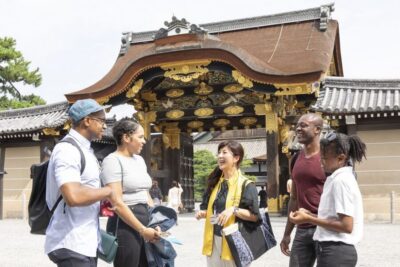
Kyoto is best explored with a plan, and this private eight-hour tour lets you build that plan around four to six places you actually care about. You can focus on temples and gardens, old neighborhoods, food, imperial sites, or a first-day mix of Kyoto’s major sights. Guides such as Ichiro, Shu, and Karkoo Tanigawa have led past tours, and the experience is designed around your group rather than a fixed bus route.
I like the custom itinerary and the chance to ask a local guide how to connect Kyoto’s widely scattered sights. I also like the personal attention: a group of six adults was able to visit the bamboo forest, Kinkaku-ji, Sannenzaka, and Kiyomizu-dera with help from a guide who adjusted to the group.
The catch is that the price does not cover transportation, admission, lunch, or other personal costs. Since this is a walking tour, you need to choose sites that fit together sensibly. Four nearby stops can make a satisfying day. Six far-apart stops can turn your Kyoto experience into a race between trains and buses.
Key points to know before booking
- Choose four to six sites: You can name the places you want, or ask your guide to suggest a route based on your interests.
- Expect a private walking day: Only your group participates, with an English-speaking, government-licensed local guide.
- Transportation is extra: The tour does not include a private vehicle, train fares, bus fares, or other transport costs.
- Admission fees are extra: Most major temples and castles charge separately, and the guide’s admission is covered only at sights listed in the tour details.
- The classic route works well: Fushimi Inari, Kiyomizu-dera, Gion, Nishiki Market, and another nearby site make a natural introduction to Kyoto.
- Plan ahead: Reservations should be made at least two weeks in advance, and the tour is often booked well before the travel date.
A private Kyoto day, not a fixed sightseeing checklist
The main strength here is control. Kyoto offers far more historic places than you can reasonably see in one day, and the choices are spread across the city and its northern and western hills. Instead of being locked into a preset schedule, you can tell the guide what matters to you.
A first-time visitor might choose Fushimi Inari-taisha, Kiyomizu-dera, Gion, and Nishiki Market. A repeat visitor might prefer Nanzen-ji, Eikando, Ginkaku-ji, and the Philosopher’s Path area. A family may want a lighter day with Arashiyama, the bamboo groves, Togetsukyo Bridge, and Tenryu-ji.
Before the tour, your guide contacts you to shape the route. This step matters. Do not simply send a long wish list of every famous temple. Pick four to six priorities and be clear about your pace, food interests, and appetite for stairs and walking. Your guide can then make the day realistic.
The meeting and pickup are on foot within a designated area of Kyoto. There is no private car included. That keeps the tour cost below a chauffeured sightseeing day, but it also means you need to be ready for public transportation and plenty of time on your feet.
A few more Kyoto half-days worth comparing
- PERFECT KYOTO 1-Day Bus Tour
★ 5.0 · 13,518 reviews - Kyoto: Fushimi Inari, Kinkakuji, Bamboo Grove 1 Day Bus Tour
★ 4.8 · 4,316 reviews - Kyoto: Tea Ceremony in a Traditional Tea House in Kiyomizu
★ 4.9 · 3,519 reviews
What the eight-hour format really gives you
Eight hours sounds generous, but Kyoto’s geography can eat into the day. Fushimi Inari lies southeast of central Kyoto. Kiyomizu-dera is in the eastern hills. Arashiyama is far to the west, while Kinkaku-ji and Ryoan-ji are in the northwest. A route that crosses the city several times may leave less time for the places you came to see.
The listed stops show short sample times, often 10 to 15 minutes, but those figures should not be treated as the full experience at each site. A proper visit to Kiyomizu-dera, Kinkaku-ji, Arashiyama, or Nijo Castle can take much longer once you include walking, photos, queues, and transport.
I would use the day in one of two ways:
- Choose four or five sites in one part of Kyoto and see them at a calm pace.
- Choose two or three major sights, then add a neighborhood, market, or garden nearby.
You can ask for six stops, but six does not mean six full guided visits. It usually means a mix of substantial stops and brief walks through districts such as Gion, Pontocho, or Higashiyama.
Fushimi Inari and southeastern Kyoto
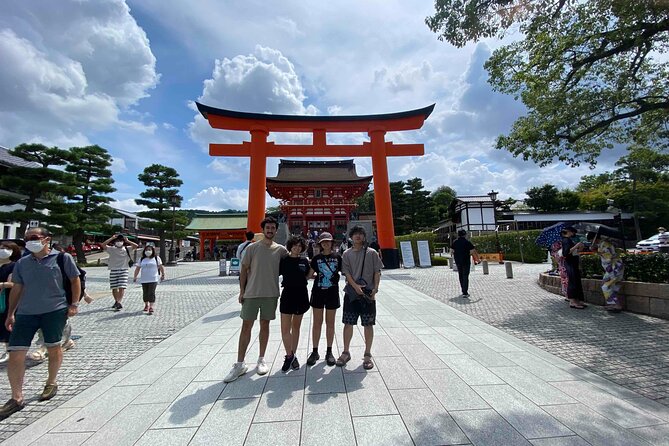
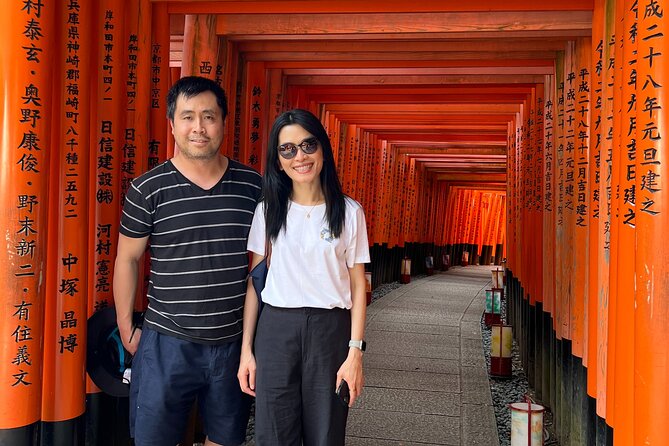
Fushimi Inari-taisha is one of Kyoto’s most recognizable sights, with long runs of orange torii gates climbing the wooded mountain. The shrine is free to enter, and the setting gives you a quick sense of how religious sites and natural surroundings meet in Japan.
A guide can help explain the shrine’s role and the meaning of the gates rather than leaving you with a string of photographs and no context. The full mountain route is long, so tell your guide how far you want to walk. If time is tight, a shorter section may be the sensible choice.
Nearby Tofuku-ji offers a very different mood. It is a major Zen temple, especially popular for autumn color, with broad grounds and strong architectural lines. Admission is extra. It makes a good choice for someone who wants a serious temple visit without the constant commercial activity found around Kiyomizu-dera.
To-ji, also in southern Kyoto, dates to the early Heian period and is known for its large temple grounds and five-story pagoda. It can fit well with Fushimi Inari or Tofuku-ji, though your guide will need to account for transport time.
Kiyomizu-dera, Higashiyama, and Gion
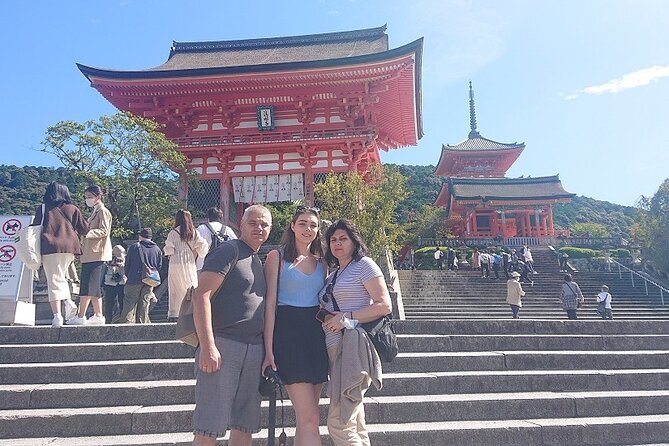
Kiyomizu-dera is one of the essential Kyoto stops. Its wooden stage looks across the eastern hills, and the approach through the old lanes of Higashiyama gives you the classic Kyoto scene: traditional buildings, small shops, and crowds moving toward the temple.
Admission is not included. The approach streets can be crowded, and the area includes slopes and steps, so comfortable shoes are important. Your guide can explain the temple’s religious traditions and help you understand what you are seeing instead of treating the visit as a quick photo stop.
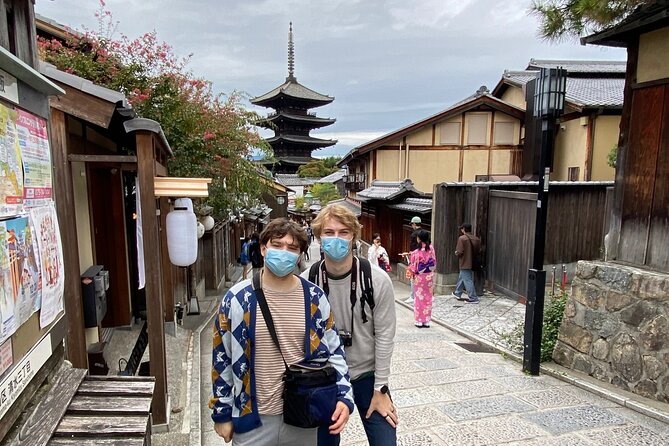
Higashiyama is the historic district along Kyoto’s eastern foothills. It is especially appealing if you want old streets and traditional architecture without spending the entire day inside temple grounds. The best part of this area is the transition between places: a temple gate, a narrow lane, a small shop, and then another view opening toward the hills.
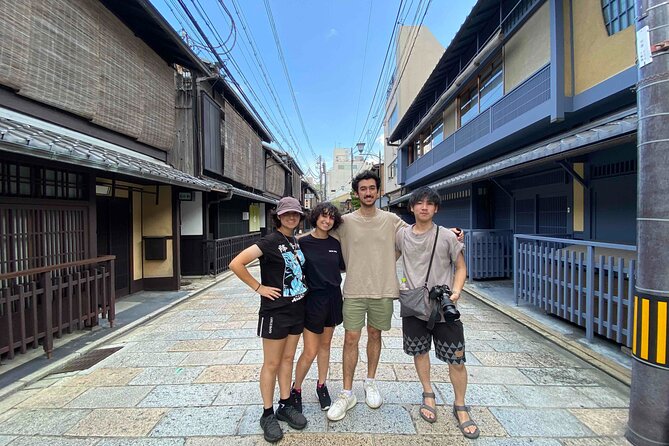
Gion is Kyoto’s famous geisha district, though it is not a stage set built for visitors. It is a working neighborhood with restaurants, homes, shops, and narrow lanes. A guide is useful here because the streets can be confusing and local customs matter. Keep your camera respectful, stay on public paths, and do not block doorways or follow people who are simply going about their work.
Kennin-ji is close to Gion and offers spacious grounds, dry gardens, and a quieter change of pace. The temple charges admission, and the listed visit time is very short, so it works best as part of a Gion and Higashiyama route rather than as a stand-alone destination.
Sanjusangendo is another strong eastern Kyoto option. Its hall is famous for 1,001 statues of Kannon, the Buddhist figure associated with mercy. The visit is more focused and interior than Kiyomizu-dera, making it a good choice for someone who wants art and religious history rather than another outdoor hilltop view.
More Private-Only Departures in Kyoto:
- Fushimi Inari Hidden Hiking Tour (Private Option Available)
★ 5.0 · 1,750 reviews - Private Kyoto Tour with a Local, Highlights & Hidden Gems, Personalised
★ 5.0 · 1,543 reviews - Kyoto 6hr Private Tour with Government-Licensed Guide
★ 5.0 · 1,369 reviews - 10 Must-see Spots in Kyoto One Day Private Tour (up to 7 people)
★ 5.0 · 1,108 reviews
Nishiki Market, Pontocho, and a taste of city life
Nishiki Market is known as Kyoto’s Kitchen. It runs along a narrow, five-block shopping street lined with more than 100 shops and restaurants. You can find prepared foods, ingredients, sweets, pickles, seafood, and small snacks.
This is a useful stop when you need a break from temple viewing, but it is not a quiet place. The passage can feel tight, and eating while walking may not be allowed at every stall. Ask your guide which foods are worth trying and where you can stop without blocking the flow of people.
Pontocho is another central Kyoto lane, running between Shijo-dori and Sanjo-dori near the Kamogawa River. It is known for restaurants and evening atmosphere. During a daytime tour, the appeal is the narrow street and traditional facades. At night, many businesses are reservation-based or expensive, so treat Pontocho as a look at Kyoto dining culture rather than a guaranteed meal stop.
A day combining Kiyomizu-dera, Gion, Nishiki Market, and Pontocho makes sense geographically and gives you a well-rounded introduction. You get a major temple, a historic district, food, and a glimpse of Kyoto after dark if your schedule allows.
Imperial Kyoto and major castles
Nijo Castle was built in 1603 as the Kyoto residence of Tokugawa Ieyasu, the first shogun of the Edo period. It offers a direct link to Japan’s political past and is a strong choice for anyone interested in power, architecture, and court life.
Admission is extra. The castle is not simply a place to walk past a gate. Give yourself time for the grounds and interiors, and ask your guide to explain the building’s role in the relationship between the shogun and the emperor.
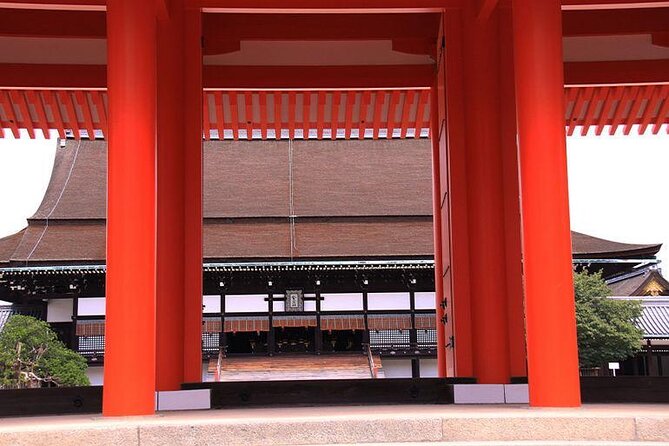
The Kyoto Imperial Palace was the residence of Japan’s imperial family until 1868, when the capital moved to Tokyo. Its spacious grounds offer a different view of Kyoto from the compact temple districts. It is a good pick if you want broad paths, formal buildings, and the story of the old imperial capital.
Shugakuin Imperial Villa and Katsura Imperial Villa are more specialized choices. Katsura is known for Japanese architecture and garden design, while Shugakuin includes upper, middle, and lower villa areas built in the 17th century. Admission is not included, and these sites require more planning than simply walking up to a temple. Ask your guide about access arrangements before building your day around them.
Northern Kyoto: gold leaf, stone gardens, and temple quiet
Kinkaku-ji, the Golden Pavilion, is one of Kyoto’s most famous sights. Its top two floors are covered in gold leaf, and the building reflects across the pond in the surrounding garden. Admission is extra, and the route can be crowded, but the view is memorable.
Do not expect a long, quiet meditation here. Kinkaku-ji is a major attraction, and the visit follows a set path. It works well as one of the day’s headline stops, not as a place where you linger for hours.
Ryoan-ji offers a sharper contrast. Its famous rock garden is spare and controlled, with a design that invites you to sit and look rather than constantly move. Admission is extra. The temple is especially valuable if you want to discuss Zen ideas and Japanese garden design with a guide.
Ninna-ji is a World Heritage temple and the head temple of the Omuro school of Shingon Buddhism. Its grounds give you another important religious site in northern Kyoto, with a different history and layout from Kinkaku-ji and Ryoan-ji.
Daitoku-ji and Myoshin-ji are large temple complexes with many subtemples. They reward visitors who want less familiar parts of Kyoto, though not every subtemple is open in the same way. A guide can help you choose a suitable section rather than sending you into a sprawling complex without a clear target.
Arashiyama and the western hills
Arashiyama is a strong choice for a full or half-day focus. The district is known for the bamboo groves, the Togetsukyo Bridge, Tenryu-ji, and a series of smaller hillside temples.
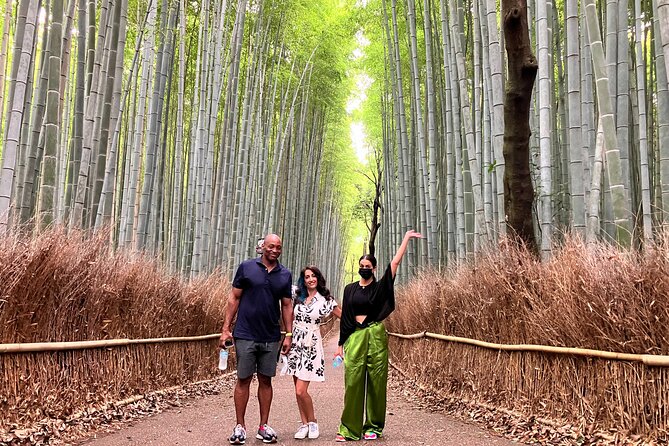
The bamboo paths are photogenic, but the famous section can be crowded. The walk is not difficult in itself, yet it can take longer than expected because you stop often and move with other people. Togetsukyo Bridge gives you a broader view across the river and has been part of the area’s identity since the Heian period.
Tenryu-ji is the major temple here and a World Heritage site. Its garden and buildings provide a strong reason to visit beyond the bamboo. Admission is extra. If you want a quieter Arashiyama day, Okochi Sanso Garden, Jojakko-ji, Nison-in, Gio-ji, Adashino Nenbutsu-ji, and Otagi Nenbutsu-ji offer alternatives.
Okochi Sanso was the former villa of actor Okochi Denjiro. Jojakko-ji and Nison-in sit on the hillsides and are known for their restrained atmosphere, trees, and moss. Gio-ji is especially known for its moss garden and small thatched buildings. Otagi Nenbutsu-ji is famous for its 1,200 stone statues, each with a different expression.
These smaller sites cost extra where admission is charged, and visiting several means more walking. They suit you if you prefer gardens and quiet temple grounds to the most famous photo stops.
Daikaku-ji, another Arashiyama-area temple, began as an imperial palace for Emperor Saga. It gives you a link between court life and Buddhist temple tradition. If you choose Arashiyama, ask your guide to create a route that matches your pace rather than trying to cover every temple in one sweep.
Northern mountain choices: Kibune and Kurama
Kibune and Kurama feel far removed from central Kyoto, even though they are part of the city. Kibune developed around Kifune Shrine in a forested valley, while Kurama is known for Kurama-dera and its hot spring.
These places suit you if you want mountain scenery and a slower day. They do not pair naturally with Fushimi Inari, Arashiyama, and Kinkaku-ji in the same eight-hour outing. Transport time matters, and the tour price does not include those fares.
Nanzen-ji and Eikando are more practical eastern alternatives. Nanzen-ji is one of Japan’s important Zen temples, with spacious grounds at the base of the Higashiyama mountains. Eikando is famous for autumn color and evening illumination. Eikando’s listed visit time is longer than many other stops, which reflects the fact that it deserves more than a quick glance.
Price, group size, and practical value
The listed price is $201.46 per person. That is not a budget walking tour, especially after adding transport, temple admission, and lunch. But the value changes when you are traveling with several people and want a private day shaped around your interests.
A private guide can be worth the cost for a group that wants help with transport, translation, history, and pacing. The guide can also save you from wasting time on a wrong turn or a poorly planned route. Group discounts may improve the price for larger parties, though you should check the final total for your dates.
The experience does not include a private vehicle. Have a transportation card and local currency ready if possible. One group found that having both allowed the day to start without delay, a small preparation that can make a real difference in Kyoto.
Free cancellation is available until 24 hours before the start time. Changes or cancellations inside that window are not accepted for a refund. The activity is near public transportation, service animals are allowed, and most people can participate, but you should still be comfortable walking for much of the day.
Who should book this Kyoto tour?
I would choose this tour if you want a private guide and have clear priorities. It is especially useful for first-time visitors who do not want to spend a full day figuring out Kyoto’s transport system, and for families or small groups who need a flexible pace.
It is also a good fit for repeat visitors. You can skip the Golden Pavilion and Kiyomizu-dera and spend your day on gardens, Zen temples, imperial villas, or northern mountain sites.
I would not choose it if you want every cost included, a private car, or a fixed schedule with no planning on your part. You also need to be realistic about distance. A smart route of four or five nearby sights will usually feel better than a heroic attempt to cross all of Kyoto.
Should you book it?
Book this tour if personal attention and choice matter more to you than an all-inclusive price. Send your guide a short list of priorities, ask for a route that limits backtracking, and decide in advance how much walking and how many admission fees suit your group.
The strongest version of the day combines a few major sights with time in a real neighborhood. Fushimi Inari, Kiyomizu-dera, Gion, and Nishiki Market make a solid first look. For a calmer day, choose Nanzen-ji, Eikando, Ginkaku-ji, or smaller Arashiyama temples. Guides such as Ichiro and Shu have been praised for professional, helpful service, while Karkoo Tanigawa was noted for accommodating a group of six adults.
FAQ
How long does the tour last?
The tour lasts approximately eight hours.
How many places can I choose?
The tour includes a customizable itinerary of four to six sites from the available selection.
Is transportation included?
No. Transportation fees are not included, and the tour does not provide a private vehicle. Meeting and pickup are on foot within the designated Kyoto area.
Are entrance fees included?
No. Entrance fees are generally extra. Guide entry fees are covered only for sights listed under the tour’s included expectations.
Is this a private tour?
Yes. Only your group participates, and you receive a licensed local English-speaking guide.
How far in advance should I reserve?
You should reserve at least two weeks in advance. The experience is often booked about 69 days before the tour date.
Just added around Kyoto
- Sekka Cotton Furoshiki Class★ 5.0 · 19 reviews
- Kyoto Sword Experience – includes Museum Ticket/Ninja Experience★ 4.5 · 149 reviews
- Scenic Green Tea Fields of Hidden Kyoto & Local Tea Exp (Private)★ 5.0 · 32 reviews
- Secret Eastern Kyoto Biking Adventure★ 5.0 · 44 reviews
- Private Sake Tasting in Central Kyoto with Sake Sommelier★ 5.0 · 32 reviews
- Samurai School in Kyoto: Samurai for a Day★ 5.0 · 202 reviews
- SHIRAKAWA Japanese Culture Experiences with private English staff★ 5.0 · 16 reviews
- A Privately Guided Photoshoot in Beautiful Kyoto by a Pro★ 5.0 · 18 reviews
Guided, compared.
Shinjuku Local Bar and Izakaya Guided Walking Tour
Our verdict →
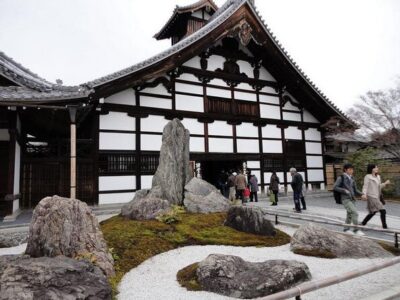
Kyoto Early Morning Tour with English-Speaking Guide
Our verdict →
Tokyo 4hr Private Tour with Government-Licensed Guide
Our verdict →