
Reviewed · HISTORICAL TOURS
Tokyo: Imperial Palace East Gardens and Tokyo Station Tour
Tokyo’s imperial story comes into focus on this walk from the quiet East Gardens to the grand red-brick face of Tokyo Station. You’ll pass castle gates, guardhouses, gardens, and stone remains before seeing how modern Marunouchi grew around the palace grounds.
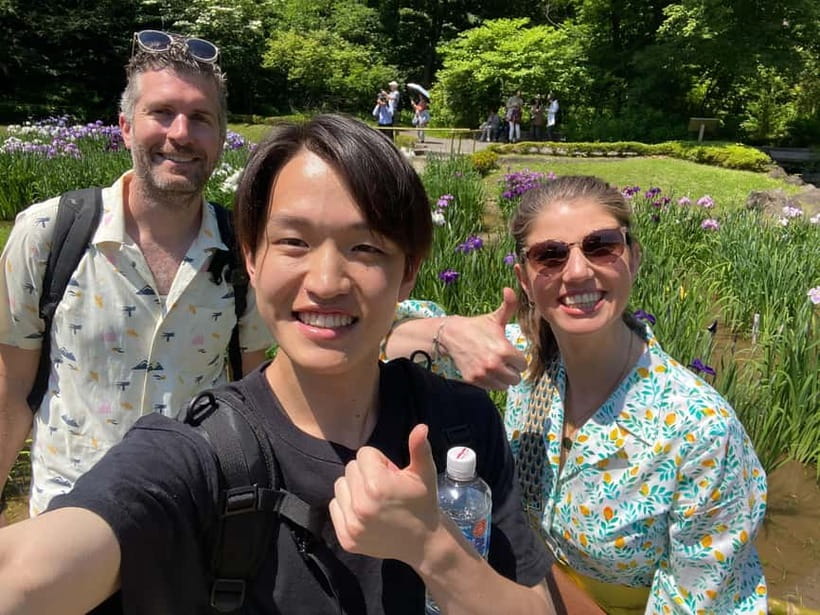
I like the clear Edo Castle context and the way the route connects old Tokyo with today’s business district. I also like the friendly guide style, especially from Yuki, whose humor and vivid explanations help you picture the castle as it was 400 years ago.
The main drawback is the pace: 150 minutes on foot can feel long in hot, wet, or cold weather. You’ll also need to manage your belongings carefully because backpacks are not allowed.
Key points to know before booking
- Start at Wada Kurayama Fountain Park Starbucks, a practical meeting point near the Imperial Palace grounds.
- See Edo Castle remains, including Ote-mon Gate, the Hyakunin Bansho Guardhouse, Fujimi-yagura, and the Honmaru area.
- Walk through Ninomaru Garden, where garden design helps explain the culture of the shogunate.
- Connect old and new Tokyo as the route moves from palace grounds to Marunouchi’s modern buildings and public art.
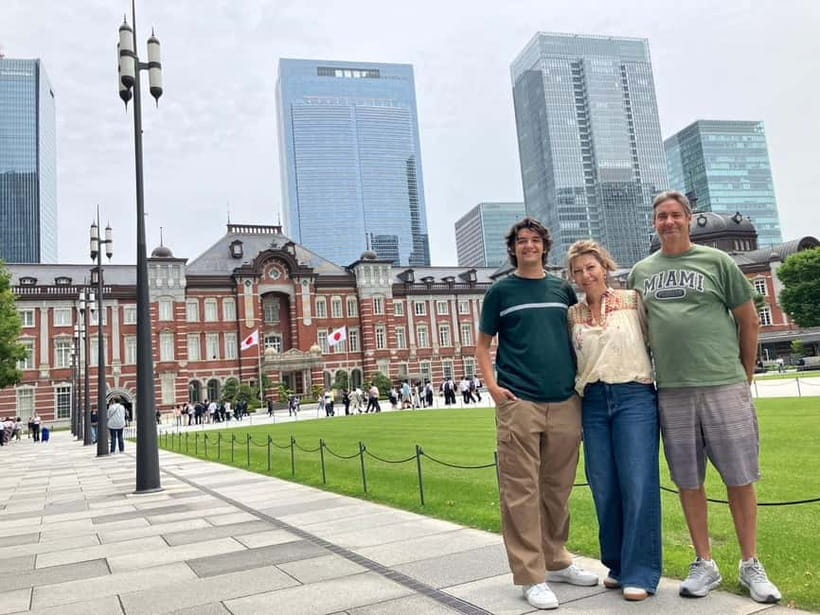
- Finish at Tokyo Station, the beautifully restored red-brick landmark rather than returning to the starting point.
- Expect a history-focused walk, with guides available in English, Japanese, Spanish, Chinese, and French.
From Ote-mon Gate into Edo Castle’s past
The walk begins near the Starbucks at Wada Kurayama Fountain Park. This location places you close to the Imperial Palace’s outer grounds and gives you a calm starting point before the city’s traffic and office towers take over.
One of the first useful lessons is that today’s Imperial Palace grounds were once the center of Edo Castle. The castle was tied to the Tokugawa shogunate, the military government that ruled Japan for centuries. You are not simply looking at a palace park. You are walking through the remains of a political center that shaped Japan.
Ote-mon Gate is an important early stop. Gates were not just entrances. They helped control movement into the castle, and their design reflected the need for security and order. Your guide can help you read the site as a working fortress rather than a pleasant green space.
The Hyakunin Bansho Guardhouse adds another practical layer. A guardhouse makes the old castle system easier to picture, since the site was once filled with checkpoints, officials, retainers, and strict rules about who could pass. These details give the stones and walls a human scale.
The East Gardens require no admission fee, which helps the $38 price feel more reasonable. You are paying mainly for interpretation, route planning, and the time saved trying to work out what each ruin meant on your own.
More Garden Tours in Tokyo
- Imperial Palace East Garden and Edo Castle Walking Tour in Tokyo
★ 5.0 · 510 reviews - Tokyo: Imperial Palace East Gardens Walking Tour
★ 4.8 · 353 reviews - Tokyo Castle, Imperial Palace, Shogun & Garden Walking Tour
★ 5.0 · 211 reviews
Ninomaru Garden and the art of controlled beauty
Ninomaru Garden is one of the gentler parts of the visit. The mood changes from gates and defensive structures to carefully arranged garden scenery. This is a good place to see how Japanese garden design can combine plants, water, paths, and open views without feeling accidental.
The garden also helps balance the military story. Edo Castle was a place of power, but it was not only walls and weapons. Gardens provided settings for ceremony, conversation, and quiet observation. Your guide can connect the design to the people who lived and worked within the castle complex.
I especially like this section for first-time visitors to Japan. You do not need prior knowledge of samurai history or Japanese garden traditions. The tour is built around simple explanations, and the garden gives you something visual to hold onto while the larger political story develops.
Take your camera, but keep flash photography off. The supplied information also advises sunscreen, water, a hat, and clothing suited to the weather. That is sound advice, since much of the experience takes place outdoors and the walk includes a moderate amount of walking.
Edo Castle ruins and the Fujimi-yagura view
The route continues through the East Gardens toward the Honmaru area, once the castle’s main compound. You’ll hear about the castle’s former main keep and see a scale model that helps show how imposing the complex would have been.
The model matters because little can be understood from a few surviving foundations alone. Looking at a physical representation lets you connect the broad stone base with the much larger structure that once rose above it. It is one of the most useful teaching moments on the tour.
Fujimi-yagura, a watchtower associated with the castle, adds another strong visual point. The name refers to viewing Mount Fuji, although the supplied tour details do not promise that Fuji will be visible during your visit. Treat the tower as a surviving piece of castle architecture, not as a guaranteed mountain-view stop.
The Honmaru area is also where the scale of the old complex becomes clearer. You may find the open grounds more impressive after hearing how the castle functioned. Without a guide, it would be easy to see lawns, stones, and trees without understanding the vanished buildings around them.
This portion should appeal to anyone who enjoys history but does not want a museum-only experience. You are outside, moving through the actual setting, while the guide supplies the missing structure.
Nijubashi and the imperial view
The walk includes scenic views toward Nijubashi, one of the best-known sights associated with the Imperial Palace. The bridge and palace approach provide a more formal image of imperial Tokyo than the castle ruins do.
This is also a useful moment to separate the Edo period from the modern imperial era. The grounds carry several layers of Japanese history, and the guide helps you understand that the Tokugawa shogunate and the present imperial institution are not the same thing.
The view is likely to be a photo stop rather than a long pause. The tour has a fixed route and ends at Tokyo Station, so you should not expect a leisurely garden visit with unlimited time at each point. If photography is a priority, have your camera ready and listen for the guide’s instructions.
The contrast is part of the route’s appeal. You move from old stonework and formal palace views toward the wide streets and tall buildings of Marunouchi. Tokyo’s past does not sit in a separate historical quarter. It shares space with offices, transport links, shops, and daily city life.
More Historical Tours in Tokyo
- Tokyo: Imperial Palace and Shogun Historical Walking Tour
★ 5.0 · 2,251 reviews - Tokyo: Imperial Palace Japanese History Walking Tour
★ 4.9 · 987 reviews - Tokyo: Imperial Palace and Shogun Walking Tour
★ 4.9 · 935 reviews - Yanaka Walking Tour: Historic and Traditional District of Tokyo
★ 5.0 · 530 reviews
Ten minutes into Marunouchi’s modern side
The stated walk from the Imperial Palace area to Marunouchi takes about ten minutes. That short transition is one of the smartest features of the experience because it makes the city’s change visible in real time.
Marunouchi is known for modern architecture, offices, public art, and its position beside Tokyo Station. The tour does not treat this district as a pause between historical stops. Instead, it explains how the palace grounds and the business center sit side by side.
You’ll see a different kind of Tokyo here. The palace area offers moats, gardens, walls, and watchtowers. Marunouchi brings contemporary buildings, broad streets, and polished urban design. The route gives you a way to compare the two without taking another train.
I find this especially helpful if your Tokyo visit is short. A separate palace visit and station visit might each take planning. This walk joins them in one compact experience, with the historical link made clear along the way.
Do keep in mind that the modern architecture portion is still a guided walk, not an indoor architecture tour. The information provided mentions art and buildings, but it does not promise entry to offices, museums, or private interiors.
Tokyo Station, the right finish
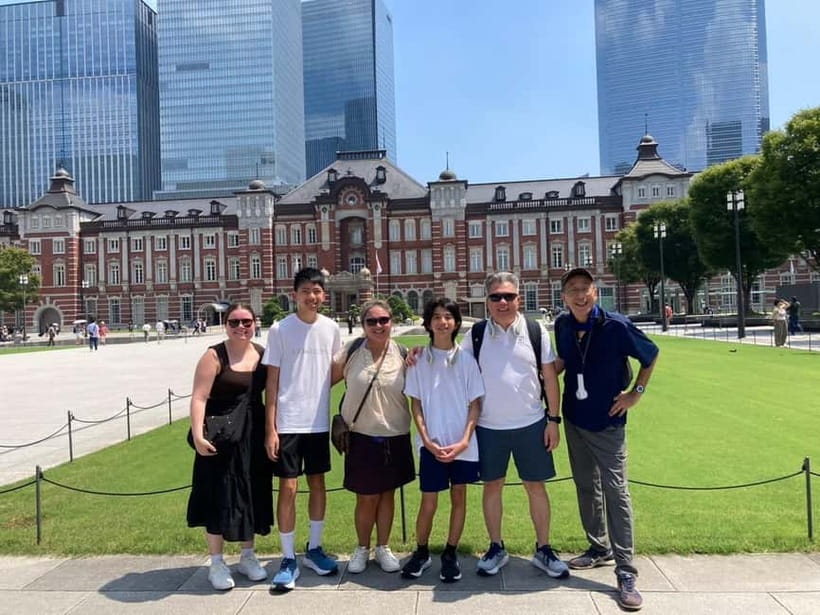
The tour ends at Tokyo Station, whose red-brick exterior gives the walk a strong final image. The station represents another stage in Tokyo’s development, far removed from the samurai-era castle but still part of the capital’s long story.
The restored exterior is worth seeing even if you are not taking a train immediately. Your guide explains the station as part of Marunouchi’s changing cityscape, and the final stop gives you a clear sense of how Tokyo grew around the palace district.
Ending here is practical. Tokyo Station is one of the city’s major transport points, so you can continue sightseeing, find food, or make your next connection after the tour. The activity finishes at the station rather than returning you to the starting point, so plan your afternoon from there.
The station also gives the tour a satisfying visual contrast. You begin with a quiet park and old castle remains, then finish beside a busy railway landmark. That movement from feudal power to modern urban life is the central idea of the route.
What the guides add to the walk
The guide is the key reason to book this rather than simply visit the gardens independently. The East Gardens are free, and you can see many of the same physical sites on your own. A good guide turns those sites into a connected story.
Yuki receives especially strong praise for making the past easy to picture and for adding humor without losing the historical thread. The comments about her describe explanations that make Edo Castle feel present rather than distant. You can expect an organized, friendly approach, though the guide assigned to your departure may differ.
The activity lists English, Japanese, Spanish, Chinese, and French. Check the available language when choosing a starting time, since the useful part of this experience depends on understanding the commentary.
The guide covers the shogunate, Edo Castle, garden design, samurai-era architecture, and the role of the palace grounds. That mix works well because it avoids making the walk only about dates and rulers. You get political history, design, architecture, and present-day city context.
Is $38 a fair price?
At $38 per person, this is not the cheapest way to walk around the Imperial Palace. You can enter the East Gardens without paying an admission fee, and independent visitors can view several major sites without a guide.
The price makes more sense if you want structure and explanation. You are paying for a 150-minute route, an English-speaking or multilingual guide, historical background, and the convenience of moving from the palace grounds to Marunouchi and Tokyo Station without planning the path yourself.
I would call it good value for a first visit or a short stay. It packs several major themes into one outing and removes much of the guesswork. If you already know Edo history well or prefer to linger alone at each garden, you may find the price less attractive.
The full route also has an important practical value: it ends at Tokyo Station. That saves you from retracing your steps and makes it easy to continue your day from a major transport hub.
Who should book this walk?
I recommend it most for first-time visitors, history fans, and anyone who wants a clear introduction to the Imperial Palace grounds. It also suits people who like seeing how an old site fits into modern city life.
Families and mixed-interest groups may find the route useful because it includes gardens, castle remains, city buildings, public art, and a famous station. The guide’s humor can help keep the history from feeling like a lecture.
You should be comfortable walking for 150 minutes with outdoor stops. Comfortable shoes are essential, and water, sunscreen, a hat, and weather-appropriate clothing will make the experience easier.
Backpacks are not allowed, so do not arrive with a large daypack. Smoking and flash photography are also not allowed. The activity is wheelchair accessible, but the route still includes a moderate amount of walking, so consider your own comfort with the length and outdoor setting.
Free cancellation up to 24 hours before the start gives you some flexibility, and the reserve-now, pay-later option can help if your plans are still changing.
My verdict on the Imperial Palace and Tokyo Station walk
Book this tour if you want the Imperial Palace East Gardens to make sense, not just look attractive. The best part is the connection between the castle ruins, Ninomaru Garden, Nijubashi, Marunouchi, and Tokyo Station.
I especially value the guide-led explanations of Edo Castle and the way the route moves from old power to modern Tokyo. Yuki’s clear, humorous style is a strong reason to choose this experience when she is available, though you should confirm the guide and language at booking.
Skip it if you want a slow, private garden visit or dislike walking outdoors for more than two hours. For everyone else, $38 buys a well-planned historical introduction with a useful finish at Tokyo Station.
FAQ
Where does the tour start?
It starts at Starbucks Coffee Imperial Palace Gaien Wada Kurayama Fountain Park, near the Imperial Palace grounds.
Where does the tour finish?
The tour finishes at Tokyo Station.
How long does the experience last?
The walking tour lasts 150 minutes.
How much does the tour cost?
The listed price is $38 per person.
Is admission to the Imperial Palace East Gardens included?
The East Gardens do not require an admission fee, and entry is included as part of the guided visit.
Which landmarks are included?
The route includes Ote-mon Gate, the Hyakunin Bansho Guardhouse, Ninomaru Garden, the Imperial Palace East Gardens, Edo Castle ruins, Fujimi-yagura, the Honmaru area, Kokyo Gaien National Garden, Marunouchi, and Tokyo Station’s exterior.
What languages are available?
Guides are available in English, Japanese, Spanish, Chinese, and French.
Is the tour wheelchair accessible?
Yes, the activity is listed as wheelchair accessible.
What should I bring?
Bring comfortable shoes, water, sunscreen, a hat, a camera, and clothing suited to the weather.
Are backpacks allowed?
No. Backpacks are not allowed. Smoking and flash photography are also prohibited.
Can I cancel the booking?
You can cancel up to 24 hours in advance for a full refund. You can also reserve now and pay later.
Just added around Tokyo
- Kawagoe Japanese Food Tour : Unagi Kaiseki and Sake near Tokyo★ 5.0 · 30 reviews
- Kawagoe 4hr Private Tour with Licensed Guide (Kawagoe Dep)★ 5.0 · 13 reviews
- Little EDO Sushi Making workshop in Kawagoe★ 5.0 · 18 reviews
- 【R34】Tokyo:Private Daikoku tour in Modified R34★ 4.9 · 92 reviews
- :Tokyo,Shibuya/ Pro Photography in Kimono / English-Friendly★ 5.0 · 26 reviews
- Tokyo:Celebrate Unique Japanese New Year Tradition Festivity★ 3.9 · 20 reviews
- Tokyo: Allstar Food Tour★ 4.7 · 29 reviews
- Tokyo: West-Side Cycling and Food Tour with Guide★ 5.0 · 37 reviews
Historical Tours, compared.

Imperial Palace and Shogun Historical Walking Tour
Our verdict →
World Heritage Kyoto & Nara Uji Authentic Matcha Experience
Our verdict →
Kyoto Gion: 2-Hour Geisha Culture & History Walking Tour
Our verdict →
Hiroshima Historical Walking Tour – Why A-Bomb was Dropped
Our verdict →
Yanaka Walking Tour: Historic and Traditional District of Tokyo
Our verdict →
Shinjuku Historical Walking Tour & Secret Backstreets
Our verdict →
Mt. Fuji Heritage Tour: Traditional Villages, Lakes & Shrine
Our verdict →Browse the lists this tour appears in