
Reviewed · GEISHA & MAIKO EXPERIENCES
Kyoto: Tea Ceremony with Maiko
Kyoto’s geisha culture can feel distant, even when you spot a maiko hurrying through Gion. This short program gives you direct time with a maiko, then lets you prepare your own matcha and ask about her life. I like the close photo opportunity and the small senjafuda charm, which make the meeting feel more personal than a simple stage performance. I also like that the program sits near Gojo Station, so you can fit it into a busy Kyoto day.
The main consideration is the setting. This is not an ochaya or traditional Japanese house, but a room in a building with stairs and a relaxed atmosphere. English support is available as much as possible, though Japanese is the listed language, so contact the provider if you want translation help. The session also runs on a firm clock, and late arrivals will not receive extra time or a refund.
Key points at a glance
- A 45-minute meeting with a maiko: Depending on the date, a maiko or geiko leads the program.
- Make your own matcha: Watch the tea preparation, then whisk your own cup with guidance.
- Taste two ohigashi sweets: These small dried Japanese sweets are served with the matcha.
- Ask about maiko life: The question session gives you a chance to discuss training, work, and the path toward becoming a geiko.
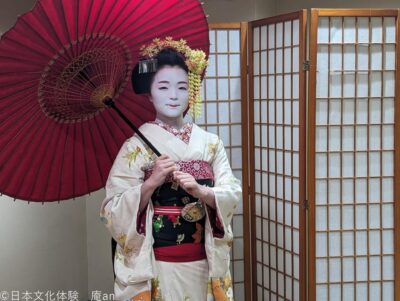
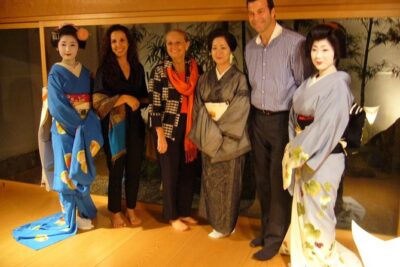
- Take a close-up photo: You can pose beside the maiko before she leaves.
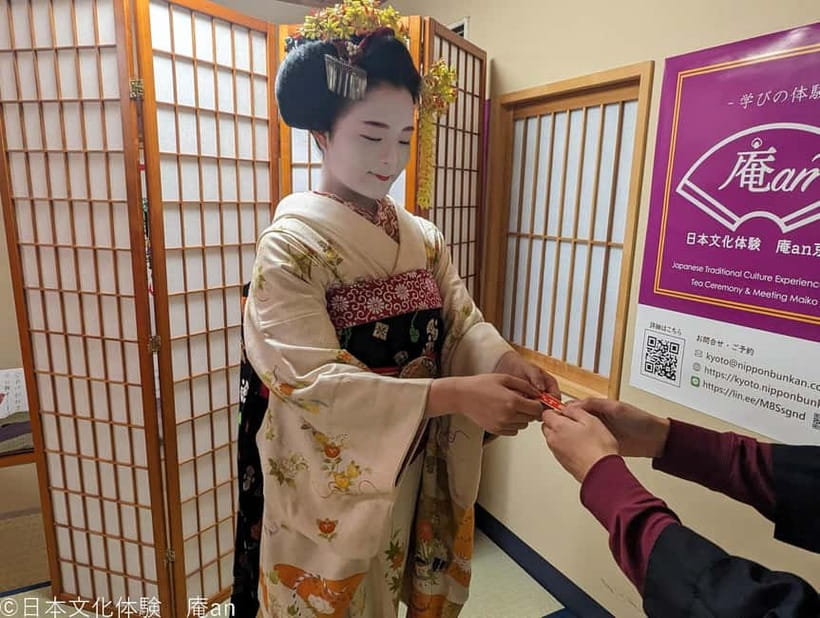
- Receive a senjafuda: The lucky charm is included as a keepsake.
Meeting a maiko near Gojo Station
The appeal here is simple: you get a personal introduction to Kyoto’s maiko tradition without committing half a day to a formal cultural class. The venue is a one-minute walk from Exit 1 of Gojo Station on the Karasuma subway line. The entrance faces Gojo-dori, though one visitor found it hard to spot and advised walking straight from Exit 1, crossing a small street, and looking above the Carnival supermarket.
That location matters. Kyoto Station is close, and the activity takes only about 30 to 45 minutes from arrival to departure. You can place it before a temple visit, between sightseeing stops, or on a day when you are catching a train and want one last Kyoto experience. Still, allow time to find the entrance and climb the stairs. There is no elevator in the building.
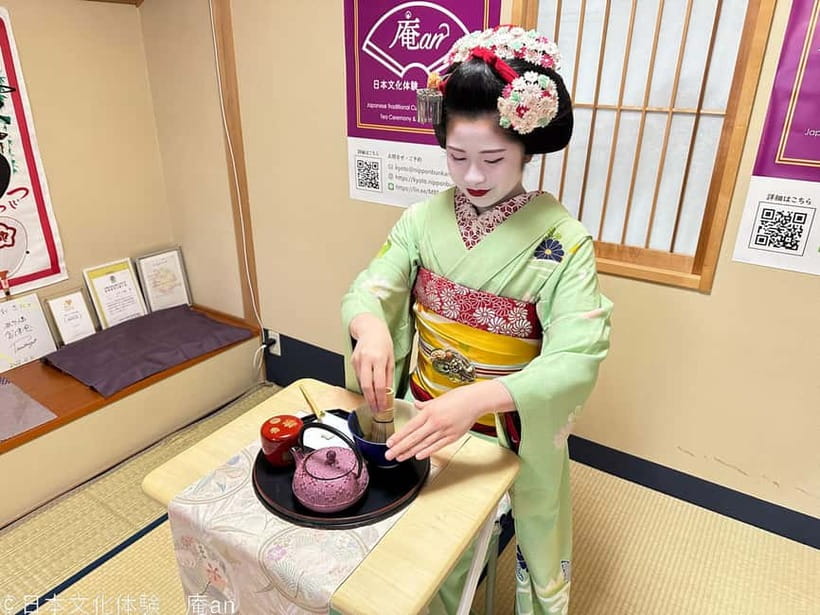
The room is not designed to recreate an old tea house. You will not be walking across tatami in a historic machiya or entering an exclusive entertainment house. Instead, expect a practical event space in a building, with staff who organize the program and help explain what is happening. That tradeoff keeps the price at $28 per person and makes the experience more approachable for first-time visitors.
More Tea Ceremony Experiences in Kyoto
- Kyoto: Tea Ceremony in a Traditional Tea House in Kiyomizu
★ 4.9 · 3,519 reviews - Kyoto: Tea Ceremony Ju-An at Jotokuji Temple
★ 4.9 · 3,207 reviews - Kyoto: 45-Minute Tea Ceremony Lesson Experience
★ 4.3 · 2,378 reviews
The opening greeting and tea demonstration
The session begins with a greeting from the maiko. Depending on the date, the host may instead be a geiko. The distinction is useful to understand: a maiko is an apprentice entertainer, while a geiko is an established professional. The activity description makes clear that you should be prepared for either.
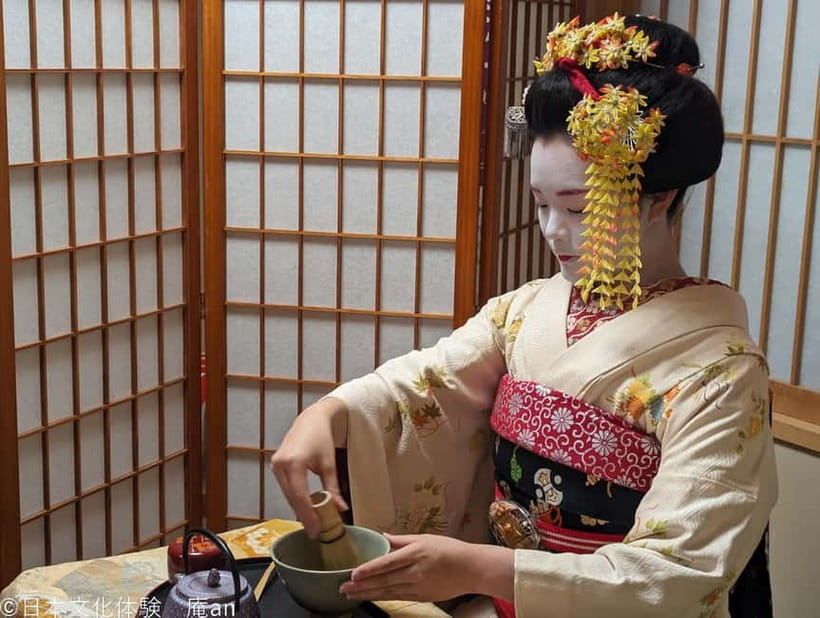
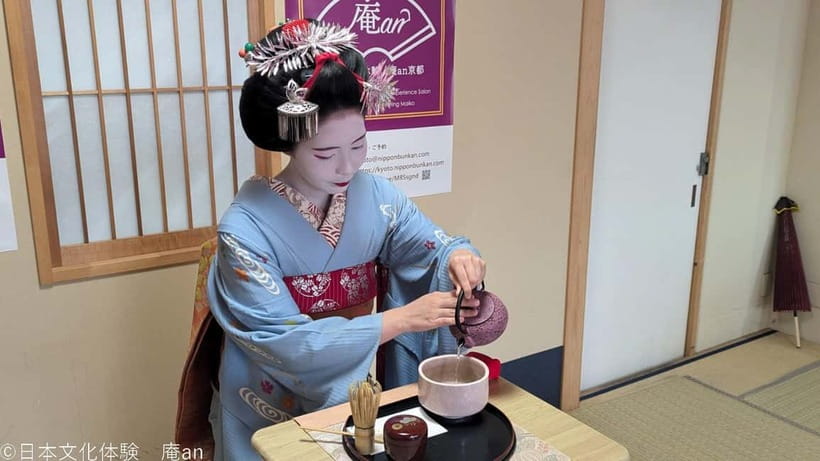
The tea portion follows. The maiko demonstrates how to make matcha and explains how to drink it. You then prepare your own cup. This is not a long, formal tea ceremony with every traditional movement explained in detail. It is a compact introduction designed for people who want to take part rather than only watch.
That hands-on element is the best reason to book. You are not simply seated in front of a performer while someone else handles the tea. You get matcha tools, follow the instructions, and make the drink yourself. The process is approachable, and the demonstration helps if you have never whisked matcha before.
Two dried Japanese sweets called ohigashi are served with the tea. Their dry texture and delicate sweetness work well with matcha, which can taste grassy and slightly bitter on its own. The sweets are small, so do not expect a full snack or meal. If you are hungry, eat beforehand.
One practical point: the program can be held in a room where people are also having lunch or dinner. That may make the atmosphere less ceremonial than you expect. It also means the event is best viewed as a cultural meeting with tea, not a private tea house booking.
Why the question session matters
The question and answer period is where the program moves beyond costume and photographs. You can ask directly about the maiko’s daily life and learn more about the route toward becoming a geiko. This is a rare chance to replace vague images of geisha culture with a clearer sense of the discipline and work behind the appearance.
The maiko answers in Japanese. English translation is provided as much as possible, and staff can help explain the program. If English support is important to you, contact the provider before booking and request it. Do not assume every exchange will be translated word for word.
Several details make this portion particularly valuable. You can ask questions that would be impossible to answer from a street sighting, such as how the profession works, what training involves, and how maiko and geiko differ. You also get a chance to speak with the person in front of you rather than treating her as a photo subject.
Masaya-san hosted one session praised for making matcha easy to learn and answering questions confidently in Japanese while an interpreter helped the group follow along. That is a useful picture of how the language arrangement may work: the maiko remains focused on the conversation, while a staff member bridges the gap for international visitors.
The question period is scheduled around the 30-minute mark, followed by photos and the gift. Since the full program lasts only 45 minutes, prepare a few questions before you arrive. If the group is large or several people want to speak, you may not get unlimited one-on-one time.
Photos and the senjafuda gift
After the questions, you can take a commemorative photo beside the maiko. This close-up opportunity is one of the program’s strongest features. It gives you a respectful way to record the meeting without trying to approach a maiko on the street, where following or interrupting her would be intrusive.
The photo is also more useful than a distant stage picture. You are standing near the maiko, with time arranged for the purpose. Staff help keep the process moving so the program can finish on schedule.
The maiko then gives you a senjafuda. A senjafuda is a small name or good-luck paper charm traditionally associated with visits and personal connections. Here it functions as a keepsake from the meeting. It is not a large souvenir, but it adds a thoughtful final touch and is included in the $28 price.
The maiko leaves after the photo and gift, with room departure at about 45 minutes. If you want extra time for questions or photos, this is not that kind of booking. The format is brisk, but that is also why it works well for a short Kyoto itinerary.
More Geisha Experiences in Kyoto:
- Kyoto Geisha Walking Tour: Gion District & Hidden Gems
★ 4.7 · 3,273 reviews - Kyoto: Gion Magical Night Walking Tour with Geisha Trivia
★ 4.9 · 2,393 reviews - Kyoto: Gion Geisha District Walking Tour – Stories of Geisha
★ 4.7 · 2,187 reviews - Best of Kyoto: Gion, Geisha, Pagodas & Cobblestones
★ 4.9 · 2,058 reviews
What $28 buys you
At $28, this is a strong value if you want three things in one short stop: an introduction to maiko culture, a matcha activity, and a close photo. You also receive two sweets and a senjafuda, so the price is not only paying for a demonstration. Staff coordination and translation support add practical value for visitors who do not speak Japanese.
The price is less compelling if you want a full traditional tea ceremony in a historic setting. You will not receive an elaborate multi-course tea experience, and the building is not an old Japanese house. The program is better understood as an accessible cultural encounter than as a formal tea school lesson.
The schedule also affects the value. You spend about 30 to 40 minutes in the main activity, with total room departure around 45 minutes. That makes it easy to fit into your day, but it limits depth. At a longer and more expensive tea ceremony, you might learn more about utensils, etiquette, architecture, and seasonal practice.
For families, children who sit on a parent’s lap are free if they are under two years old. A child who needs an individual seat pays the same fee as one person. Keep that rule in mind when comparing the total cost for a family.
Who will enjoy this short Kyoto experience
I would recommend it most strongly to you if:
- You have limited time in Kyoto.
- You want a cultural activity close to the station area.
- You are curious about maiko life and want to ask questions.
- You have never made matcha and prefer a guided introduction.
- You want a respectful, arranged photo rather than a chance encounter.
- You are comfortable with a modern building instead of a historic tea house.
It also suits first-time visitors who may feel unsure about tea ceremony etiquette. No special preparation is required. The host explains what to do, and you take part at a manageable pace.
It may not suit you if your priority is an elaborate traditional ceremony, a private session, or an old-house setting. It is also less suitable if you need step-free access, since the building has no elevator and the venues require stairs.
Timing, language, and arrival advice
The activity operates from 10:00 AM to 5:00 PM, with available starting times shown during booking. Reservations received after 5:00 PM are processed the next day. That cutoff matters if you are arranging plans at night.
Arrive early. The event will not wait for delayed arrivals, and latecomers are not entitled to a refund. The venue is close to Gojo Station, but the entrance can be easy to miss because it is above a supermarket and reached by stairs. Exit 1 is the simplest starting point.
The listed language is Japanese. English translation is available as much as possible, but you should contact the provider if you want to add translation support. That small step can make the question session far more useful.
Cancellation is free up to eight days before the activity for a full refund. Changes to the date or time within seven days can incur a fee. If the event is canceled, travel costs to the venue are not compensated, so do not book expensive nonrefundable transport around this short activity.
Is the tea ceremony worth booking?
Book it if you want an affordable, compact introduction to Kyoto’s maiko culture with real participation. The combination of a maiko demonstration, hands-on matcha, questions, a close photo, and a senjafuda gives you more than a quick performance.
Skip it if you are seeking a formal tea ceremony in a traditional Japanese house. The modern venue and short schedule are honest limitations, not surprises to discover after booking.
For most visitors with an open half-hour near Gojo, I think the $28 price is fair. Arrive early, request English support in advance, prepare a few questions, and treat the event as a personal cultural meeting rather than a grand historical reenactment. That is where this experience works best.
FAQ
Where is the tea ceremony held?
It is a one-minute walk from Exit 1 of Gojo Station on the Kyoto Subway Karasuma Line. The entrance faces Gojo-dori and is above the Carnival supermarket.
How long does the experience last?
The full activity lasts about 45 minutes. The main program ends at around 30 minutes, followed by photos, the senjafuda gift, and room departure at about 45 minutes.
Is the host always a maiko?
No. Depending on the event date, the program may be hosted by a maiko or a geiko.
Is English available?
The listed language is Japanese. English translation will be provided as much as possible, and you should contact the provider if you would like to request it.
What is included in the price?
The price includes the tea ceremony with a maiko or geiko, two dried Japanese sweets, matcha, a photo opportunity, and a senjafuda gift.
Is the venue a traditional Japanese tea house?
No. The venue is in a building rather than an ochaya or traditional Japanese house. It offers a relaxed atmosphere, and stairs are required because there is no elevator.
What happens if I arrive late?
The event cannot be held for late arrivals, and latecomers are not entitled to a refund. Arrive early enough to find the entrance and climb the stairs.
Just added around Kyoto
- Sekka Cotton Furoshiki Class★ 5.0 · 19 reviews
- Kyoto Sword Experience – includes Museum Ticket/Ninja Experience★ 4.5 · 149 reviews
- Scenic Green Tea Fields of Hidden Kyoto & Local Tea Exp (Private)★ 5.0 · 32 reviews
- Secret Eastern Kyoto Biking Adventure★ 5.0 · 44 reviews
- Samurai School in Kyoto: Samurai for a Day★ 5.0 · 202 reviews
- Private Sake Tasting in Central Kyoto with Sake Sommelier★ 5.0 · 32 reviews
- SHIRAKAWA Japanese Culture Experiences with private English staff★ 5.0 · 16 reviews
- A Privately Guided Photoshoot in Beautiful Kyoto by a Pro★ 5.0 · 18 reviews
Geisha & Maiko Experiences, compared.

Kyoto Geisha Walking Tour: Gion District & Hidden Gems
Our verdict →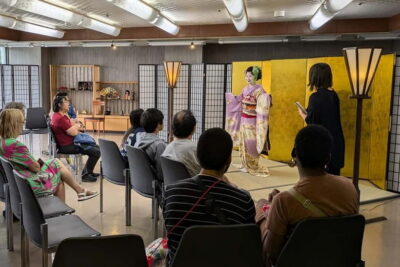
Dinner with Maiko in a Traditional Kyoto Style Restaurant Tour
Our verdict →
Browse the lists this tour appears in