Reviewed · GEISHA & MAIKO EXPERIENCES
Kyoto: Gion Evening Walk with Hidden Gems, Geisha & Sake
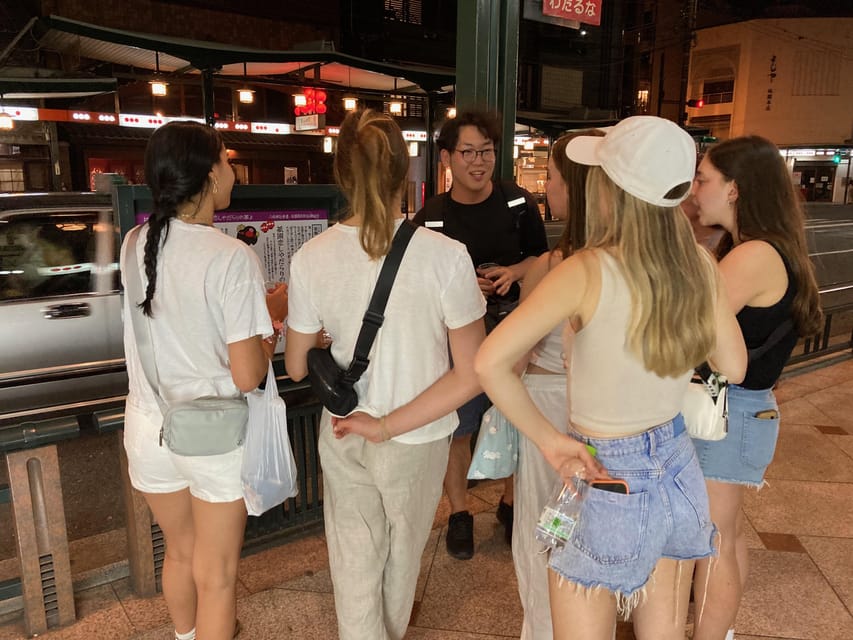
Gion is at its most atmospheric after sunset, when lanterns glow, tourist groups thin out, and the wooden streets take on a quieter mood. I like the small group of no more than 10 because it leaves room for questions, and I like the simple pleasure of walking with a cup of local sake while a guide explains what you are seeing.
The route covers several of Kyoto’s most famous sights in only 90 minutes, which is useful when your schedule is tight. The tradeoff is that this remains a brisk overview, not a long cultural seminar, and the narrow streets can be uneven, so comfortable shoes matter.
Key points at a glance
- Gion after dark: See Hanamikoji Street and nearby lanes when the lantern light changes the mood.
- Five important stops: The route includes Yasui Kompira-gū, Hōkan-ji Temple’s Yasaka Pagoda, Ninenzaka, and Yasaka Shrine.
- Sake included: You receive a cup of local sake during the walk, with a reminder to drink responsibly.
- Personal guiding: The small group makes it easy to ask about Geiko, Maiko, food, history, and what to do next.
- Photo assistance: Your guide can help you take pictures at the main stops.
- Good value: At $32, the tour is a modest way to add local context to sights you could otherwise see only from the outside.
Why Gion feels different after sunset
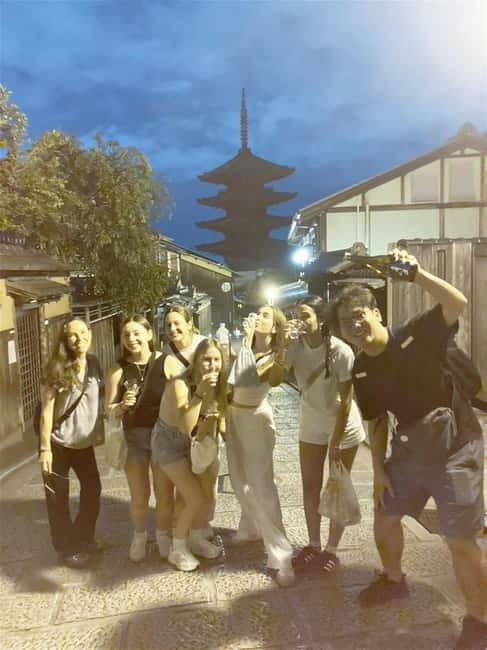
Gion is best understood as a working neighborhood, not a stage set built only for sightseeing. Its tea houses, shrines, traditional wooden buildings, and narrow lanes are tied to daily life and to Kyoto’s long performing-arts tradition.
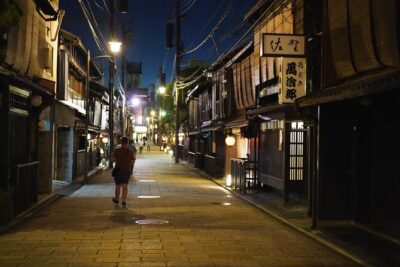
At night, the district changes character. Lantern light softens the streets, and the lack of daytime crowds gives you more space to look at details such as wooden facades, tiled roofs, and discreet entrances. You may also see Geiko or Maiko moving between appointments, though this is never guaranteed. The right approach is quiet observation, not chasing photographs.
Your guide explains the difference between Geiko and Maiko in plain English, along with the customs surrounding the profession. That context matters because it helps you understand why certain streets are treated with care and why loud voices or intrusive photos are unwelcome.
The tour is designed as a walk with conversation rather than a formal classroom talk. Past departures have included guides named Shumpei and Nick, both described as friendly, funny, and easy to talk with. Guide assignments can vary, but the format remains informal and question-friendly.
More Drinking Tours in Kyoto
- Kyoto Night Foodie Tour in Gion (9+ dishes + 6 Sake tastings)
★ 5.0 · 1,762 reviews - 3-Hour Kyoto Insider Sake Brewery Tour with Tastings & Pairings
★ 5.0 · 917 reviews - Arashiyama Bamboo, Temple, Monkeys, or Secret Sake Brewery
★ 4.8 · 886 reviews
Meeting at Shijo Kiyamachi
The meeting point is at 90-3 Shinchō, in the Shijo Kiyamachi area. Look for the guide holding an Otatrip Guide sign between McDonald’s and the Japanese restaurant Kikunoi Roan, a little south along Kiyamachi Street.
This is one place where you should not cut things close. The group may leave promptly, and the route cannot wait indefinitely for late arrivals. Give yourself enough time to find the sign, especially if you are unfamiliar with Kyoto’s busy streets.
The walk finishes at Yasaka Shrine rather than returning to the starting point. That is helpful if you want to continue exploring Gion, find dinner, or make your own way back toward central Kyoto after the tour.
Hanamikoji Street and the heart of Gion
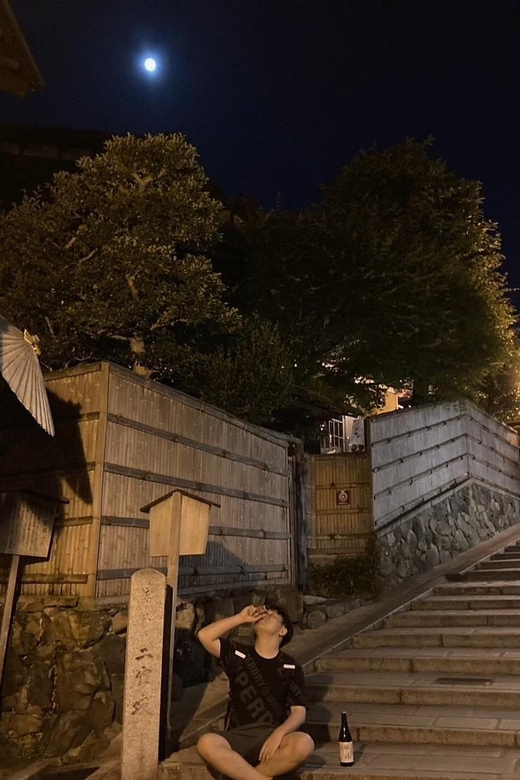
The first substantial stop is Gion, with time focused on Hanamikoji Street. This is Kyoto’s best-known Geiko street, lined with traditional tea houses and wooden townhouses.
Your guide uses the street to explain how Gion developed and how its entertainment districts function. You will hear about Geiko and Maiko traditions, the role of tea houses, and the difference between what is presented for visitors and what belongs to the local community.
Hanamikoji is photogenic, but it is also a place where manners count. Keep your voice low, stay out of doorways, and do not block people who live or work there. The tour’s small size helps here. Ten people can move through the area with less disruption than a large group.
The planned stop lasts about 15 minutes. That gives you time to take in the street and ask questions, but not enough for every detail. If you want a full study of Kyoto’s entertainment districts, you will need a longer specialist tour. For a first introduction, this short visit works well.
Yasui Kompira-gū and the power stone
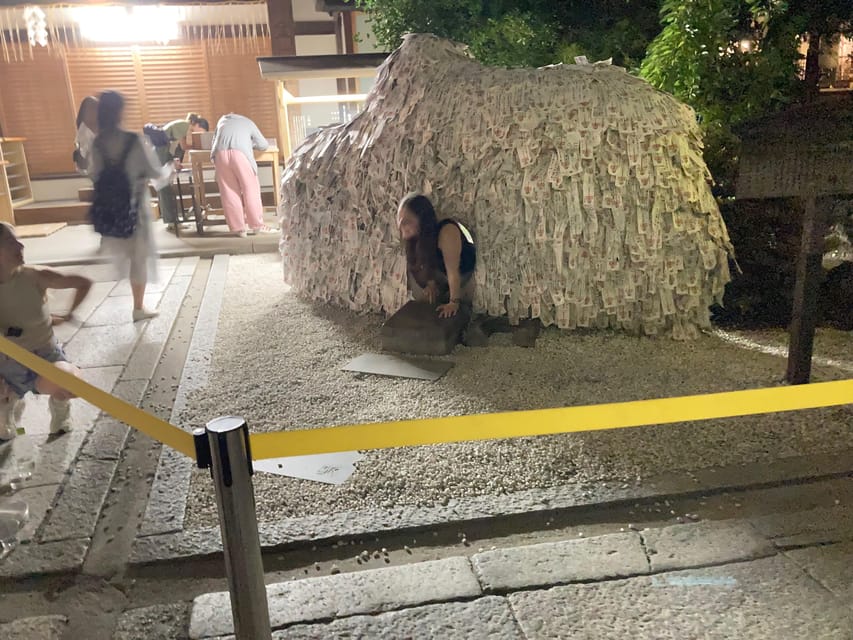
Next comes Yasui Kompira-gū Shrine, a small but memorable Shinto site. It is known for a distinctive power stone associated with cutting bad ties and building good ones.
That idea gives the stop a more personal feel than a simple photo opportunity. People come with hopes involving relationships, habits, and difficult periods in life. Your guide can explain the custom and place it within the wider world of Japanese shrine practice.
The visit lasts about 10 minutes. That is enough to see the main feature and hear its story, though the stop will feel brief if you want time for private reflection or a detailed look at every part of the shrine.
This is one of the route’s useful choices. Most first-time visitors know Gion’s famous streets and pagoda, but fewer know this shrine. It adds a local point of interest without taking you far from the main route.
More Hidden Gems Tours in Kyoto
- Kyoto Geisha Walking Tour: Gion District & Hidden Gems
★ 4.7 · 3,273 reviews - Private Kyoto Tour with a Local, Highlights & Hidden Gems, Personalised
★ 5.0 · 1,543 reviews - Arashiyama Bamboo Forest & Hidden Gems Bike Tour (Early Bird)
★ 5.0 · 613 reviews - Kyoto: Hidden Gems E-Bike Tour with Local Japanese Guide
★ 4.9 · 189 reviews
Yasaka Pagoda under lantern light
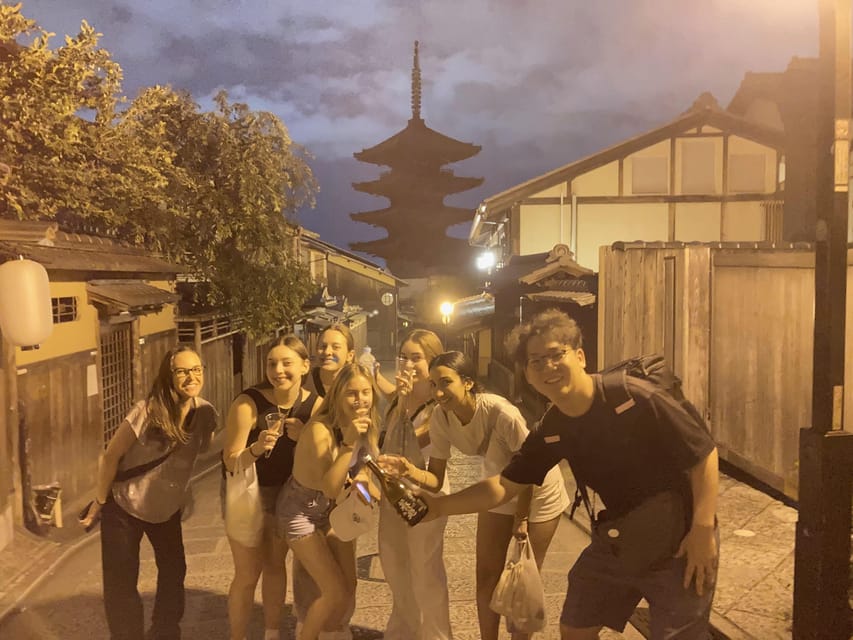
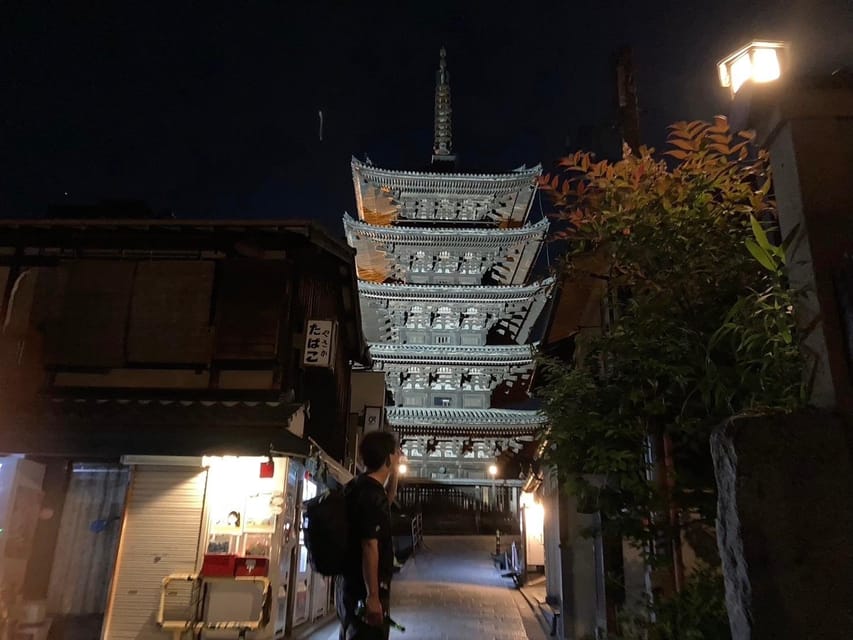
Hōkan-ji Temple, home of Yasaka Pagoda, is likely to be the visual high point. The five-story pagoda is one of Kyoto’s most photographed landmarks, and its lit form looks especially striking after dark.
During the day, this area can feel crowded and difficult to photograph without people in the frame. The evening timing gives you a better chance to appreciate the pagoda’s outline and the surrounding streets at a calmer pace. Still, do not expect an empty postcard scene every night. Gion remains one of Kyoto’s most popular areas.
The tour includes about 10 minutes here for a photo stop and explanation. Your guide can help with pictures, which is useful when you are trying to fit the pagoda, street, and group into one frame. You will not be given a long interior visit, and the experience centers on the exterior view.
The pagoda also helps connect the visual side of Kyoto with its religious past. Rather than simply collecting another famous photograph, you get a short explanation of the temple and the neighborhood around it.
Ninenzaka and the pleasure of a slow slope
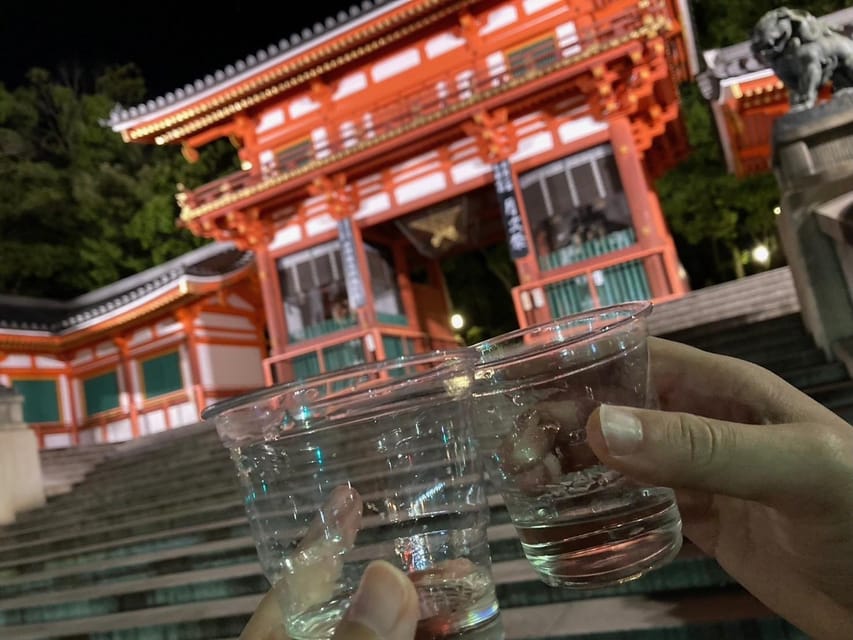
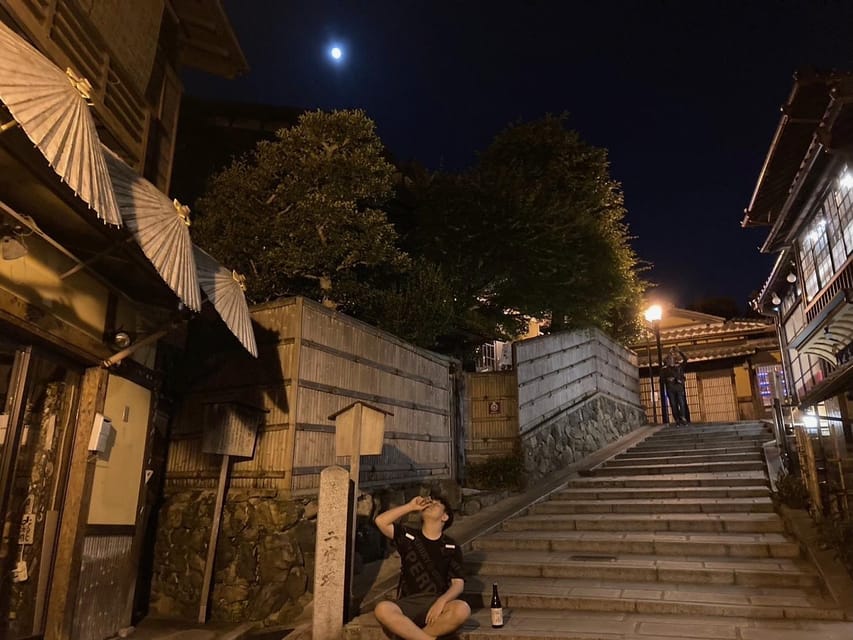
Ninenzaka is a traditional cobblestone slope lined with wooden buildings. It is a classic Kyoto scene, and at night it can feel far removed from the city’s larger commercial streets.
The route allows roughly 10 minutes here. That is enough for a short walk, photos, and a bit of explanation, but the slope deserves careful footing. Anyone with back problems should think twice about this tour, since the experience involves continuous walking over uneven streets and includes hills and steps in the general route.
Ninenzaka is also a place where you should avoid rushing. The point is not only to reach the next stop. Look at the proportions of the wooden houses, the low lighting, and the way the lane narrows as it rises. Your guide’s photo help can save time, allowing you to enjoy the surroundings rather than spend the whole stop setting up a phone.
Ending at Yasaka Shrine

The tour finishes at Yasaka Shrine, a major spiritual landmark at the eastern edge of central Kyoto. The shrine has watched over Gion for more than 1,300 years and remains one of the area’s key cultural anchors.
Ending here gives the route a clear sense of place. You begin among Gion’s entertainment streets and finish at a major Shinto shrine, with the pagoda, smaller shrine, and traditional lanes linking the two.
The tour information does not promise an extended shrine visit, so expect a concluding stop rather than a full guided exploration of the entire complex. That is fine for many people. You can continue looking around afterward if the grounds are open and you have the energy.
Because the tour ends here, ask your guide for suggestions about what to do next. The small-group format makes that sort of practical conversation easy, and several people have found the informal advice as useful as the formal sightseeing.
What the sake adds to the evening
A cup of local sake is included as you walk. It is a small detail, but it changes the rhythm of the experience. Instead of moving from one photo stop to another, you have a simple shared moment that fits the evening setting.
The sake is not the main attraction, and you should not book this as a tasting tour. There is no detailed program of breweries, production methods, or multiple pours described. Think of it as a pleasant local drink that accompanies the walk.
Responsible drinking matters, especially on cobblestones and slopes. If you do not drink alcohol, the information provided does not specify a substitute, so check before booking if that is important to you.
The drink also gives the guide a natural way to keep conversation going. Questions about food, nightlife, local customs, and what to see next fit easily into the walk.
Small-group guiding and photo help
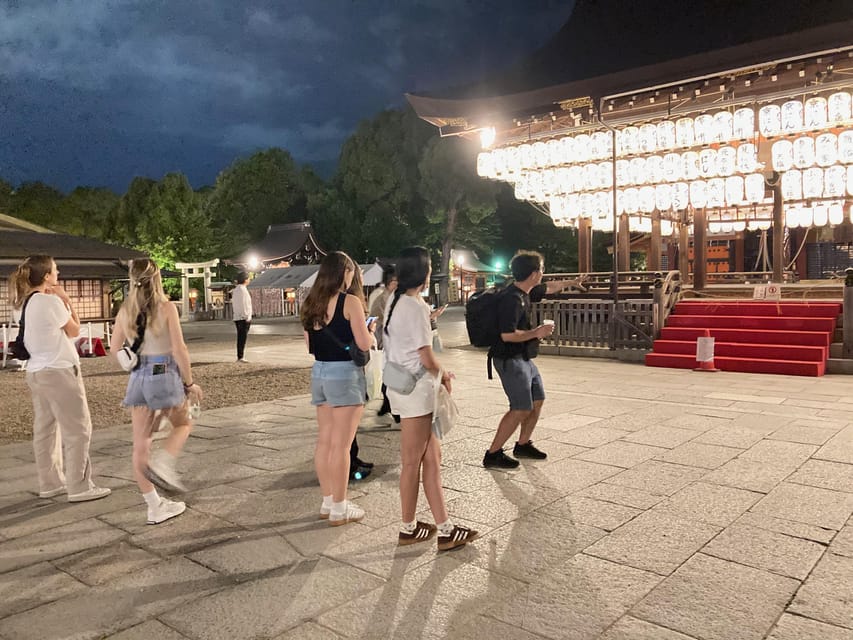
The group is limited to 10 people, though some departures may be smaller. A few past tours have even operated with only one participant when others chose an earlier time slot. You should not count on a private tour, but the small-group limit keeps the experience more personal than a large city walk.
I value this format for Gion because the setting rewards quiet movement and short explanations. A large crowd would make it harder to hear, harder to stop without blocking the lane, and more awkward in residential areas.
The guide can help take photos at key locations. This is especially useful at Yasaka Pagoda and Hanamikoji Street, where framing the traditional buildings can be tricky. It also means you can put your phone away for a few minutes and pay attention to the street.
The strongest part of the guiding style is the chance to ask ordinary questions. You can ask where to eat, what to see afterward, how Geiko and Maiko traditions work, or how Shinto differs from Buddhism. The experience is intended to be conversational rather than stiff.
Is $32 a fair price?
At $32 per person, this is a reasonable purchase if you want context and company while seeing Gion’s main sights. You could walk most of the route independently for free, but you would miss the explanations about Geiko and Maiko culture, the shrine customs, and the local meaning of the streets.
The value is strongest for a first visit to Kyoto, a solo visitor who wants an easy evening plan, or anyone who enjoys asking questions while walking. The sake and photo help add small extras without pushing the price into premium-tour territory.
The value is weaker if you already know Gion well or prefer to set your own pace. Ninety minutes moves quickly, and you will not get long visits inside every religious site. This is a compact orientation, not an exhaustive cultural program.
Free cancellation up to 24 hours before the start and reserve-now, pay-later booking make it easier to fit into a changing Kyoto schedule. The tour is offered in English, with starting times shown when you check availability.
Who should book this evening walk?
I would choose this tour for:
- First-time visitors who want an easy introduction to Gion
- Solo visitors who prefer a small social group
- Couples and friends looking for an evening activity before or after dinner
- People interested in Geiko, Maiko, Shinto, and Kyoto’s traditional streets
- Photographers who want help taking pictures at well-known locations
- Anyone with only one evening available for Gion
I would be more cautious if you have back problems, dislike walking on uneven streets, or want extensive time inside temples and shrines. It is also not suitable for smoking, which is prohibited during the activity.
Arrive early, wear comfortable shoes, and treat Gion as a neighborhood rather than a theme park. The best experience comes from walking quietly, listening closely, and letting the guide fill in the details.
My take: a friendly way to meet Gion at night
Book this tour if you want a relaxed introduction to Gion with a local guide, a little sake, and several famous Kyoto sights in one compact route. The strongest features are the small group, the evening atmosphere, and the chance to ask practical questions instead of listening to a fixed speech.
Skip it if you want a long temple tour, a formal sake tasting, or complete control over your timing. For most first-time visitors, though, $32 buys a useful first look at Gion and leaves you at Yasaka Shrine with enough evening left to continue exploring.
FAQ
How long is the Kyoto Gion evening walk?
The activity lasts 90 minutes, with the walking portion listed as approximately 70 to 90 minutes.
Where does the tour meet?
The meeting point is at Shijo Kiyamachi, at 90-3 Shinchō. Look for a guide holding an Otatrip Guide sign between McDonald’s and Kikunoi Roan, a little south along Kiyamachi Street.
Where does the tour finish?
The tour finishes at Yasaka Shrine, written as 八坂神社 in the meeting information.
What sights are included?
The route includes Gion and Hanamikoji Street, Yasui Kompira-gū Shrine, Hōkan-ji Temple and Yasaka Pagoda, Ninenzaka, and Yasaka Shrine.
Is sake included?
Yes. A cup of local sake is included during the walk.
What language is the tour offered in?
The live tour guide speaks English.
How many people are in the group?
The tour is limited to 10 participants. Some departures may have fewer people.
What should I bring?
Bring comfortable shoes because the tour involves walking through Gion, including traditional streets and a cobblestone slope. Smoking is not allowed, and the activity is not suitable for people with back problems.
More Walking Tours in Kyoto
- Kyoto: Gion Magical Night Walking Tour with Geisha Trivia
★ 4.9 · 2,393 reviews - Kyoto: Gion Geisha District Walking Tour – Stories of Geisha
★ 4.7 · 2,187 reviews - Night Walk in Gion: Kyoto’s Geisha District
★ 4.5 · 2,003 reviews - Kyoto Gion Geisha District Walking Tour – The Stories of Geisha
★ 5.0 · 1,441 reviews
More Sake Tastings in Kyoto
- Kyoto: Insider Sake Brewery Tour with Sake and Food Pairing
★ 5.0 · 704 reviews - Kyoto Sake Brewery & Tasting Walking Tour
★ 5.0 · 623 reviews - 1.5-Hour Kyoto Insider Sake Experience with 7 Tastings & Pairings
★ 5.0 · 297 reviews - Kyoto: Insider Sake Experience with 7 Tastings and Snacks
★ 5.0 · 266 reviews
Just added around Kyoto
- Sekka Cotton Furoshiki Class★ 5.0 · 19 reviews
- Kyoto Sword Experience – includes Museum Ticket/Ninja Experience★ 4.5 · 149 reviews
- Scenic Green Tea Fields of Hidden Kyoto & Local Tea Exp (Private)★ 5.0 · 32 reviews
- Secret Eastern Kyoto Biking Adventure★ 5.0 · 44 reviews
- Private Sake Tasting in Central Kyoto with Sake Sommelier★ 5.0 · 32 reviews
- Samurai School in Kyoto: Samurai for a Day★ 5.0 · 202 reviews
- SHIRAKAWA Japanese Culture Experiences with private English staff★ 5.0 · 16 reviews
- A Privately Guided Photoshoot in Beautiful Kyoto by a Pro★ 5.0 · 18 reviews
Geisha & Maiko Experiences, compared.

Kyoto Geisha Walking Tour: Gion District & Hidden Gems
Our verdict →
Dinner with Maiko in a Traditional Kyoto Style Restaurant Tour
Our verdict →