
Reviewed · HISTORICAL TOURS
Asakusa: A Big-picture History Walk to Know Japan
Asakusa is often treated as a quick photo stop, but this walk gives the neighborhood a much bigger job: explaining Japan. You’ll connect the Sumida River with the end of Japan’s long isolation, then move through Buddhist and Shinto landmarks while your guide explains how faith, art, and politics shaped the country.
I like the clear focus on Buddhism and Shinto, especially the way prayer and religious symbols are explained at the actual gates and temples. I also like the link between ukiyo-e prints and European Impressionist art, a useful surprise that makes the shopping street feel far more important than a row of souvenir stalls.
The main consideration is pace. Two hours covers a lot, and you’ll spend most of it on your feet. The tour offers a broad historical framework rather than long, detailed visits inside each site, and the headsets may sound slightly echoey for some people.
Key points about the Asakusa history walk
- The Sumida River sets the scene: Learn how Japan’s isolation ended and why the Netherlands kept a narrow trading link with the country.
- Buddhism and Shinto become easier to tell apart: The guide explains their symbols, rituals, and shared history at real religious sites.
- Japanese dragons reverse the Western story: Kaminarimon gives you a memorable way to understand the difference.
- Ukiyo-e connects Asakusa with Paris: See how Japanese woodblock prints helped influence Western Impressionist painters.
- A temple and shrine share one sacred precinct: Sensō-ji and Asakusa Shrine show how Buddhism and Shinto coexisted for centuries.
- Traditional snacks and visual aids help: Guides such as Amy have used printed images, while headsets help groups follow along.
Why this two-hour walk gives Asakusa a bigger purpose
The best reason to take this tour is that it turns separate sights into one connected story. Without help, you may see a red gate, a shopping street, a temple, and a shrine as four unrelated stops. Here, each place answers a different question about Japan.
Why did Japan close itself to much of the outside world? How can Buddhism and Shinto share the same grounds? Why does a Japanese dragon look familiar but behave differently from a European dragon? How did prints sold in Japan affect painters in Europe?
Those questions make the walk useful early in your Tokyo visit. You won’t learn every detail of Japanese history in two hours, but you should leave with a framework that helps you understand other temples, shrines, museums, and neighborhoods.
The tour costs $58 per person. That is more than a casual stroll, but the value depends on how much context you want. If you would otherwise pass through Asakusa without understanding its symbols, the fee buys a clear explanation from an English-speaking guide, plus snack tastings and group audio equipment. If you prefer to explore at your own speed and read signs independently, the price may feel less attractive.
More Historical Tours in Tokyo
- Tokyo: Imperial Palace and Shogun Historical Walking Tour
★ 5.0 · 2,251 reviews - Tokyo: Imperial Palace Japanese History Walking Tour
★ 4.9 · 987 reviews - Tokyo: Imperial Palace and Shogun Walking Tour
★ 4.9 · 935 reviews
Starting at the Sumida River and Japan’s closed country
The meeting point is in front of the Burger King beside Exit 4 of Asakusa subway station on the Ginza line. This is practical, but do step outside the exit rather than waiting underground. The walk begins near the Tokyo Cruise Asakusa Pier, beside the Sumida River.
This opening section is one of the tour’s strongest ideas. The river gives the story a physical setting. You’ll hear how the Edo shogunate restricted foreign contact for more than 200 years, allowing the Netherlands to trade through a tightly controlled channel while most other European contact was blocked.
Your guide then explains how Admiral Perry’s arrival forced Japan to reopen. The point is not simply that Japan went from closed to open. You’ll see how military pressure, trade, and contact with Western powers helped push the country into a rapid period of change.
The guide also connects this history with modern Tokyo. Odaiba’s former gun batteries and the Statue of Liberty replica facing the Pacific become reminders of how Japan’s relationship with the outside world changed. That link helps prevent the history from feeling like a detached school lesson.
You spend about 15 minutes here, so expect a concise explanation rather than a long riverfront lecture. The river itself is not the main attraction. Its value is as a starting point for the country’s story.
At the Culture Tourist Information Center, the religious basics become clear
The next stop is the Asakusa Culture Tourist Information Center, where the guide lays out the difference between Buddhism and Shinto. This is important because the rest of the walk depends on it.
Many first-time visitors see Japanese religious buildings but are unsure which details belong to which tradition. The guide gives you a basic map before you reach the major gates and sacred buildings. You’ll learn enough to notice the difference between a Buddhist temple and a Shinto shrine, and to understand why both matter in Asakusa.
The tour is especially useful if you have felt awkward around Japanese religious sites. At Asakusa Shrine and Sensō-ji, the guide explains how to approach the places respectfully and how prayer differs between Buddhism and Shinto.
This section lasts about 15 minutes. It is introductory, but that is its purpose. The guide is not trying to turn you into a religious scholar. You are getting the practical background needed to make sense of the rest of the walk.
Kaminarimon turns a famous gate into a lesson about dragons
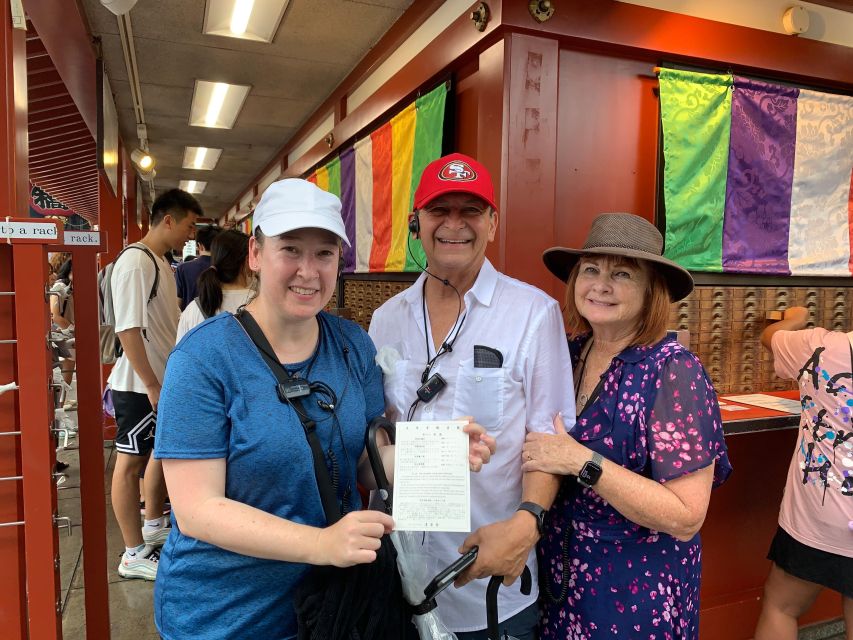
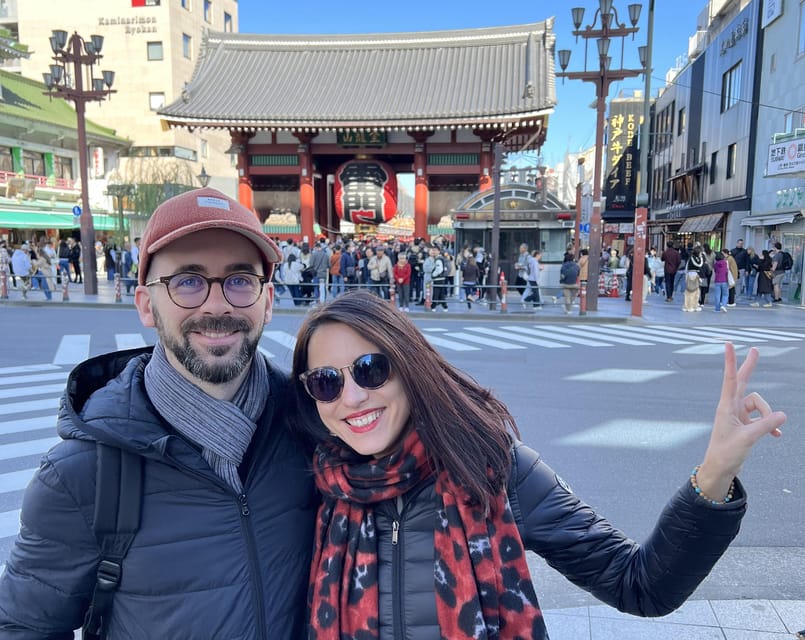
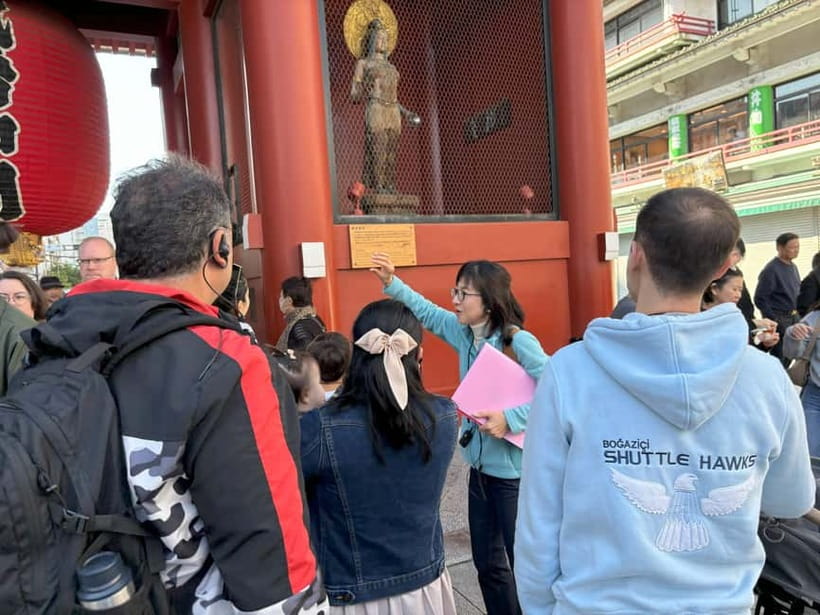
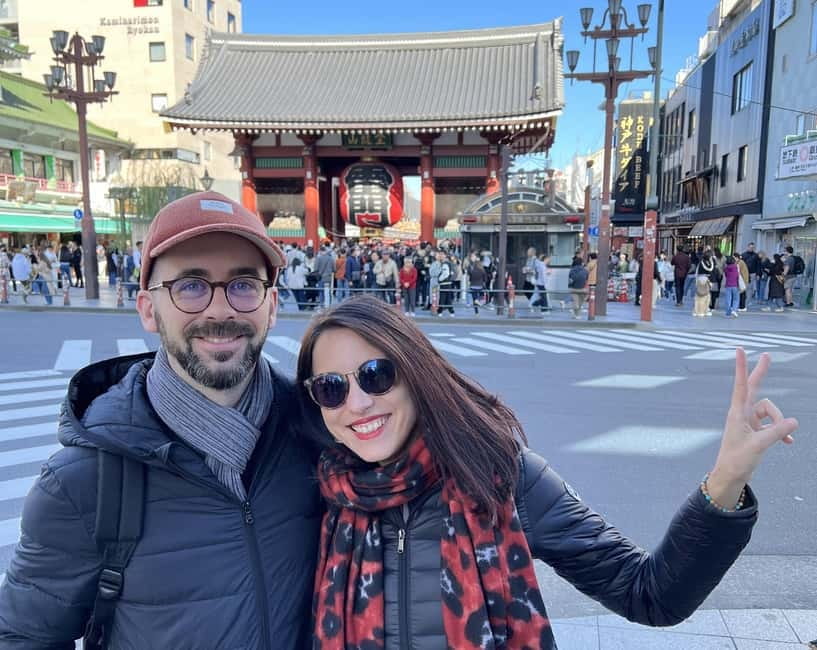
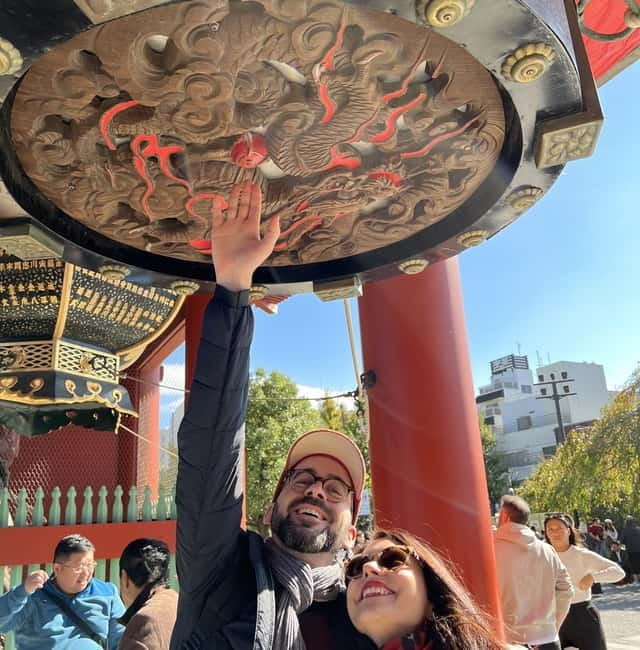
Kaminarimon, or Thunder Gate, is one of Asakusa’s best-known sights. Its huge red lantern makes an easy photograph, but the guide uses the gate for a more interesting comparison: Japanese dragons and Western dragons.
In much of Western tradition, dragons are dangerous enemies to defeat. Japanese dragons often have a different role, connected with water, weather, protection, and power. That contrast is easy to remember because you are looking at the imagery while hearing the explanation.
This is a good example of the tour’s method. Instead of giving you a list of dates, the guide uses a visible object to explain a cultural idea. You can then recognize the same pattern elsewhere in Japanese art and architecture.
Kaminarimon can be crowded, and the area is a working public space rather than a quiet museum. Your guide needs to keep the group together while making room for other people. That can make the presentation feel less leisurely than a private visit, but the 15-minute stop keeps the tour moving.
More Walking Tours in Tokyo
- Tokyo Tsukiji Fish Market Food and Culture Walking Tour
★ 5.0 · 3,184 reviews - Tokyo: Shinjuku Local Bar and Izakaya Guided Walking Tour
★ 4.9 · 1,794 reviews - Tokyo: Tsukiji Fish Market Food and Walking tour
★ 5.0 · 1,724 reviews - Tokyo: Asakusa Walking Tour with Sensoji Temple Visit
★ 4.8 · 1,583 reviews
Nakamise Shopping Street links souvenirs with European art
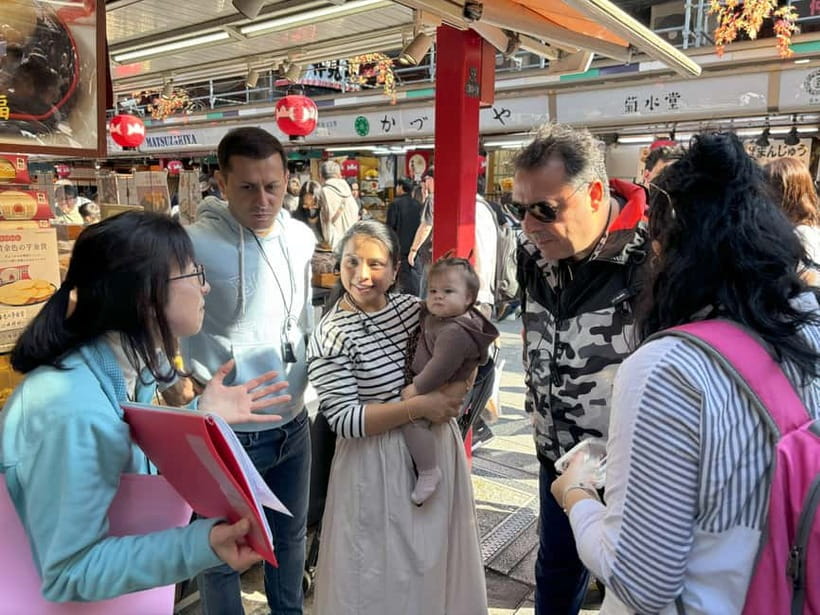
From Kaminarimon, you walk along Nakamise Shopping Street for about 30 minutes. The street is lined with shops and food stalls, and it is one of the oldest shopping streets in Japan. You will have chances to look at traditional goods, but the main purpose here is cultural explanation.
One subject is the Buddhist vajra, also called tokko. This ritual object can look like a decorative metal symbol if nobody explains it. Here, it becomes part of the larger discussion of Buddhist imagery and the way religious objects communicate ideas through shape and use.
The more unexpected subject is ukiyo-e woodblock printing. These prints reached Europe and helped influence Western Impressionist painters. You’ll hear how Japanese art changed the way European artists thought about composition, cropping, color, and everyday scenes.
That connection gives Nakamise a useful second layer. You are walking through a commercial street, but you are also learning how images made in Japan traveled abroad and affected art far beyond Japan. The setting helps you understand that Japanese culture was not simply copied from Europe after the country reopened. Japan also sent ideas outward.
Traditional snack tastings are included. The available snack is not specified in advance, so do not plan the stop around a particular food. Think of it as a small added taste of local culture rather than a meal.
Because Nakamise is a shopping street, this can be the most crowded part of the walk. You may want to return later if you wish to browse at length. During the guided visit, listen first and shop afterward.
Hōzōmon brings medieval Japan and Europe closer together
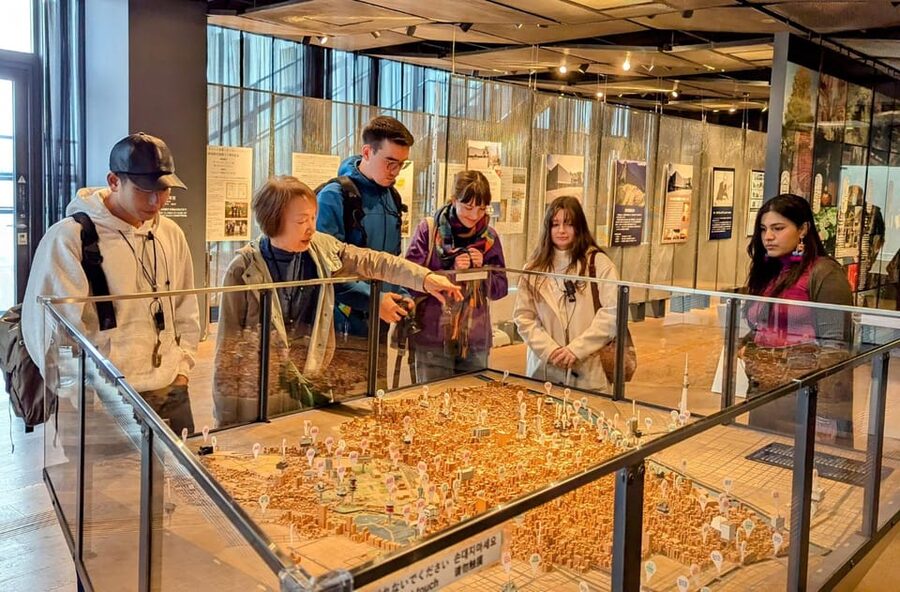
Hōzōmon Gate, also called the Treasure House Gate, offers another comparison between Japan and Europe. The guide explains that people in Japan and the West had surprisingly similar ways of thinking about 1,000 years ago.
This is a useful correction to the idea that Japan and Europe developed in completely separate mental worlds. The tour does not claim the cultures were identical. Instead, it points out shared patterns in the way people understood society, religion, symbols, and the world around them.
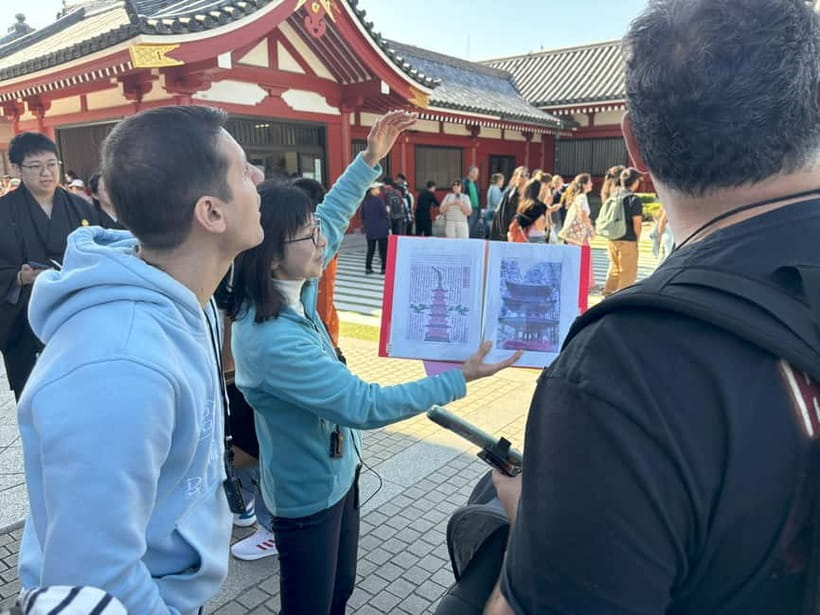
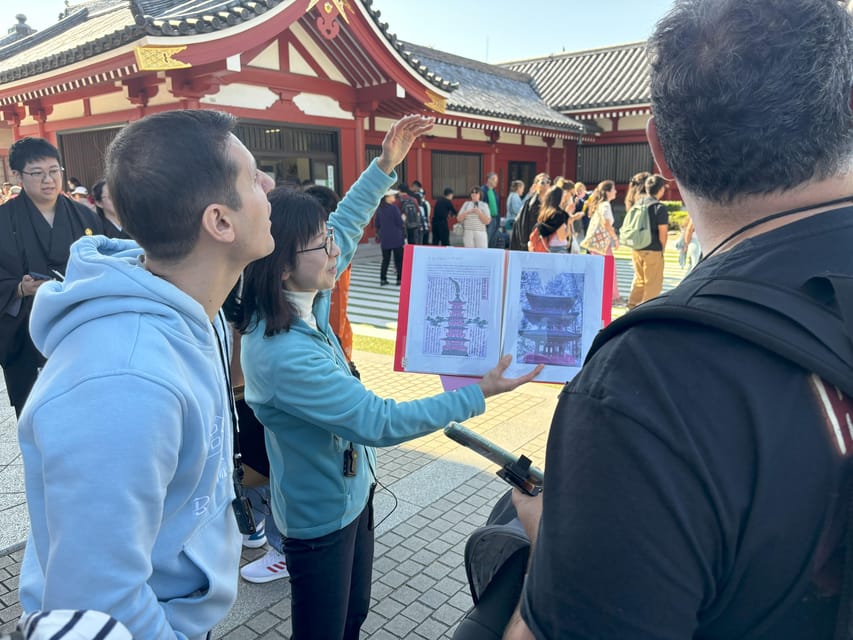
You spend about 15 minutes here. Look closely at the gate while the explanation unfolds, because the architecture and religious imagery give the discussion something concrete. This is also a point where visual aids can help. One guide, Amy, used printed images to make the explanations easier to follow, and that sort of material can be useful when an idea is difficult to picture from the building alone.
Sensō-ji explains prayer, history, and daily religious life
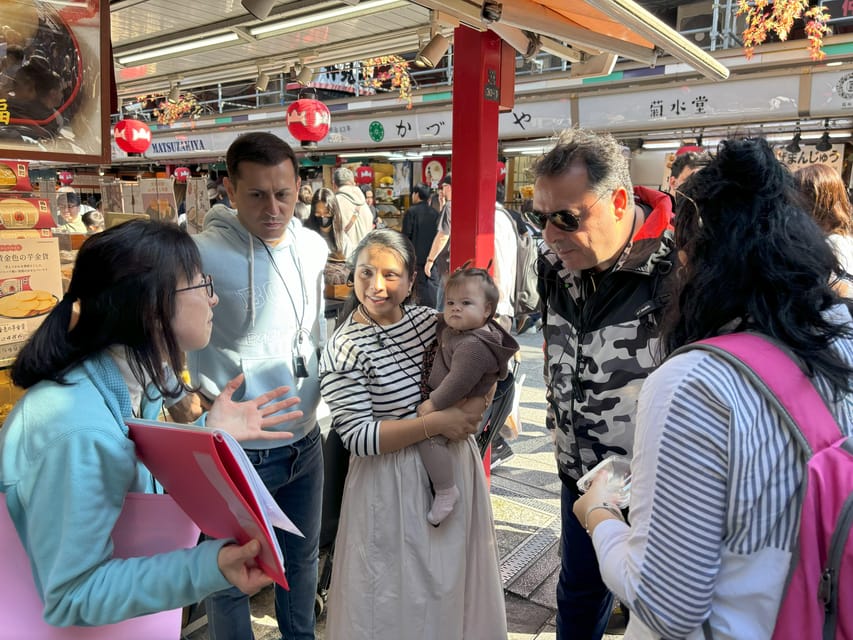
Sensō-ji is Japan’s oldest Buddhist temple and the central stop of the walk. Its fame can make it feel like a standard Tokyo attraction, but the guided explanation gives the visit more shape.
You’ll hear another comparison between medieval Japan and Europe, along with a clearer explanation of Buddhist prayer. This is where the earlier religious introduction becomes practical. You are not only looking at a historic temple. You are learning what the building represents, how it differs from a Shinto shrine, and how people use these places today.
The temple can be crowded, especially around the main approach. The guide must balance explanation with the movement of the group and the flow of people coming to pray. That is why the 15-minute timing matters. You get the essential context, but not an unhurried architectural study.
Families can manage the tour, though the historical focus suits adults best. An 8-year-old enjoyed the fortune-telling activity at the temple entrance on one visit, and a guide named Choco was praised for keeping both children and adults involved. That suggests the walk can work well for families with older children who can handle steady walking and a history-heavy presentation.
Asakusa Shrine shows a rare shared religious space
The tour ends at Asakusa Shrine, which shares the same general grounds and history as Sensō-ji. For many people, this is the most memorable stop because it makes Japan’s religious coexistence visible in one place.
You’ll learn why a Shinto shrine and a Buddhist temple can stand side by side, serve many of the same worshippers, and remain linked after more than 1,000 years. This is not a minor footnote. It is one of the best places in the tour for understanding how Japanese religious life developed.
The explanation also helps with a common oversimplification. It is tempting to think of Buddhism and Shinto as two neatly separate systems. In practice, their histories have often overlapped. Seeing the shrine beside Sensō-ji gives you a direct example of that shared space.
The final 15 minutes provide a tidy ending because the tour returns to the main question: how did Japan become the country you are visiting today? The answer includes foreign pressure and modernization, but also long-running local traditions that continued alongside change.
Guides, audio equipment, and the pace of the walk
The tour is conducted in English by a live guide. Past guides have included Choco, Sachi, Sachiko, Yoko, Yasu, Amy, and Kay. The individual style will vary, but the strongest pattern is a warm, personal presentation with plenty of room for questions.
Sachi has been especially effective with families and with explaining the history of the neighborhood. Choco has kept children engaged, while Amy used printed images to make abstract points easier to grasp. Kay, a Tokyo local, focused on practical guidance for approaching shrines respectfully.
Groups of three or more receive headsets so you can hear the guide while walking. This is helpful around busy streets, though one participant found the earpiece produced some echo and made parts of the talk harder to understand. If that happens, tell the guide early rather than struggling for the whole walk.
The pace is moderate, with roughly 15 minutes at most stops and 30 minutes along Nakamise. Wear comfortable shoes and bring water. The tour runs in rain or shine, so weather-appropriate clothing matters. The route involves a moderate amount of walking and is not suitable for people with mobility impairments. If you have mobility concerns, contact the operator before booking, since accommodations may be possible.
Who will get the most from this Asakusa tour
I would choose this walk if you want a strong introduction to Japan before visiting more temples, shrines, museums, or historic districts. It is also a good fit if you have been to Asakusa before but felt you saw the sights without understanding them.
The tour suits adults, couples, families with school-age children, and first-time visitors who prefer explanations over unstructured sightseeing. It is particularly useful for anyone interested in religion, art, or Japan’s relationship with Europe.
You may want a different plan if you want lots of free time for shopping, photography, or quiet temple visits. The route covers a small area, and its strength is interpretation rather than distance. You also should not expect a full survey of every period of Japanese history.
Free cancellation is available up to 24 hours before the start, and you can reserve while paying later. If the minimum number of participants is not reached, the operator will cancel at least 24 hours ahead and issue a full refund.
Should you book the $58 walk?
Book it if you want Asakusa to make sense, not just look attractive. The strongest parts are the Sumida River explanation, the clear Buddhism and Shinto comparison, the ukiyo-e connection, and the final look at the temple and shrine sharing one historic setting.
At $58, the tour is best value for someone who would otherwise need to research these subjects independently. It is less suited to a visitor who wants a cheap orientation stroll or plenty of time to browse Nakamise.
For most first-time visitors with two hours to spare, I would book it, especially near the start of a Tokyo stay. You’ll leave with useful context for the rest of Japan, and the next temple gate you see should mean more than it did before.
FAQ
How long does the Asakusa history walk last?
The tour lasts two hours.
Where does the tour meet?
Meet in front of the Burger King beside Exit 4 of Asakusa subway station, station code G19, on the Ginza line.
What language is the tour conducted in?
The live tour guide speaks English, and an English audio guide is included.
Are headsets provided?
Headsets are provided for groups of three or more so you can hear the guide more clearly while walking.
What sights are included?
The route includes Tokyo Cruise Asakusa Pier, Asakusa Culture Tourist Information Center, Kaminarimon, Nakamise Shopping Street, Hōzōmon Gate, Sensō-ji Temple, and Asakusa Shrine.
Is food included?
Traditional snack tastings are included. The specific snack is not stated in the tour information.
Is the tour suitable for children?
Children younger than six may join without charge. The historical focus is recommended for adults, but families are welcome.
Does the tour operate in bad weather?
Yes. The tour operates rain or shine, so bring suitable clothing and comfortable shoes.
Can I cancel for a refund?
You can cancel up to 24 hours in advance for a full refund. If the minimum number of participants is not reached, the operator will cancel at least 24 hours before the tour and provide a full refund.
Just added around Tokyo
- Kawagoe Japanese Food Tour : Unagi Kaiseki and Sake near Tokyo★ 5.0 · 30 reviews
- Kawagoe 4hr Private Tour with Licensed Guide (Kawagoe Dep)★ 5.0 · 13 reviews
- Little EDO Sushi Making workshop in Kawagoe★ 5.0 · 18 reviews
- 【R34】Tokyo:Private Daikoku tour in Modified R34★ 4.9 · 92 reviews
- :Tokyo,Shibuya/ Pro Photography in Kimono / English-Friendly★ 5.0 · 26 reviews
- Tokyo:Celebrate Unique Japanese New Year Tradition Festivity★ 3.9 · 20 reviews
- Tokyo: Allstar Food Tour★ 4.7 · 29 reviews
- Tokyo: West-Side Cycling and Food Tour with Guide★ 5.0 · 37 reviews
Historical Tours, compared.
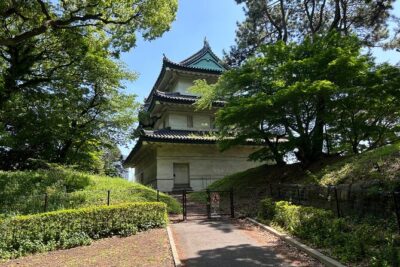
Imperial Palace and Shogun Historical Walking Tour
Our verdict →
World Heritage Kyoto & Nara Uji Authentic Matcha Experience
Our verdict →
Kyoto Gion: 2-Hour Geisha Culture & History Walking Tour
Our verdict →
Hiroshima Historical Walking Tour – Why A-Bomb was Dropped
Our verdict →
Yanaka Walking Tour: Historic and Traditional District of Tokyo
Our verdict →
Shinjuku Historical Walking Tour & Secret Backstreets
Our verdict →
Mt. Fuji Heritage Tour: Traditional Villages, Lakes & Shrine
Our verdict →Browse the lists this tour appears in