
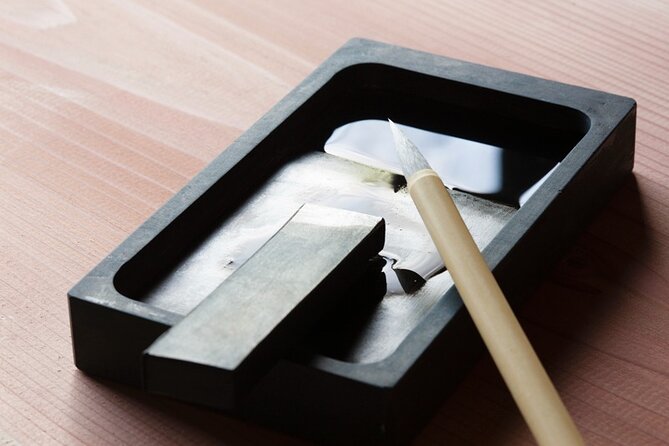
Reviewed · CALLIGRAPHY CLASSES
Calligraphy Workshop in Namba, Dotonbori
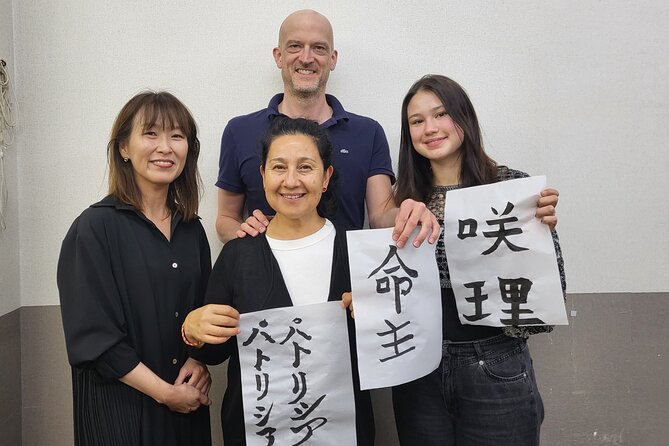
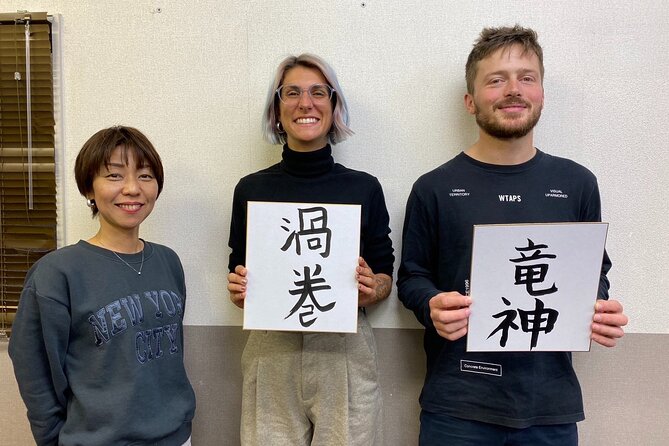
The main appeal here is simple: you get to make something personal in the middle of Osaka. An instructor guides you through shodo, the Japanese art of brush calligraphy, then helps you write your own name in kanji or katakana. You finish with a handmade souvenir, not a factory-made trinket.
I like the calm, focused mood and the small group size, which is capped at six people. I also like the cultural explanation behind the characters, especially with Nao teaching and English interpretation provided by Stephen or another workshop staff member. The one thing to consider is that finding the studio may take a little care, since it is on the third floor of a building and one participant suggested clearer signage.
Key points
- Write your own name in Japanese: Choose kanji or katakana and create a keepsake on colored paper or a luggage tag.
- Beginner-friendly instruction: Nao takes you through brush handling, ink, strokes, and character forms step by step.
- English help is available: Stephen and other English-speaking staff explain the lesson and cultural background.
- Small group setting: The workshop accepts no more than six people, allowing time for individual guidance.
- Excellent Namba location: Dotonbori, Nihonbashi, and Kuromon Market are close enough to pair with the class.
- Two hours, about $49.54: That is a fair price for a hands-on cultural activity and a personalized souvenir.
Why brush calligraphy works so well in Osaka
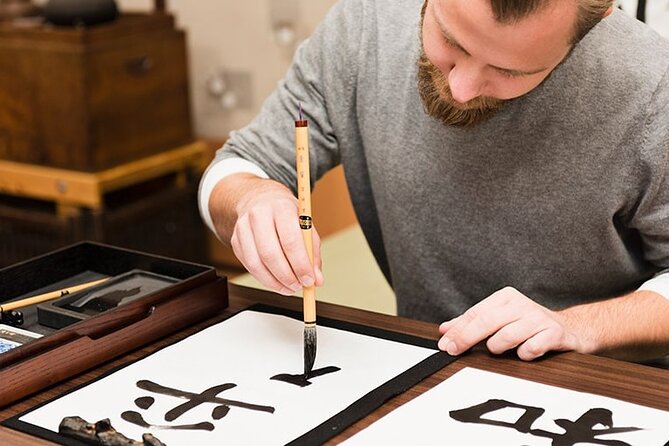
Namba is noisy, bright, and packed with food, shopping, and nightlife. This workshop offers a useful change of pace. For two hours, you sit down, slow your hand, and pay attention to each stroke. The contrast is part of the experience.
You are not simply copying decorative symbols. The class explains what Japanese calligraphy means and why the written form matters. That context gives the activity more weight. A character is not just a shape on paper, and your name is not just a translation. You learn how Japanese writing can carry meaning, balance, and personality.
The class is also short enough to fit into a busy Osaka schedule. You can place it between a morning at Kuromon Market and an evening around Dotonbori, or use it as a quieter break during a day in Namba.
More Calligraphy Classes in Osaka
- Osaka: Private Japanese Calligraphy Experience
★ 5.0 · 66 reviews - Learning Zen of Japanese Calligraphy in kimono near Osaka Castle
★ 4.5 · 53 reviews - Osaka: Private Tea Ceremony and Calligraphy Experience
★ 5.0 · 50 reviews
What happens during the two-hour class
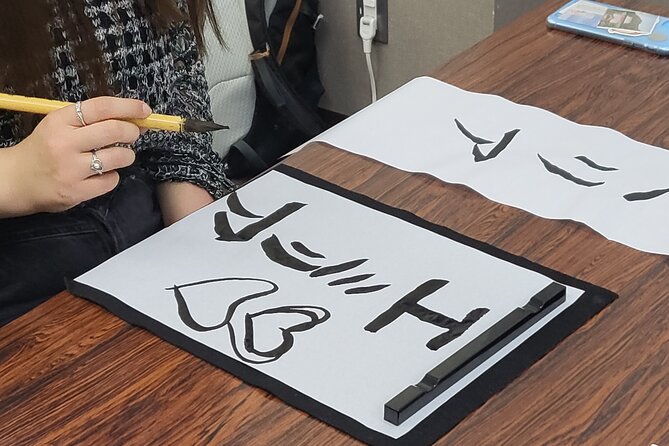
The workshop begins with an introduction to Japanese calligraphy and its place in Japanese culture. You learn about shodo, then receive an explanation of the tools and basic method.
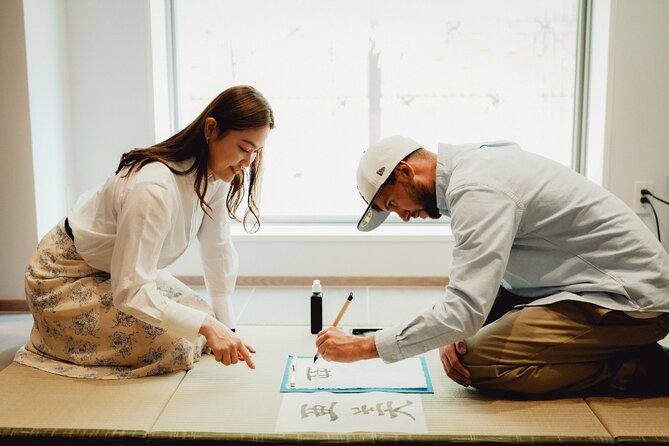
The hands-on part follows. You practice with brush and ink, working on the controlled strokes that make calligraphy harder than it first appears. The brush is less forgiving than a pencil. Pressure, speed, direction, and stopping at the right moment all affect the final mark.
Instructor Nao is described as calm and patient, which matters here. Beginners need permission to make imperfect strokes without feeling rushed. The class is designed for first-time participants, and the instruction proceeds step by step rather than assuming you already understand Japanese writing.
English interpretation is part of the experience. Stephen has served as interpreter in several sessions, explaining the teacher’s instructions and the meaning behind the characters. That support lets you ask questions and understand the cultural points instead of simply watching a demonstration.
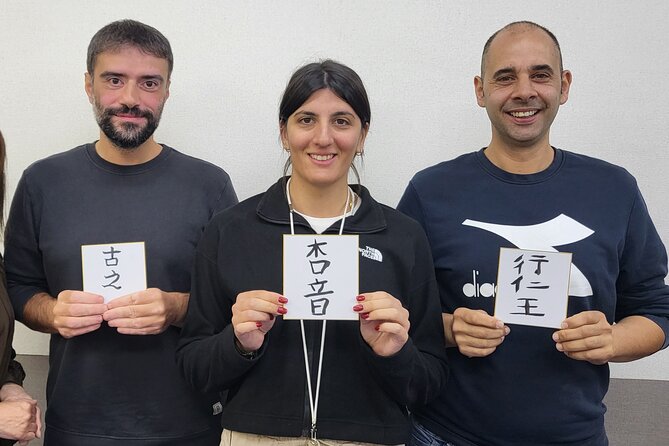
You practice kanji and learn how your name can be written in Japanese. Depending on the chosen form, your name may be represented with kanji or katakana. The important point is that you are involved in the choice and writing process, rather than receiving a finished name card with no explanation.
Learning kanji instead of copying pretty shapes
Many short cultural activities give you a quick demonstration, a few minutes of practice, and a photograph. This workshop gives more attention to meaning. You learn why a character looks the way it does and how its strokes fit together.
That makes the lesson rewarding, but it also makes it more demanding. Calligraphy takes concentration. You may produce a first attempt that looks uneven, then improve once you slow down and follow the stroke order. I would approach this as a lesson in patience, not a craft project designed to produce perfect work on the first try.
The cultural explanation is especially useful if you know little about Japanese writing. You leave with a better sense of the difference between kanji and katakana, along with a clearer idea of why calligraphy remains an important art form.
Several participants have gone on to buy calligraphy materials after the class. That tells you something about the lesson’s practical appeal. You are given enough technique and encouragement to imagine continuing at home, though the workshop itself remains a compact introduction rather than a full course of study.
Your name becomes the souvenir
The final project is the strongest part for many people. You write your name in Japanese and place it on colored paper or a luggage tag. The result is a one-of-a-kind item made by your own hand.
A luggage tag gives the souvenir a useful purpose, while colored paper may be easier to display or pack flat. Either way, the keepsake connects directly to your time in Osaka. It also carries the marks of your learning, including the small irregularities that prove you made it yourself.
This is a better fit for you than a souvenir purchased in a shop if you want something personal. It is also a nice family activity. Children as young as nine and eleven have taken part, and families with teenagers have enjoyed the class together. Younger children will still need to concentrate and follow instructions, so I would not treat it as an unstructured drop-in craft session.
Couples and solo participants can enjoy it just as much. One solo participant received attention from two instructors when no one else had booked that session. Since the maximum group size is six, the class can feel personal even when several people attend.
Same trip, a completely different kind of day:
- Osaka Go Karting Tour with Funny Costume
★ 5.0 · 2,658 reviews - Osaka Castle: Museum and Tower Entry Ticket
★ 4.5 · 2,380 reviews - Osaka: Shinsekai Food Tour with 13-15 Dishes at 5 Eateries
★ 4.8 · 2,204 reviews - Osaka Food Tour: 13 Dishes at 5 Local Eateries
★ 5.0 · 2,149 reviews
Nao, Stephen, and the value of good instruction
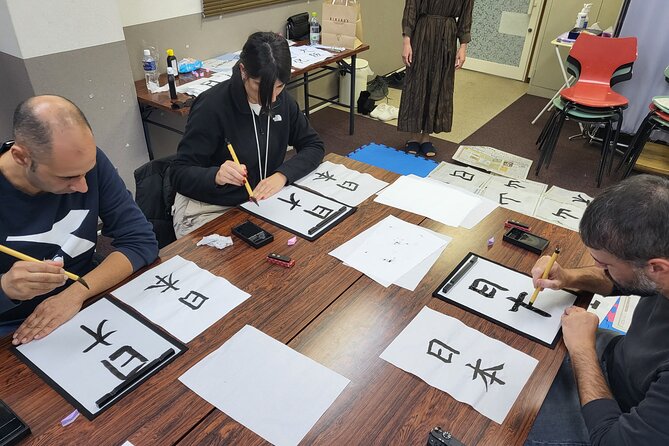
The teacher and interpreter shape this experience. Nao leads the calligraphy instruction, while Stephen has provided English explanations in several classes. Other staff names appear in individual sessions, so the exact team may vary.
The most useful quality is patience. You are learning a precise art through a tool that responds to every movement. A calm teacher can show you how to hold the brush, how much pressure to use, and when to lift it from the paper without making the process intimidating.
The English interpretation also does more than translate words. It helps connect the physical exercise to Japanese culture. You can ask what a character means, why a particular form is used, and how your name is represented. That turns a basic handwriting lesson into a cultural exchange.
The class has been used by families, couples, solo visitors, and people looking for an activity on an extra day in Osaka. It is a good choice if you want interaction with local instructors but prefer a structured setting rather than a large group demonstration.
Finding the studio in Nanbanaka
The meeting point is at Isuku English Gakuin Japan, 3F, Takeda Building, 1-chome 6-1 Nanbanaka, Naniwa Ward, Osaka 556-0011. The activity starts and ends at this meeting point.
The address is near public transportation, and its central Namba location makes it easy to combine with nearby sights. Still, allow a little time to locate the entrance and elevator. The studio is inside a building, and one participant found the signage confusing, especially in relation to a nail salon sign. The provider planned to add a sign near the elevator.
This is the sort of detail that can make the difference between arriving relaxed and arriving flustered. Keep the full address on your phone, check the building signs, and do not assume the workshop has a large street-facing storefront.
Once you have finished, you are already well placed for the rest of your day. Dotonbori is close for food and neon-lit canal views. Nihonbashi offers another part of central Osaka, while Kuromon Market is a practical stop for snacks and local food. The workshop does not include these areas, but its location lets you build a full day around it.
Is $49.54 a fair price?
At about $49.54 per person, this is not the cheapest activity you can add to an Osaka itinerary. You are paying for instruction, interpretation, materials, a two-hour session, and a personalized keepsake.
I think the value is good if you want a hands-on cultural activity. A short demonstration can be interesting, but it rarely gives you enough time to learn, practice, ask questions, and finish a personal project. Here, the two-hour format leaves room for all four.
The value is less convincing if you only want a quick photo or a souvenir with no effort. Calligraphy is participatory. You will spend time practicing strokes, and the final result may not look polished. That is part of the point, but it is worth knowing before you book.
The small group limit also helps justify the cost. With no more than six participants, the instructor can correct technique and give encouragement. A large class might cost less, but you would likely receive less individual attention.
Who will enjoy this workshop most
I would recommend this class to:
- Families with school-age children or teenagers who can focus for two hours.
- Couples looking for a quiet cultural activity in Namba.
- Solo visitors who want direct contact with a Japanese instructor.
- First-time visitors curious about kanji, katakana, and Japanese brush technique.
- Anyone who wants a useful, personal souvenir rather than a mass-produced item.
- People with a spare morning or afternoon in central Osaka.
You do not need previous calligraphy experience. The class is built for beginners, and the instruction is described as clear and encouraging.
I would think twice if you dislike seated, careful activities or want a fast-moving tour. This is not a sightseeing walk, and it does not take you through several Osaka attractions. Its appeal comes from concentration, conversation, and the satisfaction of making something with your own hands.
How to fit it into a Namba day
The workshop lasts about two hours, so it is easy to pair with nearby places. You could visit Kuromon Market before class, then take a break for calligraphy before heading to Dotonbori for dinner. Or schedule the class after exploring Nihonbashi, when a quiet indoor activity provides a welcome pause.
Give yourself enough time to arrive. The address is central, but the third-floor location may not be obvious from the street. Since the workshop begins and ends at the same place, you do not need to manage a second meeting point afterward.
The best plan is to keep the surrounding schedule flexible. You may want extra time after class to look over your finished name piece, take a few photographs, or ask follow-up questions about the characters. You will probably not want to rush straight into the next timed activity.
Booking timing and cancellation
This experience is commonly booked about 38 days in advance, so I would reserve ahead if your Osaka dates are fixed. The small six-person limit can make popular times fill faster than a large group tour.
Confirmation is provided at booking, and the ticket is mobile. Most people can participate, and the activity is near public transportation.
Free cancellation is available if you cancel at least 24 hours before the start time. Cancellations or changes made within 24 hours are not accepted for a refund. If the minimum number of participants is not reached and the class is canceled, you are offered another date or experience, or a full refund.
Should you book the Namba calligraphy class?
Book it if you want a calm, personal way to learn about Japanese culture and you like the idea of taking home something you made yourself. The patient instruction, English interpretation, small group size, and name-writing project give the class more substance than a quick souvenir activity.
Families should find it especially appealing, and couples or solo visitors will have enough structure and support to enjoy it. The location is handy for Dotonbori, Nihonbashi, and Kuromon Market, though you should allow time to find the third-floor studio.
Skip it if you want nonstop sightseeing or a polished professional artwork without practicing. For everyone else, $49.54 buys two focused hours, a cultural lesson, and a keepsake that will remind you of Osaka because your own hand made it.
FAQ
Where does the calligraphy workshop take place?
It takes place at Isuku English Gakuin Japan, 3F, Takeda Building, 1-chome 6-1 Nanbanaka, Naniwa Ward, Osaka 556-0011.
How long does the workshop last?
The workshop lasts approximately two hours.
How much does the experience cost?
The listed price is $49.54 per person.
Is the workshop suitable for beginners?
Yes. The instructor provides detailed, step-by-step guidance, and no previous calligraphy experience is required.
How many people can join?
The maximum group size is six participants.
Will the class be available in English?
English interpretation is provided. Stephen has served as an English-speaking interpreter, while other staff may assist in individual sessions.
Who teaches the calligraphy?
Nao is identified as the calligraphy teacher in several sessions. The specific supporting staff may vary.
What will I write during the class?
You practice Japanese calligraphy, including kanji, and learn to write your own name in kanji or katakana.
What do I take home?
You create a handwritten souvenir by writing your name on colored paper or a luggage tag.
Can I cancel for a full refund?
Yes, if you cancel at least 24 hours before the experience start time. Cancellations made less than 24 hours in advance are not refunded.
Just added around Osaka
- Exclusive Sushi Making Experience with a Master Chef – Osaka Area★ 5.0 · 25 reviews
- Private Home-Style Cooking Class in Osaka with Local Mom Yoshiko★ 5.0 · 46 reviews
- Hidden Osaka – Yukaku Red Light Tour & Culinary Adventure★ 4.8 · 96 reviews
- Osaka: Walking Tour and Top Highlights★ 4.8 · 104 reviews
- Osaka: Private Ceramic Painting Workshop★ 5.0 · 13 reviews
- Pickleball in Osaka, Kobe & Kyoto with Locals!★ 4.7 · 80 reviews
- Eat Like a Local in Osaka – Private Custom Street Food Tour★ 4.3 · 33 reviews
- Osaka:SUMO BEATS SHOWCASE: Taiko Drum and Wagyu burger!★ 4.2 · 37 reviews
Calligraphy Classes, compared.
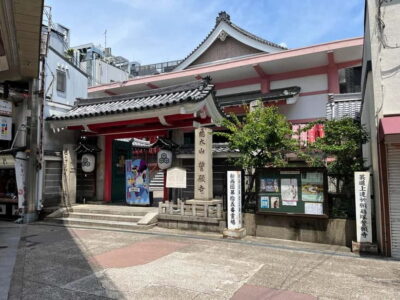
Calligraphy class at Buddhist temple in city center
Our verdict →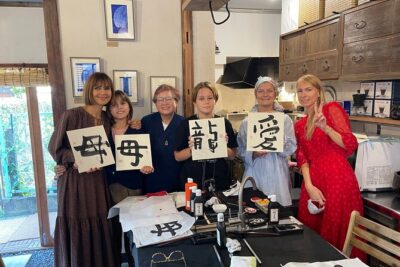
Let’s experience calligraphy in YANAKA, Taito-ku, TOKYO !!
Our verdict →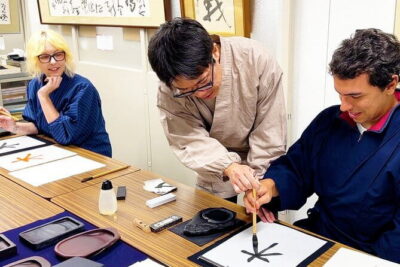
An Amazing set of Cultural experience: Kimono, Tea Ceremony and Calligraphy
Our verdict →
Private Japanese Calligraphy in Kyoto – Learn Shodō with a Master
Our verdict →
Browse the lists this tour appears in