
Reviewed · SAMURAI EXPERIENCES
Samurai Training with Modern day Musashi in Kyoto
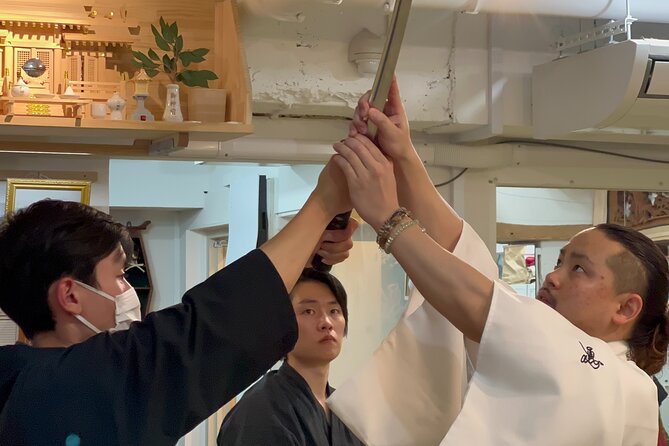
The best part of this Kyoto experience is that it takes place in a working martial arts dojo, not a stage set built for photos. Yushin-sensei leads the training, with Jordan and John helping explain the movements, history, etiquette, and sword parts in English and Japanese.
I like the hands-on instruction, especially learning how to draw, wield, and return a katana safely. I also like the chance to wear dōgi, obi, and hakama before practicing a real kata. The main limitation is important: mat cutting with a real katana is not currently offered, so this is sword training and demonstration, not a live cutting session.
Key points before you book
- Train inside an actual Kyoto dojo: The room includes a Shinto shrine and wooden name plaques for dojo members, giving the setting a working-school feel.
- Learn a complete short kata: You practice a set sequence rather than simply posing with a sword.
- Meet Yushin-sensei and his teaching team: Jordan and John help with instruction, explanations, and questions.
- Wear traditional training clothing: Dōgi, obi, and hakama make the lesson feel more formal and photograph well.
- Watch a rare two-katana performance: The master demonstrates skills you will not be asked to perform yourself.
- Expect a small but flexible group: The stated maximum is nine participants, with classes often planned around six.
Why this dojo feels different from a costume photo stop
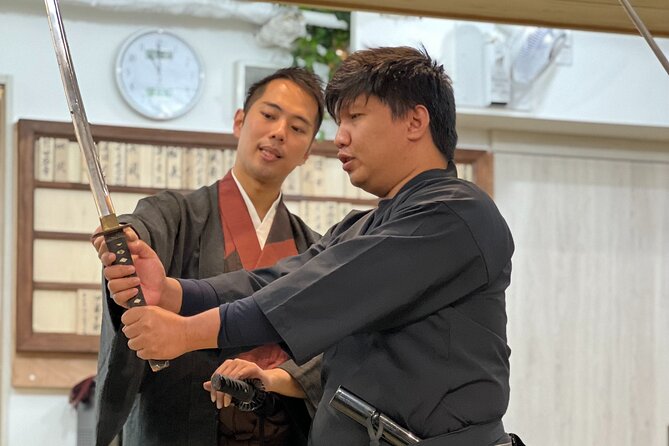
Kyoto has no shortage of samurai-themed activities. Some are mainly about dressing up, posing, and watching a short performance. This one takes a more serious route. You enter a functioning martial arts center where people train, names are displayed on wooden plaques, and a Shinto shrine forms part of the room.
That setting changes the mood. You are not simply handed a prop sword and told to smile. You are shown how to stand, how to handle the weapon, and how to move with control. The lesson introduces iaido, the Japanese art of drawing and handling a sword, while also explaining samurai customs and the role of discipline.
I especially like that the teaching team treats the activity as both cultural introduction and basic martial arts lesson. Yushin-sensei brings more than 20 years of experience, while Jordan and John help make the instruction accessible to English-speaking participants. The atmosphere can be light and friendly, but the form itself is taught with care.
Do not expect a full martial arts course in one sitting. You have about 1 hour 45 minutes, sometimes closer to two hours depending on group size. That is enough time to learn the basics and practice a short form, but not enough to build real proficiency.
More Samurai Experiences in Kyoto
- Kyoto Samurai Experience
★ 5.0 · 1,294 reviews - Kyoto: Kendo and Samurai Experience with Uniform and Gear
★ 4.9 · 815 reviews - Kyoto: Samurai Sword Class by Experts in Traditional Arts
★ 4.9 · 657 reviews
Getting dressed in dōgi, obi, and hakama
The session begins with traditional training clothing. You put on a dōgi, tie an obi, and wear hakama. This is more than a costume change. The clothing helps mark a shift from ordinary sightseeing into the formal setting of the dojo.
It also adds a useful visual touch. If you want photographs of your Kyoto experience, this is the point when the activity becomes especially memorable. You can look the part while learning the etiquette that goes with it.
The clothing may feel unfamiliar at first, and anyone expecting a quick dress-up stop should know that the outfit leads into active practice. You will need to stand, step, draw, and handle the sword with care. A moderate level of physical fitness is recommended, and participants must be at least 12 years old.
Learning what the samurai sword means
Before you start swinging a katana, the instructors explain basic samurai culture, swordsmanship, and safety. This part gives the physical movements some context. You learn that the sword was not just a dramatic object, but part of a larger system of training, etiquette, responsibility, and social history.
The instruction also covers the sword itself. Depending on the flow of the class, you may hear about the parts of a katana, how swords are made, and where Japanese swords are produced. A historical katana may also be shown, allowing you to see details that are easy to miss in a museum case.
This is one of the strongest parts of the experience for curious adults. You can ask questions and get explanations rather than memorizing a few movements for a photo. The information comes in a compact package, but the teachers make time for questions when the group allows.
I would not book this expecting a scholarly lecture on medieval Japan. The focus is practical and introductory. Still, the combination of cultural background and physical practice gives you a more useful understanding than a short theatrical show would.
Drawing, sheathing, and wielding the katana
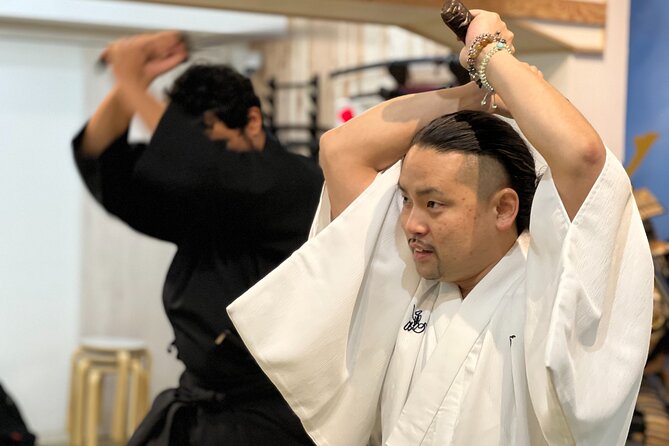
The practical training starts with the basics. You learn how to draw the sword, how to hold it, how to control your movements, and how to return it to the sheath. The order matters. A katana is not handled like a stage prop, and the instructors emphasize safety throughout.
The practice swords used for training are iaito, which allow you to work on the motions without using a sharpened blade. This is a sensible choice for an introductory class and for families with teenagers. You still handle a sword with authentic weight and form, but the activity is structured to keep the focus on technique rather than danger.
Expect corrections. The instructors pay attention to foot position, hand placement, posture, and the direction of each movement. That attention is valuable because the basic form can look simple until you try it. A relaxed grip, controlled step, or clean return to the sheath takes more concentration than most first-time participants expect.
The class is interactive, but it is not a free-for-all. You follow instructions and practice at the pace set by the teachers. If you have martial arts experience, you may appreciate the precision. If you have none, the lesson remains approachable because each movement is broken into manageable parts.
Same trip, a completely different kind of day:
- PERFECT KYOTO 1-Day Bus Tour
★ 5.0 · 13,518 reviews - Kyoto: Fushimi Inari, Kinkakuji, Bamboo Grove 1 Day Bus Tour
★ 4.8 · 4,316 reviews - Kyoto: Tea Ceremony in a Traditional Tea House in Kiyomizu
★ 4.9 · 3,519 reviews - Kyoto Geisha Walking Tour: Gion District & Hidden Gems
★ 4.7 · 3,273 reviews
Practicing an actual kata
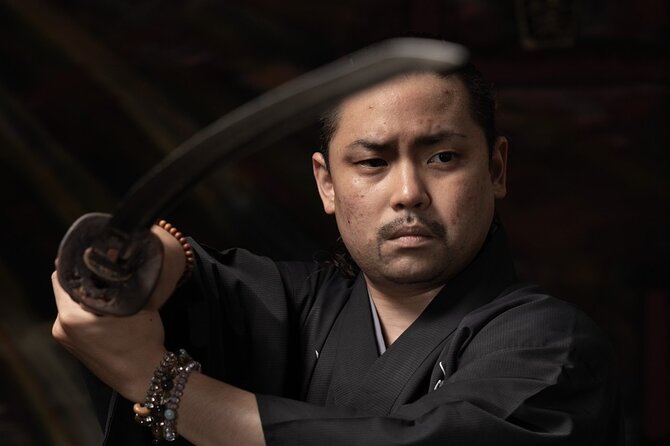
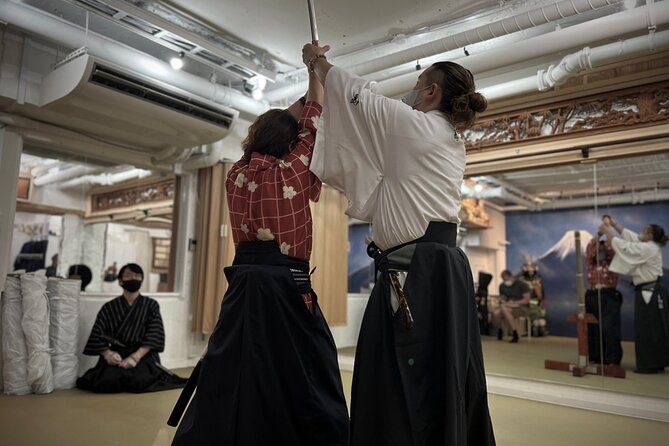
The highlight for many people is learning a short kata, or formal sequence. Rather than repeating random sword poses, you put together a defined set of movements. That gives the lesson a clear goal and lets you see how individual techniques fit into a larger form.
A kata demands focus and memory. You must remember the order, keep your body aligned, and move deliberately. It is not about speed. The value lies in control, awareness, and respect for the form.
You may have an opportunity to take photographs or video while practicing, but do so only when the instructors permit it. The dojo is a training space, so attention and safety come first. The traditional clothing, wooden plaques, and shrine make a better backdrop than a generic studio, but the setting should still be treated with respect.
Families can work well here. The minimum age is 12, and the lesson has enough visual appeal for teenagers while giving adults something substantial to do. Children younger than 12 cannot participate, so this is not a good choice for families with younger siblings who need to join in.
Watching Yushin-sensei perform
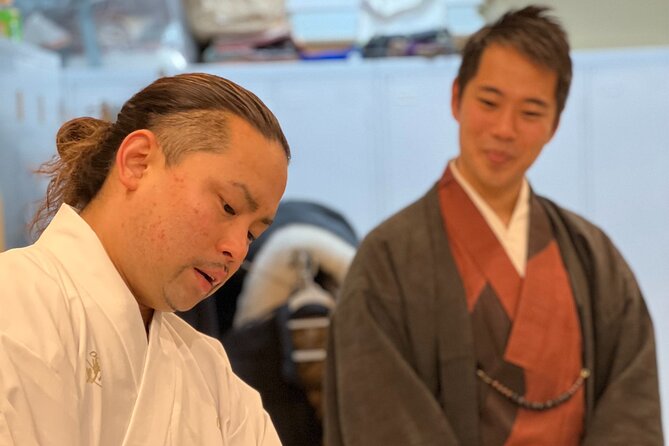
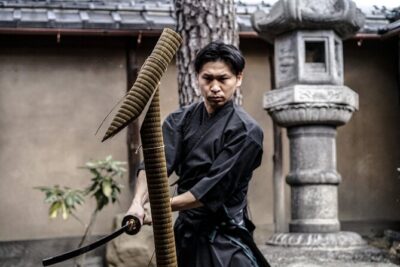
After you practice, Yushin-sensei demonstrates his own skill. The performance includes powerful katana work and a two-katana sequence, one of the distinctive features of this experience. It gives you a sharp contrast with your own careful beginner movements.
The demonstration is a chance to watch timing, posture, and control at a much higher level. You will see why swordsmanship is built on repetition and discipline rather than movie-style flourishes. The performance also gives the class a satisfying finish after the slower work of learning the kata.
Be clear about the current format. Mat cutting with a real katana is not offered at present. Some older descriptions of this activity refer to cutting demonstrations, but the current information specifically says that this part is unavailable. You should book for instruction, cultural context, and sword demonstrations, not for cutting a rolled mat.
You may still see or learn about historical swords and their components, depending on the session. That is different from using a sharpened blade yourself. The training portion is designed around safe practice with iaito.
The guides and the teaching style
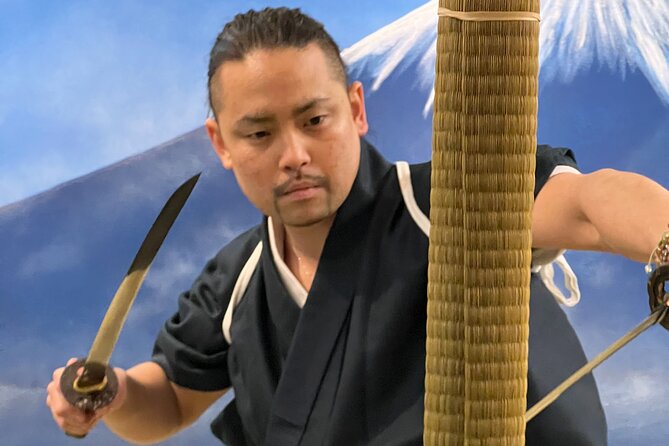
Yushin-sensei is the central instructor, and his long experience gives the class authority. Jordan assists with teaching and has trained at the dojo, while John helps with interpretation and communication. Their roles make the session easier for international participants to follow.
The teaching style is friendly, but not careless. You can expect jokes and conversation, yet the instructors also correct form and explain why the movements matter. That balance is useful in Kyoto, where a very formal lesson can feel intimidating to a first-time participant.
English support is available, alongside Japanese instruction. Still, martial arts movements are partly visual, so you should be prepared to watch closely and repeat carefully. If you have questions about swords, samurai customs, or the dojo itself, the format leaves room to ask them.
The group size is planned around six participants per class, although the actual number can be higher when only a few parties are booked. The stated maximum is nine. A smaller group means more room for individual corrections, while a full class may make the practice area feel less personal.
Price, timing, and practical value
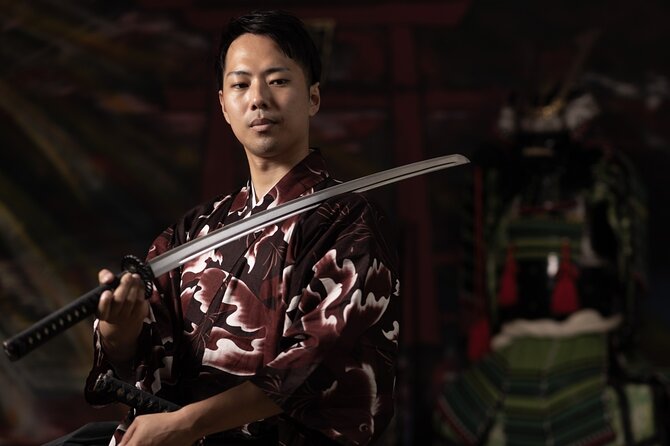
At $132.65 per person, this is not a bargain activity. You are paying more than you would for a short costume photo session or a basic cultural demonstration. The value comes from the setting, the hands-on instruction, the clothing, the history and sword explanation, and the time spent practicing a real kata.
I think the price makes the most sense if you want an experience with substance. Martial arts students, history fans, teenagers, and families looking for an unusual Kyoto activity are likely to get more from it than someone who only wants a quick photo with a sword.
The session lasts about 1 hour 45 minutes, with some classes running between 1.5 and two hours. That is a useful length during a busy Kyoto day. It is long enough to feel like a proper activity, but short enough to fit around temple visits, meals, or an evening reservation.
The meeting point is at 452-4 Matsugaechō in Nakagyo Ward, central Kyoto, and the activity ends at the same place. It is near public transportation, which makes it practical to reach without building your day around a long transfer. Confirmation is sent within 48 hours of booking, subject to availability.
You receive a mobile ticket, and free cancellation is available if you cancel at least 24 hours before the local start time. Inside that 24-hour window, you should expect no refund and no changes.
Who should book this Kyoto experience
I would choose this for anyone who wants a hands-on cultural activity instead of another passive sightseeing stop. It suits couples, families with teenagers, solo visitors, and people with some martial arts background.
It is especially good for:
- Teenagers who enjoy samurai stories, Japanese culture, or martial arts
- Families with children aged 12 and older
- Adults who want to learn rather than simply watch
- Martial arts students curious about iaido and Japanese sword form
- Visitors who value a real dojo setting over a theatrical attraction
- Photographers who want traditional clothing and a distinctive Kyoto backdrop
You should think twice if your main goal is live blade cutting. That is not part of the current program. You should also allow for the possibility of a group larger than six, even though the experience is designed around small classes.
Should you book Samurai Training in Kyoto?
Book it if you want to learn basic sword handling, practice a formal kata, and understand why samurai training depends so heavily on control and etiquette. The actual dojo setting, Yushin-sensei’s instruction, and the two-katana performance give the session more weight than a simple tourist costume activity.
Skip it if you want a fast photo stop, a full martial arts course, or mat cutting with a sharpened sword. For most visitors age 12 and older who want an unusual Kyoto memory with real instruction, the price is fair, the time commitment is manageable, and the experience offers a welcome change from temple sightseeing.
FAQ
Where does the samurai training take place?
The activity takes place at 452-4 Matsugaechō, Nakagyo Ward, Kyoto, 604-8034, Japan. It is near public transportation and ends at the same meeting point.
How long does the experience last?
The session lasts about 1 hour 45 minutes. Depending on the number of participants, it may take between 1.5 and two hours.
What will I wear during the class?
You will dress in samurai training gear, including a dōgi, obi, and hakama.
Will I use a real katana?
You will learn how to draw, sheath, and wield a katana, and you will practice with iaito designed for safe training. Mat cutting with a real katana is not currently offered.
What is the minimum age?
Participants must be at least 12 years old. A moderate level of physical fitness is recommended.
How many people can join the class?
The activity has a maximum of nine participants. Classes are planned around six participants, although the group may be larger when only a small number of parties are booked.
Just added around Kyoto
- Sekka Cotton Furoshiki Class★ 5.0 · 19 reviews
- Kyoto Sword Experience – includes Museum Ticket/Ninja Experience★ 4.5 · 149 reviews
- Scenic Green Tea Fields of Hidden Kyoto & Local Tea Exp (Private)★ 5.0 · 32 reviews
- Secret Eastern Kyoto Biking Adventure★ 5.0 · 44 reviews
- Private Sake Tasting in Central Kyoto with Sake Sommelier★ 5.0 · 32 reviews
- Samurai School in Kyoto: Samurai for a Day★ 5.0 · 202 reviews
- A Privately Guided Photoshoot in Beautiful Kyoto by a Pro★ 5.0 · 18 reviews
- Samurai Performance and Casual Experience: Kyoto Ticket★ 4.5 · 115 reviews
Samurai Experiences, compared.
Browse the lists this tour appears in