Reviewed · MORNING
Kyoto Early Morning Private Tour with Government-Licensed Guide
Kyoto is at its best before the crowds arrive, and this private tour makes that early start worthwhile. You can reach places such as Fushimi Inari or Kiyomizu-dera while the paths are calmer, then spend your time with a licensed local guide instead of following a large group.
I like the freedom to choose just two or three places, and I like the practical help a private guide can provide, from explaining shrine customs to showing you how to get around afterward. Guides including Rie, Yasu, Tomy, Kay, and Nabet have tailored visits to family interests, mobility needs, and preferred sights.
The main limitation is simple: four hours is not enough for Kyoto’s greatest hits all at once. You must choose carefully, and entrance tickets, transportation, lunch, and personal expenses are not included.
Key points to know before booking
- Early starts make the difference: Tours have begun as early as 6:30 or 7 a.m., when famous sites can feel far calmer.
- You choose two or three stops: The long list of possible sights is a menu, not a promise to visit every place.
- This is a walking tour: Pickup takes place on foot within a designated Kyoto area, with no private vehicle included.
- Private guiding adds useful context: Your guide can explain Japanese culture, temple customs, local history, and practical Kyoto navigation.
- The guides adapt well: Rie, Yasu, Tomy, Kay, Bell, Mayumi, Nabet, and Yoshi are among the guides praised for personal service and clear explanations.
- The price is reasonable for a private tour: At $101.82 per person, the value depends on your group size, route, and use of the guide’s time.
Why an early Kyoto start is worth the alarm
Kyoto’s major sights are no secret. Fushimi Inari, Kiyomizu-dera, the Arashiyama Bamboo Forest, and the Golden Pavilion draw large crowds, especially during cherry blossom season, autumn color, holidays, and weekends. A start around 6:30 or 7 a.m. gives you a much better chance of enjoying the approach and main grounds at a relaxed pace.
This does not mean you get the entire city to yourself. It does mean you spend less time working around tour groups and more time looking up at a gate, garden, or temple roof. One guide noted that an early visit to Kiyomizu-dera and Fushimi Inari made both stops easier to enjoy, even during a busy period.
The early hour also changes the mood. Fushimi Inari’s torii gates feel more atmospheric before the heat of the day, while Arashiyama’s bamboo paths are more pleasant before the district fills with visitors. You need to be comfortable waking early, but that is the central tradeoff of this experience.
More Morning Tours in Kyoto:
- Kyoto Early Morning Tour with English-Speaking Guide
★ 5.0 · 1,427 reviews - Kyoto: Early Morning Tour with English-Speaking Guide
★ 4.9 · 1,128 reviews - Kyoto Morning Tour from Kyoto or Osaka
★ 4.0 · 281 reviews
A private route, not a 34-stop sightseeing sprint
The possible stops cover nearly every corner of Kyoto. That can look confusing at first, so think of the tour as a planning session with a guide rather than a fixed bus circuit.
You choose two or three sites from the available list. A practical route might focus on Fushimi Inari and Kiyomizu-dera, both in southeastern Kyoto. Another could pair Arashiyama with the Bamboo Forest and Tenryu-ji. A culture-focused morning might include Gion, Nishiki Market, and Pontocho.
Trying to combine Fushimi Inari, the Golden Pavilion, Arashiyama, and Ginkakuji in four hours would leave you rushing between distant parts of the city. I would rather see two places properly, with time for questions, than collect a long list of quick photographs.
Send your priorities clearly. If you care most about gardens, tell the guide. If you are interested in food, traditional neighborhoods, Japanese religion, photography, or family-friendly walking, say so before the tour. The provider describes the route as customizable, and the strongest part of the experience is the chance to make those four hours fit your interests.
Fushimi Inari, where the torii gates are only the beginning
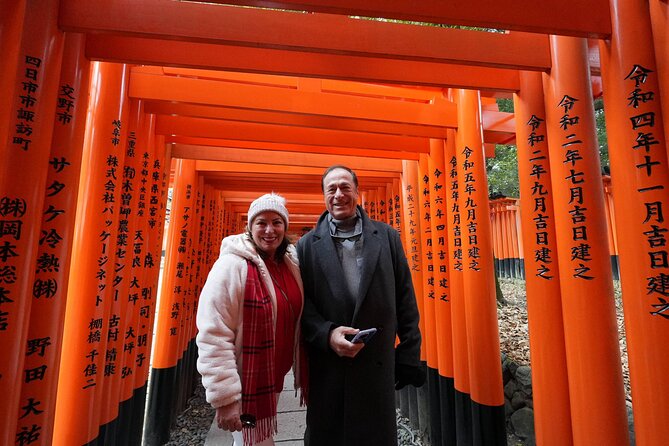
Fushimi Inari-taisha is the obvious choice for an early Kyoto tour. Its long corridors of vermilion torii gates climb into the wooded hills, creating one of the city’s most recognizable walks.
The gates are donated by individuals and businesses, and a guide can give you more to think about than the color and repeated patterns. The shrine is dedicated to Inari, associated with rice, prosperity, and commerce, and fox figures appear around the grounds as messengers. The supplied tour information specifically points out that Fushimi Inari offers more than its famous tunnels, which is good advice.
You should discuss how far you want to walk. Even a short visit gives you the lower shrine area and the first gates, while a longer climb changes the pace and effort. Since the tour is on foot, this stop is best for people ready for stairs and uphill walking.
Kiyomizu-dera and the old streets of Higashiyama
Kiyomizu-dera is one of Kyoto’s essential temples, with broad views from its wooden stage and a striking approach through the Higashiyama district. The temple’s name means Pure Water Temple, linked to the Otowa waterfall below the main hall.
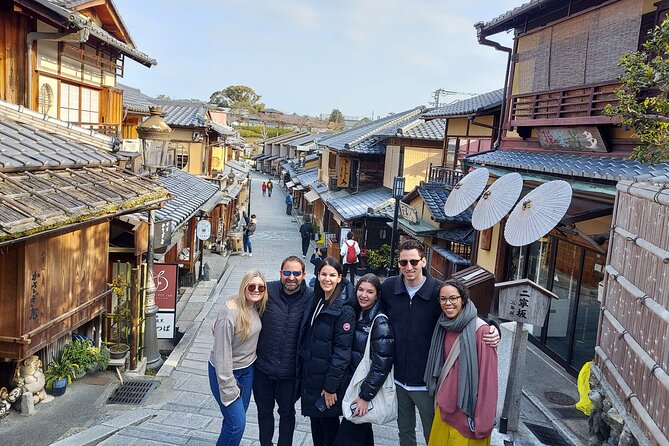
A guide helps make sense of the ritual details, buildings, and customs rather than leaving you to treat the temple as a photo stop. The surrounding Higashiyama streets preserve an older Kyoto feel, with traditional buildings, narrow lanes, and shops serving visitors on their way to the temple.
The drawback is popularity. Even with an early start, Kiyomizu-dera is not a secret place. The route also includes slopes and uneven surfaces, so tell the guide about mobility concerns. One guide extended a tour by about half an hour to assist a participant with ankle trouble, but you should not assume extra time is included.
A few more Kyoto half-days worth comparing
- PERFECT KYOTO 1-Day Bus Tour
★ 5.0 · 13,518 reviews - Kyoto: Fushimi Inari, Kinkakuji, Bamboo Grove 1 Day Bus Tour
★ 4.8 · 4,316 reviews - Kyoto: Tea Ceremony in a Traditional Tea House in Kiyomizu
★ 4.9 · 3,519 reviews - Kyoto Geisha Walking Tour: Gion District & Hidden Gems
★ 4.7 · 3,273 reviews
Arashiyama and the Bamboo Forest
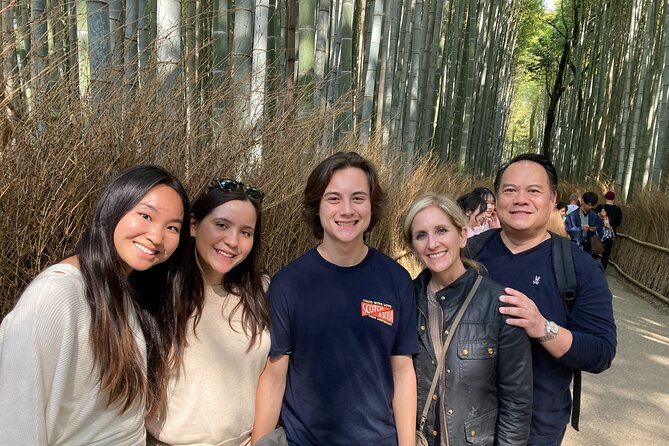
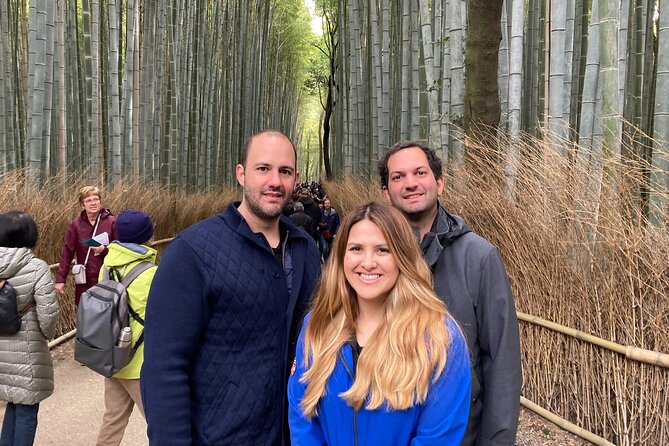
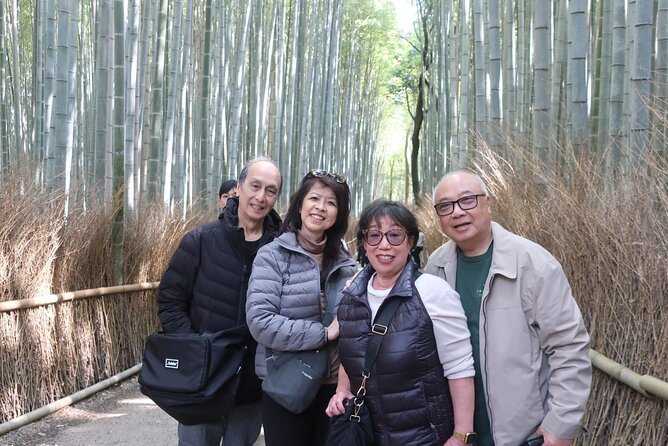
Arashiyama is a strong choice if you want scenery, temples, and a slower morning walk. The Bamboo Forest is the headline attraction, but the district also includes the Togetsukyo Bridge, Tenryu-ji, Okochi Sanso Garden, and several quieter temple paths.
The bamboo grove is most enjoyable when you can walk without stopping every few steps for a photo. An early visit improves your odds, though the path can still be busy. One guide took a couple through the Bamboo Forest and Fushimi Inari early in the day, with the bamboo creating a particularly peaceful start.
Tenryu-ji is the major temple here and is valued for its garden and Zen setting. If you want a calmer side of Arashiyama, ask about Jojakkoji, Nisonin, Gioji, Adashino Nenbutsuji, or Otagi Nenbutsuji. These require more time and walking, so they are better as part of an Arashiyama-focused tour rather than an ambitious citywide route.
The Togetsukyo Bridge is free to view and gives you a pleasant river scene. Okochi Sanso Garden has an admission fee and takes additional time. Pick the experience that matters most to you instead of trying to fit every Arashiyama stop into one morning.
Nijo Castle, the Imperial Palace, and Kyoto’s political past
Nijo Castle offers a different side of Kyoto from its temples. Built in 1603 as Tokugawa Ieyasu’s Kyoto residence, it connects the city to the shogunate and the Edo period.
The castle is known for its grand interiors and nightingale floors, designed to make a soft chirping sound underfoot. The grounds give you a useful contrast with the religious sites in eastern and western Kyoto. Admission is not included, so budget for a separate ticket.
The Kyoto Imperial Palace covers another chapter of the city’s story. It served as the Imperial Family’s residence until 1868, when the capital moved to Tokyo. The spacious grounds can feel more open and formal than Kyoto’s compact temple lanes.
These stops suit you if political history, architecture, and formal gardens interest you more than shrine rituals. They are also easier to combine with central Kyoto sights such as Nishiki Market, Gion, or Pontocho than with distant Arashiyama.
Gion, Nishiki Market, and Pontocho after the temples
Gion is Kyoto’s best-known historic entertainment district, with narrow lanes, traditional buildings, restaurants, and teahouses. A guide can help you read the area respectfully and avoid wandering into places where visitors are not welcome.
Do not expect a guarantee of seeing geisha or maiko. The value here is the setting, the architecture, and the explanation of how the district functions. A private guide is useful because the lanes can be confusing, and a short orientation can help you return later on your own.
Nishiki Market is a five-block shopping street known as Kyoto’s Kitchen. More than one hundred shops and restaurants sell food and local goods. It is a good place to ask questions about ingredients and Japanese eating customs, but it is also a working market with narrow passages. A private guide can help you understand what you are seeing, though your four-hour schedule may leave little time for a full meal.
Pontocho is another narrow dining district along the Kamo River. It is most atmospheric later in the day, but a morning visit can help you learn the layout before returning for dinner. These central stops make sense for a first orientation, especially if you want food and neighborhoods rather than a temple-heavy morning.
Choosing among Ginkakuji, Kinkakuji, and Kyoto’s Zen temples
Ginkakuji, the Silver Pavilion, began as the retirement villa of shogun Ashikaga Yoshimasa. Despite its name, the pavilion was never covered in silver. Its gardens and restrained design are the main reasons to visit.
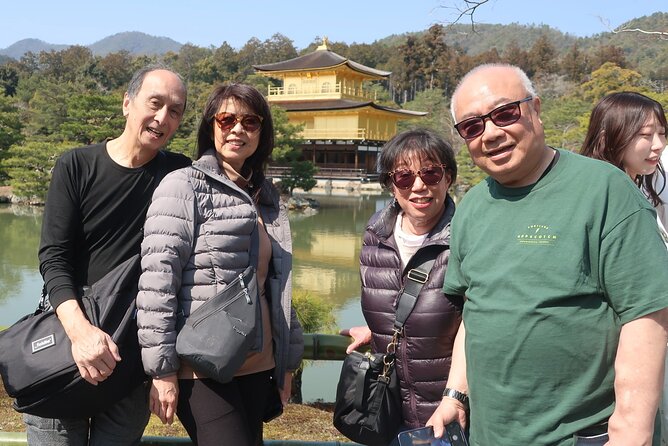
Kinkakuji, the Golden Pavilion, offers a more immediate visual impact. Its top two floors are covered in gold leaf, and the reflecting pond creates the classic Kyoto scene. The stop is scheduled for about 30 minutes in the suggested outline, but admission is extra and the grounds can be crowded.
Ryoanji is home to Japan’s most famous rock garden. It is a good choice if you want quiet observation and Zen design rather than ornate buildings. Nanzenji offers wide temple grounds at the foot of the eastern mountains, along with the distinctive Suirokaku aqueduct.
Tofukuji is another large Zen temple, especially well known for autumn color. It is a strong seasonal choice, but you should be realistic about timing. Kinkakuji, Ryoanji, and northern Kyoto sites are not a natural match with Fushimi Inari or Arashiyama in a four-hour walk.
Northern and western Kyoto for repeat visitors
The longer list includes places that deserve their own half-day or full-day plan. Shugakuin Imperial Villa, Katsura Imperial Villa, Kibune, Kurama-dera, Yoshimine-dera, and the temples of northern Arashiyama all require more careful planning.
The Imperial villas are valued for architecture and gardens, while Kibune and Kurama offer a greener mountain setting away from central Kyoto. Kurama-dera is in a rural town less than an hour from the city center, according to the supplied details, but transport and admission costs are not included.
In Arashiyama, Daikakuji, Otagi Nenbutsuji, Gioji, and Adashino Nenbutsuji suit a visitor who has already seen the headline sights. Otagi Nenbutsuji is known for its 1,200 stone rakan figures, each with a different expression. That is a memorable detail, but reaching several of these temples takes time.
I would choose these places only if you tell the guide that you prefer less central sights and are willing to give up the most famous landmarks. They are not add-ons to a packed morning.
What the guide adds beyond a map
The strongest reason to book a private tour is not transportation. It is the conversation.
The guides have been praised for explaining history and culture clearly, answering questions about daily life in Japan, and helping people navigate Kyoto after the tour ends. Yasu has used public transportation with groups of four, while another guide helped a family understand how to reach later sights independently.
Rie contacted a group before its visit, then finished the morning by taking them to a favorite sushi restaurant. That sort of practical handoff can be useful when you are still getting your bearings. It is not a guaranteed restaurant arrangement, but it shows how the private format can adapt to the day.
Several guides have also been singled out for excellent English, photography help, flexibility, and personal attention. Kay was described as both guide and photographer during visits to Fushimi Inari and the Bamboo Forest. Nabet’s appeal was his ability to explain each activity and adjust the morning to the group’s chosen route.
You should still remember that guides differ in style. Some mornings may move quickly, especially when the guide is trying to fit four locations into the schedule. Tell your guide if you want more time for photographs, fewer explanations, or a slower pace.
Price, transport, and what you actually pay for
The listed price is $101.82 per person. That is a fair price for a private, licensed English-speaking guide if you are traveling with several people and make good use of the time. A family of four gets a private morning for about $407.28 before tickets and transportation, which can compare well with several separate paid activities.
For one person or a couple, the cost feels higher than a group tour. The benefit is control. You are not waiting for strangers, and you can focus on the two or three places you care about most.
The tour includes an English-speaking licensed local guide and a walking meetup within a designated Kyoto area. Pickup is on foot, not by private car. Public transportation or a taxi may be used during the morning, but those fees are yours to pay.
Entrance fees are also extra. This includes places such as Nijo Castle, Kiyomizu-dera, Kinkakuji, Ginkakuji, Ryoanji, and the Imperial villas. Lunch and personal purchases are not included. Group discounts are offered, but the exact saving is not specified, so check the total for your party before booking.
Who should book this Kyoto morning?
I would recommend this tour to first-time Kyoto visitors who want help making sense of the city without surrendering control of the day. It is also a good fit for families, small groups, and people who want to ask direct questions about customs, food, religion, and daily life.
It suits you especially well if you can start early and already know your top two or three priorities. The private format is useful for families with teenagers, people who want photography help, and anyone who needs a flexible pace.
I would hesitate if you want a long, relaxed visit inside every temple, if you dislike early mornings, or if you expect a vehicle to carry you across Kyoto. I would also avoid booking before deciding on a sensible route. The tour cannot overcome Kyoto’s distances, traffic, opening hours, and entrance lines.
Free cancellation is available up to 24 hours before the start time. Changes or cancellations inside that window are not accepted for a refund.
Should you book this early-morning tour?
Book it if you want a smart introduction to Kyoto and value a local guide more than a fixed checklist. Choose a compact route, such as Fushimi Inari with Kiyomizu-dera, or Arashiyama with the Bamboo Forest and Tenryu-ji. Those pairings make better use of four hours than crossing the whole city.
The early start is the real advantage. Add the private planning, cultural explanations, and practical navigation help, and the $101.82 per-person price can be worthwhile, especially for a family or small group.
Skip it if your Kyoto plan is already organized or if you want to visit every famous site. This tour works best when you accept one basic truth: in Kyoto, seeing less can mean enjoying much more.
FAQ
How long is the tour?
The tour lasts approximately four hours.
How many sights can I choose?
The tour is customizable, and you choose two or three sites from the available options.
Is this a private tour?
Yes. Only your group participates, and you do not combine with another tour group.
Is hotel pickup included?
A meetup is provided on foot within a designated area of Kyoto. The experience does not include a private vehicle.
Are transportation costs included?
No. Transportation fees are not included. The tour is described as a walking tour, though guides have used public transportation or taxis during some customized outings.
Are entrance tickets included?
Entrance fees are not included. The listed exclusions include admission costs, along with lunch and personal expenses.
Is an English-speaking guide included?
Yes. The tour includes a licensed local English-speaking guide.
Can I cancel for a full refund?
Yes, if you cancel at least 24 hours before the experience start time. Cancellations or changes made less than 24 hours in advance are not refunded or accepted.
Just added around Kyoto
- Sekka Cotton Furoshiki Class★ 5.0 · 19 reviews
- Secret Eastern Kyoto Biking Adventure★ 5.0 · 44 reviews
- Kyoto Sword Experience – includes Museum Ticket/Ninja Experience★ 4.5 · 149 reviews
- Scenic Green Tea Fields of Hidden Kyoto & Local Tea Exp (Private)★ 5.0 · 32 reviews
- Private Sake Tasting in Central Kyoto with Sake Sommelier★ 5.0 · 32 reviews
- Samurai School in Kyoto: Samurai for a Day★ 5.0 · 202 reviews
- SHIRAKAWA Japanese Culture Experiences with private English staff★ 5.0 · 16 reviews
- A Privately Guided Photoshoot in Beautiful Kyoto by a Pro★ 5.0 · 18 reviews
Morning, compared.
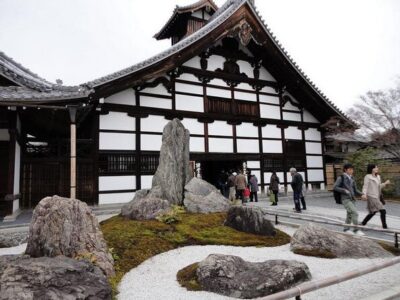
Kyoto Early Morning Tour with English-Speaking Guide
Our verdict →
Private-group Morning Cycling Tour in Hida-Furukawa
Our verdict →