
Reviewed · TRADITIONAL CRAFTS
Tokyo: Origami Fun for Families & Beginners in Asakusa
The clever part of this Asakusa activity is its mix of easy digital guidance and hands-on Japanese craft. You choose a model, pick your paper, and work through the folds at your own speed. Beginners can make several pieces in 45 minutes, while children get a quiet break from Tokyo sightseeing.
I like the huge choice of more than 100 models and 50 paper colors, and I like the small group size, limited to six people. Staff members keep an eye out and can help, with David singled out in one booking as a warm and effective instructor. The main consideration is that this is not a teacher-led private class, so anyone expecting constant one-to-one instruction may want a longer lesson.
Key points at a glance
- More than 100 models: Pick from animals, flowers, vehicles, and designs from beginner to intermediate level.
- 50 paper colors: Choose paper with your finished design in mind, then add stickers, stamps, and marker details.
- Tablet-guided folding: Pause, replay, and return to earlier steps whenever a fold causes trouble.
- Small group setting: The studio accepts up to six participants, making it easier to ask for help.
- Good family pacing: A seven-year-old, parent, and grandparent each made about four pieces during one session.
- Bring socks: Socks are required, and the studio has stairs, no ramps or lifts, and seating without back support.
Folding paper in the heart of Asakusa
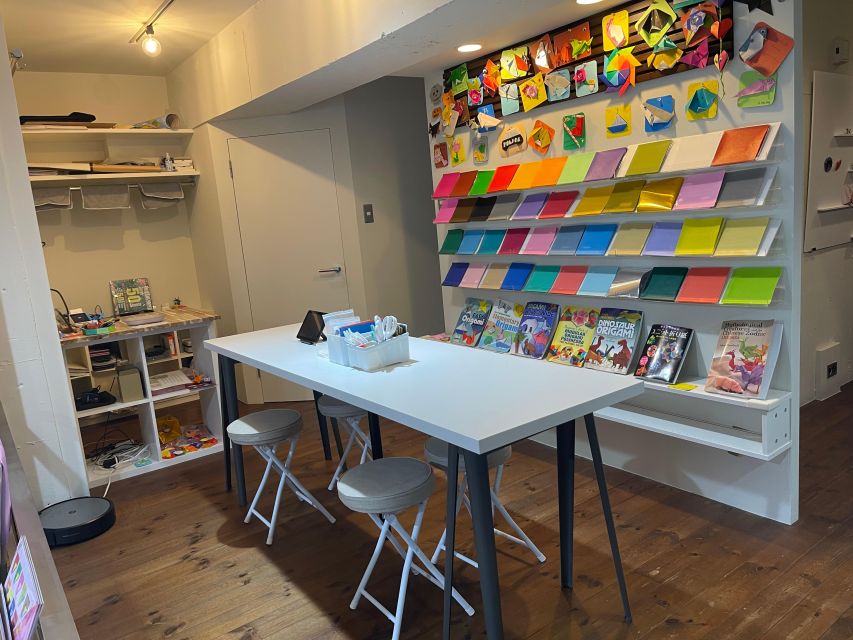
Asakusa is one of Tokyo’s easiest places to pair a short activity with sightseeing. The area is known for major tourist sights, and this studio gives you a calm, creative stop rather than another quick photo and a crowded walkway.
The activity lasts 45 minutes. That is long enough to learn the basic process and make several small creations, but short enough to fit between other plans. One family made about four pieces per person, while another booking praised the balance between an introduction and practice time.
You should arrive ready to sit on the floor or on seating without back support. This matters more than it may sound, especially if you are managing a tired child or an older family member. The studio is not handicap accessible. There are stairs only, with no ramps or lifts.
Finding the entrance takes a little care. Use the main street side of the building, not the side facing the park. Look for the company sign on the front and the brown sea turtle attached to the wall below the window. If you are standing by the park, you are at the back and cannot enter from there.
More Craft Workshops in Tokyo
- Tokyo Sumo Experience: Chanko & Mochi with a Former Pro
★ 4.8 · 567 reviews - Kintsugi Experience: Art of Golden Joinery in Tokyo
★ 5.0 · 467 reviews - Tokyo Chopstick Making Workshop with Artisan
★ 5.0 · 466 reviews
Choosing from 100 origami designs
The first step is choosing a model on a PC tablet. The menu is divided into categories, and the selection includes more than 100 designs. You can choose animals, flowers, vehicles, and other figures, with difficulty ranging from beginner to intermediate.
This range is useful because the people in your group may have different skill levels. A young child can start with a simpler shape while an adult tries something more involved. You are not locked into one project, either. The instructions say you may fold as many models as time allows during the 45-minute session.
The tablet system also removes some pressure from the activity. You do not have to keep pace with a live class, and you can replay a step or return to an earlier part of the instructions. If you miss a crease or turn the paper the wrong way, you can review the sequence instead of trying to remember a teacher’s quick demonstration.
Still, a screen cannot replace a pair of hands showing you exactly where your fold went wrong. Staff members are present to help, but the session is not built around a teacher guiding every participant from start to finish. One booking described the guide as watching the work without becoming intrusive, which is likely the right expectation here: help is available, but you do much of the work independently.
Picking paper from the 50-color wall
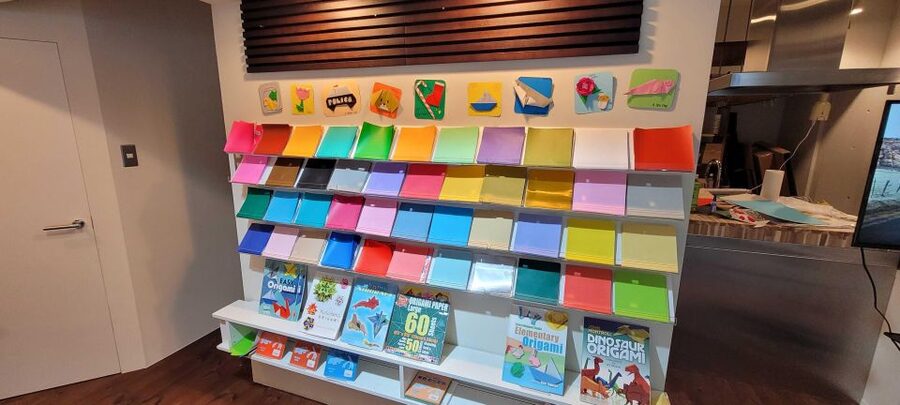
After choosing a design, you head to the origami paper wall. There are 50 colors, giving you room to make the same model look very different from someone else’s.
This choice is more than decoration. A flower, bird, vehicle, or animal can change character depending on the color you pick. The instructions encourage you to think about the design while selecting the sheet, so take a moment before grabbing paper at random.
Supplies are included in the price. You also have access to stickers, stamps, and markers for finishing touches. That last step is especially useful for children, since it gives them a creative task after the more exact folding work is over.
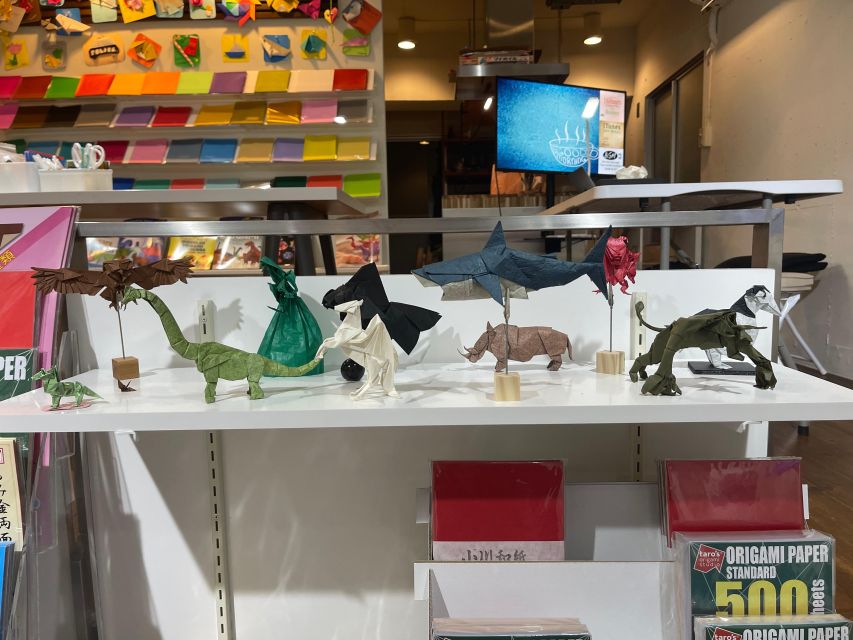
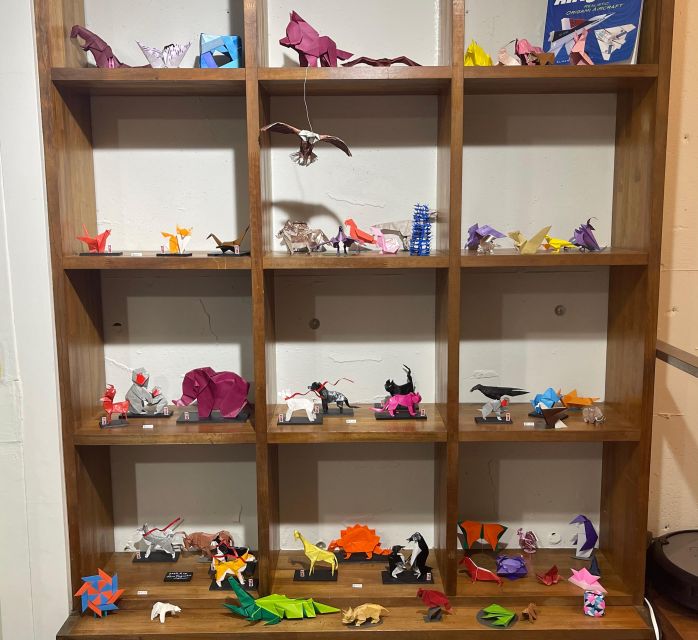
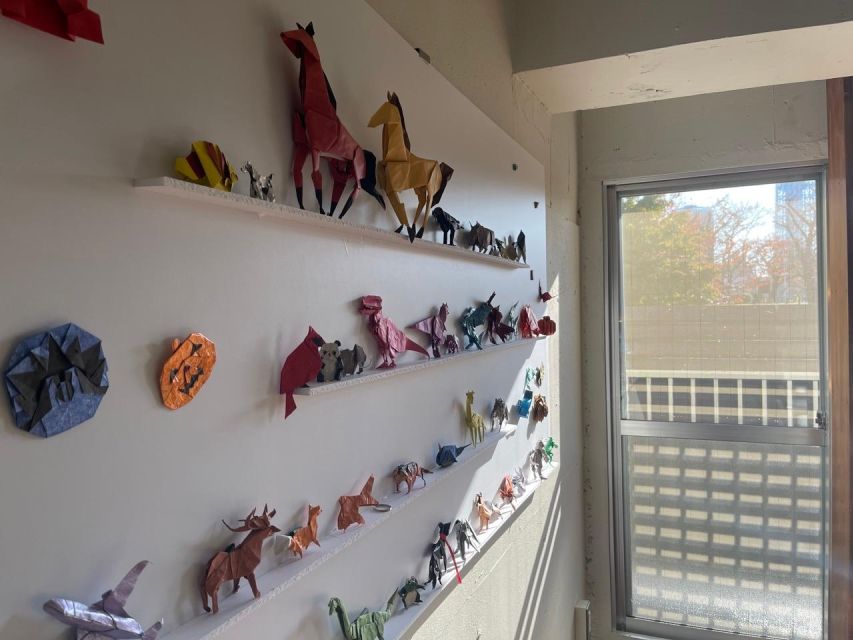
You may take photos during the session and look at the studio’s origami displays before or after folding. You can also make purchases, though the supplied information does not specify what is available or give prices. I would treat shopping as an optional extra rather than part of the main value of the booking.
How the tablet lesson works
Once you have your model and paper, return to the tablet and press Play. The screen takes you from a square sheet to the finished object in a series of steps.
The process is simple:
- Select a model from the tablet menu.
- Choose one or more sheets from the 50-color paper wall.
- Start the instructions by pressing Play.
- Pause, replay, or return to previous steps as needed.
- Decorate the finished piece with stickers, stamps, and markers.
The system suits people who like to work quietly and repeat instructions. It also helps families avoid the common problem of one person learning while everyone else waits. Each participant can choose a different design and move at a personal pace.
English and Japanese are available for the activity. Staff can assist with folding if you get stuck. One booking described a one-on-one session with David that included folding several figures and learning about origami, but you should not assume a private lesson will be part of every visit. The advertised format remains tablet-guided, with staff support rather than continuous personal teaching.
Same trip, a completely different kind of day:
- 1-Day Tokyo Bus Tour
★ 5.0 · 14,250 reviews - Tokyo: TOKYO SKYTREE® Admission ticket
★ 4.5 · 11,192 reviews - Tokyo: teamLab Planets TOKYO Digital Art Museum Entry Ticket
★ 4.6 · 9,779 reviews - Tokyo: Sumo Show Experience with Chicken Hot Pot and a Photo
★ 4.8 · 6,678 reviews
What 45 minutes feels like
Forty-five minutes goes quickly once you start. You first need time to choose a model and paper, then the folding itself can take several minutes per piece. Decoration and photos use a little more of the clock.
For a family, the short length is a strength. Younger children often enjoy a focused project more than a long formal class, and the session leaves room for Asakusa sightseeing afterward. The activity is also a good rainy-day plan because the main work takes place indoors in a quiet studio.
The tradeoff is that ambitious folders may want more time. One parent said a longer session would have been welcome. If you are new to origami and choose an intermediate model, you may spend most of the session completing one complicated piece rather than making several. Start with an easier design if your priority is variety.
The group limit of six helps keep the room manageable. It does not guarantee a private instructor, but it does mean the staff member has fewer people to monitor than in a large workshop. That is useful when several participants need help at once.
Why this works for beginners
Origami can look intimidating when you see a finished figure with many sharp folds. This activity breaks the process into small steps and lets you repeat them. You do not need prior experience, and the model range allows you to begin with a basic animal or flower before trying something more detailed.
I especially like the freedom to choose your own project. A child who wants a vehicle is not forced to make a bird, and an adult who wants to practice precision can select a harder model. The paper colors and decorating supplies also make the final result feel personal, even if the folding pattern is shared.
The main skill you need is patience. Tablet instructions can show the sequence, but you still need to line up corners and press clean creases. Very young children may need an adult beside them for every step. Children under 13 must have adult supervision throughout the activity, and children under five who cannot fold independently need an adult supervising the entire session.
The age guidance deserves a careful reading. The experience recommends children four and older, while another instruction recommends attendees be at least five. Children under four are not suitable. For a four-year-old, I would book only if the child can sit, follow simple steps, and accept close adult help.
A quiet family break from Asakusa sightseeing
This is not a performance or a sightseeing tour. Its value comes from doing something with your hands in an area where many plans revolve around looking, walking, and taking photos.
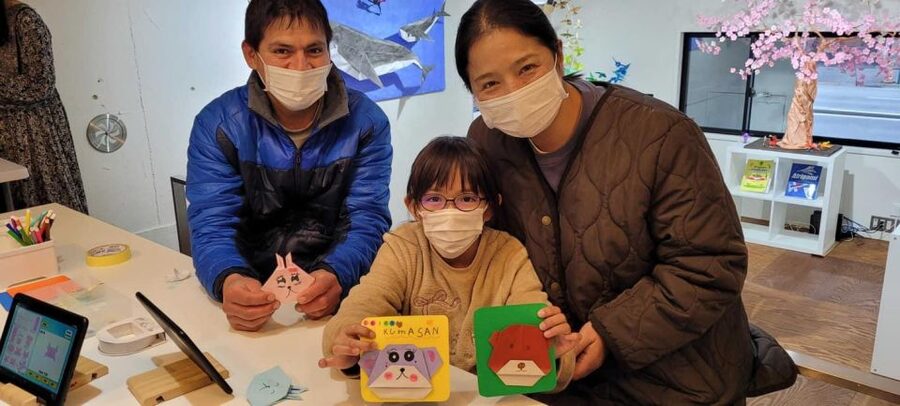
A parent, child, and grandparent can all work at the same table while choosing separate models. One family with a seven-year-old and a grandmother made about four pieces each, which gives you a practical sense of the pace. A child who finishes early can decorate, take photos, or look at the displays while another family member completes a harder fold.
The setting is described as relaxing and beautiful, but you should keep the format in mind. You will be sitting without back support, and the room is not designed for wheelchair access. Anyone who needs accessible entry or supportive seating should choose another activity.
Socks are mandatory. Bring them with you or buy a pair before entering. This is an easy detail to miss, and you cannot take part without wearing socks.
Is $27 a fair price?
At $27 per person, the price is reasonable if you want a structured craft activity with paper, supplies, tablet instruction, staff help, and taxes included. You are paying for more than a sheet of paper and a few diagrams. You get access to a large model library, 50 paper colors, decorating materials, studio displays, and a small group capped at six.
The value is strongest for families and first-time folders. Several people can take part at once, and each person can choose a different project. That is better value than paying for a private lesson if you mainly want a relaxed introduction.
The price is less compelling if you are already skilled at origami or want a dedicated teacher. This is not a private teacher-guided class, and the 45-minute limit may feel brief if you work slowly. You are buying a well-organized introduction, not an advanced workshop.
The booking terms also make planning easier. You can cancel up to 24 hours in advance for a full refund, and you can reserve now and pay later. Starting times vary, so you need to check availability for your preferred slot.
Who should book this activity?
I would choose this for families with school-age children, first-time origami folders, and adults who want a calm indoor activity in Asakusa. It also suits mixed-age groups because each person can select a different model and work at a different level.
It is a good match if you enjoy creative activities but do not want a long class. The tablet lets you work independently, while staff remain available when you need a correction or explanation. English and Japanese support make the basic process easier for international visitors.
I would think twice if you need step-free access, a chair with back support, or constant personal instruction. I would also avoid booking if anyone in your group has a cold, since people with a cold are listed as unsuitable for the activity.
The overall rating is 4.7 out of 5 from 26 ratings, and the strongest praise centers on helpful guidance, a pleasant small-group atmosphere, and the activity’s success with beginners. One booking described the session as a trip highlight, while another valued the instructor’s help with a child. Those details fit the format well: this is a gentle introduction, with enough support to keep a beginner moving without turning the experience into a formal classroom.
Should you book the Asakusa origami session?
Book it if you want a short, hands-on family activity with lots of choice and a low-pressure format. The 100-plus models, 50 colors, small group, and replayable tablet steps give beginners plenty of room to experiment.
Skip it if your priority is a private expert lesson, accessible facilities, or a long session. Bring socks, arrive at the street-side entrance, and choose a simple model first if you want to leave with several finished pieces. For a family already spending time in Asakusa, this is a practical way to slow down and make something you can carry home.
FAQ
How long does the origami activity last?
The activity lasts 45 minutes.
How much does the experience cost?
The price is $27 per person.
Is the activity suitable for beginners?
Yes. The tablet-guided format is designed for people with no prior origami experience, and models range from beginner to intermediate difficulty.
How many people can join the group?
The group is limited to six participants.
What languages are available?
Instruction and staff support are available in English and Japanese.
Is this a private teacher-led lesson?
No. The activity uses tablet instructions, with staff members available to help when needed. It is not a private teacher-guided lesson.
What should I bring?
You must bring socks or purchase a pair beforehand. Socks must be worn to take part.
Can children join the activity?
The activity is recommended for children four and older, although another instruction recommends participants be at least five. Children under four are not suitable, and children under 13 need adult supervision throughout. Children under five who cannot fold independently need close adult supervision.
Is the studio wheelchair accessible?
No. The facility has no ramps or lifts and can be reached only by stairs. Seating does not have back support.
Just added around Tokyo
- Kawagoe Japanese Food Tour : Unagi Kaiseki and Sake near Tokyo★ 5.0 · 30 reviews
- Kawagoe 4hr Private Tour with Licensed Guide (Kawagoe Dep)★ 5.0 · 13 reviews
- Little EDO Sushi Making workshop in Kawagoe★ 5.0 · 18 reviews
- 【R34】Tokyo:Private Daikoku tour in Modified R34★ 4.9 · 92 reviews
- :Tokyo,Shibuya/ Pro Photography in Kimono / English-Friendly★ 5.0 · 26 reviews
- Tokyo:Celebrate Unique Japanese New Year Tradition Festivity★ 3.9 · 20 reviews
- Tokyo: Allstar Food Tour★ 4.7 · 29 reviews
- Tokyo: West-Side Cycling and Food Tour with Guide★ 5.0 · 37 reviews
Traditional Crafts, compared.
Tokyo Sumo Experience: Chanko & Mochi with a Former Pro
Our verdict →
Kintsugi Experience: Art of Golden Joinery in Tokyo
Our verdict →

Matcha Making Experience with Mochi Sweets in Asakusa
Our verdict →
Authentic knife making experience at a blacksmith in Kyoto
Our verdict →

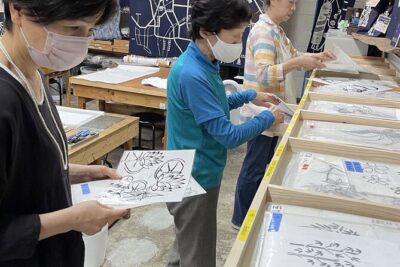
Roketsu dyeing experience: M course Roketsu Dyeing Experience
Our verdict →Browse the lists this tour appears in