
Reviewed · TEMPLES & SHRINES
Gion and Fushimi Inari Shrine Kyoto Highlights with Government-Licensed Guide
Kyoto’s geisha districts make the best first impression when you’re on foot, and this tour takes you through Gion’s narrow lanes, the Shirakawa canal area, and nearby Pontocho and Miyagawacho without leaving you to guess which alley matters. You’ll also see Fushimi Inari’s torii gates, Yasaka Shrine, Kiyomizu-dera, and Kennin-ji in one well-packed outing.
I like the small maximum of 10 people, since it should be easier to hear explanations and ask questions. I also like the focus on geiko and maiko history, including the difference between the two and the demanding training behind their work. The main drawback is pace: six hours of walking, with several major sights, can feel hurried, and admission to Kiyomizu-dera and Kennin-ji is not included.
Key points to know before booking
- Six hours on foot: This is a walking-heavy Kyoto introduction, not a vehicle tour.
- Fushimi Inari first: You get time among the famous vermilion torii gates before moving into eastern Kyoto.
- Gion beyond the main street: The route includes Shirakawa, Tatsumi Daimyojin, Yasaka Shrine, and lanes inaccessible to cars.
- Geiko and maiko context: Your English-speaking guide explains their training, roles, and place in Kyoto’s traditional entertainment districts.
- Small group format: The tour accepts up to 10 people, with group discounts available.
- Meeting point matters: You meet at Tatsumi-jinja Shrine and return there. Pickup and drop-off are on foot.
Why this route works for a first Kyoto evening
Kyoto can be difficult to read at street level. A wide avenue may lead to a tiny shrine, a quiet canal lane may be one of the city’s most photographed corners, and a famous district can change character within a few steps. I like this tour because it links several of those contrasts in one outing.
You begin at Fushimi Inari-taisha in southern Kyoto, then move toward the traditional districts around Gion. The result is a broad introduction to Kyoto rather than a single-neighborhood walk. You see a major Shinto site, old entertainment quarters, historic shrines, and Buddhist temples in one day.
The route is not simply a checklist of famous names. Its value comes from walking between places and hearing how they fit together. In Gion, your guide can point out details you might pass without noticing, such as the difference between an ordinary restaurant, an ochaya tea house, and a lane built around evening hospitality.
The six-hour length gives the guide room to explain the setting instead of rushing from one photo stop to the next. Still, you should arrive ready to walk. There is no private vehicle, and the advertised pickup and drop-off are on foot.
More Temple & Shrine Tours in Kyoto
- Kyoto: Fushimi Inari, Kinkakuji, Bamboo Grove 1 Day Bus Tour
★ 4.8 · 4,316 reviews - Kyoto: Tea Ceremony in a Traditional Tea House in Kiyomizu
★ 4.9 · 3,519 reviews - Kyoto: Tea Ceremony Ju-An at Jotokuji Temple
★ 4.9 · 3,207 reviews
Fushimi Inari and the first hour among the torii
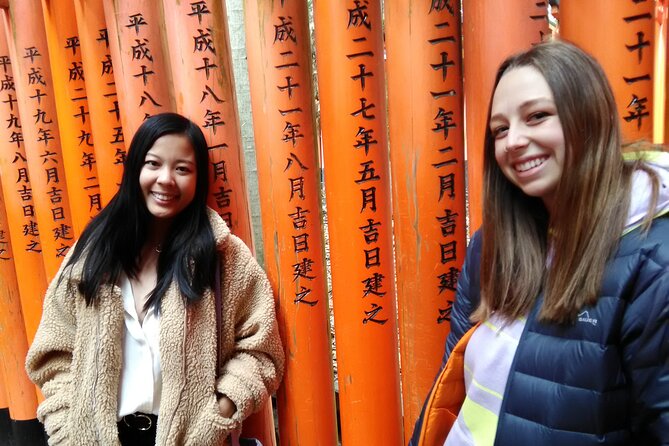
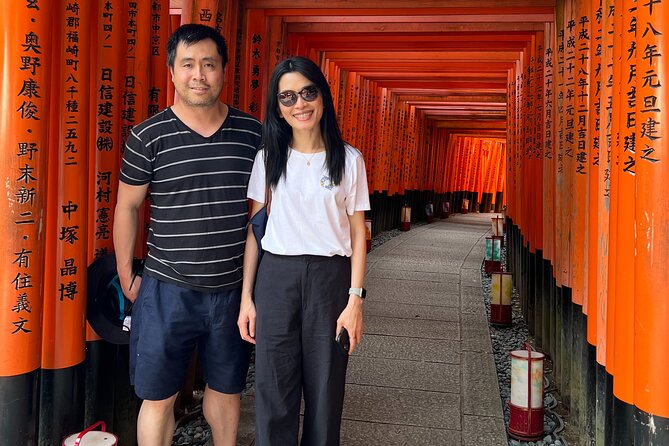
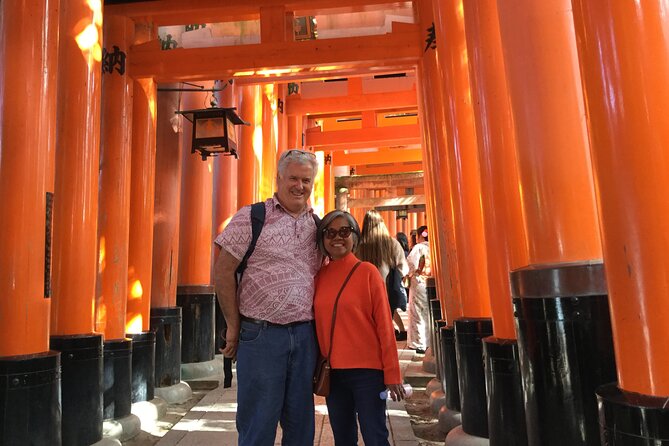
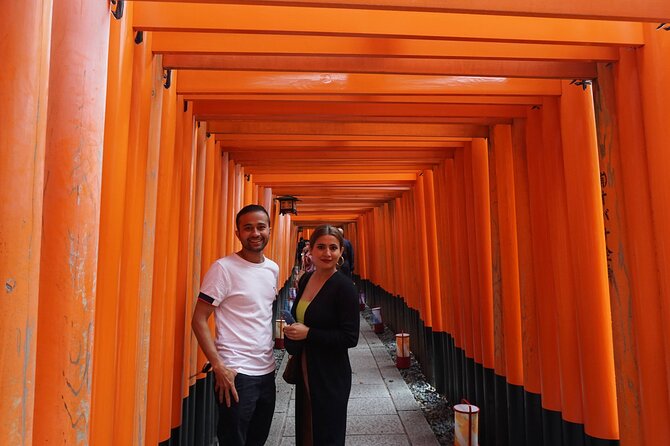
Fushimi Inari-taisha is famous for its thousands of vermilion torii gates, which form long passages along trails behind the main shrine buildings. The gates are dedicated by individuals and businesses, and together they create one of Kyoto’s most recognizable sights.
You have about one hour here, with no admission charge. That is enough to enter the torii corridors, take photographs, and get an introduction to the shrine’s role in Shinto practice. It is not enough for a full climb through the entire mountain trail network, so keep your expectations sensible.
This first stop is especially useful if you have not visited Fushimi Inari before. The gate passages can feel confusing, and a guide helps you understand what you are seeing rather than treating them as a backdrop for pictures. I would still keep your camera ready, since the color and repeating lines change as you move through the gates.
Fushimi Inari is also a practical place to begin a long tour because the atmosphere differs sharply from Gion. Here, the focus is on shrine paths and torii gates. Later, the tour shifts toward canals, tea houses, traditional streets, and temple grounds.
Gion, Pontocho, and Miyagawacho on foot
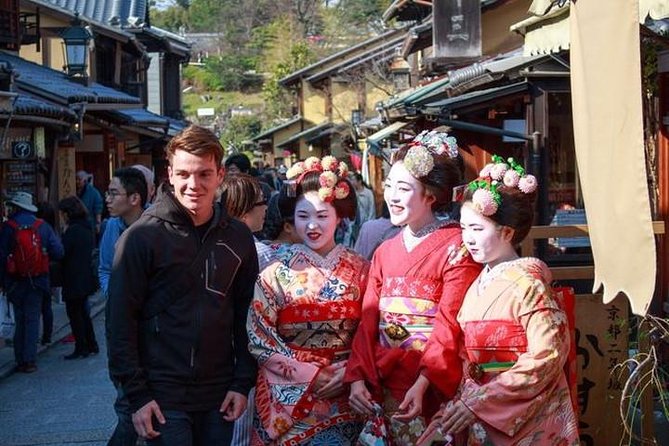
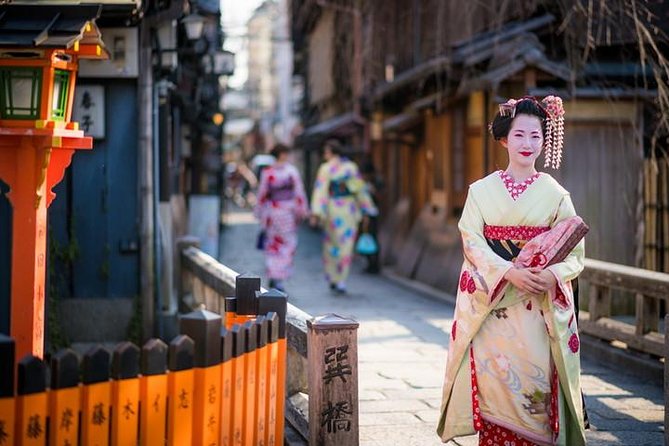
Gion is Kyoto’s best-known geisha district, located around Shijo Avenue between Yasaka Shrine and the Kamo River. It includes shops, restaurants, traditional teahouses, and narrow lanes where cars cannot easily go.
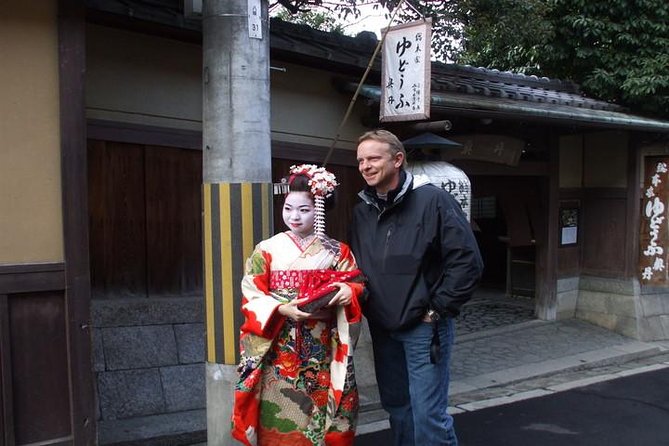
The appeal is not just old wooden buildings. Gion remains a working district, and your guide provides useful context about the people who work there. You learn about geiko and maiko, including the path of study required to become one and the difference between the two roles.
Do not book this tour on the assumption that you will definitely see a geiko or maiko. One evening may bring an unexpected sighting, while another may not. A guide can explain the district without treating its residents as a show put on for visitors.
The route also reaches Pontocho and Miyagawacho, two other traditional entertainment areas. Seeing these districts together helps you compare their character and location. The narrow streets can be easy to miss if you only follow the main tourist avenues.
One useful detail from the experience is the chance to stop for a small taste of local sweets. This is a minor part of the tour, not a food-focused activity, but it adds a pleasant pause during a long walk.
Shirakawa and Tatsumi Daimyojin
The Shirakawa area runs beside the Shirakawa Canal, parallel to Shijo Avenue. Willow trees, refined restaurants, and ochaya line the water, giving this part of Gion a quieter feel than the larger streets nearby.
I consider Shirakawa one of the strongest sections of the walk because it shows how close Kyoto’s busy visitor routes are to calmer lanes. The canal and traditional buildings make good photographs, but your guide’s explanation is what gives the place meaning. You learn how the area connects to geiko and maiko activity and to Kyoto’s long entertainment traditions.
Tatsumi Daimyojin Shrine is another small but worthwhile stop. It sits near Shirakawa and is associated with the surrounding tea houses and geisha district. You spend about 10 minutes here, so this is a brief introduction rather than a long shrine visit.
Tatsumi-jinja Shrine also serves as the meeting point, so you should locate it before the tour begins. The stated address is in Motoyoshicho, in Kyoto’s Higashiyama Ward. Since the pickup is on foot, do not wait for a bus or vehicle to collect you.
Same trip, a completely different kind of day:
- PERFECT KYOTO 1-Day Bus Tour
★ 5.0 · 13,518 reviews - Kyoto Geisha Walking Tour: Gion District & Hidden Gems
★ 4.7 · 3,273 reviews - Kyoto: Gion Magical Night Walking Tour with Geisha Trivia
★ 4.9 · 2,393 reviews - Kyoto: 45-Minute Tea Ceremony Lesson Experience
★ 4.3 · 2,378 reviews
Yasaka Shrine and the edge of Gion

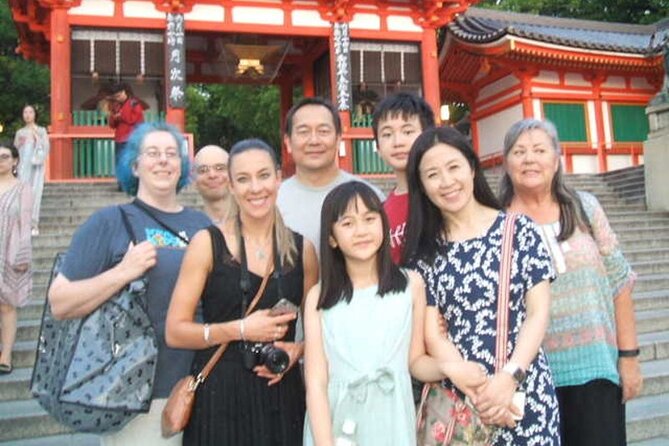
Yasaka Shrine, also called Gion Shrine, sits between Gion and the Higashiyama area. The shrine was founded more than 1,350 years ago and remains one of Kyoto’s best-known Shinto sites.
The scheduled stop is about 10 minutes. That is enough to see the main setting and hear a concise explanation, but not enough for a slow, detailed visit to every corner. If Yasaka Shrine is a major personal priority, you may want to return on your own later.
Its position makes it a useful bridge in the tour. You move from the entertainment district toward the temples and slopes of eastern Kyoto. The short visit keeps the overall route moving, though it also contributes to the packed feeling of the day.
Kiyomizu-dera and the cost of admission
Kiyomizu-dera is one of Kyoto’s major Buddhist temples, founded more than 1,250 years ago on Mt. Otowa in the Higashiyama mountain range. It is a major destination, and the route allows about an hour there.
This is one of the tour’s strongest stops for first-time visitors. You get a guide’s explanation of the temple and its setting instead of arriving alone and trying to understand the complex from signs. The surrounding approach and temple grounds also give you a sense of how Kyoto’s historic eastern district is arranged.
Admission is not included. That matters when you compare the tour’s price with a self-guided day, because the $154.37 per-person charge covers the licensed English-speaking guide but not every entrance fee.
The one-hour allocation is useful but limited. Kiyomizu-dera can easily absorb more time, especially if you want photographs or a slower look around. If you are determined to explore every part of the temple, the group schedule may feel restrictive.
I would wear shoes with good support and plan for uneven walking. The tour information identifies this as a walking activity, and Kiyomizu-dera’s hillside setting adds to the physical demand.
Kennin-ji and a quick temple finish
Kennin-ji is close to Hanamikoji and Shijo streets, right in the Gion area. Its grounds are pleasant to walk, and the temple is known for two dry gardens.
The scheduled time here is only about one minute, which is the clearest sign that this is a quick orientation stop rather than a full temple visit. Admission is not included. You may see the setting and receive a brief explanation, but you should not book the tour expecting a long examination of the gardens or interior.
This short stop can still be useful. After learning about Gion’s entertainment districts, you see a Buddhist temple within easy reach of the same streets. That contrast helps explain why Kyoto can shift from a commercial lane to a quiet religious compound in a matter of minutes.
If Kennin-ji is high on your list, plan a separate visit. The tour gives you an introduction, not the time needed for a careful visit.
What the $154.37 price really buys
At $154.37 per person, this is not a budget walking tour. The price makes the most sense if you value a licensed local guide, an English explanation, and a route that combines several parts of Kyoto in six hours.
You are paying for interpretation and organization more than transportation or admissions. There is no private vehicle, and the tour is conducted on foot. Kiyomizu-dera and Kennin-ji admission fees are extra, while the guide entry fees are covered only for sights specifically listed in the route.
The price is easier to justify for a first visit, especially if you have limited time and want a guide to connect Fushimi Inari with Gion and Higashiyama. It is less attractive if you already know Kyoto well, prefer long independent visits, or want to spend an entire evening in one district.
Group discounts may improve the value for several people booking together. The maximum group size is 10, which is small enough for personal questions without being a private tour.
The guide makes the biggest difference
The strongest part of this experience depends on the individual guide. The advertised guide is a government-licensed local English speaker, and one guide named Mari san received especially warm praise for explaining Gion’s past and the differences between maiko and geiko.
That topic is worth your attention. Kyoto’s geiko districts are often reduced to quick photographs, but the training system, etiquette, and working life behind the costumes are more interesting than the costume alone. A good guide keeps the explanation respectful and helps you understand that these are working professionals, not performers waiting for tourists.
The small group should help here. With no more than 10 people, you can ask follow-up questions and hear the guide in narrow streets. You are also less likely to lose the group than on a large coach-style outing.
Guide assignments can vary, so Mari san may not be leading every departure. Still, the experience calls for someone who can explain cultural details clearly and manage a long walking route.
Who should book this walking tour
I would recommend it to a first-time Kyoto visitor who wants a strong overview without planning several separate half-day visits. It also suits anyone who worries about getting lost in Gion’s narrow streets or wants cultural context rather than a list of shrine names.
It is a good fit for:
- First-time visitors with one free day for major Kyoto sights
- People interested in geiko and maiko history
- Small groups who prefer a guide but do not want a private tour
- Visitors comfortable walking for about six hours
- Anyone who wants Fushimi Inari and Gion in the same experience
I would be more cautious if you dislike fixed schedules or have limited mobility. Most people can participate, and service animals are allowed, but the activity is explicitly a walking tour. The schedule also gives some stops only a few minutes, so independent explorers may want more time.
The tour is near public transportation, but you are responsible for reaching the meeting point at Tatsumi-jinja Shrine. Confirmation is received at booking, and free cancellation is available up to 24 hours before the start time. Changes or cancellations inside that window are not accepted for a refund.
Should you book it?
Book this experience if you want a guided introduction to Kyoto’s most recognizable eastern districts and prefer learning the story behind Gion rather than simply taking photographs. The mix of Fushimi Inari, Shirakawa, Yasaka Shrine, Kiyomizu-dera, and Kennin-ji gives you plenty of variety.
Skip it if you want deep, unhurried visits to every temple or if $154.37 feels high for a walking tour with some admission fees left out. For the right visitor, the value is in the route, the small group, and the guide’s explanation of a district that can be hard to understand alone.
FAQ
How long does the tour last?
The tour lasts approximately six hours.
Where does the tour begin?
It begins at Tatsumi-jinja Shrine, also called Tatsumi Daimyojin, in Motoyoshicho, Higashiyama Ward, Kyoto.
Where does the tour end?
The activity ends back at the meeting point.
Is transportation included?
No. This is a walking tour, and pickup and drop-off are conducted on foot. A private vehicle is not included.
How large is the group?
The tour has a maximum of 10 travelers.
Is an English-speaking guide included?
Yes. A licensed local English-speaking guide is included.
Is admission to Fushimi Inari included?
Yes. Fushimi Inari-taisha has no admission charge, and the itinerary lists admission as free.
Are Kiyomizu-dera and Kennin-ji admission fees included?
No. Admission to Kiyomizu-dera and Kennin-ji is not included.
Can I expect to see a geiko or maiko?
The tour explains geiko and maiko history and training, but a sighting is not guaranteed. Some departures may encounter them unexpectedly, while others may not.
Can I cancel for a full refund?
Yes, if you cancel at least 24 hours before the experience start time. Cancellations or changes made less than 24 hours before the start time are not accepted for a refund.
Just added around Kyoto
- Sekka Cotton Furoshiki Class★ 5.0 · 19 reviews
- Kyoto Sword Experience – includes Museum Ticket/Ninja Experience★ 4.5 · 149 reviews
- Scenic Green Tea Fields of Hidden Kyoto & Local Tea Exp (Private)★ 5.0 · 32 reviews
- Secret Eastern Kyoto Biking Adventure★ 5.0 · 44 reviews
- Private Sake Tasting in Central Kyoto with Sake Sommelier★ 5.0 · 32 reviews
- Samurai School in Kyoto: Samurai for a Day★ 5.0 · 202 reviews
- SHIRAKAWA Japanese Culture Experiences with private English staff★ 5.0 · 16 reviews
- A Privately Guided Photoshoot in Beautiful Kyoto by a Pro★ 5.0 · 18 reviews
Temples & Shrines, compared.

Tea Ceremony in a Traditional Tea House in Kiyomizu
Our verdict →

Meiji Shrine, Asakusa, Skytree Bus Tour and Cruise
Our verdict →
Fushimi Inari Hidden Hiking Tour (Private Option Available)
Our verdict →
Osaka/Kyoto:Kinkakuji,Arashiyama,FushimiInariShrine,NaraPark
Our verdict →
Nikko: Kegon Falls, Lake Chuzenji & Toshogu Temple
Our verdict →
Kamakura & Enoshima Day Trip including Temple Tickets
Our verdict →Browse the lists this tour appears in