
Reviewed · TEMPLES & SHRINES
Kyoto Early Bird English Tour: Fushimi Inari & Gion(Private opt)
Kyoto is at its best before the tour buses arrive, and this morning route takes advantage of that. You begin at Fushimi Inari’s famous red torii gates, then work your way through Kiyomizu-dera and the old streets of eastern Kyoto before finishing in Gion. Starting early matters most at Fushimi Inari, where quiet forest paths can make the shrine feel far more peaceful.
I like the mix of major sights and smaller cultural details, especially the local guide’s explanations and photo help. Guides such as Ikki are praised for clear English, strong knowledge of Kyoto, good humor, and practical food advice. The main caution is the pace: seven stops in one morning means some places receive only 15 minutes, and one report describes a much shorter tour than the advertised four to five hours.
Key points to know before booking
- Fushimi Inari comes first, giving you the best chance of seeing the torii gates before the worst crowds.
- The route covers seven famous places, from Kiyomizu-dera and Yasaka Pagoda to Gion and Yasaka Shrine.
- Ikki is a frequently requested guide, praised for fluent English, local knowledge, patience, and taking many photos.
- This is a walking tour with public transportation, not a chauffeured sightseeing trip.
- The private format suits families and mixed-age groups, since only your own party takes part.
- Budget an extra ¥890 per person, covering the stated ¥390 transport fare and ¥500 Kiyomizu-dera admission.
Why this early Kyoto route works

Kyoto’s best-known sights can become difficult places to enjoy later in the day. Fushimi Inari is a prime example. The shrine’s lower gates are easy to reach and highly photographed, but the paths continue up Mount Inari through wooded slopes. An early arrival gives you more room for pictures and a better chance to hear your guide without constant noise around you.
This tour also solves a common first-visit problem: Kyoto’s headline sights are spread across different parts of the city. Instead of trying to link Fushimi Inari, Kiyomizu-dera, and Gion on your own, you follow a planned route with a guide handling the cultural explanation and public transportation connections.
I especially like the way the morning moves from a major Shinto shrine to Buddhist temple grounds, historic lanes, a geisha district, and another major shrine. You get a useful introduction to Kyoto’s religious traditions and old neighborhoods rather than seeing only one type of attraction.
The private setup is another strong point. Your group alone takes part, so you can ask questions, pause for photographs, and tell the guide what matters most to you. It is also helpful for families. One family specifically appreciated how well Ikki treated an eight-year-old child, while another group included teenagers and older parents who all enjoyed the outing.
More Temple & Shrine Tours in Kyoto
- Kyoto: Fushimi Inari, Kinkakuji, Bamboo Grove 1 Day Bus Tour
★ 4.8 · 4,316 reviews - Kyoto: Tea Ceremony in a Traditional Tea House in Kiyomizu
★ 4.9 · 3,519 reviews - Kyoto: Tea Ceremony Ju-An at Jotokuji Temple
★ 4.9 · 3,207 reviews
Fushimi Inari before the crowds
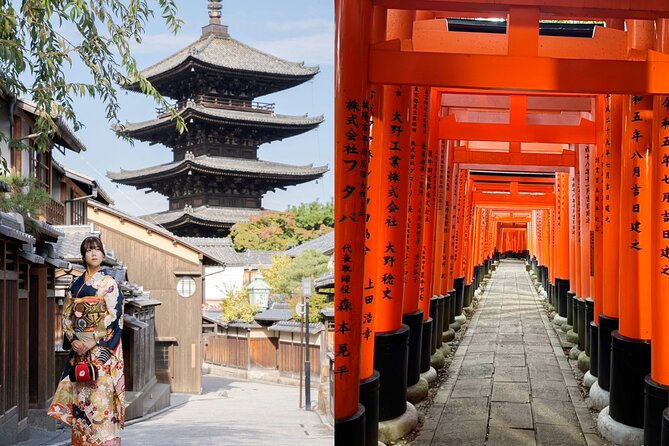
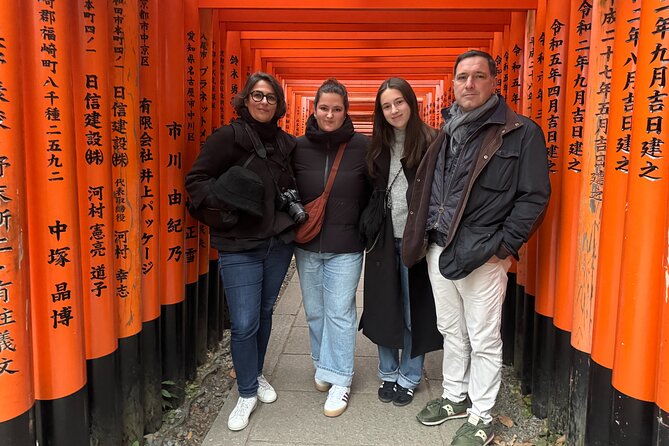
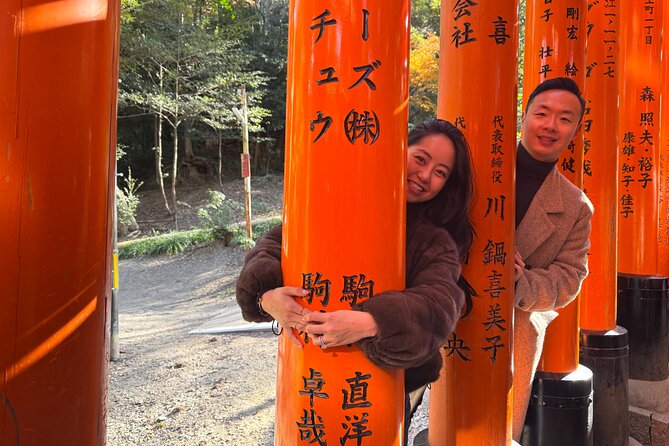
Fushimi Inari-taisha is the natural opening stop. Its thousands of orange-red torii gates create covered passageways that rise toward Mount Inari. The shrine is dedicated to Inari, associated with rice, prosperity, and business success, and fox figures appear throughout the grounds because foxes are linked with Inari.
You should expect more than a quick photo stop. The gates form a long route, and the wooded setting changes as you walk uphill. The tour allots about an hour here, which is enough to see the main approach and experience part of the mountain path, but not enough for a full climb to every upper shrine.
That time limit is sensible for a highlights tour. A complete exploration of Mount Inari would take much longer and require more uphill walking. If you want to hike the entire route, this tour will not leave enough time. If you want the famous gates, some context, and strong photo opportunities, the hour is more practical.
The guide can also explain how to behave at the shrine and how to take part in Japanese religious customs. One guest praised Ikki’s prepared booklet, which included photographs, language notes, and guidance on temple and shrine practices. That sort of help is valuable because the rituals can seem confusing when you are seeing them for the first time.
Kiyomizu-dera and Kyoto from above
From Fushimi Inari, the route continues by public transportation toward Kiyomizu-dera. The stated transport cost is ¥390 per person, and the temple admission costs another ¥500. Those fees are not included in the tour price, so keep cash or a suitable payment method ready.
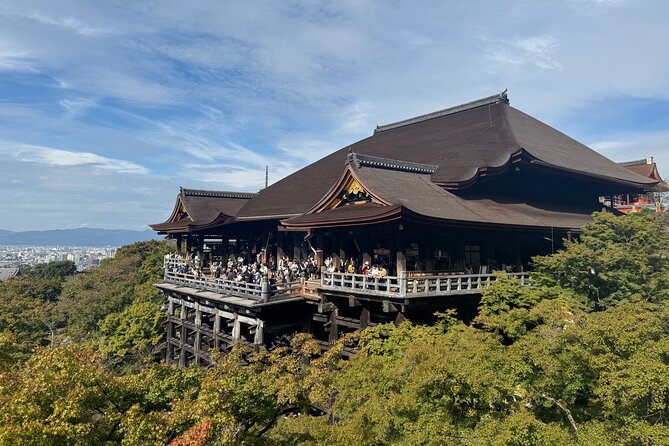
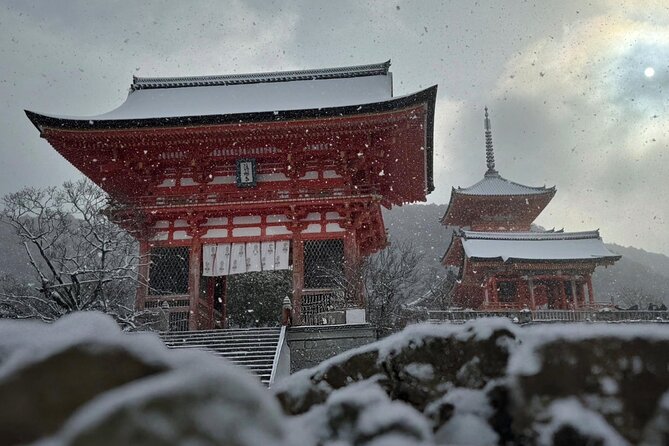
Kiyomizu-dera is one of Kyoto’s essential stops. Built on the side of a mountain, it offers broad views over Kyoto and is known for its large wooden stage. The temple grounds combine religious buildings, viewpoints, seasonal scenery, and busy approach lanes.
The tour allows about an hour here. That gives you time to see the main areas, learn what the temple represents, and enjoy the city view. It does not allow for a slow visit to every corner, especially if the approach streets are crowded or you stop to shop.
I like placing Kiyomizu-dera early in the day, before the eastern Kyoto lanes become harder to walk. Still, you should be prepared for slopes, steps, and plenty of time on your feet. The tour asks for moderate physical fitness, and that is a fair description.
The temple is also where the value of a guide becomes clear. A guide can point out details you might pass without noticing and explain how Buddhist and Shinto practices differ. Several tour experiences praised the cultural explanations at each stop, not just the sightseeing.
Sannenzaka and Ninenzaka: old Kyoto streets
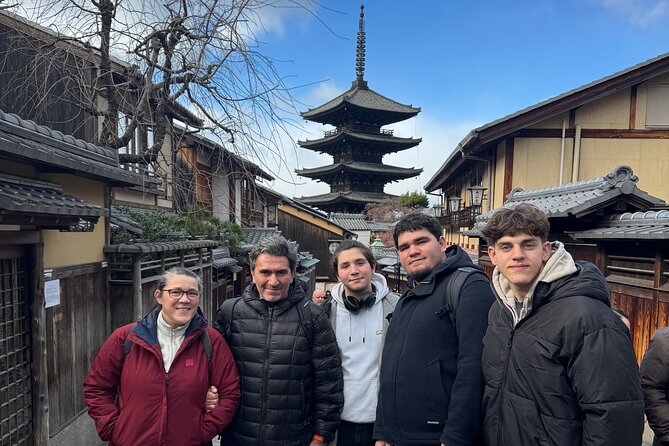
After Kiyomizu-dera, you walk through Sannenzaka and Ninenzaka. These stone-paved lanes run between traditional wooden buildings filled with souvenir shops, small restaurants, and sweets shops.
The official time here is only 15 minutes, so treat this as a short orientation walk rather than a shopping session. You will see the character of the district and learn how the old streets connect the temple area with Gion, but you may want to return later if you hope to browse carefully.
The lanes are picturesque, which makes them useful for photographs. They can also be uneven and crowded, so comfortable shoes matter. The route is not difficult in a technical sense, but it is not a flat city stroll either.
Same trip, a completely different kind of day:
- PERFECT KYOTO 1-Day Bus Tour
★ 5.0 · 13,518 reviews - Kyoto Geisha Walking Tour: Gion District & Hidden Gems
★ 4.7 · 3,273 reviews - Kyoto: Gion Magical Night Walking Tour with Geisha Trivia
★ 4.9 · 2,393 reviews - Kyoto: 45-Minute Tea Ceremony Lesson Experience
★ 4.3 · 2,378 reviews
Yasaka Pagoda and Yasaka Koshin-do
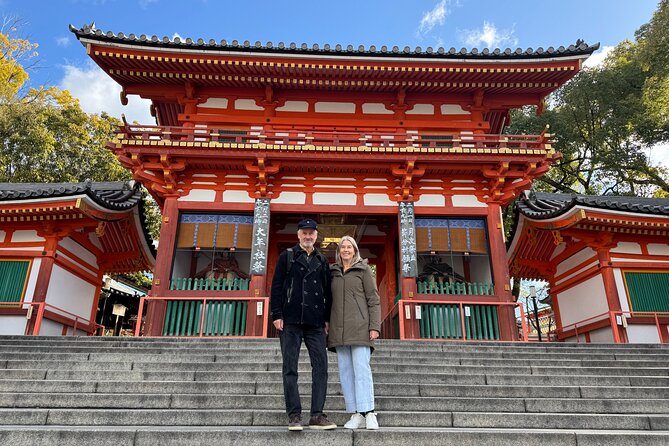
Yasaka Pagoda, also called Hokanji Temple, is one of the most recognizable structures in this part of Kyoto. Its tall wooden form rises above the surrounding streets and gives you a strong sense of the district’s age and scale.
The stop lasts about 15 minutes. That is enough for an explanation and photographs from the nearby street, but not a long temple visit. The tour description notes that the pagoda was built without nails, a detail that helps explain why this structure attracts so much attention.
Nearby Yasaka Koshin-do offers a sharp visual change. Its colorful decorations are more playful than the restrained tones found at many Japanese temples. Small hanging ornaments fill the grounds and make this a memorable photography stop.
Again, the schedule gives you roughly 15 minutes. I would think of both places as quick, focused encounters. You will see two very different sides of Kyoto, but you will not have time to linger at either one.
Gion, with context and courtesy
Gion is Kyoto’s best-known geisha district, with traditional machiya houses, teahouses, and preserved streets. The tour includes about 15 minutes here, which is enough to walk through part of the area and understand its role in Kyoto’s cultural life.
Do not expect a long search for geisha or a staged performance. This is a residential and working district, and respectful behavior matters. Avoid blocking narrow lanes, entering private spaces, or photographing people without permission.
A guide is useful here because the streets can look similar at first glance. An English-speaking local can explain the difference between a traditional tea house, a machiya town house, and the entertainment traditions associated with the district. Several people valued Ikki’s ability to connect the buildings and customs with broader local history.
The short visit also means you can return on your own later. Since the tour ends nearby, Gion is easy to continue exploring after the formal portion ends.
Yasaka Shrine and the useful finish
The final stop is Yasaka Shrine, a major Shinto shrine associated with prosperity and protection. It serves as the headquarters of about 2,300 related shrines throughout Japan, making it more than a pleasant endpoint. Its location also makes practical sense.
The tour allows 30 minutes here, longer than at the smaller stops. You can take in the shrine grounds, ask final questions, and discuss what to do next in Kyoto. The guide can also point you toward transport routes for your hotel or next attraction.
Ending at Yasaka Shrine gives you flexibility. You are already in the Gion area, close to more historic streets, restaurants, and bus connections. Several people valued the guide’s food suggestions, and one guide even walked a group to a conveyor-belt sushi restaurant after the tour. That kind of help can be especially useful on your first day in Kyoto.
The guide can shape the whole morning
The strongest praise centers on the guiding, especially Ikki. He is described as having excellent English, being born and raised in Kyoto, and explaining history and local religion in a way that is easy to follow. His personality also matters. The feedback repeatedly describes him as polite, funny, patient, prepared, and attentive.
The photography is an unusual extra. Ikki takes photos during the tour and sends them afterward, giving you pictures that are difficult to capture when you are traveling as a couple or family. This is not a professional portrait session, but it can remove the familiar problem of asking strangers to take a group photo.
You should not assume Ikki is guaranteed unless the booking allows you to request him. The experience may use another guide, and the quality can depend on that assignment. Still, his name appears often enough that asking for him is reasonable.
The private format also means the guide can adjust the conversation. You can ask about food, religion, language, local customs, or what to see after the tour. That personal exchange is one reason this experience may be more useful than a large group walk that simply moves from photo stop to photo stop.
Time, walking, and the one warning to take seriously
The stated duration is four to five hours. The route includes long periods on foot, uphill temple approaches, stone streets, and public transportation. Wear shoes you can walk in comfortably, and bring water since food and drinks are not included.
There is one important timing issue. One detailed account described the experience as lasting about two and a half hours, considerably shorter than the stated schedule. That may reflect an individual change, a compressed visit, or a mismatch in expectations, but you should confirm the expected duration when booking if the full morning matters to you.
Punctuality is essential. If you arrive late at the Kyoto Station meeting point, you may not be able to join and will not receive a refund. The route depends on moving between several places, so the guide cannot easily hold the group.
The meeting point is Kyoto Station, at Higashishiokoji Kamadonocho in Shimogyo Ward. The tour ends at Yasaka Shrine in Gion. That one-way design saves you from returning to the station and leaves you in a useful sightseeing district.
Is $99.10 a fair price?
At $99.10 per person, this is not the cheapest way to walk through Kyoto. You also pay ¥390 for public transportation and ¥500 for Kiyomizu-dera, bringing the known extra costs to ¥890 per person before any food or shopping.
The price makes more sense if you value a private guide, clear English explanations, local recommendations, and photographs. A private booking for only your group can be worthwhile for a family or small party that wants freedom to ask questions. It is less compelling if you already know Kyoto well or prefer to move slowly and spend a full morning at one or two sites.
You are paying for organization as much as admission. The route connects places that are awkward to combine without planning, and the guide gives cultural meaning to the temples, shrines, and streets. If you tried to arrange the same morning alone, you would save the guide fee but take on navigation, timing, and research.
Who should book this Kyoto morning?
I would recommend it to first-time Kyoto visitors who want to cover the city’s best-known eastern sights in one organized morning. It is also a good fit for families, couples, and small groups who want a private experience and help with photographs.
It suits you less if you dislike early starts, cannot manage hills and steps, or want long, unhurried visits at each place. The 15-minute stops are efficient but brief. You should also choose another experience if your main goal is a full Mount Inari hike or extended time shopping in Sannenzaka and Ninenzaka.
Free cancellation is available up to 24 hours before the start time. Changes or cancellations inside that window are not accepted, so check your plans before the deadline.
Should you book it?
Book this tour if you want a well-planned first look at Kyoto, especially if you can start early and appreciate a guide who explains customs rather than simply naming buildings. The combination of Fushimi Inari, Kiyomizu-dera, Gion, and Yasaka Shrine gives you a strong overview in one morning.
Before paying, confirm the start time, expected length, and guide assignment. Request Ikki if possible, budget for the ¥890 in stated transport and temple fees, and accept that some stops will be quick. With those expectations, this is a strong choice for seeing Kyoto’s major eastern sights with useful local help.
FAQ
How long does the tour last?
The stated duration is approximately four to five hours. One account describes a tour lasting about two and a half hours, so confirm the expected timing when booking.
Where does the tour start?
The tour starts at Kyoto Station, at Higashishiokoji Kamadonocho in Shimogyo Ward, Kyoto.
Where does the tour end?
The tour ends at Yasaka Shrine in the Gion area. From there, you can continue sightseeing or take public transportation to another destination or your hotel.
Is this a private tour?
Yes. Only your group participates in the activity.
Is the tour conducted in English?
Yes. An English-speaking local guide leads the experience.
Are transportation costs included?
No. Public transportation costs ¥390 per person and are not included in the tour price.
Is Kiyomizu-dera admission included?
No. Admission to Kiyomizu-dera costs ¥500 per person and is not included.
What happens if I arrive late?
If you are late for the meeting time, you may not be able to join the tour and will not receive a refund.
Can I cancel for a full refund?
Yes. You can cancel at least 24 hours before the experience starts for a full refund. Cancellations made less than 24 hours before the start time are not refunded.
Just added around Kyoto
- Sekka Cotton Furoshiki Class★ 5.0 · 19 reviews
- Kyoto Sword Experience – includes Museum Ticket/Ninja Experience★ 4.5 · 149 reviews
- Scenic Green Tea Fields of Hidden Kyoto & Local Tea Exp (Private)★ 5.0 · 32 reviews
- Secret Eastern Kyoto Biking Adventure★ 5.0 · 44 reviews
- Private Sake Tasting in Central Kyoto with Sake Sommelier★ 5.0 · 32 reviews
- Samurai School in Kyoto: Samurai for a Day★ 5.0 · 202 reviews
- SHIRAKAWA Japanese Culture Experiences with private English staff★ 5.0 · 16 reviews
- A Privately Guided Photoshoot in Beautiful Kyoto by a Pro★ 5.0 · 18 reviews
Temples & Shrines, compared.

Tea Ceremony in a Traditional Tea House in Kiyomizu
Our verdict →
Meiji Shrine, Asakusa, Skytree Bus Tour and Cruise
Our verdict →
Fushimi Inari Hidden Hiking Tour (Private Option Available)
Our verdict →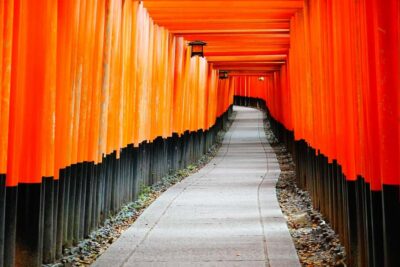
Osaka/Kyoto:Kinkakuji,Arashiyama,FushimiInariShrine,NaraPark
Our verdict →
Nikko: Kegon Falls, Lake Chuzenji & Toshogu Temple
Our verdict →
Kamakura & Enoshima Day Trip including Temple Tickets
Our verdict →Browse the lists this tour appears in