
Reviewed · WALKING TOURS
Tokyo: Asakusa Walking Tour with Japanese Comedian
Asakusa makes a fine first stop in Tokyo because it gives you temples, shrines, old streets, river views, and a clear look at everyday Japanese religious life in one compact area. This walking tour adds a useful human touch: Ryo explains the district as a local, then slips in humor from his work as an English-speaking Japanese comedian.
I especially like the free view of Asakusa from a nearby building and the stop at Sumida Park, where you can frame Tokyo Skytree and the Asahi Beer Company before entering the temple quarter. I also like that Ryo points out smaller religious sites and Buddhist statues instead of rushing straight to Senso-ji. The main consideration is pace: 90 minutes is short for such a full area, and the experience is focused on sightseeing rather than shopping, food, or a long temple visit.
Key points to know
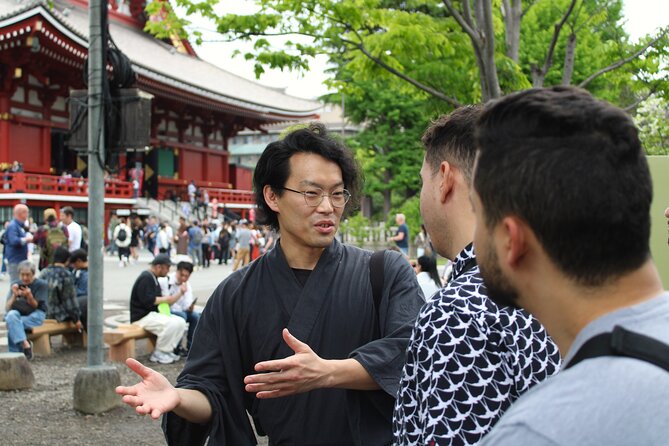
- Ryo brings two useful perspectives: six years as an Asakusa rickshaw driver and experience performing standup comedy in English.
- The opening view is free: you can see Tokyo Skytree, the Asahi Beer Company, and Asakusa from Sumida Park and a nearby building.
- The tour explains both faiths: Asakusa Shrine and Senso-ji sit close together, giving you a simple way to understand how Shinto and Buddhism coexist in Japan.
- The group is limited to eight: that makes questions and conversation easier than on a large bus or audio tour.
- The route covers the essentials: Kaminarimon Gate, Nakamise Shopping Street, Asakusa Shrine, Senso-ji Temple, and several smaller religious sites.
- The price is reasonable for context: at $31 per person, you are paying less for admission and more for interpretation, local stories, and a better sense of place.
Why Asakusa works so well with a local guide
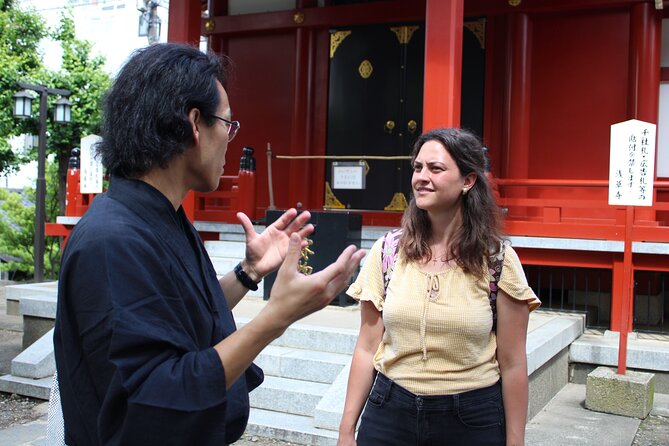
Asakusa is easy to visit on your own, but it is also easy to see only the surface. You can photograph Kaminarimon Gate, stroll down Nakamise Shopping Street, and walk into Senso-ji without knowing why the area matters or how its religious buildings relate to one another.
That is where this tour earns its keep. Ryo connects the visible details to Japanese customs, history, and local life. He explains the development of Senso-ji and how it received support from different groups over the centuries, including local people and military leaders from earlier periods.
I would choose this walk early in a Tokyo stay. It helps you get your bearings in Asakusa, and one participant specifically found it a useful way to understand the area at the start of a first Japan visit. You leave with more than a set of photos. You have a framework for reading the gates, statues, prayer spaces, and streets you see elsewhere in Japan.
The tone is not a formal lecture. Ryo’s comedy background gives the walk a lighter feel, although humor is an added feature rather than the main attraction. The strongest part of the experience is his ability to explain local culture in plain English.
More Walking Tours in Tokyo
- Tokyo Tsukiji Fish Market Food and Culture Walking Tour
★ 5.0 · 3,184 reviews - Tokyo: Imperial Palace and Shogun Historical Walking Tour
★ 5.0 · 2,251 reviews - Tokyo: Shinjuku Local Bar and Izakaya Guided Walking Tour
★ 4.9 · 1,794 reviews
Meeting at Tokyo Cruise near Asakusa Station
The meeting point is in front of Tokyo Cruise, the water bus station near the river. It is a one- or two-minute walk from Asakusa Station on the Tokyo Metro Ginza Line, which makes the start fairly simple if you are already using the subway.
You need to arrive five minutes before the start. The group leaves on time and cannot wait for late arrivals, so do not treat the meeting time as a loose suggestion. Asakusa has several station exits and a large amount of foot traffic, so give yourself extra time if you are unfamiliar with the area.
There is no hotel pickup. You meet the guide at the stated location and finish at Senso-ji’s main hall, rather than being escorted back to a station. That is not a major problem because the area has good transport links, but you should plan your next move before the walk ends.
Sumida Park and the first Tokyo views
The tour begins around Sumida Park, where the city opens up beside the river. The early views include Tokyo Skytree and the Asahi Beer Company, two landmarks that help you place Asakusa within modern Tokyo.
Ryo also takes you to the top of a nearby building for a free view of Asakusa. This is a smart opening move. Before you enter the narrow lanes around the temples, you get a wider picture of the district and can see how the old religious center sits within the modern city.
I like this part because it gives the tour a visual rhythm. You begin with a broad view, then move toward gates, streets, statues, and temple buildings. It also makes the area easier to understand later. When you look back toward the river or Skytree, you know where you are in relation to the main temple grounds.
The stop is for sightseeing and explanation, not a long break. If you want extensive photographs or time to admire every river view, you may need to return after the tour.
Kaminarimon Gate, Asakusa’s famous entrance
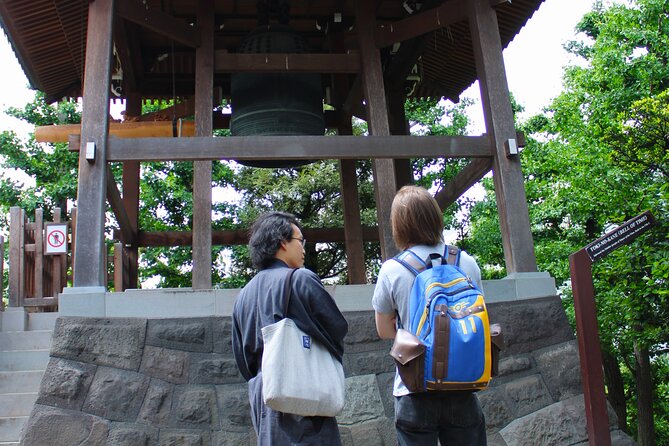
Kaminarimon Gate is the best-known entrance to Asakusa, with its large lantern and strong visual presence. It is also where the district shifts from ordinary city streets into the approach to Senso-ji.
Ryo uses the gate as more than a photo stop. He gives you context for Asakusa and explains what you are seeing as you move into the temple area. That matters because a quick photograph tells you almost nothing about the gate’s role or the way it frames the route ahead.
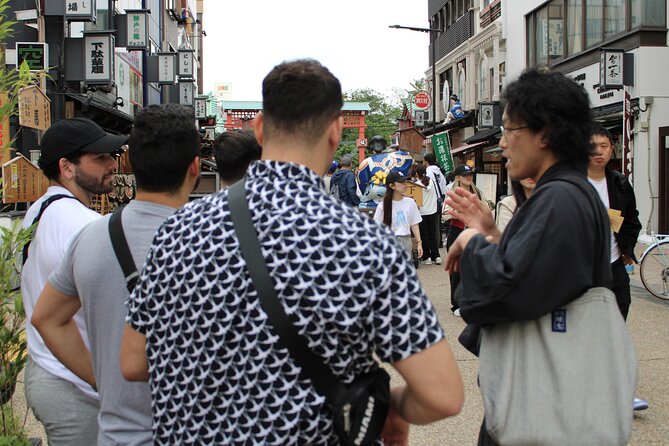
This is one of the busiest points on the walk, so expect people, cameras, and a steady flow through the entrance. The small-group format helps here. With no more than eight people, it should be easier to stay together and hear the guide than it would be in a large crowd.
You will have a chance to take photos, but this is not a dedicated photography tour. Ryo keeps the group moving toward the religious sites and the shopping street.
Same trip, a completely different kind of day:
- 1-Day Tokyo Bus Tour
★ 5.0 · 14,250 reviews - Tokyo: TOKYO SKYTREE® Admission ticket
★ 4.5 · 11,192 reviews - Tokyo: teamLab Planets TOKYO Digital Art Museum Entry Ticket
★ 4.6 · 9,779 reviews - Tokyo: Sumo Show Experience with Chicken Hot Pot and a Photo
★ 4.8 · 6,678 reviews
Nakamise Shopping Street and the story of Senso-ji
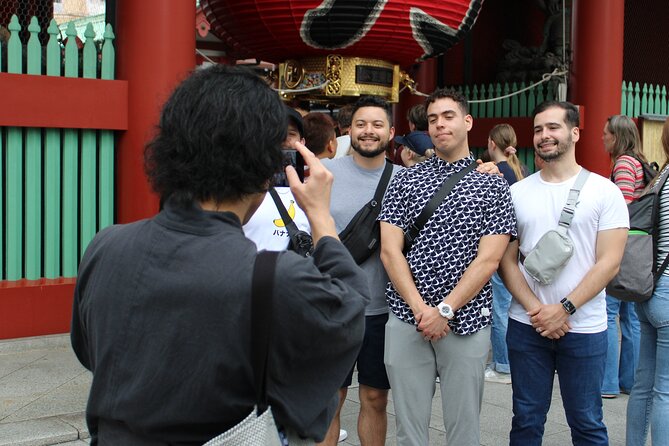
From Kaminarimon, you continue along Nakamise Shopping Street toward Senso-ji. The street is lined with shops and is one of the most recognizable approaches to the temple.
The important point is that this walk does not stop for shopping or food. Ryo explains the street and the temple’s origins, using illustrations to make the story easier to follow. He also gives advice about shopping after the tour, which is more useful than trying to browse while the group is on a fixed route.
If you want souvenirs, snacks, or time to compare shops, plan to return later. That separation works well for me. You get the cultural explanation without losing half the tour to a purchase, but you must accept that the walking portion is not a shopping outing.
Nakamise also helps show how Senso-ji developed as a public place supported by many kinds of people. Ryo explains how the temple was loved and maintained by local communities and by powerful figures from different periods. That gives the street more meaning than a simple row of souvenir stalls.
Asakusa Shrine beside a Buddhist temple
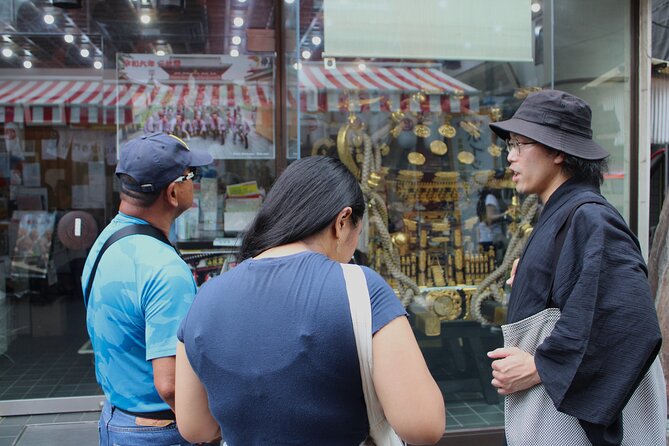
One of the most useful lessons here is the close relationship between Asakusa Shrine and Senso-ji. You see a Shinto shrine beside a Buddhist temple, a pairing that can confuse first-time visitors if nobody explains it.
Ryo uses the setting to discuss Japanese religious views. The point is not to force a simple distinction between two separate worlds. Instead, you learn how Buddhist and Shinto practices can exist side by side in Japanese life.
This is the kind of information that is hard to pick up from a guidebook while walking alone. You can identify a torii gate or a temple hall, but knowing why both traditions appear in the same district changes how you read the site.
The shrine stop also slows the route down for a closer look at the smaller details. You are not only ticking off the two major names in Asakusa. You are learning how the buildings function and why they matter.
Senso-ji and the many statues around the grounds
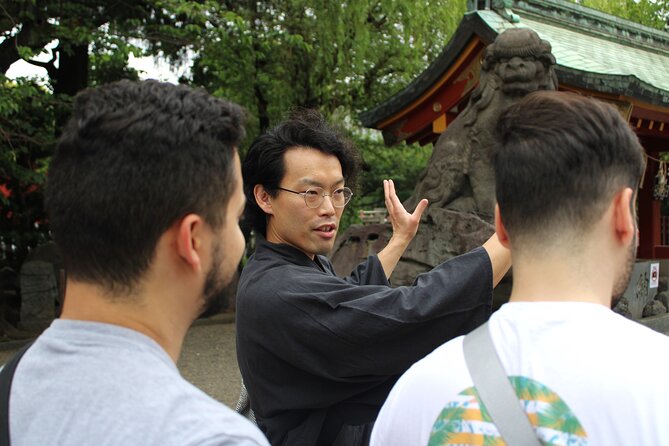
Senso-ji is the main event, and the tour ends at the temple’s main hall. Ryo explains the origin of the temple and places it within the longer story of Asakusa.
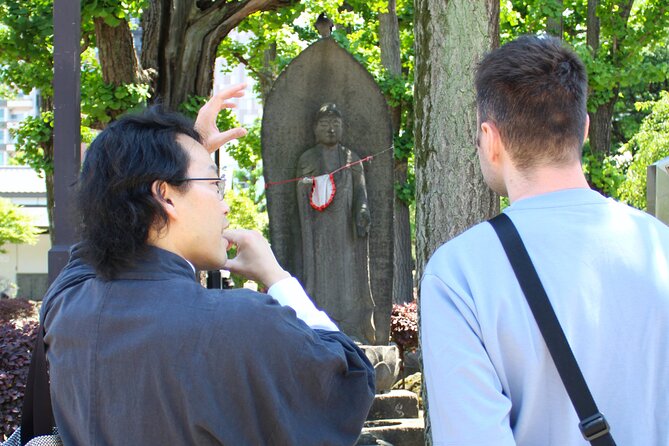
Along the way, he points out other temples, shrines, and Buddhist statues around the area. This is one of the strongest reasons to take the tour instead of walking directly to the main hall. The statues are not just decoration. Ryo explains the significance of different Buddhist deities, giving you a better chance to recognize similar figures during the rest of your Japan trip.
The main hall can be crowded, and 90 minutes does not allow for a slow, private visit. You should see this experience as an introduction to Senso-ji, not a complete study of every building and ritual. After the tour, you can return to spend more time on your own.
The finish at the main hall is practical. You are already in the heart of Asakusa, with Nakamise, the temple grounds, and nearby shops within reach. Ryo does not escort you to the station, but he can point you in the right direction during the walk and offer suggestions for later shopping.
What Ryo adds to the walk
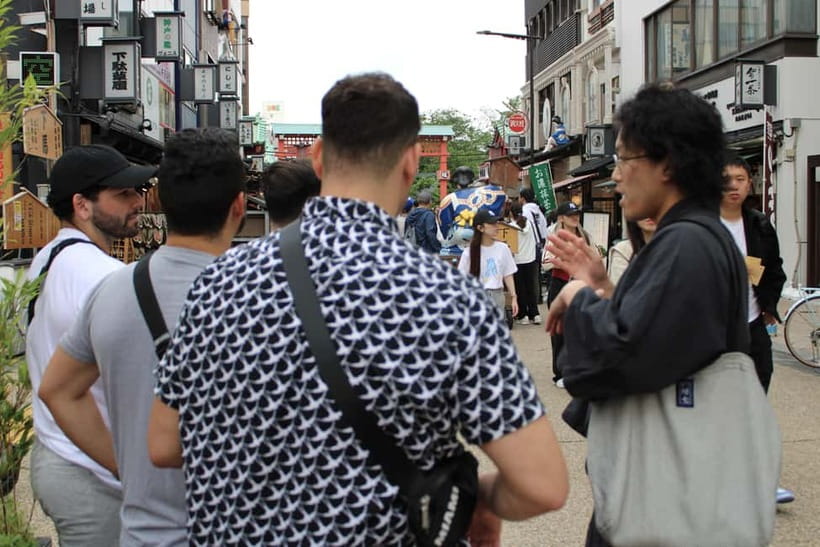
Ryo has six years of experience working in Asakusa as a rickshaw driver. That background matters because rickshaw work puts him in regular contact with the district’s streets, landmarks, and questions from people seeing Asakusa for the first time.
He also performs standup comedy in English. You should expect occasional humor based on Japanese culture and his work as a comedian, not a full comedy show. The humor can make the historical material easier to remember, while the main value remains his local explanation.
The ratings average 4.6 out of 5 from 18 ratings, with especially strong praise for his detail, kindness, cultural explanations, and ability to point out less obvious places. One small-group booking became a private walk, and the participant valued Ryo’s answers about Japanese history and his modest, friendly manner.
The feedback is not uniformly glowing. One person felt the guide was pleasant but not especially enthusiastic, and also felt that many of the main sights were already on their own plan. That is a fair warning. If you have already researched Asakusa closely, this may feel like a guided version of places you intended to see anyway.
For most first-time visitors, though, the added context is the point. You are not paying to enter a hidden attraction. You are paying to have someone explain familiar sights in a way that connects them.
Is $31 a fair price?
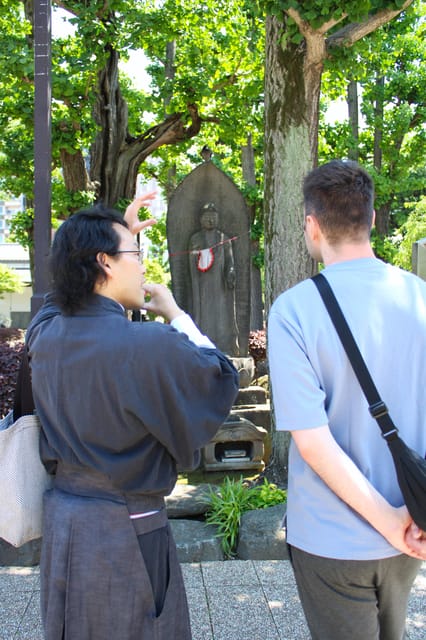
At $31 per person, the tour is priced as a short guided introduction rather than a full-day cultural program. The temples and shrines are the setting, not paid attractions included in the cost. The value comes from Ryo’s time, the small group, the free building view, and the explanations along the route.
I consider that fair if you want structure and local insight. In 90 minutes, you cover the key landmarks without spending hours on a large group bus. You also avoid the work of researching the history of Senso-ji, the meaning of the religious buildings, and the role of the statues.
The value is lower if you prefer to explore slowly, shop as you go, or read about each site on your own. You could visit the same major places without paying a guide fee. The decision comes down to whether you want interpretation and conversation.
The published duration is 90 minutes. One account describes the experience as lasting about two hours, so I would leave a little space before your next fixed booking. The walk covers several stops, and the exact pace may depend on the group.
Who should book this Asakusa walk?
I would recommend it to first-time visitors who want a quick, clear introduction to one of Tokyo’s most important historic districts. It also suits you if you enjoy asking questions, want help understanding Japanese customs, or prefer a small group to a large organized tour.
Families and mixed-age groups may appreciate the short length and the comic element, though the supplied information does not promise a special children’s format. People interested in religious architecture will get more from the tour because Ryo discusses Buddhist deities, Shinto and Buddhist practice, and the origins of Senso-ji.
You should think twice if your priority is food, shopping, or photography. The group does not stop to buy meals or souvenirs, and the route is fixed. You can shop afterward, but that time is not part of the guided walk.
The tour is wheelchair accessible according to the activity details. Since the route includes streets, a park, a shopping passage, and temple grounds, you may still want to confirm current conditions if you have specific mobility needs.
Practical details before you reserve
The tour is offered in English and Japanese, with Ryo as the comedian guide. The group is limited to eight people, which is small enough for direct conversation without requiring a private booking.
You can cancel up to 24 hours ahead for a full refund, and you can reserve now while paying later. The activity details also say you can skip the ticket line, though the experience is a walking tour through public areas rather than a ticketed attraction visit.
Wear comfortable shoes and arrive early. The route includes several sites in a short period, and late arrivals cannot be accommodated. Keep your shopping plans for afterward, when you can follow Ryo’s recommendations at your own pace.
Should you book it?
Book this tour if you want context more than a checklist. Ryo’s strongest contribution is explaining why Asakusa has both a Buddhist temple and a Shinto shrine, how Senso-ji developed, and what the many statues and smaller sites mean.
Skip it if you already know Asakusa well or want an unhurried visit with plenty of food and shopping stops. At $31, it is a sensible buy for a first visit, especially if the idea of a local guide who mixes history with English comedy appeals to you. Start early in your Tokyo stay, then return to Senso-ji and Nakamise afterward for the slower look this short walk cannot provide.
FAQ
Where does the Asakusa walking tour meet?
You meet in front of Tokyo Cruise, the water bus station. It is one or two minutes from Asakusa Station on the Tokyo Metro Ginza Line.
How long does the tour last?
The stated duration is 90 minutes. One participant described the experience as lasting about two hours, so leaving some extra time before your next plan is sensible.
Where does the tour finish?
The walk finishes at the main hall of Senso-ji Temple.
Who leads the tour?
Ryo leads the tour. He has six years of experience working in Asakusa as a rickshaw driver and also performs standup comedy in English.
What languages are available?
The live guide is available in English and Japanese.
Does the tour include shopping or food stops?
No. The route does not stop for food or souvenir shopping. Ryo can recommend places for you to visit after the tour.
How large is the group?
The tour is limited to eight participants.
Is the tour wheelchair accessible?
Yes. The activity information describes the walking tour as wheelchair accessible.
How early should I arrive?
You should arrive at the meeting point five minutes before the start. The tour begins on time and cannot wait for late arrivals.
Can I cancel for a refund?
Yes. You can cancel up to 24 hours in advance for a full refund. You can also reserve now and pay later.
Just added around Tokyo
- Kawagoe Japanese Food Tour : Unagi Kaiseki and Sake near Tokyo★ 5.0 · 30 reviews
- Kawagoe 4hr Private Tour with Licensed Guide (Kawagoe Dep)★ 5.0 · 13 reviews
- Little EDO Sushi Making workshop in Kawagoe★ 5.0 · 18 reviews
- 【R34】Tokyo:Private Daikoku tour in Modified R34★ 4.9 · 92 reviews
- :Tokyo,Shibuya/ Pro Photography in Kimono / English-Friendly★ 5.0 · 26 reviews
- Tokyo:Celebrate Unique Japanese New Year Tradition Festivity★ 3.9 · 20 reviews
- Tokyo: Allstar Food Tour★ 4.7 · 29 reviews
- Tokyo: West-Side Cycling and Food Tour with Guide★ 5.0 · 37 reviews
Walking Tours, compared.

Kyoto Geisha Walking Tour: Gion District & Hidden Gems
Our verdict →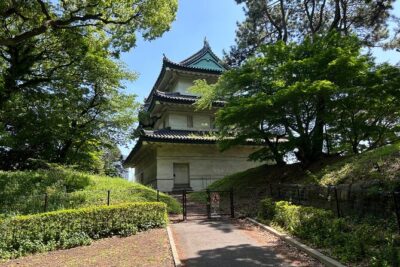
Imperial Palace and Shogun Historical Walking Tour
Our verdict →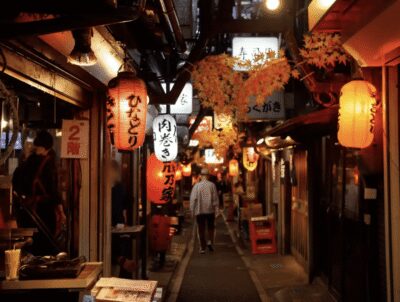
Shinjuku Local Bar and Izakaya Guided Walking Tour
Our verdict →

Nishiki Market Brunch Walking Tour (7 Tastings + Brunch)
Our verdict →
Kyoto Arashiyama Walking Tour: Bamboo, Monkeys, Gardens & Secrets
Our verdict →
Tokyo Castle & Imperial PalaceーShogun Walking Tour
Our verdict →Browse the lists this tour appears in