
Reviewed · CASTLE TOURS
Osaka: Castle History Walking Tour / Castle Tower Admission
Osaka Castle is far more than a photogenic tower. Its real story is written in the triple moats, angled stone walls, and trap-like gates designed to slow an attacking army. This tour helps you read those defenses instead of simply walking past them on the way to the elevator.
I like the focus on military design, especially the explanation of how the largest stone was moved in the 16th century. I also like the separate entrance for the tower, which can save time. The main caution is timing: the advertised duration is 90 minutes, while the detailed route lists several guided portions that can add up to longer, so check the start time and allow room for a flexible visit.
Key points to know before you book

- The castle’s defenses are the main event: You’ll follow moats, gates, sharp turns, and walls built to confuse and expose attackers.
- The largest stone gets a starring role: You’ll hear how enormous stones were transported and spot marks left by individual stoneworkers.
- The tower visit is partly guided and partly on your own: Your guide explains the building’s role, then you have time to explore the museum floors independently.
- The separate entrance matters: Morning departures can help you avoid the longer queues that develop later.
- Hokoku Shrine adds a personal link to Toyotomi Hideyoshi: It gives the castle story a useful human and political center.
- Guide quality is a major strength: Guides including Mao, Spike, Saya, Kaz, Ken, Yuta, and Yu are praised for clear English, warmth, and willingness to answer questions.
Why Osaka Castle makes more sense from the outside in
Many first-time visitors head straight for the tower. That is understandable. The gold details, broad rooflines, and city view make it an easy Osaka landmark to photograph.
The trouble is that the modern tower can hide the older story. Osaka Castle was built as a military headquarters and a final place of defense, not simply as a grand residence. Its outer grounds show that purpose better than the tower museum does.
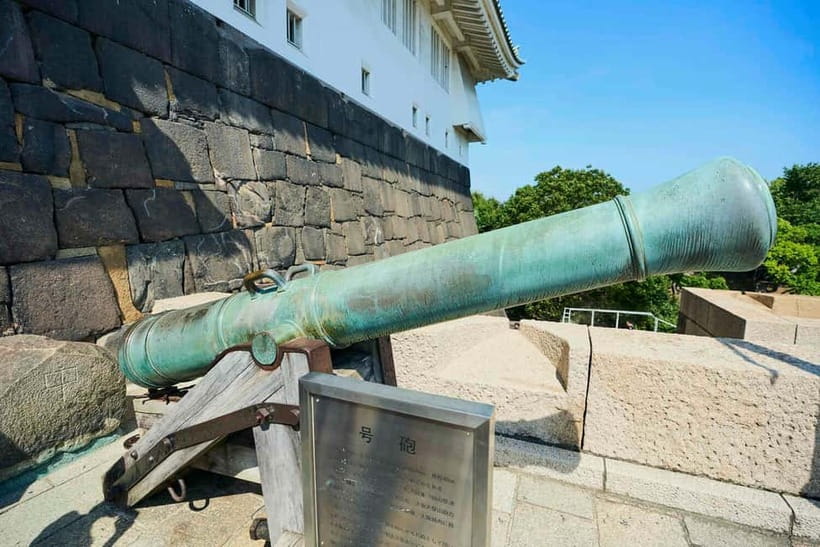
This walking tour begins with the fortress system. You’ll see how one defensive layer led to another, forcing an attacking force to move slowly and lose its formation. The route includes outer moats, multiple gates, and masugata entrances, square-shaped gate areas that made attackers turn sharply before entering.
That turn was not decorative. It gave defenders a chance to fire from several directions while an enemy struggled to find the correct route. The tour also points out zigzag paths that once exposed invaders to arrows and guns.
I find this approach useful because it gives you a simple question to ask throughout the visit: How would an army try to get through here, and how would the defenders stop it? Once you think that way, a massive stone wall becomes a piece of military planning rather than background scenery.
More Castle Tours in Osaka
- Osaka Castle: Museum and Tower Entry Ticket
★ 4.5 · 2,380 reviews - Ultimate Osaka Walking Tour: Castle, Dotonbori & Hidden Gems
★ 5.0 · 862 reviews - Osaka Castle Walking Tour and Castle Tower Admission
★ 5.0 · 561 reviews
Meeting at Lawson S Otemae Rest House Store
The meeting point is in front of Lawson S Otemae Rest House Store. This detail matters because there are several Lawson stores around the castle area. You should check the supplied Google Maps location carefully and look for the Local Guide Stars sign.
Do not rely on the word Lawson alone. The wrong convenience store could put you on the wrong side of the grounds and make a punctual meeting harder.
Wear comfortable shoes. The experience involves walking through the castle grounds, passing historical structures, and moving toward the tower. Weather-appropriate clothing is also sensible, since much of the route takes place outdoors.
The guides are English-speaking, and the group may be small. Some departures have effectively become private tours when nobody else booked, though you should not count on that. The benefit of a small group is the chance to ask about details such as unusual stone markings, Japanese history, or the rivalry between the Toyotomi and Tokugawa families.
Moats, gates, and the castle’s clever traps
The first substantial part of the route looks at the castle from the ground. You’ll study the moats and the way the defenses were layered rather than placed in one straight line.
A moat forced an attacker to stop, find a crossing, and approach under observation. After that came gates and turns. The masugata entrances made attackers pass through one controlled space, change direction, and expose themselves again before reaching the next section.
The tour also explains why the walls are angled. Their broad bases and carefully fitted stones made them difficult to climb. Smooth, sloping surfaces offered few handholds, while the height and scale added another problem for anyone trying to get over them.
This is the kind of information you might miss on a self-guided visit. You can see a wall, admire the craftsmanship, and move on. A guide shows you how the wall worked as part of a system.
Look for marks cut into the stones. These identifying marks were linked to master craftsmen or work groups. They are small details, but they add a human layer to a huge construction project. Instead of imagining an anonymous mass of labor, you begin to see individual teams claiming responsibility for sections of the fortress.
The largest stone and the practical problem of building a fortress
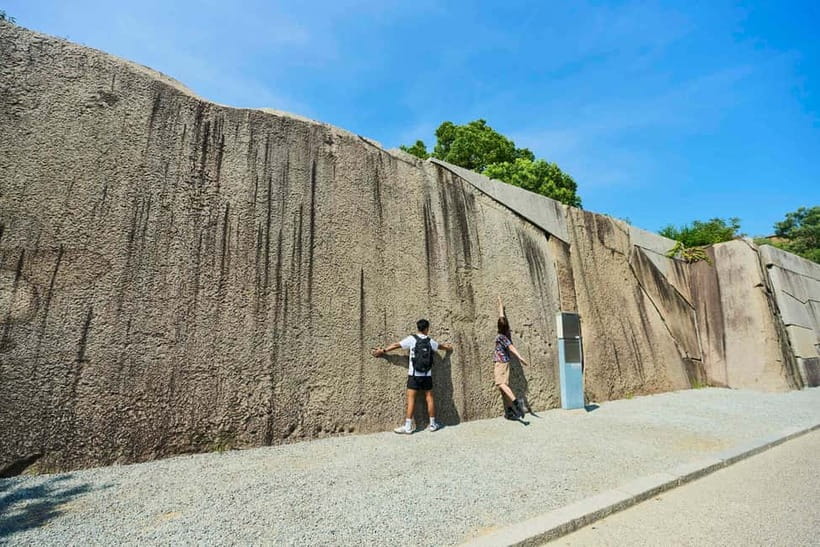
One of the most memorable stops is the castle’s largest stone. The point is not only its size. It is the basic question of how anyone moved such a block in the 16th century.
The explanation of transport methods gives the construction story a practical edge. There were no modern cranes or trucks doing the work. Moving stones required planning, manpower, tools, and control over the route from quarry to castle.
Your guide can also connect the stonework to the larger military purpose. A wall had to be strong, difficult to climb, and impressive enough to affect an opponent’s morale. The huge blocks were structural, but they also sent a message about the power of the ruler who ordered the castle built.
The stop works well for children and adults because the question is easy to grasp: how do you shift something this large? It also gives you a break from names and dates before the tour returns to politics and warfare.
More Historical Tours in Osaka
- Osaka: Osaka Castle & Historical Museum Guided Tour
★ 4.8 · 28 reviews - Osaka Castle & Samurai History Walking Tour
★ 5.0 · 22 reviews - (Ticket Included) Explore Osaka Castle & Museum of History
★ 4.8 · 21 reviews - Osaka: Osaka Castle 3 hours Historical Walking Tour
★ 4.6 · 14 reviews
Hokoku Shrine and the Toyotomi connection
The route includes a guided visit to Hokoku Shrine. This stop helps connect the physical castle to Toyotomi Hideyoshi, the leader whose legacy remains central to Osaka’s identity.
The castle’s story cannot be separated from the contest between the Toyotomi family and Tokugawa Ieyasu. Hideyoshi’s rise, the importance of Osaka, and the later fight over his successor all lead toward the castle’s final crisis.
Hokoku Shrine offers a quieter setting for that political story. You can pause, ask questions, and consider how people remember a historical figure after his power has disappeared.
The shrine may also add cultural details beyond castle warfare. One tour group happened to see a traditional Japanese wedding ceremony there, although that is not a promised part of the experience. Treat it as a possible bonus, not a scheduled feature.
The stop is relatively brief compared with the castle grounds, but it prevents the tour from becoming a pure engineering lesson. Osaka Castle was built by people with ambitions, loyalties, fears, and rivalries. The shrine helps keep that part of the story in view.
Entering the tower by a separate entrance
After the outdoor route, you enter Osaka Castle Tower with the included admission ticket. The separate entrance is one of the clearest practical advantages of booking this experience.
Lines can grow later in the morning. One visitor specifically found a 9 a.m. departure useful because, by the time the tour ended around 11, the line for the castle and elevator was much longer. An early start can also leave you free for lunch and other Osaka sights afterward.
The skip-the-line arrangement does not mean the guide will lead you through every museum floor. Guided explanations cover the castle’s role as command post and last defense, then the tower portion includes self-guided time.
That distinction is important. You are paying for context and access, not a private museum lecture on every level. If you prefer to read every display at your own pace, the arrangement works well. If you want a guide beside you throughout the interior, this is not that type of tour.
The tower’s displays help explain the castle’s later story, but the outdoor walk gives you the strongest sense of how the fortress functioned. The two parts complement each other: outside, you see the defensive machine; inside, you can spend time with the history and exhibits.
Arrow slits, gun ports, and gold used as strategy
The guide points out arrow slits and gun ports, details that make the tower’s military purpose clear. These openings were not random windows. They allowed defenders to attack while keeping much of their own position protected.
You’ll also hear how gold decoration worked as psychological warfare. Gold made the castle look powerful and wealthy, but it also affected how an approaching force judged the ruler inside. The building did not merely resist attack with stone. It projected authority before a battle began.
That combination of force and display is one of the tour’s most interesting ideas. The castle was meant to be hard to enter, but it was also meant to be seen. Its scale and shine could intimidate as much as its walls and moats.
At the top, you’ll get a city view from the castle. It is a fitting reward after following the defensive route below. The view also helps you understand the castle’s position in Osaka, though the tour’s value does not depend on clear weather alone. The military explanations work even on a gray day.
The fall of an apparently invincible fortress
The most important historical turn comes at the end of the story. Osaka Castle fell during the campaigns of 1614 and 1615, despite the defenses that made it appear nearly impossible to take.
The conflict grew from the rivalry between Toyotomi Hideyoshi’s legacy and Tokugawa Ieyasu’s ambition. That contest gives the castle a dramatic ending: a fortress designed to delay and divide an enemy still became the center of a struggle that changed political power in Japan.
The tour does not leave you with the simple idea that strong walls guarantee victory. Fortifications matter, but alliances, leadership, timing, and political pressure matter too. That is a useful lesson for understanding Osaka Castle beyond its postcard image.
A guide can also answer questions about the Tokugawa era, local Osaka history, and new discoveries connected to the site. Several guides, including Spike, Ken, Yuta, Mao, and Kaz, are praised for handling detailed questions and explaining the story in clear English.
Which guide might you get?
The guide varies by departure. The names connected with recent tours include Mao, Spike, Saya, Kaz, Ken, Yuta, Yu, Kat, Ami, Kenta, Sayaka, Kimie, Ukyo, Soy, Tets, and others.
The most consistent strength is not a single personality. It is the guide’s role in pointing out details you would likely miss alone, keeping the group together, and adjusting the pace when needed. Guides have been especially praised for friendliness, clear communication, cultural explanations, and patience with older participants or families.
Some guides are especially lively. Mao is described as warm and passionate, Spike as strong on the castle’s history, and Yuta as easy to talk with and willing to answer nuanced questions. Kaz has been praised for enthusiasm and for adjusting the walk to a group’s needs. These are useful signs if you want a tour that feels conversational rather than formal.
English ability appears to be a strong point across the experience, but accents and speaking styles can vary from one guide to another. The tour suits you best if you enjoy asking questions and listening while walking.
Is $33 a fair price?
At $33 per person, the tour sits above the cost of visiting a site on your own, but the comparison is not simply ticket price versus ticket price.
Your fee includes the Osaka Castle Tower admission, an English-speaking guide, the outdoor route through the defenses, and access through a separate entrance. The main value is the explanation of how the castle works as a fortress. Without that context, you may see moats, gates, and stone walls without understanding their purpose.
The price makes the most sense if you have limited time in Osaka, care about military architecture, or want help organizing the visit. It is also useful for families, since a good guide can turn a long sequence of walls and historical names into a story with clear stakes.
You may find better value elsewhere if you prefer a slow, silent visit or plan to study every museum display independently. The tour does not include a guided explanation of each floor in the castle museum, and the schedule is focused on the main defensive features rather than exhaustive interior coverage.
Timing, pace, and small practical details
The experience is advertised as 90 minutes, with availability depending on the chosen start time. The detailed route describes a 75-minute guided castle section, a 20-minute guided visit to Hokoku Shrine, and another castle section that includes guided, photo, and self-guided time. Those descriptions do not fit neatly into a single 90-minute total, so you should allow some flexibility.
The pace is active but not presented as a strenuous hike. Comfortable shoes are still important because the route is outdoors and includes a good amount of walking.
An early start is a smart choice if available. It can help you reach the tower before queues grow and leaves more of the day open. It may also make the castle grounds feel easier to navigate before later crowds appear, though exact conditions can change.
Free cancellation is available up to 24 hours before the experience for a full refund, and you can reserve now and pay later. Those terms are helpful if your Osaka plans are still shifting.
Who should book this Osaka Castle tour?
Book it if you want the castle to make sense as a military structure, not just a tower with a view. It is especially well suited to history fans, architecture enthusiasts, families, and first-time visitors who want a clear route through a large site.
I would also choose it if you have only a short stay in Osaka. A guide can direct you to the key walls, stones, gates, shrine, and tower without making you work out the layout yourself.
Think twice if you want a fully self-guided museum visit with long stretches of quiet browsing. The outdoor explanations are the heart of the experience, and the tower museum is not guided floor by floor.
For $33, I think the tour earns its keep through the guide and the separate entrance, not through the admission ticket alone. If you book, choose an early departure when possible, confirm the Lawson meeting point, wear good shoes, and come ready to look at the castle as a battle plan.
FAQ
Where does the Osaka Castle tour meet?
Meet in front of Lawson S Otemae Rest House Store. Several Lawson stores are nearby, so confirm the correct location on Google Maps and look for the Local Guide Stars sign.
How long does the tour last?
The activity is advertised as 90 minutes. The detailed route includes several guided and self-guided portions, so allow some flexibility around the stated time.
Is Osaka Castle Tower admission included?
Yes. An Osaka Castle Tower admission ticket is included in the price.
Is the tour offered in English?
Yes. The tour includes a live English-speaking guide.
Does the guide lead you through every floor of the castle museum?
No. Guided tour coverage of each museum floor is not included. The experience combines outdoor explanations, tower admission, and time for you to explore independently.
What does the tour focus on?
It focuses on Osaka Castle’s military design, including moats, layered gates, masugata entrances, zigzag routes, stone walls, arrow slits, gun ports, and the castle’s role as a command post and final defense.
Does the tour visit Hokoku Shrine?
Yes. Hokoku Shrine is included as a guided stop.
What should I bring?
Bring comfortable shoes and clothing suited to the weather. The tour includes walking through historical sites and outdoor castle grounds.
More Walking Tours in Osaka
- Osaka: Hotspots & Hidden Gems Walking Tour Private or Group
★ 4.9 · 1,300 reviews - Osaka Local Foodie Walking Tour in Dotonbori and Shinsekai
★ 5.0 · 985 reviews - Osaka Bar Hopping Night Walking Tour in Namba (3 bars, 6 tastes)
★ 5.0 · 958 reviews - Osaka: Deep Backstreets Walking Tour with Dinner Option
★ 4.9 · 902 reviews
Just added around Osaka
- Exclusive Sushi Making Experience with a Master Chef – Osaka Area★ 5.0 · 25 reviews
- Private Home-Style Cooking Class in Osaka with Local Mom Yoshiko★ 5.0 · 46 reviews
- Hidden Osaka – Yukaku Red Light Tour & Culinary Adventure★ 4.8 · 96 reviews
- Osaka: Walking Tour and Top Highlights★ 4.8 · 104 reviews
- Osaka: Private Ceramic Painting Workshop★ 5.0 · 13 reviews
- Pickleball in Osaka, Kobe & Kyoto with Locals!★ 4.7 · 80 reviews
- Eat Like a Local in Osaka – Private Custom Street Food Tour★ 4.3 · 33 reviews
- Osaka:SUMO BEATS SHOWCASE: Taiko Drum and Wagyu burger!★ 4.2 · 37 reviews
Castle Tours, compared.
Tokyo Castle & Imperial PalaceーShogun Walking Tour
Our verdict →
Japanesel Archery Experience HIROSHIMA CASTLE SHARAKU
Our verdict →
Browse the lists this tour appears in