
Reviewed · TEMPLES & SHRINES
Kamakura Private Tour: Temples, Nature, and the Great Buddha
Kamakura’s best moments are not all found on the main streets. This private tour takes you from the quiet grounds of Jochiji Temple into wooded mountain paths, then down toward the Great Buddha, Hasedera, and the sea. It gives you a useful mix of temples, shrines, nature, and coastal views in about five hours.
I like the private format, which lets your guide slow down for children, older family members, heat, or rain. I also like the route’s variety: you get serene Zen grounds, a fox-linked shrine, the unusual money-washing ritual at Zeniarai Benten, and time by the beach. The tradeoff is clear: this is a mountain walk, not an easy town stroll.
- Jochiji begins the day quietly, with forest, stone paths, and Zen atmosphere.
- The Daibutsu Hiking Course covers at least 5 km, including an uphill mountain pass.
- Zeniarai Benten and Sasuke Inari add local legends and less predictable stops.
- Admission is included at Jochiji, Kotoku-in, and Hasedera.
- The Great Buddha and Hasedera finish the cultural portion, with Yuigahama Beach nearby.
- Guides such as Yu, Yoko, Teiko, Noriko, and Yumi have been praised for adapting the pace and explaining customs clearly.
From Kita-Kamakura into the hills
You meet your guide at Kita-Kamakura Station, a convenient starting point for Kamakura’s northern temple district. The tour is private, so only your group takes part. A minimum of two people is required, and the advertised price is $98.44 per person.
From the station, the route heads first to Jochiji Temple. This keeps the opening calm and gives you a gentle introduction before the trail begins. Your guide can explain the role of Zen Buddhism, local temple customs, and the place Kamakura held during the age of the shogunate.
The tour lasts about five hours, but the listed stops add up to less than that. The remaining time is used for walking between sites, pauses, explanations, and the changing pace of the group. That matters on a hot or rainy day, when the mountain section may take longer than expected.
Jochiji Temple and a quieter side of Kamakura
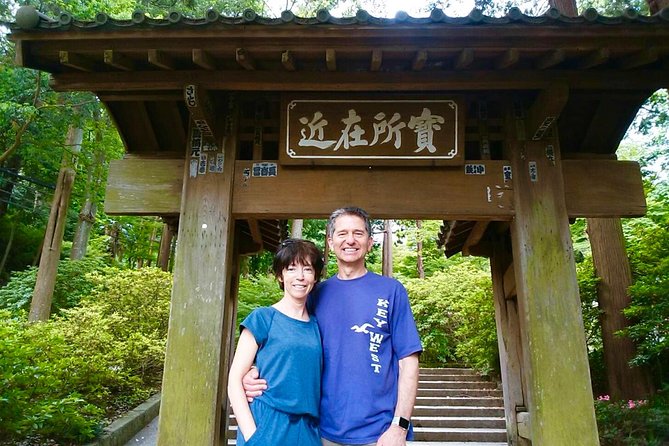
Jochiji was built in 1281 by Hojo Tokiyori to honor his son, who died young. Its setting is one of its main pleasures. Forest surrounds the temple, and the grounds offer a calmer start than the better-known sites closer to the Great Buddha.
You have about 25 minutes here, with admission included. That is enough for a look around and a clear explanation of the temple’s place in Kamakura’s religious story, though not enough for a slow, detailed exploration of every corner.
I especially like this stop because it gives you context before the crowds and larger landmarks appear. It is also a good point to check your shoes, water, and energy. The trail ahead is manageable for people with moderate fitness, but it is not flat.
More Temple & Shrine Tours in Kamakura:
- Tokyo: Kamakura & Enoshima Day Trip including Temple Tickets
★ 4.5 · 1,375 reviews - Kamakura Temples Private Guided Tour from Tokyo
★ 4.8 · 21 reviews - Kyoto: Fushimi Inari, Kinkakuji, Bamboo Grove 1 Day Bus Tour
★ 4.8 · 4,316 reviews
The Kamakura Hiking Trails require real effort
The hiking section lasts about 40 minutes, followed by more walking through the hills. You will pass along the Daibutsu Hiking Course, a wooded route linking the northern part of town with shrines and the Great Buddha area.
The word hiking deserves attention here. You will walk at least 5 km over the full tour, including a mountain pass, uneven ground, and uphill sections. Several experiences went more slowly in hot weather, and one group needed a taxi after a knee injury. Rain can also make the mountain road slippery.
Wear walking shoes with a firm sole. Bring water, protect yourself from the sun, and do not treat this as a casual pavement walk. If you have limited mobility, a recent injury, or difficulty with hills, contact the provider before booking. The private setup helps, but it does not remove the physical demands of the route.
The reward is a greener, quieter side of Kamakura. You get a break from city streets and a chance to connect the temples with the wooded hills around them. On a clear day, the route gives you a sense of why Kamakura works so well as a day trip from Tokyo.
Zeniarai Benten and the money-washing ritual
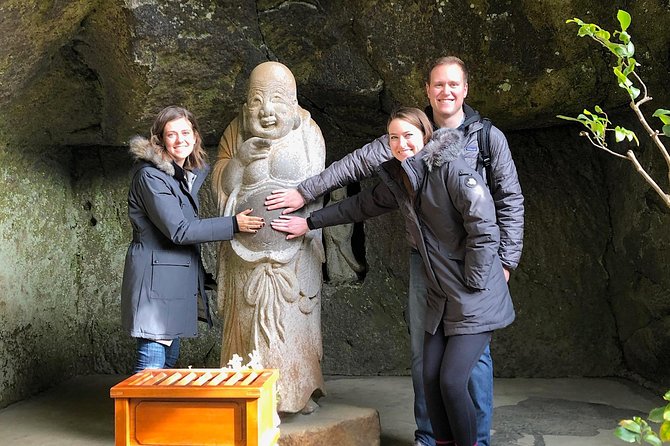
The path leads to Zeniarai Benten Ugafuku Shrine, reached through a mysterious opening in the hillside framed by a torii gate. The setting feels tucked into the rock, and the shrine has a distinctive ritual: visitors wash money in its spring water.
You have about 25 minutes here. The guide can explain the shrine’s traditions and help you understand what you are seeing instead of treating the stop as a quick photo opportunity. The shrine is free to enter, though any personal offerings or purchases would be your own expense.
This is one of the tour’s more unusual stops. It is not simply another large temple with a broad courtyard. The approach, the cave-like entrance, and the money-washing custom give it a different character.
Sasuke Inari connects myth with Kamakura’s first shogun
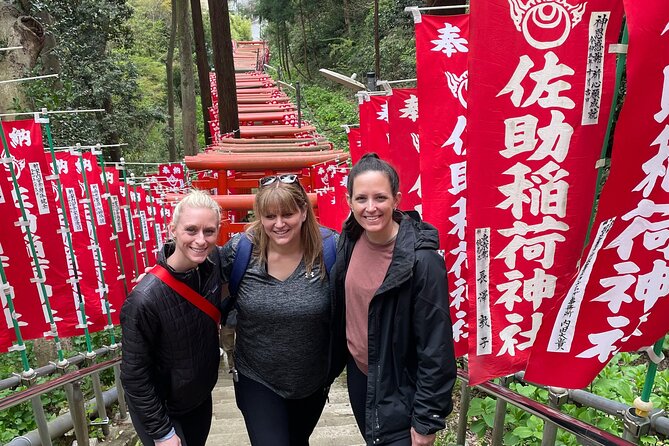
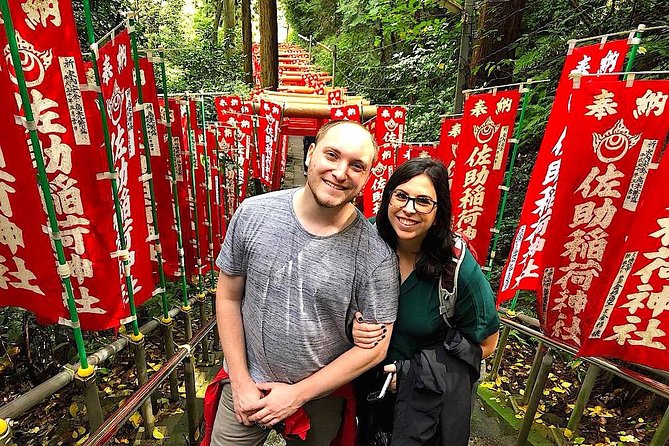
Next comes Sasuke Inari Shrine, a smaller and more atmospheric stop. According to local legend, Minamoto Yoritomo, Kamakura’s first shogun, dreamed of a white fox named Inari. The fox advised him on how to win a battle, and Yoritomo later honored the spirit at this shrine.
The visit lasts about 20 minutes. The story gives your guide a natural way to explain the overlap between local belief, Shinto practice, and Kamakura’s political beginnings. The shrine also fits well with the walking route because it feels tied to the wooded hills rather than separated from them.
You should not expect the same scale as the Great Buddha or Hasedera. That is part of the appeal. The smaller shrines make the day feel less like a checklist of famous monuments and more like a walk through the religious life of the town.
A few more Kamakura half-days worth comparing
- From Tokyo: Kamakura & Enoshima 1-Day Bus Tour
★ 4.5 · 189 reviews - Kamakura Historical Walking Tour with the Great Buddha
★ 5.0 · 129 reviews - Kamakura Walking Tour – The City of Shogun
★ 5.0 · 100 reviews - Kamakura 8 hr Private Walking Tour with Licensed Guide from Tokyo
★ 5.0 · 80 reviews
The Great Buddha is the tour’s major landmark

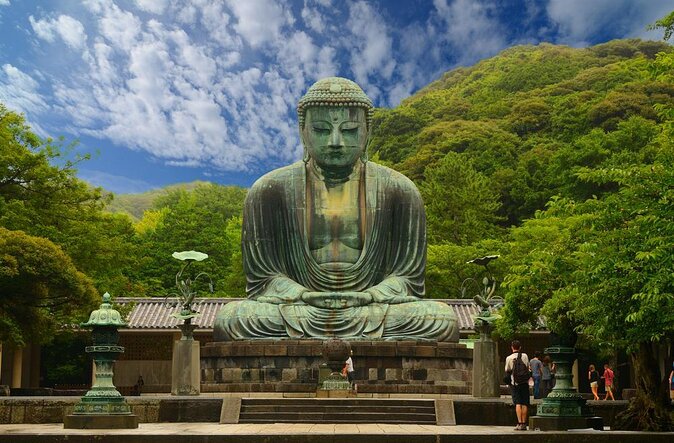
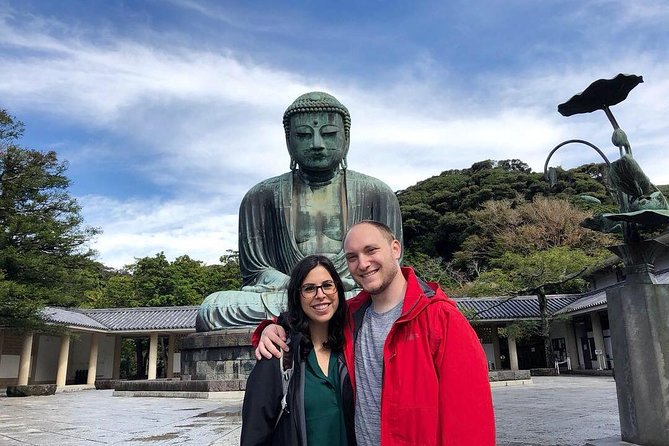
At Kotoku-in, the bronze Great Buddha of Kamakura provides the tour’s biggest visual moment. The statue is 13.35 meters tall and weighs about 121 tons. The bronze figure in its present form dates from 1252.
Admission is included, and you have about 20 minutes at the site. That is enough to see the statue, hear its background, and take photographs. The interior can also be visited when available, though the supplied tour details do not promise a specific inside visit.
The Great Buddha is popular for good reason, but it is also the point where the route can feel more crowded than the forest shrines. Your guide helps put the statue in context, which is useful because its size can otherwise become the whole story.
This is also where the tour shifts from a wooded walk to the more famous southern Kamakura sights. If you have only half a day, pairing the Great Buddha with Hasedera is efficient. You see the landmark most people expect, but you reach it after a route that reveals more of the town.
Hasedera adds gardens, views, and seasonal color
Hasedera sits partway up Mount Kamakura, with views south toward the ocean and Yuigahama Beach. You spend about 30 minutes here, and admission is included.
The temple is known for its gardens, hillside setting, and religious atmosphere. In June and July, hydrangeas add seasonal color to the grounds. The exact display depends on timing and conditions, but summer visitors may find the flowers especially appealing.
The hillside location means more steps and slopes. It is not an ideal place to rush through, yet the tour’s schedule gives you less than an hour. Your guide can help you focus on the main features and explain the temple’s significance without making you decode the grounds on your own.
Hasedera is one of the strongest stops for people who want both scenery and culture. From higher points, you can look toward the coast, then continue down toward the beach. It also gives the day a nice change from the darker forest paths and enclosed shrine spaces.
Yuigahama Beach ends the walk by the sea
The final stop is Yuigahama Beach, where you have about 15 minutes to relax and look south across the water. The beach faces south, so the sea views can be especially pleasant when the weather is clear.
In summer, an open-air market known as Umi-no-ie may be operating. Food and drinks are not included, so budget separately if you want refreshments. The tour ends at Hase Station, and the guide usually accompanies you toward Kamakura Station as well.
This short beach stop works as a gentle finish. After temples, stairs, and mountain paths, you get open space and a chance to rest. Do not expect a long beach visit. Fifteen minutes is enough for a pause and a few photographs, not for a full afternoon beside the water.
A private guide can change the day
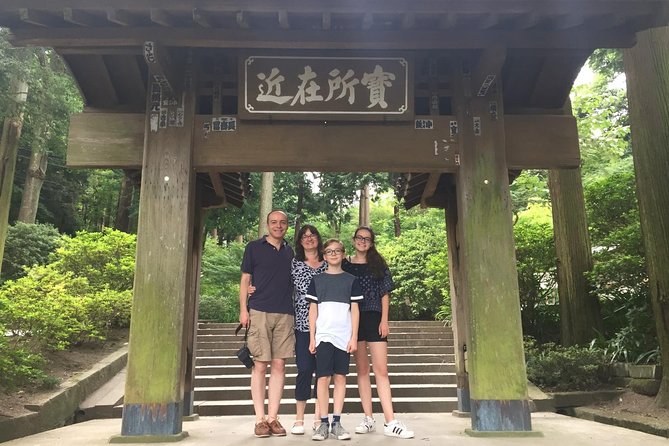
The strongest reason to choose this tour is the guide, not simply the list of sites. Guides named in the supplied experiences include Yu, Yoko, Teiko, Yumi, Noriko, Naho, Naho, Takami, and others. You cannot assume a particular guide will be assigned, but the guide team has experience adjusting the day to the group.
That flexibility matters. Guides have slowed down for heat, helped families with children, assisted an injured participant, and changed the route during rain. One group with older members received an alternative plan that reduced the mountain walking. Another group used trains and buses during persistent rain instead of continuing on the trail.
The private format also lets you ask questions that a fixed group tour may not handle well. Guides have explained Buddhist and Shinto customs, helped with temple etiquette, arranged restaurant suggestions, taken photographs, and accompanied people to the correct station afterward.
The listed price includes an English-speaking guide, taxes and fees, participant photos, and entry to Jochiji, Kotoku-in, and Hasedera. Food, drinks, and private transportation are not included. Hotel pickup is available for an extra 8,000 yen per person.
At $98.44 per person, the value is strongest for two or more people who want help with the route and cultural background. You are paying for a private half-day guide, three admissions, and a route that would be harder to follow on your own, especially if you do not read Japanese trail signs.
The price is less attractive if you mainly want transportation or an easy sightseeing circuit. You still pay your own train, bus, or taxi costs when needed, and you may want to buy lunch after the tour. Extensions cost 1,000 yen per person per half hour, payable in cash.
Who should book this Kamakura tour
I would choose this tour for a couple, family, or small group that wants Kamakura’s major sights with a more personal route. It suits people who enjoy temples but also want woods, local legends, and the beach. Families can benefit from the flexible pace, especially when children need breaks.
It is also a good fit for a first visit from Tokyo. The guide can help connect the train arrival, trail, shrines, Great Buddha, Hasedera, and Hase Station without leaving you to manage every turn.
I would hesitate if you dislike hills, have trouble walking 5 km, or are visiting during very hot weather without a plan for frequent rests. One group found the mountain pass strenuous in 95°F, or 35°C, heat. Rain may also change the hiking portion, and poor weather can lead to a different date or a full refund if the experience is canceled.
Free cancellation is available up to 24 hours before the start time. Changes or cancellations inside that window are not refunded, except when the provider cancels because of poor weather.
Should you book it?
Book this tour if you want Kamakura beyond the Great Buddha and are ready for a genuine hill walk. The private guide, included admissions, trail route, and flexible pace make it a strong choice for families and first-time visitors who value explanation over rushing from one landmark to the next.
Skip it if your priority is a flat, transport-based tour or a long beach stay. For everyone else, this is a well-balanced half-day: quiet Zen grounds first, wooded shrines in the middle, major landmarks later, and the sea at the end.
FAQ
Where does the tour start?
The tour starts at Kita-Kamakura Station in Yamanouchi, Kamakura.
Where does the tour end?
It ends at Hase Station. The guide usually accompanies you toward Kamakura Station afterward.
How much walking is involved?
You will walk at least 5 km, including a mountain pass and uphill sections. Moderate physical fitness is required, and comfortable walking shoes are essential.
Are temple admission fees included?
Yes. Admission to Jochiji Temple, Kotoku-in and the Great Buddha, and Hasedera Temple is included.
Is food included?
No. Food and drinks are not included. Any lunch or refreshments are paid for separately.
Can the tour be changed for bad weather?
The tour requires good weather. If it is canceled because of poor weather, you will be offered another date or a full refund. Guides may also adjust the route during rain.
Just added around Kamakura
- First time in Kamakura? Enjoy a Tour of All Must-sees!★ 5.0 · 15 reviews
- Kamakura Tours Half Day or Full Day Tours with a local guide.★ 5.0 · 12 reviews
- Buddha, Bamboo & Zen – Bespoke Kamakura Private Walking Tours★ 5.0 · 25 reviews
- Your Own HANKO Name Seal Activity in Kamakura.★ 5.0 · 24 reviews
- Exciting Kamakura – One Day Tour from Tokyo★ 5.0 · 40 reviews
- Kamakura Bamboo Forest and Great Buddha Private Tour★ 5.0 · 12 reviews
- Tokyo Yokohama Night View Tour With Kamakura And Enoshima★ 3.5 · 14 reviews
- Tokyo: Day Trip to Kamakura in Spanish – Spanish★ 4.9 · 22 reviews
Temples & Shrines, compared.

Tea Ceremony in a Traditional Tea House in Kiyomizu
Our verdict →
Meiji Shrine, Asakusa, Skytree Bus Tour and Cruise
Our verdict →
Fushimi Inari Hidden Hiking Tour (Private Option Available)
Our verdict →
Osaka/Kyoto:Kinkakuji,Arashiyama,FushimiInariShrine,NaraPark
Our verdict →
Nikko: Kegon Falls, Lake Chuzenji & Toshogu Temple
Our verdict →
Kamakura & Enoshima Day Trip including Temple Tickets
Our verdict →Browse the lists this tour appears in