Reviewed · PRIVATE
Private Highlights of Kyoto Tour
Kyoto’s biggest challenge is not finding beautiful places. It is fitting the city’s far-flung temples, shrines, markets, and old neighborhoods into one sensible day. This private tour tackles that problem with two focused routes, local public transport, and a guide who can explain what you are seeing instead of simply pointing you toward the next gate.
I especially like the chance to travel by train and bus, since you get a practical introduction to Kyoto while moving between major sights. I also like the private format: guides such as Mie, Mia, Chako, Mai, and Hiseko have been praised for clear English, cultural explanations, patience with children, and flexible pacing. The main drawback is the price, $151.20 per person, plus your own lunch, and the day involves plenty of walking.
Key points at a glance
- Two routes cover different sides of Kyoto: Choose the northwest course for Arashiyama, the bamboo forest, Ryoan-ji, Kinkaku-ji, and either Nishiki Market or Nijo Castle. The southeast course focuses on sake, Fushimi Inari, Sanjusangendo, Kiyomizu-dera, and Gion.
- A private guide makes the packed day easier: You receive personal help with public transport, site order, questions, photos, and cultural details.
- The tour begins at 9:00 a.m. near Kyoto Station: Meet at Hotel Granvia Kyoto, beside the JR Kyoto Station Central Entrance.
- Expect a full seven hours on your feet: Temple grounds, stone lanes, steps, and crowded approaches make comfortable shoes essential.
- The one-day bus pass adds practical value: You can continue using it after the tour, giving you another chance to explore Kyoto independently.
- The strongest part is the guiding: Mie, Mia, Chako, Mai, and other guides have been singled out for humor, historical detail, flexibility, and warm conversation.
Why a private Kyoto day works so well
Kyoto is easy to underestimate. On a map, Kinkaku-ji and Arashiyama may look like neighboring stops, while Fushimi Inari and Kiyomizu-dera appear close enough for a quick hop. In practice, Kyoto’s sights are spread across the city, and public transport takes planning.
This tour gives you a person who handles that planning while you watch the city pass by. You use buses and trains rather than traveling in a private car, so you see a little of daily Kyoto along the way. That also means you should expect station entrances, bus stops, transfers, and standing room at busy times.
The group size is capped at eight, though some bookings may be smaller. One couple found themselves with only their guide, which gave them a very personal day. That is the real advantage here: you can ask why a temple looks the way it does, slow down at a favorite spot, or request help with a restaurant or Japanese phrase.
The guides are the heart of the experience. Mie is repeatedly praised for being organized, funny, and good with children. Mia receives high marks for clear English, historical knowledge, and patience. Chako is described as a guide, translator, photographer, and cultural interpreter all at once. These names indicate the quality of guides who may operate the tour, but you should not assume a particular person is guaranteed when booking.
A few more Kyoto half-days worth comparing
- PERFECT KYOTO 1-Day Bus Tour
★ 5.0 · 13,518 reviews - Kyoto: Fushimi Inari, Kinkakuji, Bamboo Grove 1 Day Bus Tour
★ 4.8 · 4,316 reviews - Kyoto: Tea Ceremony in a Traditional Tea House in Kiyomizu
★ 4.9 · 3,519 reviews
Choosing between the northwest and southeast routes
The two options are not simply minor variations. They offer different views of Kyoto, so pick according to your priorities.
The northwest route is best if you want the bamboo forest, Zen gardens, and the famous Golden Pavilion. It includes Arashiyama Park, Bamboo Forest Street, Ryoan-ji, Kinkaku-ji, and a later choice between Nishiki Food Market and Nijo Castle.
The southeast route is the better choice for Shinto shrine gates, sake, Kyoto’s old lanes, and Gion. It includes Gekkeikan Okura Sake Museum, Fushimi Inari-taisha, Sanjusangendo, Kiyomizu-dera, the Ninenzaka and Sannenzaka slopes, and Gion.
The supplied stop list also names both Kinkaku-ji and Kiyomizu-dera, along with Nijo Castle, Sanjusangendo, and the northwest stops. Since the tour description presents two route choices, confirm the exact sequence with the operator after booking. A seven-hour day cannot give every listed stop equal time, especially with public transport and lunch.
Arashiyama and the bamboo forest
On the northwest course, Arashiyama comes first. This is a smart opening because the area is one of Kyoto’s most requested sights and can feel crowded later in the day.
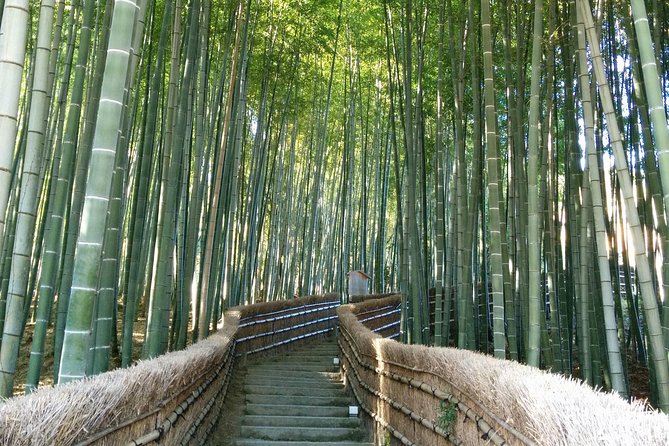
Bamboo Forest Street gives you about 30 minutes to walk among the tall bamboo stalks. It is a short visit, not a long woodland hike, so set your expectations accordingly. The scene is striking, but the path is popular. Your guide can help you understand how this famous walkway fits into the larger Arashiyama area rather than treating it as a quick photo stop.
The area also includes the Togetsukyo Bridge, a large wooden bridge associated with Arashiyama. Depending on timing, your guide may point out the bridge and nearby paths as you move through the district. The combination of bridge, river area, temples, and bamboo gives this route a pleasant change of pace from Kyoto’s dense central streets.
The tradeoff is time. Arashiyama can easily consume a full morning if you want to wander beyond the main path. Here, you are visiting it as one piece of a demanding day.
Ryoan-ji and the quiet logic of a Zen garden
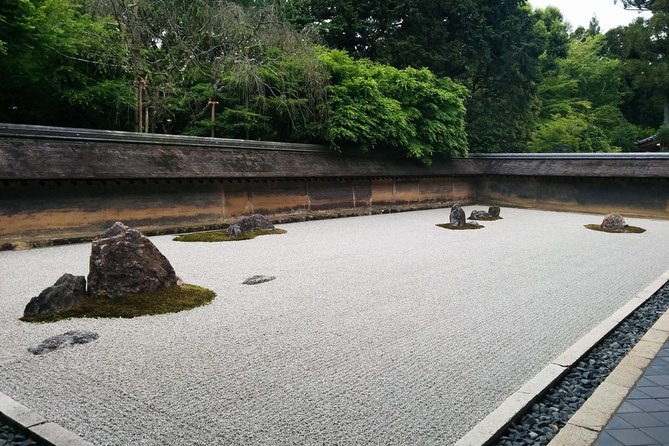
Ryoan-ji is a smaller stop, listed at about 30 minutes, but it can be one of the most thought-provoking. Its famous rock garden uses 15 stones arranged so that the full set cannot be seen from a single viewpoint.
That detail gives your guide something useful to explain. Rather than simply looking at rocks and moving on, you can ask about the garden’s design, Zen practice, and the way Japanese gardens use empty space. The visit rewards close attention more than speed.
If you prefer gardens and architecture to shopping, the northwest route has a strong balance here. The drawback is that 30 minutes may feel brief if you want a long period of quiet observation.
More Private-Only Departures in Kyoto:
- Fushimi Inari Hidden Hiking Tour (Private Option Available)
★ 5.0 · 1,750 reviews - Private Kyoto Tour with a Local, Highlights & Hidden Gems, Personalised
★ 5.0 · 1,543 reviews - Kyoto 6hr Private Tour with Government-Licensed Guide
★ 5.0 · 1,369 reviews - 10 Must-see Spots in Kyoto One Day Private Tour (up to 7 people)
★ 5.0 · 1,108 reviews
Kinkaku-ji, Kyoto’s glittering postcard
Kinkaku-ji, the Golden Pavilion, is one of Kyoto’s most recognizable sights. The three-story pavilion is covered in gold leaf and reflected in a pond surrounded by trees.
You receive about 50 minutes at the temple, with admission included. This is enough to see the main view, walk the grounds, and hear why the building matters. It is not enough for an unhurried exploration of every corner, but most first-time visitors will appreciate the clear focus.
The pavilion is dazzling, yet the setting matters just as much as the gold. The pond and surrounding greenery frame the building in classic Kyoto fashion. Your guide can also help separate the visual appeal from the building’s religious and historical role.
Expect other people here. Kinkaku-ji is popular for good reason, and the visit is more about enjoying the scene than finding solitude.
Nishiki Market or Nijo Castle
Later on the northwest route, you may choose between Nishiki Food Market and Nijo Castle. This is a useful choice because the two stops appeal to different interests.
Nishiki is the pick for food, local ingredients, and a look at Kyoto’s culinary culture. The tour does not include lunch, so the market can be a tempting place to buy food, though you should budget separately and keep the schedule in mind.
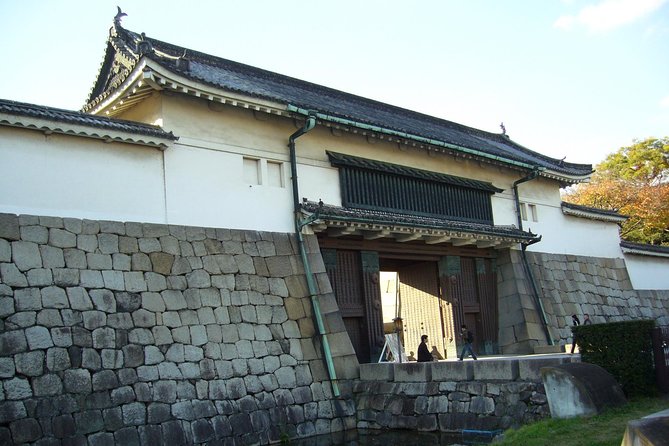
Nijo Castle suits you better if architecture, power, and old interiors interest you more than snacks. It is the only castle in Kyoto built during the Tokugawa Shogunate period at the beginning of the 17th century. The original living quarters of the shogun are the main attraction, with gold leaf and elaborate painted designs.
I would choose Nijo Castle if this is your only Kyoto day and you want a stronger historical contrast with the temples. Choose Nishiki if you want food and street life, or if you have already seen a castle interior elsewhere in Japan.
Gekkeikan and the southeast route
The southeast route begins with Gekkeikan Okura Sake Museum, a stop that adds an important local product to a day otherwise filled with religious sites. You learn about the production of sake, Japan’s rice wine, at a museum connected with one of the country’s oldest sake brands.
Admission is included, and the stop lasts about 50 minutes. The experience is especially useful if you have wondered how sake is made but have not had the chance to visit a brewery museum. The tour information also refers to tasting, though the exact tasting arrangement may depend on the operating conditions that day.
This is a good route choice for visitors who want more than temple photographs. You get a cultural subject you can continue exploring at meals and shops during the rest of your Japan trip.
Fushimi Inari’s red gates
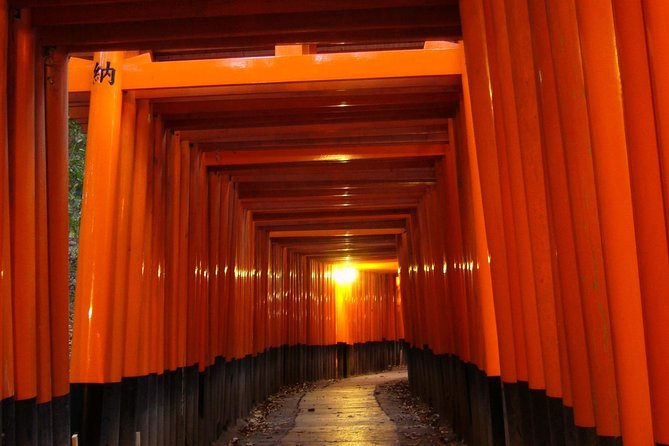
Fushimi Inari-taisha is famous for its thousands of red torii gates, which climb the wooded slopes behind the shrine. Stone fox figures appear throughout the grounds, linking the site to Inari, a Shinto deity associated with rice and prosperity.
The planned visit is about 50 minutes. That is enough to walk through part of the gate-lined route and see the main shrine area, but not enough to hike the entire mountain. If you want to reach the higher sections, you will need more time than this tour provides.
This is one of the most visually memorable stops on the southeast route. It also requires sensible shoes, since the route includes slopes and steps. The guide can explain the meaning of the gates and shrine symbols, which adds much more than a quick solo walk-through.
Sanjusangendo and Kiyomizu-dera
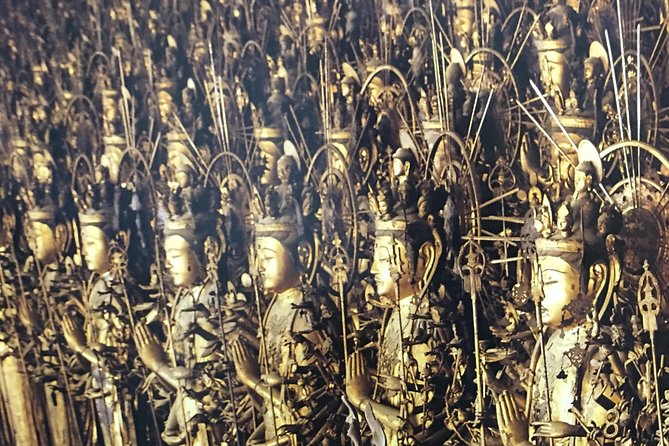
Sanjusangendo offers a completely different indoor experience. Its main draw is the astonishing display of 1,001 Kannon statues. The scale and repetition make this one of the day’s most distinctive temple visits.
You have about 50 minutes here, and admission is included. This stop is a strong reason to select the southeast route if you enjoy religious art and sculpture.
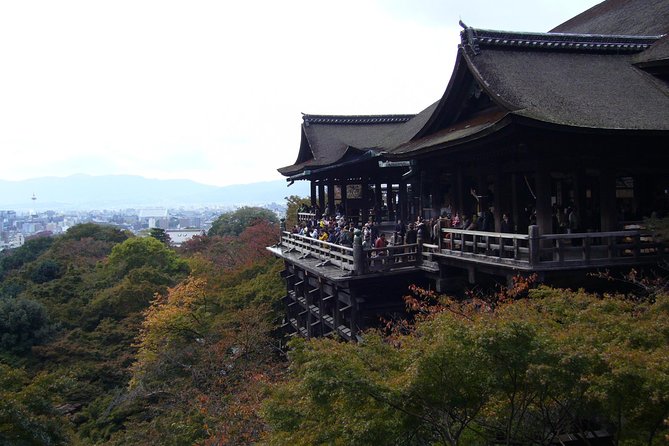
After lunch at your own expense, the tour continues to Kiyomizu-dera. The temple dates to the eighth century and is known for its broad wooden balcony with views over Kyoto. The sight is often printed on postcards, but the real appeal is standing above the city and seeing the view in person.
The approach is part of the experience. You walk up the steep historic lanes of Ninenzaka and Sannenzaka, lined with traditional-looking buildings, shops, and food stops. These streets can be crowded, and the uphill walk is not trivial. The route is rewarding, but anyone with limited mobility should consider the slopes before booking.
Ending in Gion
Both routes finish in Gion, Kyoto’s best-known district for geisha traditions. The tour gives you a useful final setting after a day of temples and transport: narrow streets, traditional architecture, and a chance to continue exploring on your own.
The tour ends around Gion rather than returning you to your hotel. That is convenient if you want dinner nearby or plan to join a separate Gion-focused evening walk at 6:00 p.m. It is less convenient if you need to return to Kyoto Station immediately, so leave time for your own journey afterward.
Your guide may also suggest places to eat. Specific recommendations in the feedback include ramen, okonomiyaki, and off-the-main-road restaurants. Food is not included, but this kind of local advice can add real value to the day.
What the $151.20 price buys you
At $151.20 per person, this is not a budget sightseeing day. The price includes a professional English-speaking guide, public transportation during the tour, admission to several temples and museums, and a one-day city bus pass that you can keep using after the tour.
The value improves for couples, families, and small groups who want personal attention. A private guide can adjust explanations, answer questions, help with a child’s attention span, and recommend lunch. Several accounts describe guides pacing the day around young children and changing the plan to suit personal interests.
The price is harder to justify if you only want transport between famous photo stops. You can visit many Kyoto sights independently for less, provided you are comfortable planning routes, buying tickets, and researching the places in advance.
Lunch and drinks are extra. Hotel pickup and drop-off are not included. Meet at 9:00 a.m. at Hotel Granvia Kyoto near the JR Kyoto Station Central Entrance.
Walking, weather, and practical comfort
Plan for a full day outdoors with frequent walking. The bamboo forest, temple grounds, shrine paths, Ninenzaka, and Sannenzaka all call for comfortable shoes. The tour is described as suitable for most participants and allows service animals, but the steep lanes and steps may be tiring.
The experience requires good weather. If poor weather forces cancellation, you are offered another date or a full refund. You can also cancel up to 24 hours before the start time for a full refund. Confirmation is sent within 48 hours of booking, subject to availability.
A maximum of eight people keeps the group manageable, but the tour remains active and tightly scheduled. Allow time for lunch, since it is not provided, and expect to use public transport with ordinary Kyoto commuters.
Who should book this Kyoto tour?
I would recommend it most strongly to first-time Kyoto visitors who want to see major sights without spending days building a route. It is also a good fit for families, couples, and small groups who value a guide’s conversation and flexibility.
The tour suits you if you want cultural context along with the famous views. Guides have helped with Japanese phrases, explained temple symbolism, suggested restaurants, taken photographs, and kept children engaged. That personal help can make a large city feel much easier to manage.
I would choose the northwest route for bamboo, Zen gardens, Kinkaku-ji, and a choice between food or castle architecture. I would choose the southeast route for red torii gates, sake, sculpture, Kiyomizu-dera, and Gion.
Should you book it?
Book this tour if you have one main day in Kyoto and want a well-organized introduction with a private English-speaking guide. The strongest value is not simply the number of sights. It is the explanations, route help, family-friendly pacing, and chance to ask questions throughout the day.
Skip it if your priority is a slow visit, a low-cost itinerary, or long hikes at Fushimi Inari and Arashiyama. For everyone else, $151.20 is a reasonable premium for reducing the planning burden and seeing a wide range of Kyoto in seven hours, provided you accept the walking, extra lunch cost, and busy schedule.
FAQ
Where does the tour begin?
The tour begins at 9:00 a.m. at Hotel Granvia Kyoto, near the JR Kyoto Station Central Entrance in Kyoto.
How long does the tour last?
The tour lasts approximately seven hours.
What are the two route choices?
The northwest route includes Arashiyama, Bamboo Forest Street, Ryoan-ji, Kinkaku-ji, and a choice between Nishiki Food Market and Nijo Castle. The southeast route includes Gekkeikan Okura Sake Museum, Fushimi Inari-taisha, Sanjusangendo, Kiyomizu-dera, and Gion.
Is transportation included?
Yes. Public transportation during the tour is included, along with a one-day city bus pass that you can continue using after the tour.
Is lunch included?
No. Lunch, food, and drinks are not included, so you pay for your own meal.
Does the tour include hotel pickup and drop-off?
No. Hotel pickup and drop-off are not included. You meet the guide at Hotel Granvia Kyoto and the tour concludes in Gion.
Can I cancel for a full refund?
Yes. You can cancel at least 24 hours before the start time for a full refund. Changes or cancellations made less than 24 hours in advance are not accepted for a refund. If poor weather causes the tour to be canceled, you are offered another date or a full refund.
Just added around Kyoto
- Sekka Cotton Furoshiki Class★ 5.0 · 19 reviews
- Kyoto Sword Experience – includes Museum Ticket/Ninja Experience★ 4.5 · 149 reviews
- Scenic Green Tea Fields of Hidden Kyoto & Local Tea Exp (Private)★ 5.0 · 32 reviews
- Secret Eastern Kyoto Biking Adventure★ 5.0 · 44 reviews
- Private Sake Tasting in Central Kyoto with Sake Sommelier★ 5.0 · 32 reviews
- Samurai School in Kyoto: Samurai for a Day★ 5.0 · 202 reviews
- SHIRAKAWA Japanese Culture Experiences with private English staff★ 5.0 · 16 reviews
- A Privately Guided Photoshoot in Beautiful Kyoto by a Pro★ 5.0 · 18 reviews
Private, compared.
Private Tour to Mt. Fuji and Hakone (Fully Licenced Operator)
Our verdict →
Fushimi Inari Hidden Hiking Tour (Private Option Available)
Our verdict →
Private Kyoto Tour with a Local, Highlights & Hidden Gems, Personalised
Our verdict →
Tokyo Customized Private Tour (Must See Places in 1 Day)
Our verdict →
Tokyo 4hr Private Tour with Government-Licensed Guide
Our verdict →
Tokyo, Shaped Around You: A Private Experience with a Local
Our verdict →