
Reviewed · TEA CEREMONY EXPERIENCES
Kyoto Private Tea Ceremony at a Japanese Inns
The candlelit room is the main attraction here. Inside a traditional Kyoto inn, you spend an evening in a private 20-tatami banquet hall that is normally closed to the public. The setting is quiet, dark, and theatrical without feeling like a stage show. The private room and the after-dark timing give this experience a mood you will not get at Kyoto’s daytime temples.
I like the mix of activities. You get a kimono or haori photo session, a short Zen meditation, a tea ceremony demonstration, and hands-on matcha whisking in less than an hour. I also like the warm, family-friendly hosting by Matsuda and Mayumi, plus the translation devices that let children and adults ask questions in their own language. The main drawback is the short running time: this is an introduction to tea culture, not a long, formal study of every rule and gesture.
Key points to know before booking
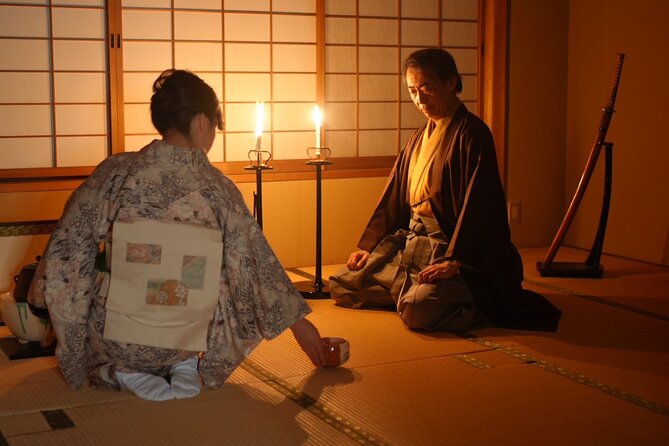
- Candlelit ryokan setting: The ceremony takes place in a private 20-tatami room inside the long-established Ryofuso inn.
- Four-part program: Allow about 15 minutes for dressing and photos, 4 minutes for meditation, 20 minutes for the demonstration, and 20 minutes for making matcha.
- Private group format: Only your party participates, with groups limited to 2 to 6 people.
- Good language support: Translation devices are available, so Japanese is not required.
- Useful for families: Children under 15 are listed at ¥3,000, while the adult price is ¥15,000.
- Easy evening plan: The activity lasts about 59 minutes and ends where it begins in Kyoto’s Shimogyo Ward.
A candlelit evening inside a Kyoto ryokan
Kyoto can feel surprisingly quiet after its major sights close for the night. That is when this activity makes sense. Instead of trying to squeeze in another temple visit, you enter a traditional inn and take part in a small cultural program built around stillness, ceremony, and presentation.
The room is a 20-tatami banquet hall. Tatami gives the space its familiar Japanese feel, while candlelight changes the mood. The darkness helps you focus on the tea utensils, the movement of the host, and the bowl in front of you. It also makes the kimono photographs more dramatic.
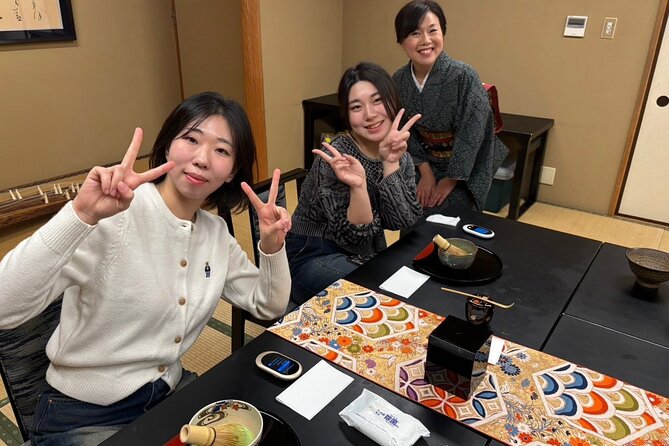
This is not a public group show. Your party of two to six people has the room to itself, which matters when you are asking questions, taking photographs, or trying to copy the matcha whisking technique. A private format also makes the experience practical for families, since children can participate without needing to stay quiet around a large group.
The meeting point is ZEN: Tea Ceremony Experience in Kyoto, at 490 Kanayacho, Ryofuso 4F, in Shimogyo Ward. It is near public transportation, and the activity returns to the same place at the end. Since the session lasts about 59 minutes, you can fit it into an evening without giving up a full dinner or another planned stop.
More Tea Ceremony Experiences in Kyoto
- Kyoto: Tea Ceremony in a Traditional Tea House in Kiyomizu
★ 4.9 · 3,519 reviews - Kyoto: Tea Ceremony Ju-An at Jotokuji Temple
★ 4.9 · 3,207 reviews - Kyoto: 45-Minute Tea Ceremony Lesson Experience
★ 4.3 · 2,378 reviews
Kimono, haori, fans, and a 15-minute photo session
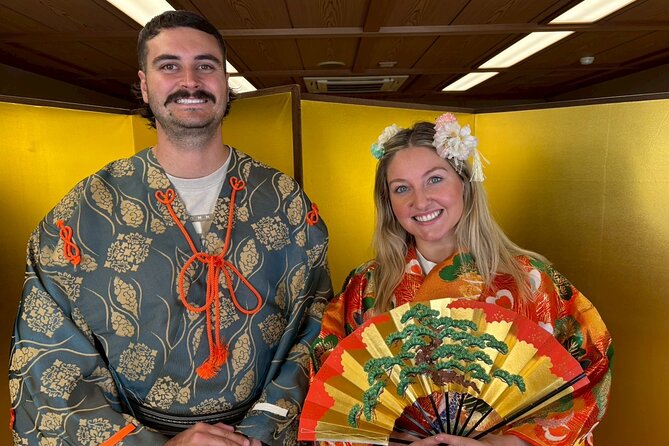
The first section takes about 15 minutes and focuses on clothing and photographs. Depending on your group and the presentation, you can wear a bridal uchikake or a men’s haori. Props include folding fans and swords, and staff help with the photography using professional lighting.
This part is more than a quick costume change. It gives you a visual introduction to Japanese formal dress and creates a clear contrast with the quiet tea ceremony that follows. The props also make the photographs more playful, which can work well for families and mixed-age groups.
You are welcome to take photographs throughout the activity. Staff assist with the pictures, so you do not have to rely only on a phone held at arm’s length. Still, keep your expectations sensible. The listed program provides professional lighting and staff help, but it does not promise a full commercial portrait session or a large set of edited images.
The photo section may be the most active part of the evening. If you prefer tea culture for its calm, you might find the props a little showy. If you want a memorable family picture or a visual record of your time in Kyoto, this opening section adds real value to the price.
Four minutes of Zen to settle the room
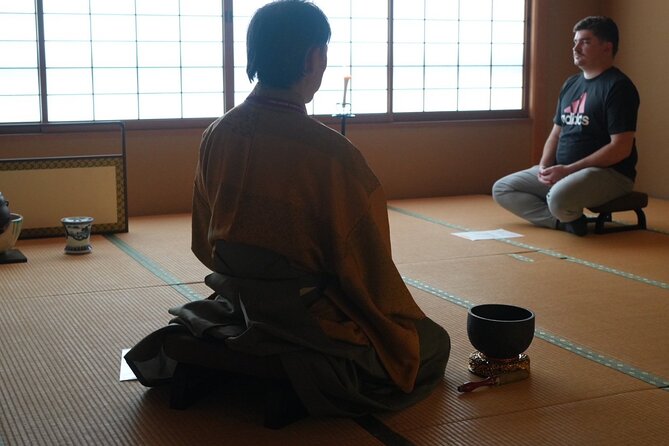
After the photographs, you spend about four minutes in Zen meditation. That is a short period, but it has a useful purpose. It gives you a chance to shift from posing and conversation into the slower rhythm of the tea ceremony.
Do not book this expecting a long meditation class. The four-minute period is a brief introduction, not a full lesson in Zen practice. Its value comes from the transition. You have been handling props, adjusting clothing, and taking pictures. The meditation helps create a clean break before the tea demonstration begins.
The candlelit setting supports this change in pace. You can focus on the room, your breathing, and the quiet movements around you. For children, four minutes is a manageable amount of time. For adults who want a longer spiritual practice, it will feel more like a pause than a complete meditation session.
Watching the tea ceremony as a welcomed participant
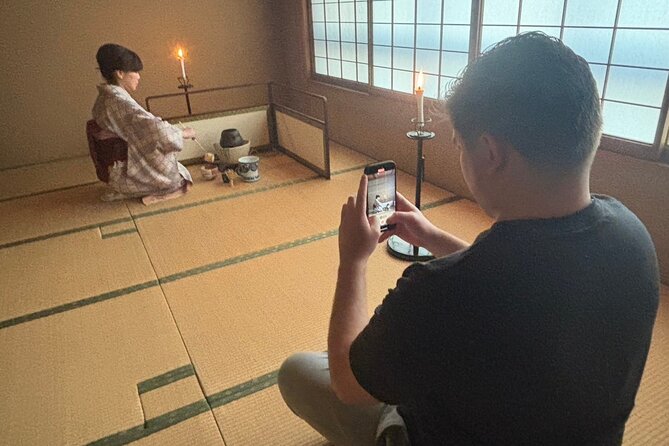
The central demonstration lasts about 20 minutes. You are treated as a participant in a traditional tea gathering, rather than simply watching a performance from a distance. You receive a bowl of matcha and a sweet, and the host shows you the flow of the ceremony.
That distinction is important. A tea ceremony is not only about drinking green tea. The order of movements, the handling of utensils, the presentation of the bowl, and the relationship between host and guest all matter. In a short session, you will not learn every detail, but you can see how these parts fit together.
The demonstration also gives you a chance to observe before you try anything yourself. Watch how the utensils are arranged and how the tea is prepared. Pay attention to the deliberate pace. The ceremony asks you to notice small actions that might seem ordinary in a faster setting.
Matcha has a strong, grassy taste that not everyone enjoys. The included sweet helps balance it, but do not expect a sugary café drink. The value here is the setting and the ritual around the bowl, not just the flavor of the tea.
Matsuda and Mayumi host the experience and help explain what is happening. Translation devices are available, so you do not need Japanese to follow along. This is especially helpful when children want to ask questions in their own language or when a group includes people with different levels of English.
Same trip, a completely different kind of day:
- PERFECT KYOTO 1-Day Bus Tour
★ 5.0 · 13,518 reviews - Kyoto: Fushimi Inari, Kinkakuji, Bamboo Grove 1 Day Bus Tour
★ 4.8 · 4,316 reviews - Kyoto Geisha Walking Tour: Gion District & Hidden Gems
★ 4.7 · 3,273 reviews - Kyoto: Gion Magical Night Walking Tour with Geisha Trivia
★ 4.9 · 2,393 reviews
Making your own matcha for the final 20 minutes
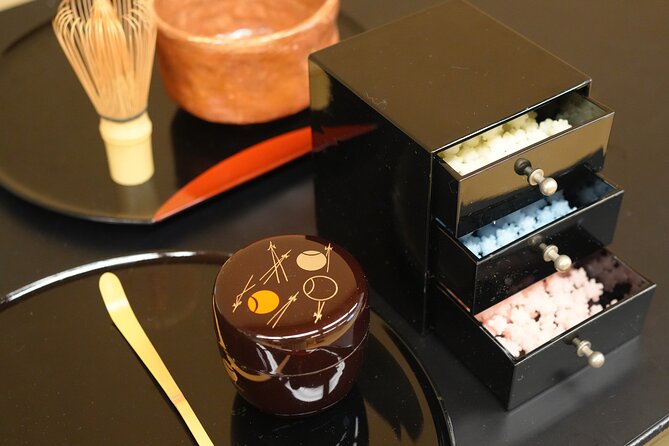
The last major section gives you about 20 minutes to whisk your own matcha. This is where the activity shifts from watching to doing. You receive guidance on using the tea utensils and try to create the drink yourself.
The hands-on section is one of the strongest reasons to choose this experience over a simple cultural performance. You can feel how the whisk works, see the tea change as you mix it, and understand that the final bowl depends on technique. It also gives children something clear to do after the quieter meditation and demonstration.
Your first bowl may not look like the host’s. That is part of the point. You are learning through practice, and the private format lets you take your time and ask questions. Staff can use translation devices to explain the steps, so the language barrier should not prevent you from taking part.
This portion also makes the cost easier to judge. You are not paying only for 59 minutes in a decorated room. You are paying for clothing, guided photography, a demonstration, tea and sweets, utensils, a private space, and direct participation in preparing matcha.
What the private format means for families and couples
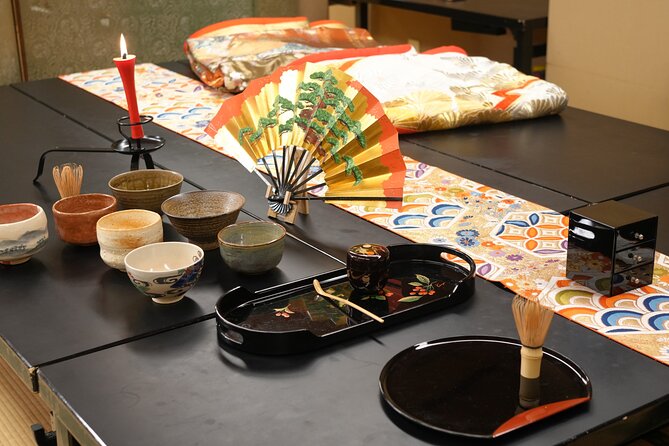
The experience accepts groups of two to six people. That range suits couples, families, and small groups of friends. Since no one outside your party participates, you can shape the evening around your own pace and questions.
Families should pay attention to the pricing. Adults are listed at ¥15,000, while children under 15 are listed at ¥3,000. The online price provided for this experience is $97.98 per person, so check the price shown at the time of booking and confirm how the child rate applies to your reservation.
The program has several different kinds of activity in a short period. Children can take pictures in costume, join the meditation, watch the ceremony, and whisk matcha. Adults who want a serious, highly formal tea lesson may find the family-friendly structure less rigorous than a longer specialist class.
Couples can use the experience as a compact evening cultural stop. The photographs provide a keepsake, while the tea ceremony offers a quieter shared activity. Because the venue is private, you do not have to worry about a stranger’s schedule changing the mood of your visit.
Is ¥15,000 good value for about 59 minutes?

At the adult price of ¥15,000, this is not a cheap cup of tea. The value depends on what you want from the evening. If you only want to taste matcha, the price is hard to justify. Kyoto has less expensive ways to drink green tea.
The calculation changes when you count the full program. You receive costume use, props, staff-assisted photography, Zen meditation, a tea ceremony demonstration, matcha and sweets, a hands-on whisking session, a licensed guide, translation support, and exclusive use of the room for your party.
The program is also convenient. It takes less than an hour, starts and finishes at the same location, and works after many sightseeing sites have closed. That makes it easier to add to a busy Kyoto itinerary than a longer class requiring a half-day commitment.
I would view the price as reasonable for a polished cultural introduction with photographs and private hosting. I would not choose it if your main goal is detailed instruction in tea ceremony etiquette. For that, you would want to compare it with a longer class focused almost entirely on tea preparation and formal procedure.
Practical details that affect your evening
Advance reservation is required, and the experience is often booked about eight days ahead. I would not leave this to the last day, especially if you need a particular evening or are traveling with the maximum group size.
The activity uses a mobile ticket. Confirmation is provided when you book. The meeting point is on the fourth floor of Ryofuso, and the end point is the same place, so allow enough time to find the building and reach the correct floor.
The activity requires good weather under its stated policy. If poor weather causes a cancellation, you are offered another date or a full refund. The same applies if the minimum number of participants is not met.
You can cancel for a full refund up to 24 hours before the local start time. Cancellations or changes made within 24 hours are not refunded or accepted. Keep that cut-off in mind before making a firm evening plan around the session.
Who will enjoy this Kyoto tea ceremony most
I would recommend this to you if you want several cultural experiences in one compact evening. It works particularly well for first-time visitors who want a clear introduction to matcha, kimono, Zen, and the visual style of a tea gathering without committing to a long formal course.
Families are a strong match, thanks to the private room, child pricing, costumes, props, and short meditation. The translation devices are another practical advantage when children or adults are more comfortable asking questions in a language other than Japanese.
Couples and small groups may also appreciate the privacy and photographs. The candlelight gives the evening a special setting, while the hands-on tea preparation keeps it from becoming a passive show.
You may want to skip it if you dislike costume photographs, do not care about matcha, or want a full academic explanation of tea ceremony history and etiquette. The experience is designed as an accessible cultural encounter, not an advanced course.
Should you book this experience?
Book it if you want an atmospheric, private Kyoto activity with a strong visual element and a little hands-on practice. The combination of a historic inn, candlelight, kimono or haori dress, staff-assisted photographs, Zen meditation, tea service, and matcha whisking gives you a lot to do in 59 minutes.
I especially like the language support and the friendly hosting by Matsuda and Mayumi. Those details make the session easier for families and mixed-language groups. The main question is value: at ¥15,000 for adults, you should want more than a drink. If you do, this is a well-focused evening experience. If you want deep tea study, choose a longer and more specialized class instead.
FAQ
Where does the tea ceremony take place?
It takes place at ZEN: Tea Ceremony Experience in Kyoto, located at 490 Kanayacho, Ryofuso 4F, Kyoto, 600-8323, in Shimogyo Ward.
How long does the experience last?
The activity lasts approximately 59 minutes.
What activities are included?
The program includes kimono or haori dressing and photographs, a four-minute Zen meditation, a tea ceremony demonstration, and a matcha whisking session.
Is the activity private?
Yes. Only your group participates, with group sizes limited to two to six people.
Do I need to speak Japanese?
No. Translation devices are available to help with communication.
What is included with the tea ceremony?
Matcha green tea, sweets, tea ceremony utensils, costumes, props such as folding fans and swords, staff assistance with photography, and a licensed guide are included.
What are the listed prices?
Adults are listed at ¥15,000, and children under 15 are listed at ¥3,000. The provided online price is $97.98 per person, so confirm the current amount when booking.
Can I cancel for a refund?
You can cancel at least 24 hours before the local start time for a full refund. Cancellations or changes made less than 24 hours before the start time are not accepted, and the payment is not refunded.
Just added around Kyoto
- Sekka Cotton Furoshiki Class★ 5.0 · 19 reviews
- Kyoto Sword Experience – includes Museum Ticket/Ninja Experience★ 4.5 · 149 reviews
- Scenic Green Tea Fields of Hidden Kyoto & Local Tea Exp (Private)★ 5.0 · 32 reviews
- Secret Eastern Kyoto Biking Adventure★ 5.0 · 44 reviews
- Private Sake Tasting in Central Kyoto with Sake Sommelier★ 5.0 · 32 reviews
- Samurai School in Kyoto: Samurai for a Day★ 5.0 · 202 reviews
- Samurai Performance and Casual Experience: Kyoto Ticket★ 4.5 · 115 reviews
- SHIRAKAWA Japanese Culture Experiences with private English staff★ 5.0 · 16 reviews
Tea Ceremony Experiences, compared.

Tea Ceremony in a Traditional Tea House in Kiyomizu
Our verdict →


World Heritage Kyoto & Nara Uji Authentic Matcha Experience
Our verdict →

Arashiyama Bamboo Forest, Monkeys, Matcha & Temple Tour
Our verdict →
Browse the lists this tour appears in