
Reviewed · SAMURAI EXPERIENCES
Knife Making Experience in Samurai Sword Town
Seki is the kind of Japanese town where a kitchen knife carries centuries of craft in its edge. At the Knife Museum, you work with experienced bladesmiths to polish, sharpen, engrave, and assemble a Damascus kitchen knife, then test it on fresh vegetables. It is a real hands-on workshop, not a quick photo stop.
I like the small-group feel, which lets Sumio, Yoshi, and Hiro give close attention and explain each step with humor. I also like the wider view of Seki: sword history, modern cutlery, a temple visit, lunch, a signed certificate, and a limited-time mini knife souvenir are all packed into one day.
The main consideration is the price, $316.27 per person. That is a serious spend for five hours, and the value depends on how much you care about making and taking home your own blade rather than simply buying one.
Key points to know before booking
- Make your own Damascus kitchen knife: You handle the polishing, sharpening, engraving, and assembly rather than watching a demonstration from a distance.
- Learn from experienced local makers: Sumio, Yoshi, and Hiro guide the workshop, with the bladesmiths bringing decades of practical experience.
- See Seki beyond the workshop: The schedule includes the Seki Swordsmith Museum, Gifu Cutlery Hall, and Seki Zenko-ji Temple.
- Expect a five-hour private activity: Only your group participates, and the tour returns to Sekitomioka Station.
- Take home useful keepsakes: Your finished knife comes with a signed certificate, and a handmade mini knife is included while the limited supply lasts.
- Plan around the train journey: The activity begins at 10:30 a.m. at Sekitomioka Station, roughly 1.5 to 2 hours from Kyoto by train.
Why Seki is the right place for a knife workshop
Seki City has been associated with sword making since the 13th century. That long connection helps explain why this experience feels more grounded than a generic craft class in a major tourist center.
The town is also known for cutlery production today. The visit to Gifu Cutlery Hall puts the workshop into a modern context, showing how old forging and finishing skills remain connected to everyday knives.
You do not need to be a samurai enthusiast to enjoy this. A good kitchen knife is an object you use often, and making one gives you a better sense of the labor behind its balance, edge, and finish. The activity suits curious cooks, craft fans, history buffs, and anyone seeking a hands-on day outside the usual Kyoto and Nagoya routes.
The private format matters. Only your group takes part, so the guides can spend time with each person instead of moving a large crowd through a fixed demonstration. Past groups have included both small parties and larger groups, and the instruction is adjusted to keep the work moving.
More Samurai Experiences in Nagoya:
- Seki: Samurai Knife Making Experience at the Knife Museum
★ 5.0 · 61 reviews - Gifu Samurai Sword Town;Japanese Damascus Knife Making Experience
★ 5.0 · 27 reviews - Tokyo: Samurai Restaurant Show Ticket with 2 Drinks
★ 4.5 · 1,307 reviews
At the Knife Museum, the work begins
The main event takes place at the Knife Museum, where you start making your own knife. The museum also displays unusual and rare knives from around the world, so you get a look at the wider world of blades before focusing on your own.
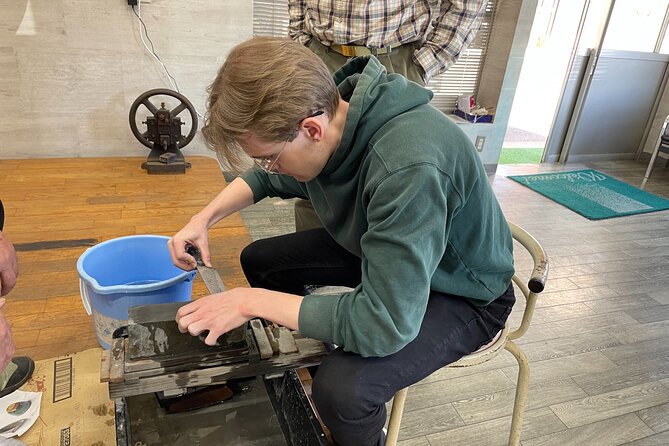
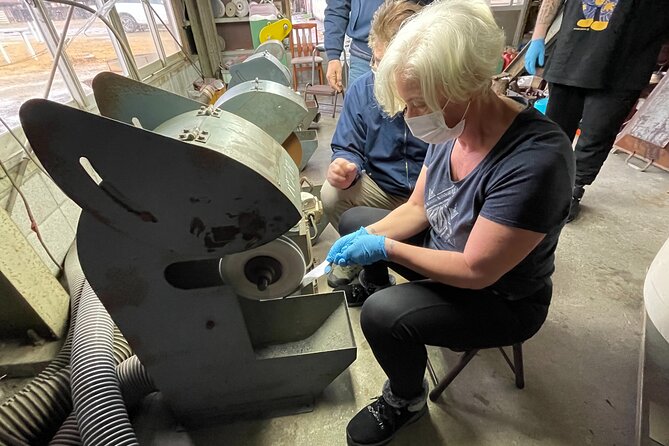
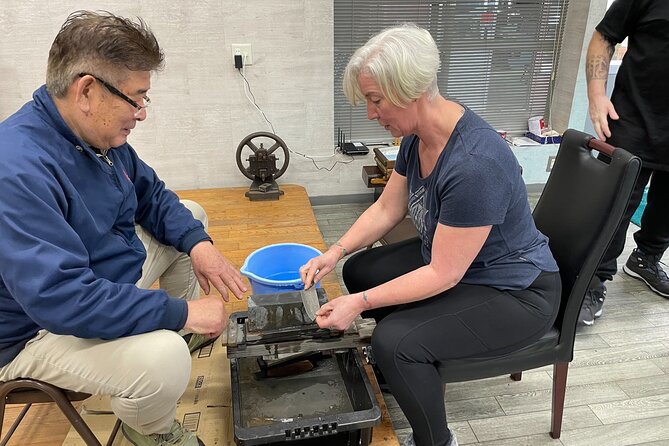
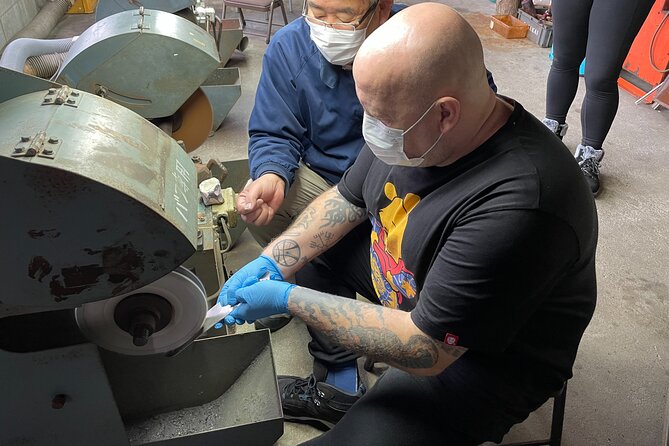
The workshop covers several practical stages. You polish the blade, sharpen it, engrave it, and assemble the finished knife. That list sounds simple, but each stage demands care. A rushed stroke can affect the finish, while sharpening asks you to pay attention to the blade’s angle and edge.
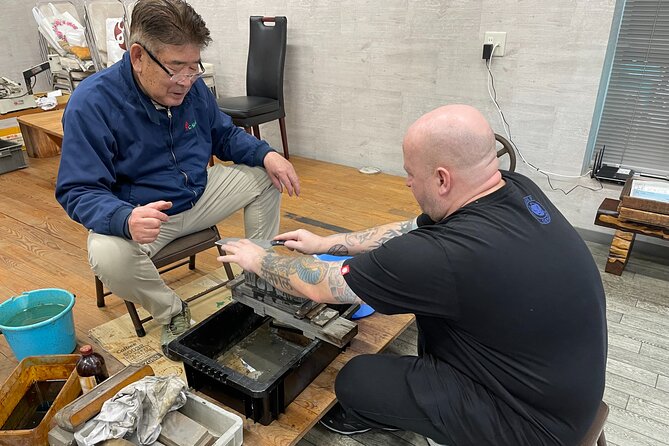
The guides provide the instruction, and the small-group format means you can ask for help as you work. Sumio and Yoshi are brothers, and their passion for the craft is a central part of the experience. Hiro also helps host the activity, and the three guides are described as friendly, clear, and good-humored.
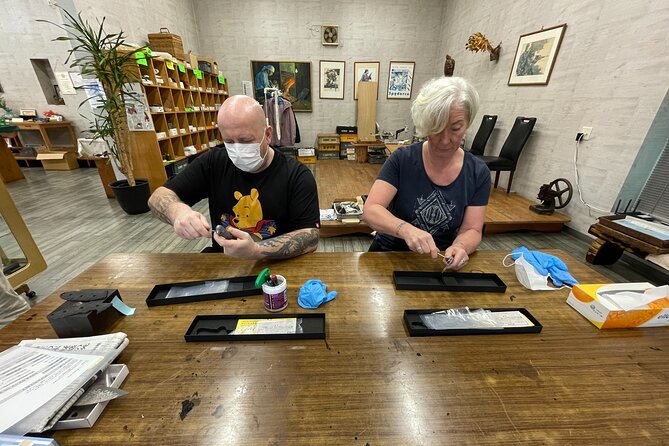
This is not a class where you arrive, press a button, and receive a finished product. You take part in the visible finishing work that turns a blade into a personal kitchen tool. The engraving adds an especially personal touch, although the available information does not specify the exact engraving options, so ask the provider if you have a particular design in mind.
The completed knife is a practical souvenir rather than a decorative trinket. You also get to test its sharpness on fresh vegetables, which gives the workshop a satisfying final step. It lets you see how the finished edge performs instead of simply placing the knife in a box.
A Japanese lunch is included during the day. The details of the menu are not specified, so do not book this expecting a particular dish. Still, the meal helps make the activity feel like a full local outing rather than a short workshop squeezed between train connections.
The Seki Swordsmith Museum adds the historical frame
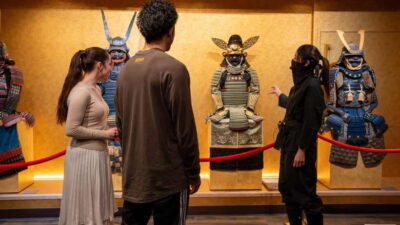
After the knife-making portion, you visit the Seki Swordsmith Museum for about an hour. This stop explains why Seki became one of Japan’s major sword-making centers and how the town’s blade traditions developed.
The museum is useful because the workshop alone could leave you focused only on polishing and sharpening. Here, you can connect those actions to the older sword-making culture of the region. You see the craft in a broader setting, from samurai weapons to the cutlery that Seki produces today.
The museum visit is also a welcome change of pace after two hours of hands-on work. If you are traveling with someone who is less interested in making a knife, this section gives them another way into the subject through objects and history.
The schedule allows about one hour. That is enough for a focused visit, but it is not a full-day museum program. You should see it as context for the workshop, not as the main attraction.
Gifu Cutlery Hall shows Seki’s modern side
The 30-minute stop at Gifu Cutlery Hall is brief but well placed. Seki is described as one of the world’s three major cutlery-producing regions and Japan’s highest-volume cutlery-producing area. This stop shows that Seki’s knife tradition is not frozen in the samurai past.
The hall helps you compare the knife you have just worked on with the wider range of cutlery produced in the region. It also gives you a better sense of the town’s economic identity. Seki is not only a historical sword town. It remains a working center for knives and related tools.
Because the visit lasts only half an hour, keep your expectations in check. You will not have unlimited time to browse every display or carefully compare every product. The stop works best as a compact introduction to the scale of Seki’s cutlery industry.
More Craft Workshops in Nagoya:
- Tokyo Sumo Experience: Chanko & Mochi with a Former Pro
★ 4.8 · 567 reviews - Kintsugi Experience: Art of Golden Joinery in Tokyo
★ 5.0 · 467 reviews - Tokyo Chopstick Making Workshop with Artisan
★ 5.0 · 466 reviews - Tokyo: Matcha Making Experience with Mochi Sweets in Asakusa
★ 4.9 · 388 reviews
Seki Zenko-ji Temple brings a quieter finish
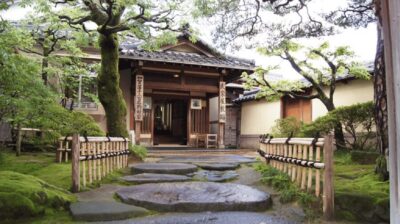
The final scheduled stop is Seki Zenko-ji Temple, with about 90 minutes set aside. The temple’s foundation dates to the mid-18th century, and its Great Bell and Kaidan tour are noted features.
This stop gives the day a different rhythm. After the noise and concentration of knife work, and the museum explanations about swords and cutlery, a temple offers space to look around at Japanese religious architecture and tradition.
You can try ringing the bell, according to the activity details. The temple is not presented as a large landmark complex, so the appeal is in the contrast with the workshop and museums. It rounds out the day with a cultural stop that is not directly tied to blades.
The overall route is thoughtfully varied. You move from making a knife, to learning about samurai swords, to seeing modern cutlery, and then to visiting a temple. None of the individual stops consumes the whole day, which keeps the experience from becoming repetitive.
What the $316.27 price really buys you
At $316.27 per person, this is not a budget activity. You are paying for a private, guided workshop, the finished Damascus knife, a Japanese lunch, entry to the Knife Museum and Seki Swordsmith Museum, the local visits, a signed certificate, and a mini knife souvenir while supplies last.
The value is strongest if you want the making process itself. Buying a knife in Japan would likely be easier and less expensive than spending five hours crafting one. That comparison misses the point, though. The finished blade is tied to your own work, including the polishing, sharpening, engraving, and assembly.
The private setup also helps justify the cost. You are not placed in a large class where an instructor must divide attention among dozens of people. The guides can correct your technique and answer questions as you go.
The limited-time mini knife is a pleasant extra, but I would not make it the reason to book. Availability is limited, and the main value is the knife you make yourself and the time spent learning about Seki.
A signed certificate is included as another reminder of the day. It is useful if you collect certificates from cultural activities, but again, the real souvenir is the finished blade.
Getting there from Kyoto and meeting the group
The meeting point is Sekitomioka Station in Seki, Gifu, and the activity starts at 10:30 a.m. It ends back at the same meeting point. The experience can work as a day trip, with the journey from Kyoto taking roughly 1.5 to 2 hours by train.
That travel time makes the start time important. You will need to plan your train connection carefully and allow enough time to find the station meeting point. Pickup is offered as a feature, but the supplied meeting information identifies Sekitomioka Station as the start, so confirm the exact pickup arrangement before booking.
The activity is near public transportation, and confirmation is provided when you book. Most people can participate, but the workshop naturally involves handling tools and working carefully with a blade. If you have concerns about taking part in the sharpening or polishing stages, ask the provider before committing.
The tour is private, so the people in your group control the pace to some degree. That is useful for families, couples, and friends with a shared interest. It also means you should not expect to meet a large mix of unrelated participants.
Who will enjoy this most
I would recommend this experience first to someone who likes objects with a story and a function. You do not simply bring home a souvenir. You bring home a kitchen knife that you helped finish in one of Japan’s best-known cutlery towns.
It also suits visitors with an interest in samurai culture who want more than a museum display. The sword museum provides the historical background, while the workshop shows how blade skills connect to something you can use in an ordinary kitchen.
The experience is a good fit for couples or small private groups because the guides can offer direct help. The humor and friendly approach of Sumio, Yoshi, and Hiro matter here. Five hours with technical instruction can feel stiff if the hosts are distant, but the available feedback points to a warm, personal teaching style.
I would hesitate to recommend it to someone who wants a quick activity near a central city or who does not care about making a knife. The train ride takes planning, and the price is high for a half-day outing. The day rewards interest and patience, not casual sightseeing.
Practical details that can affect your decision
Wear something that lets you work comfortably for several hours. The exact clothing requirements are not provided, but polishing and sharpening are hands-on tasks, so practical clothes make more sense than dressing for a formal dinner.
Keep your schedule flexible after the start time. The experience is planned for about five hours, and the individual visits have set lengths, but hands-on work can feel more involved than a standard guided tour.
The knife-making portion lasts about two hours, followed by roughly one hour at the Swordsmith Museum, 30 minutes at Gifu Cutlery Hall, and 90 minutes at Zenko-ji Temple. Together, those sections account for the full half-day structure.
Free cancellation is available if you cancel at least 24 hours before the local start time. Changes or cancellations inside that window are not accepted for a refund, so check your train plans before the deadline.
Should you book this Seki knife-making day?
Book it if you want a personal craft experience, a useful Japanese souvenir, and a closer look at Seki’s sword and cutlery traditions. The best part is not simply owning a Damascus knife. It is knowing that you polished, sharpened, engraved, and assembled it with guidance from local makers.
Skip it if your budget is tight, your Japan schedule is already crowded, or you would rather spend the day in a major city. At $316.27, this demands a deliberate choice.
For the right person, the cost and train journey are reasonable tradeoffs. You get a private workshop, local guides, museums, a temple, lunch, and a one-of-a-kind blade in about five hours. That combination makes this one of the stronger choices for anyone who wants to connect Japanese craft with something practical.
FAQ
Where does the experience begin?
It begins at Sekitomioka Station in Seki, Gifu, Japan, at 10:30 a.m. The activity returns to the same meeting point at the end.
How long does the activity last?
The experience lasts approximately five hours. The schedule includes two hours at the Knife Museum, one hour at the Seki Swordsmith Museum, 30 minutes at Gifu Cutlery Hall, and 90 minutes at Seki Zenko-ji Temple.
What do I make during the workshop?
You make your own Damascus kitchen knife. The hands-on work includes polishing, sharpening, engraving, and assembly, followed by a sharpness test on fresh vegetables.
Is lunch included?
Yes. A Japanese lunch is included, though the supplied details do not specify the menu.
What do I take home?
You take home your finished knife and a signed certificate of completion. A handcrafted mini knife souvenir is also included while supplies last.
Can I cancel for a refund?
Yes. You can cancel at least 24 hours before the experience start time for a full refund. Cancellations or changes made less than 24 hours before the start time are not accepted for a refund.
Just added around Nagoya
- Kimono Rental and Tea Ceremony Experience in Inuyama★ 5.0 · 15 reviews
- Gifu Samurai Sword Town;Japanese Damascus Knife Making Experience★ 5.0 · 27 reviews
- Magome & Tsumago Nakasendo Full-Day Private Trip with Government-Licensed Guide★ 5.0 · 20 reviews
- Nagoya: Toyota Commemorative Museum Guided Tour★ 4.7 · 22 reviews
- Nagoya Private Custom Tour with Local Guide★ 5.0 · 15 reviews
- Nagoya: Traditional Japanese Sweets-Making Workshop★ 4.6 · 14 reviews
- Nagoya: Customized Private Tour★ 4.6 · 15 reviews
- From Nagoya: Inuyama Castle, Ena Gorge, Magome, Tsumago Tour★ 4.4 · 18 reviews
Samurai Experiences, compared.


Browse the lists this tour appears in