
Reviewed · KAMAKURA TOURS
Kamakura 4hr Private Trip with Government-Licensed Guide
Kamakura is easy to underestimate. It sits close to Tokyo, yet its temples, wooded hills, old shrine roads, and seaside views feel far removed from the capital. This private tour lets you choose your own small slice of the city, from the 11.4-meter Great Buddha to Hasedera’s hillside views or Hokoku-ji’s narrow bamboo paths.
I like the private format, since you can set the pace and ask for help with trains, temple customs, lunch, or family needs. I also like the local touch: guides such as Shinji, An, Yoshi, and Hiro have helped visitors manage train delays, practice Japanese, choose restaurants, and adjust plans around cherry blossoms or rain.
The catch is that four hours passes quickly. You normally choose only two or three places, admission fees and transport cost extra, and the tour involves walking. If you want to see nearly every major temple in Kamakura, this is not the right format.
Five useful things to know before you book
- Choose two or three sights: Build the visit around the Great Buddha, Hasedera, Tsurugaoka Hachimangu, bamboo, Zen temples, Enoshima, or another listed stop.
- Meet in Kamakura: The standard meeting arrangement is on foot within the designated Kamakura area, commonly at Kamakura Station.
- Use trains and your feet: There is no private vehicle, so the guide helps you handle public transportation and the walking routes between sights.
- Pay entrance fees separately: The price covers the licensed guide, not temple, shrine, train, lunch, or personal costs.
- Expect a genuinely private outing: Only your own group participates, making it easier to slow down for children, older family members, photography, or questions.
- Allow time for crowds: Cherry blossom season and New Year can be very busy, so your guide’s local timing advice matters.
Why a private four-hour Kamakura visit works
Kamakura is not a single sight with a neat entrance and exit. It is a spread-out town with several temple districts, a central shopping street, a beach, and a separate island nearby. You can visit independently, but you need to understand the train lines, walking distances, opening hours, and the difference between a temple and a Shinto shrine.
That is where this tour earns its keep. Your guide can help you choose a sensible pair or trio rather than sending you racing across town. One family used the time for the Great Buddha, a bamboo garden, and Tsurugaoka Hachimangu. Another group chose the Great Buddha, Engaku-ji, the beach, and Enoshima, with the route shaped around a traditional lunch.
The four-hour limit is both a strength and a weakness. It gives you a manageable half-day from Tokyo, but it does not leave room for every stop on the long menu. You will get more from the experience if you decide before meeting the guide what matters most.
The price is listed at $108.99 per person. That is a fair value for a private, licensed guide if you are traveling as a family or small group and want help with transport and cultural context. It is less attractive for a solo visitor on a tight budget, especially after adding train fares, entrance tickets, and food.
A few more Kamakura half-days worth comparing
- Tokyo: Kamakura & Enoshima Day Trip including Temple Tickets
★ 4.5 · 1,375 reviews - From Tokyo: Kamakura & Enoshima 1-Day Bus Tour
★ 4.5 · 189 reviews - Kamakura Historical Walking Tour with the Great Buddha
★ 5.0 · 129 reviews
Meeting at Kamakura Station and setting the route
The tour begins with a meeting on foot within the designated Kamakura area. Kamakura Station is the practical meeting point named for the experience, and it makes sense for a day built around local trains and walking.
This is a useful start for anyone coming from Tokyo, Yokohama, or another part of Japan. A guide can help you get oriented before you head toward the first temple or shrine. One guide met a delayed family after a train accident, while another helped visitors traveling from Yokohama by subway and train.
At the start, tell your guide what you want from the next four hours. You might prefer major sights, quiet temple grounds, religious customs, family-friendly walking, photography, gardens, or a food stop. Some guides bring printed images and other visual material, which can make unfamiliar Buddhist and Shinto symbols easier to understand.
The tour is conducted by public transportation and on foot. There is no private car, so you should wear comfortable shoes and expect ordinary station transfers and town walking. The walking element is part of the experience, but it may be tiring for anyone with limited mobility.
Tsurugaoka Hachimangu, Kamakura’s central shrine
Tsurugaoka Hachimangu is a strong choice if you want an introduction to Kamakura’s political and religious past. The shrine honors Hachiman, associated with Emperor Ojin and with the Minamoto family and samurai tradition.
Its location makes it a natural first or last stop. It is close to the central streets and shopping areas, so you can pair it with Komachi Shopping Street if food, small purchases, and people-watching appeal to you.
The listed stop time is short, but your guide can explain the basic shrine customs and the meaning of what you see. Do not expect a quiet temple garden here. This is one of Kamakura’s best-known places, and the approach can feel busy.
Timing matters greatly around New Year. The first three days can bring very large crowds, and Wakamiya-oji may close to cars, creating a broad pedestrian route. A guide can help you visit at a sensible point in the day, but special holiday conditions still mean slower movement.
The Great Buddha at Kotoku-in
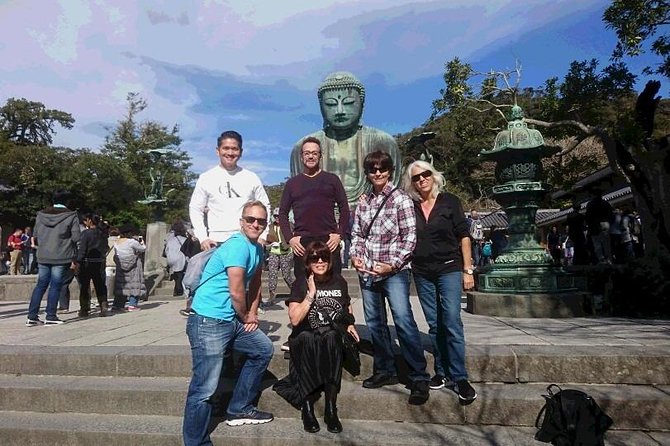
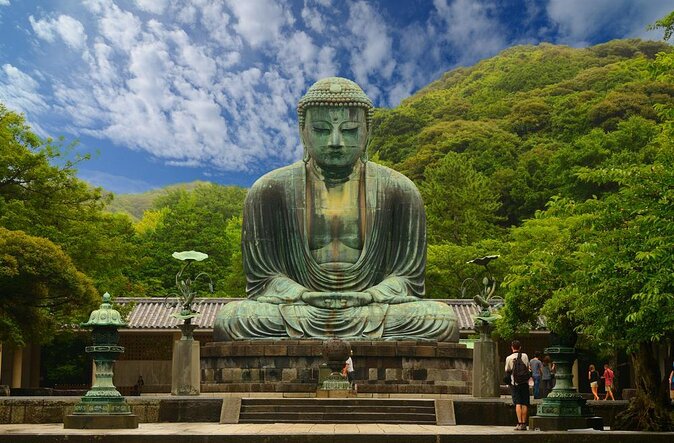
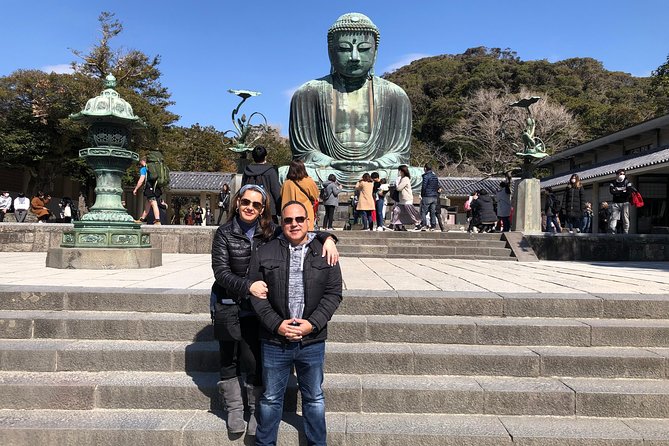
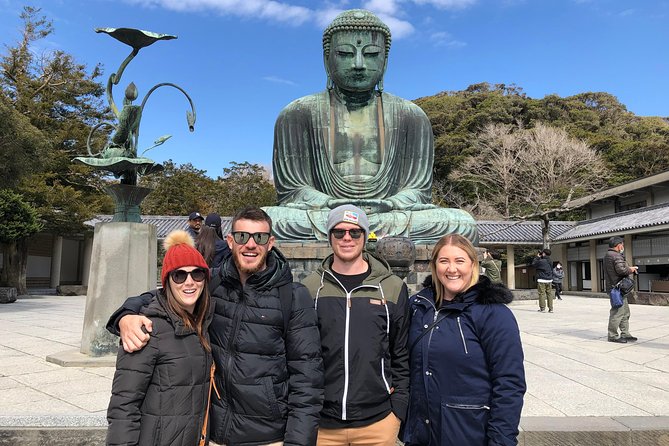
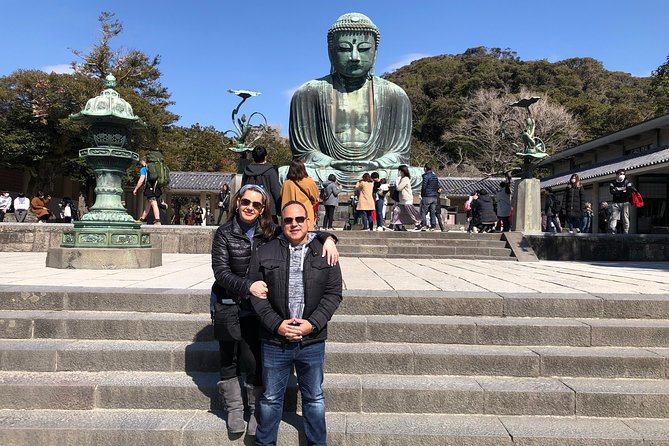
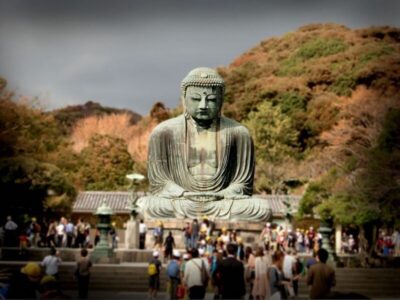
The Great Buddha is Kamakura’s signature sight. The bronze Amida Buddha measures 11.4 meters high and sits within the grounds of Kotoku-in Temple. Its scale is impressive, but the setting is open enough for you to appreciate the figure without needing a long visit.
This is one of the best choices for a first visit because it gives you an immediate sense of Kamakura’s Buddhist identity. Your guide can explain who Amida is and place the statue within the town’s wider religious story.
Entrance is not included, so keep a little extra money ready. The listed stop is brief, which works if you pair the Buddha with Hasedera or another nearby attraction. If you enjoy photography, tell your guide. One visitor used the private format to explore at a comfortable pace while taking pictures.
The drawback is simple: the Great Buddha is popular. At busy times, the grounds may not feel reflective. The statue itself remains worth seeing, but do not mistake a short stop for a full temple visit.
More Private-Only Departures in Kamakura:
- Kamakura Private Tour: Temples, Nature, and the Great Buddha
★ 5.0 · 121 reviews - Kamakura 8 hr Private Walking Tour with Licensed Guide from Tokyo
★ 5.0 · 80 reviews - Kamakura: Private Guided Walking Tour with Local Guide
★ 4.8 · 60 reviews - Kamakura Private & Customizable Tour – All-in-One Experience
★ 5.0 · 49 reviews
Hasedera and the climb to the view
Hasedera is a particularly good choice for people who want more than a single monument. The temple is associated with an eleven-headed Kannon, a 9.18-meter gilded wooden statue linked with mercy. The grounds also rise toward a high point with views across Kamakura.
That climb is one reason I would pair Hasedera with the Great Buddha. The two sights are close enough to make practical sense, and together they offer both a large outdoor statue and a temple complex with height, gardens, and religious art.
You should ask your guide about the walking conditions before choosing it if stairs are difficult for you. The view is the reward, but this is not a flat stop. The listed time is brief, so a full visit may require choosing Hasedera as one of your main two or three sites rather than treating it as a quick add-on.
Hokoku-ji’s small bamboo grove
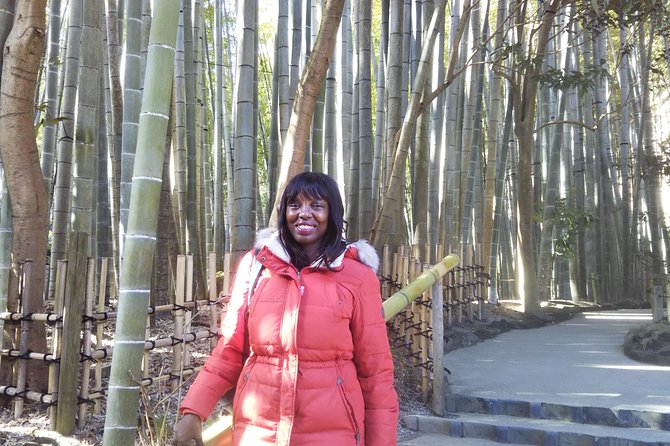
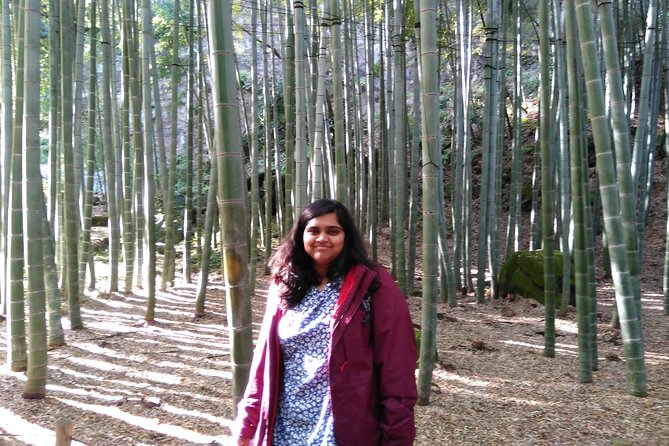
Hokoku-ji is known for a compact bamboo grove behind the main hall. More than 2,000 dark green stalks line narrow paths, creating a very different mood from the open grounds around the Great Buddha.
This is a smart pick if you want a quiet, visual stop and a change from large temple compounds. The grove is not enormous, which is part of its appeal. You walk a short route rather than spending half a day in a giant park.
A matcha stop has also formed part of some customized outings, and one family paired the bamboo garden with tea. Treat that as something to discuss with your guide, not as a guaranteed part of the standard tour.
The main limitation is time. Hokoku-ji is farther from the station area than some central sights, and reaching it by public transport and on foot can use a meaningful portion of your four hours. Choose it because you want the bamboo, not simply because it appears on the list.
The five great Zen temples near Kita-Kamakura
Kamakura gives you several strong Zen choices, and the northern temple area is useful for a more focused religious visit.
Engaku-ji is ranked second among Kamakura’s five great Zen temples. It was founded in 1282 by Hojo Tokimune and is one of the leading Zen temples in eastern Japan. Its grounds offer a sense of scale and calm, but you will need to allow time for the approach and the temple complex itself.
Kencho-ji ranks first among the five great Zen temples and was founded in 1253. It is the oldest Zen temple in Kamakura. If Zen history matters to you, this is a serious choice, though fitting it together with distant sights may be difficult in four hours.
Jochi-ji ranks fourth, while Jufuku-ji ranks third. Tokei-ji is a smaller Rinzai temple near Engaku-ji, and Eisho-ji is the only surviving nunnery in Kamakura. These are better choices for someone who has already seen the headline attractions or prefers less famous religious sites.
You should not try to collect all five in one tour. Pick one or two that match your interest, then let your guide explain the differences. The private setup is most useful here because you can ask about Zen practice, temple design, and the role of each site without keeping up with a large group.
Hills, shrines, and quieter eastern Kamakura
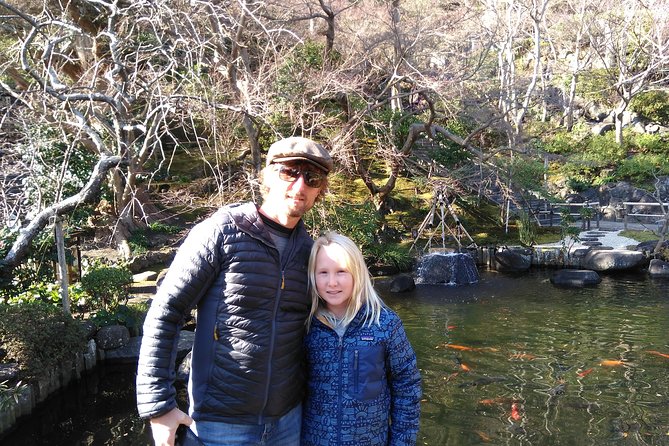
Kamakura’s wooded hills give the town its shape. Several trails connect temples and shrines, and a short walk can change the feel of the day from urban sightseeing to a quiet route through trees.
Zeniarai Benten is one of the more unusual stops. People visit to wash money at the shrine’s spring, since zeniarai means coin washing. It is a memorable custom and a good choice if you want something beyond standard temple architecture.
Meigetsu-in is often called Hydrangea Temple because hydrangeas bloom across its grounds. It belongs to the Rinzai Zen tradition and dates to 1160. The flowers make timing important, but the temple can still appeal outside the main bloom period.
Zuisen-ji lies in a narrow valley surrounded by wooded hills. Jomyo-ji, ranked fifth among the five great Zen temples, sits in eastern Kamakura and was founded by the Ashikaga family. Ankokuron-ji and Myohon-ji are Nichiren temples on the southeastern hills, while Jufuku-ji and Eisho-ji offer more central alternatives.
These places reward travelers who prefer a slower, less obvious route. The tradeoff is transport time. You cannot comfortably combine several eastern temples with Enoshima and the Great Buddha in one four-hour session.
Enoshima and the seaside option
Enoshima is a small island just west of Kamakura, connected to the mainland by a bridge. It has shrines and other attractions, and reaching it requires a short train ride from Kamakura.
Choosing Enoshima changes the day from temple-focused sightseeing to a seaside outing. One family specifically wanted the beach and island, and the guide reshaped the visit around those interests. That is exactly the kind of adjustment this private tour handles well.
I would choose Enoshima only if the coast matters more to you than another temple. The island can use a large share of your four hours once train travel and walking are counted. It is a poor add-on to a packed temple route, but a good main destination for families or anyone needing a change of pace.
What the guide adds beyond directions
A good guide does more than point toward the next station. The strongest experiences described by the guides include explanations of Shinto and Buddhism, help with Japanese food, train assistance, restaurant suggestions, and patient answers to family questions.
Shinji has been especially flexible with last-minute bookings and train delays. An has helped visitors arrange beautiful temple routes and practical details. Hiro has included a local restaurant and helped a child practice Japanese. Yasuho adjusted a family visit during peak cherry blossom season, while Andy used visual material to explain history and religious symbols.
Guide quality can vary. One experience included a comment that stronger English would have helped, so you should keep your questions clear and confirm the plan at the beginning. The provider uses English-speaking licensed local guides, but communication will not be identical with every guide.
The private format also means the guide can join you for lunch if you request that kind of help, though lunch itself is not included. Do not assume every special activity mentioned by a guide is part of the base tour. Ask what fits within the four hours and what costs extra.
Who should book this Kamakura tour?
Book it if you want a flexible introduction to Kamakura and value help with trains, customs, and route planning. It suits families, first-time visitors, photographers, older relatives who need a slower pace, and anyone who would rather ask questions than read every sign alone.
It is also a good choice during busy seasons. Cherry blossoms and New Year can make Kamakura harder to navigate, and a local guide can help you make better use of a short visit.
Skip it if you want a cheap, fully self-guided day or if you plan to spend many hours at one temple. The cost is higher than traveling independently, and you still pay for transportation and admission.
The best strategy is to arrive with a short wish list. Choose the Great Buddha and Hasedera for a classic first visit, Tsurugaoka Hachimangu and one Zen temple for history and religion, or Hokoku-ji and Enoshima for bamboo and the coast.
Free cancellation is available up to 24 hours before the start time. Changes or cancellations inside that window are not accepted, so check your plans before booking.
FAQ
How long is the Kamakura private tour?
The experience lasts approximately four hours.
How many attractions can I choose?
The tour includes a customizable visit to two or three sites from the available options.
Where do I meet the guide?
You meet the guide on foot within the designated Kamakura area. Kamakura Station is the stated meeting point for an easy start.
Is transportation included?
No. Transportation fees are not included, and the tour uses public transportation and walking rather than private transportation.
Are entrance tickets included?
No. Entrance fees are separate. Guide entry fees are covered only for sights listed under the available expectations.
Is lunch included?
No. Lunch and personal expenses are not included.
Is this a private tour?
Yes. Only your own group participates, and you cannot combine multiple tour groups.
Can I visit Enoshima?
Yes. Enoshima is one of the possible stops, but you should discuss the route with your guide because the island requires a short train ride from Kamakura.
What is the cancellation policy?
You can cancel up to 24 hours before the local start time for a full refund. Cancellations or changes made less than 24 hours before the start time are not accepted.
Should you book it?
I would book this tour for a first Kamakura visit when you want the Great Buddha, one or two temples, and a guide who can keep the day practical. The private format is the real value: you can slow down, change direction, ask about religion and food, and avoid wasting your short visit on poor connections.
I would not book it for an ambitious temple marathon. Four hours is best used for two or three well-chosen places, not for trying to conquer all of Kamakura. Pick your priorities, bring comfortable shoes, budget for tickets and trains, and this can be a friendly and efficient way to meet one of Japan’s most rewarding day-trip towns.
Just added around Kamakura
- First time in Kamakura? Enjoy a Tour of All Must-sees!★ 5.0 · 15 reviews
- Your Own HANKO Name Seal Activity in Kamakura.★ 5.0 · 24 reviews
- Kamakura Tours Half Day or Full Day Tours with a local guide.★ 5.0 · 12 reviews
- Buddha, Bamboo & Zen – Bespoke Kamakura Private Walking Tours★ 5.0 · 25 reviews
- Exciting Kamakura – One Day Tour from Tokyo★ 5.0 · 40 reviews
- Kamakura Bamboo Forest and Great Buddha Private Tour★ 5.0 · 12 reviews
- Tokyo Yokohama Night View Tour With Kamakura And Enoshima★ 3.5 · 14 reviews
- Tokyo: Day Trip to Kamakura in Spanish – Spanish★ 4.9 · 22 reviews
Kamakura Tours, compared.
Kamakura & Enoshima Day Trip including Temple Tickets
Our verdict →
Kamakura Historical Walking Tour with the Great Buddha
Our verdict →
Kamakura 8 hr Private Walking Tour with Licensed Guide from Tokyo
Our verdict →
Kamakura Private & Customizable Tour – All-in-One Experience
Our verdict →
Browse the lists this tour appears in