
Reviewed · WALKING TOURS
Hiroshima’s Heart: A 4-Hour Private Storytelling Walk
Hiroshima’s story comes into focus when you connect the city before 1945 with the place it is today. This private walk does that through personal storytelling, moving from a traditional garden and samurai-era castle to Peace Memorial Park and the A-Bomb Dome.
I like the choice of starting at Shukkeien or Peace Memorial Park, and I like that guide Alex can adjust the pace for your group. His clear English, long experience living in Hiroshima, and ability to explain difficult subjects in a calm, approachable way are real assets. The main caution is time: fitting the garden, castle, shrine, park, and museum into four hours can make the day feel full, especially if you want a quiet museum visit.
Key points to know before booking
- A private group of up to six: You get Alex’s attention rather than sharing the walk with strangers.
- Two useful starting choices: Begin at Shukkeien for prewar context, or meet directly in Peace Memorial Park.
- A city-before-and-after approach: Hiroshima Castle and Gokoku Shrine help explain the city before the atomic bombing.
- The museum visit is flexible: Alex may guide you through key sections, or give you an introduction before you explore alone.
- A relaxed storytelling pace: There is time for questions, local perspectives, and moments of reflection.
- Good value for a family or small group: The $209.03 price covers up to six people, though admission fees and transport are extra.
Why this Hiroshima walk works
Many Hiroshima visits begin and end with the atomic bombing. That is understandable, but it can leave you with only part of the city’s story. This walk starts earlier, showing you Hiroshima as a castle town with gardens, shrines, local customs, and ordinary daily life before the events of 1945.
Alex has lived in Hiroshima for more than 20 years. That matters here. You are not simply moving from one monument to the next while memorizing dates. The tour is designed around context, lived experience, and the small details that help you understand how Hiroshima remembers its past while carrying on with daily life.
The private format is especially useful at places where questions matter. You can ask for clarification, slow down at a memorial, or spend less time somewhere that does not suit your group. Families also get more freedom to pause, and a group of six can keep a natural pace without waiting for a large crowd.
The tour costs $209.03 per group, not per person. For six people, that is about $35 per person before admission fees. For two people, it is a much higher per-person cost, but you are paying for a private guide, a customizable route, and four hours of personal attention. I see the strongest value for families, friends traveling together, or anyone who wants more than a standard sightseeing circuit.
More Walking Tours in Hiroshima
- Hiroshima Historical Walking Tour – Why A-Bomb was Dropped
★ 4.8 · 893 reviews - Hiroshima Peace (Heiwa) Walking Tour at World Heritage Sites
★ 5.0 · 872 reviews - Hiroshima City 4hr Private Walking Tour with Licensed Guide
★ 5.0 · 437 reviews
Starting at Shukkeien Garden
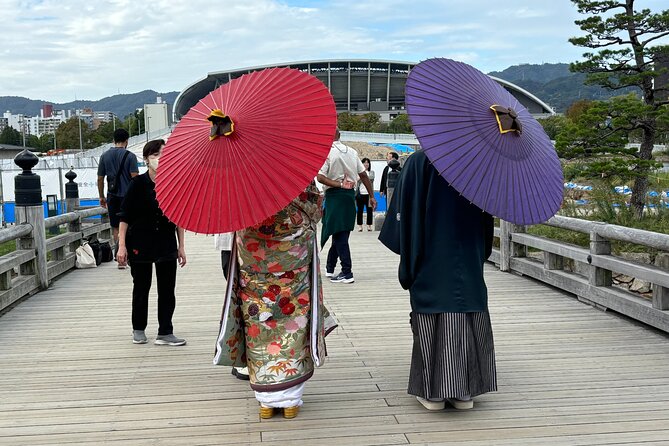
Shukkeien is a gentle place to begin. Its winding paths, ponds, and bridges offer a quiet opening before the more serious parts of the day. Admission is ¥360 per person, and that fee is not included.
The garden gives Alex a natural setting for explaining Hiroshima’s early history and cultural roots. You can expect a slower first hour here, with conversation woven into the walk rather than a rapid list of facts. That is useful if you want to get your bearings before entering the city’s major memorial area.
I like this starting point for first-time visitors who want to understand that Hiroshima was not created by the bombing. It was an established city with traditions, institutions, and a long local story. The garden helps make that clear without forcing the subject too quickly.
The trade-off is practical. If you are most interested in the Peace Memorial Park, beginning at Shukkeien means you spend time walking across the city before reaching the main memorials. The route is intended to connect these places, but you should not expect a short, museum-only visit.
Hiroshima Castle and the city before 1945
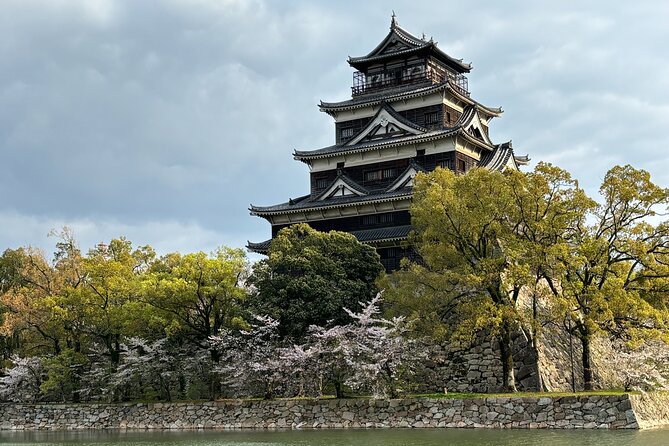
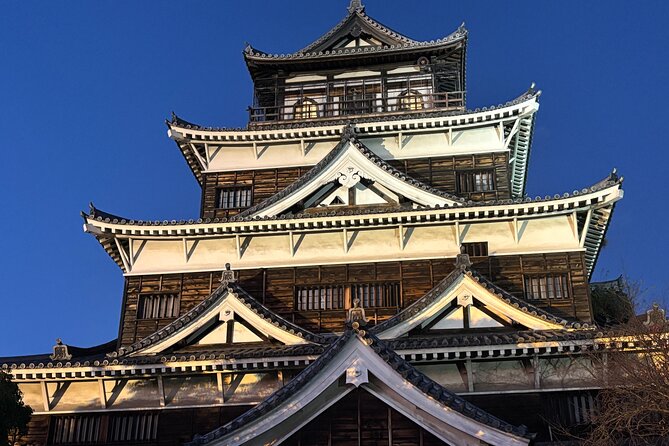
Hiroshima Castle is a reconstructed landmark, but its grounds still help explain the city’s samurai-era center. The original castle was built in 1589, and the area around it offers a useful contrast to the memorial sites later in the walk.
The visit lasts about 30 minutes and has no admission fee for the grounds listed here. Alex uses the castle to discuss how people lived before 1945 and how the area changed after the bombing. That link is the point. You are not stopping for a castle photograph alone.
A reconstructed building can never give you the complete physical past, so keep your expectations sensible. The value lies in location and explanation. With Alex, the castle becomes part of a before-and-after story rather than an isolated sightseeing stop.
For families, this section can provide a needed change of tone after the quiet garden. Children may find the castle setting easier to engage with than a memorial, while adults can begin to see how much of Hiroshima’s identity existed before the wartime destruction.
A quiet pause at Gokoku Shrine
Hiroshima Gokoku Shrine adds a different kind of context. This is a Shinto shrine connected with local tradition, rituals, and festivals. The visit takes about 30 minutes and admission is free.
I like having the shrine in the route because it shows everyday spiritual life rather than focusing only on major historic events. You can ask about customs, local observances, and how a shrine fits into the city. That makes the walk feel more connected to present-day Hiroshima.
This stop is also a useful pause before entering Peace Memorial Park. The subject matter becomes heavier from here, and the shrine gives you a calm space to reset. If your group is not interested in religious or cultural sites, this may feel less essential, but Alex can explain why it belongs in the larger story.
Same trip, a completely different kind of day:
- Peaceful Hiroshima & Miyajima UNESCO 1 Day Bus Tour
★ 5.0 · 5,309 reviews - Hiroshima: Hiroshima and Miyajima UNESCO Sites 1-Day Tour
★ 4.9 · 2,330 reviews - Hiroshima / Miyajima Full-day Private Tour with Government Licensed Guide
★ 5.0 · 1,298 reviews - Osaka/Kyoto: Hiroshima Miyajima Bus Tour & Shinkansen Ticket
★ 4.7 · 919 reviews
Following the Peace Line into Peace Memorial Park
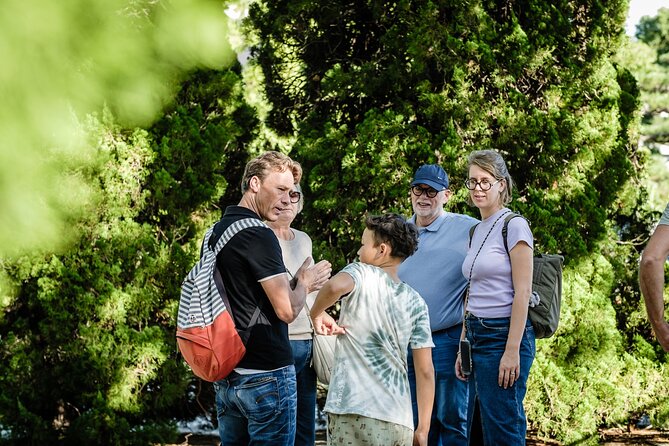
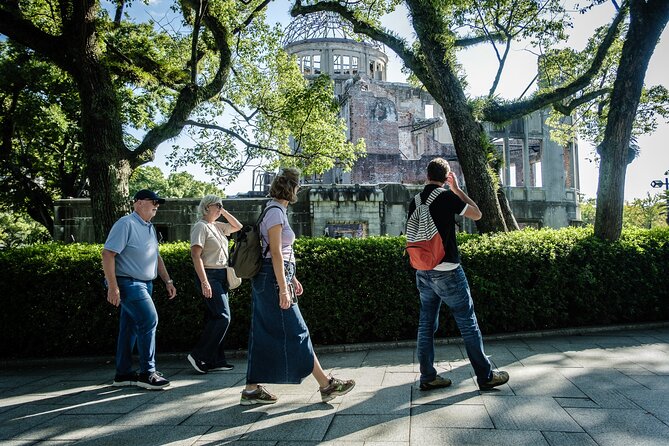
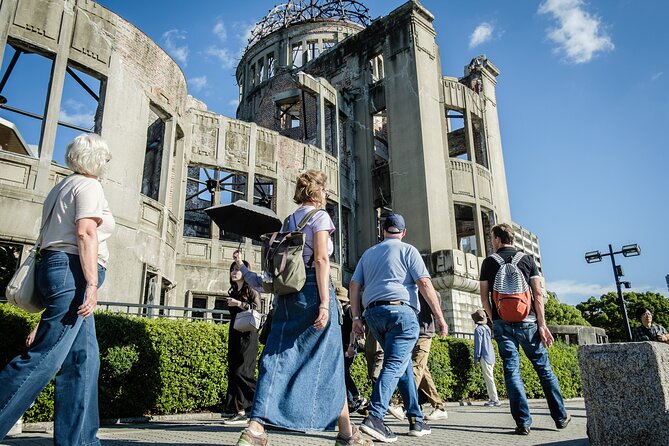
The tour then turns toward Peace Memorial Park, the emotional center of the walk. You visit major monuments, including the A-Bomb Dome and Children’s Peace Monument, while Alex provides historical background and stories connected with survivors and local families.
The park visit is scheduled for about one hour, though the exact balance depends on your questions and whether you spend more time at the museum. The key advantage of a private guide is that you can stop when something prompts a question instead of simply following a fixed group timetable.
The A-Bomb Dome is one of the most recognizable sights in Hiroshima. Its damaged structure is powerful, but the setting can also make it easy to move past without understanding what you are seeing. Alex’s role is to connect the building to the city and to the people affected by the bombing.
The Children’s Peace Monument brings a more personal focus. It is tied to the memory of children who died or suffered after the bombing, and it helps explain why paper cranes and children’s memorials are such important parts of Hiroshima’s peace message.
This is not a light sightseeing stop. You may want time to look quietly rather than talk. Alex’s relaxed approach is suited to that, but remember that a four-hour schedule still has limits. Tell him if you prefer fewer explanations and more private time at the monuments.
The A-Bomb Dome and Peace Memorial Museum
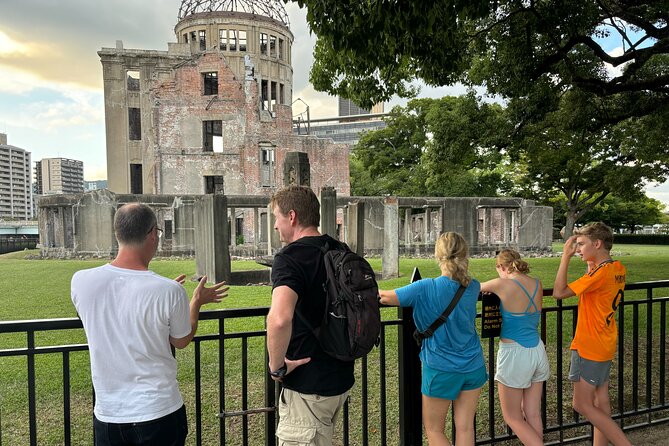
The Peace Memorial Museum is planned as the final major stop, with about one hour allocated to it. The entrance fee is ¥200 per person and is not included.
Alex may guide you through key sections when conditions allow. If the museum is crowded, or if you would rather take it in quietly, he can provide an introduction and let you explore on your own. That flexibility is important because the museum is emotionally demanding and people absorb it at different speeds.
You should not expect a private museum tour under every circumstance. The description makes clear that the level of guidance depends on crowding and your preference. I consider that a strength, not a weakness. Some people want dates, context, and help putting the exhibits in order. Others need silence and personal space.
The museum visit can also stretch the schedule. If you spend a full hour here, the earlier stops may need to remain close to their planned lengths. If the museum is your main reason for booking, tell Alex at the start and ask him to shape the route around it.
Alex’s guiding style and communication
Alex is described as an English-speaking local guide, and his communication is one of the strongest reasons to consider this experience. Feedback about his tours repeatedly points to clear English, an easy manner, and explanations that are straightforward rather than academic.
He also speaks Dutch, which may be useful for Dutch-speaking visitors. More broadly, his style appears flexible and personal. He has adjusted meeting times, met people at their hotel when needed, and offered suggestions for food and further activities in Hiroshima.
That does not mean every extra request is guaranteed. Transportation, meals, and admission fees are not part of the price. Still, the included recommendations can help you use the rest of your stay well, especially if you want advice on local food or what to do after the walk.
Families should take note of the group feedback. A family of six completed the route and found that the children stayed engaged through the castle, city walk, and museum. That suggests Alex can keep the conversation accessible for mixed ages, though the amount of walking and the museum’s subject matter may still be tiring for younger children.
Four hours on foot: what the pace means
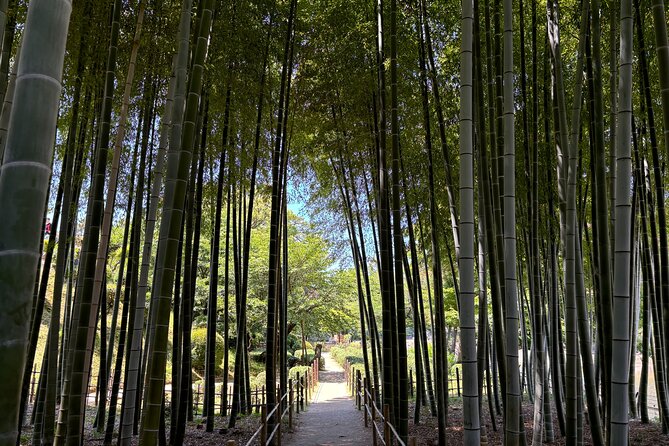
The advertised duration is approximately four hours. This is a walking tour, and transportation is not included if it is needed. Pickup is offered, but the meeting point must be arranged within central Hiroshima, with Peace Memorial Park or the area in front of Shukkeien Garden serving as the stated options.
The route covers a lot: one hour at Shukkeien, 30 minutes at the castle, 30 minutes at Gokoku Shrine, one hour in Peace Memorial Park, and one hour at the museum. Those times add up to four hours before allowing much room for transitions, questions, food, or unexpected delays.
That makes the tour best for people comfortable with a fairly full half-day. Wear practical shoes and keep your expectations realistic. The pace is described as relaxed, but the itinerary itself is substantial.
The private arrangement helps. You are not forced to keep the exact same pace as a large group, and Alex can adjust the balance between sites. Still, if you want long periods at every monument and a slow museum visit, you may need to choose priorities.
Price, group size, and overall value
At $209.03 for up to six people, the price is easiest to justify with a full group. Six people pay roughly $35 each before the ¥360 garden ticket and ¥200 museum admission. A couple pays much more per person, but gains a private four-hour guide and a route that can be tailored to personal interests.
The tour includes:
- A private four-hour walking experience
- An English-speaking local guide
- A customizable route
- A flexible meeting point in central Hiroshima
- Suggestions for food and further activities
You pay separately for Shukkeien, the Peace Memorial Museum, lunch, and any transportation needed. The museum fee is modest, but the garden fee and food costs should still be included in your planning.
I would choose this over a basic group tour if you care about context and conversation. I would skip it if you prefer to move independently, read every museum panel at your own pace, or spend most of your day at one site.
Who should book this experience
This walk suits first-time visitors who want a clear introduction to Hiroshima’s past and present. It is also a good fit for families, small groups, and people who want to ask questions without feeling rushed.
You will get the most from it if you appreciate local stories, cultural explanation, and a guide who can connect several sites into one narrative. The private setup also helps if your group has different interests, since you can discuss how much time to spend at the garden, castle, park, and museum.
You may want another option if you have limited mobility, since the route is built around walking and no transport is included. Most people can participate, and service animals are allowed, but the available information does not provide a detailed accessibility plan for every stop.
Free cancellation is available up to 24 hours before the start time. Inside that window, the booking is nonrefundable and changes are not accepted.
Should you book Hiroshima’s Heart?
Book it if you want Hiroshima explained as a living city, not just a collection of memorials. Alex’s long connection to the city, clear communication, private format, and flexible storytelling make this a strong choice for a first full day in Hiroshima.
The main decision is how you want to use your four hours. If you want every major stop plus the museum, the schedule will be full. If you tell Alex what matters most, the private format should help you get a more useful balance. For a group of four to six, the price is particularly fair. For two people, book it for the personal guidance, not for low cost.
FAQ
Where does the tour begin and end?
You can begin at Peace Memorial Park or in front of Shukkeien Garden, depending on your preference. The tour ends at Peace Memorial Park after the museum or at Shukkeien Garden, based on the chosen starting point.
How long is the walking tour?
The tour lasts approximately four hours.
What is included in the price?
The price includes a private four-hour walking tour, an English-speaking local guide, a customizable itinerary, a flexible meeting point within central Hiroshima, and personal recommendations for food and further activities.
Are admission fees included?
No. Shukkeien Garden costs ¥360 per person, and the Peace Memorial Museum costs ¥200 per person. These fees are paid separately.
Can Alex guide me inside the Peace Memorial Museum?
When conditions allow, Alex guides you through key sections. If the museum is crowded or you prefer to explore independently, he provides an introduction instead.
Is this a shared group tour?
No. It is a private activity for your group only, with up to six people.
Just added around Hiroshima
- Full Day Hiroshima and Miyajima Tour by Bullet Train from Kyoto★ 4.5 · 120 reviews
- The Peace Memorial to Miyajima : Icons of Peace and Beauty★ 4.5 · 31 reviews
- Hiroshima Saijo Sake Tasting Tour with visit to 7 Breweries★ 5.0 · 104 reviews
- Shore Excursion from Hiroshima Port : Private Tour in Hiroshima★ 5.0 · 17 reviews
- Okunoshima Rabbit Island Cycling Tour with Local Guide★ 4.5 · 17 reviews
- Hiroshima & Miyajima All-Inclusive Tour w/Licensed guide Pancho★ 5.0 · 54 reviews
- Private Full Day Hiroshima Tour★ 4.5 · 29 reviews
- Hiroshima Private Tour with a Local – Highlights & Hidden Gems★ 4.5 · 24 reviews
Walking Tours, compared.

Kyoto Geisha Walking Tour: Gion District & Hidden Gems
Our verdict →
Imperial Palace and Shogun Historical Walking Tour
Our verdict →
Shinjuku Local Bar and Izakaya Guided Walking Tour
Our verdict →


Nishiki Market Brunch Walking Tour (7 Tastings + Brunch)
Our verdict →
Kyoto Arashiyama Walking Tour: Bamboo, Monkeys, Gardens & Secrets
Our verdict →
Tokyo Castle & Imperial PalaceーShogun Walking Tour
Our verdict →Browse the lists this tour appears in