
Reviewed · PEACE MEMORIAL TOURS
Hiroshima Peace Park & Atomic Bomb Dome Guided Walk
Hiroshima Peace Park is not a sightseeing checklist. It is a place where each monument asks you to pause, remember, and think about what happened on August 6, 1945. This two-hour walk brings the main memorials together, from the Fountain of Prayer to the Atomic Bomb Dome. I like the clear route and the human stories, especially the tribute to Dr. Marcel Junod and the memorials for children and Korean victims.
I also like that guide Adina takes time to explain details you might miss on your own. His background as a PhD student has allowed him to discuss the nuclear reaction behind the bombing, while his calm, patient approach keeps the subject grounded. The main drawback is pace: ten minutes at the Peace Memorial Museum is enough for an introduction, not enough for a full museum visit.
The walk costs $21 per person and lasts two hours. That is fair value if you want a guided introduction to Hiroshima’s central memorial area, especially on a first visit. Wear good shoes, carry water and sunscreen, and prepare for an emotional experience rather than a light afternoon outing.
Key points to know before you go
- A focused route through the main memorials: You visit the Gates of Peace, Fountain of Prayer, Flame of Peace, Cenotaph, Children’s Peace Monument, Peace Bell, Atomic Bomb Dome, and Hypocenter Monument.
- Adina is the central strength: His explanations are described as detailed, patient, and enthusiastic, with particular attention to the science and history of the atomic bomb.
- The museum visit is brief: Entry is included, but the guided stop is listed as about ten minutes, so plan extra time if you want to examine the exhibits carefully.
- The route includes overlooked stories: Dr. Marcel Junod and the Korean Victims Memorial add human detail beyond the best-known Hiroshima landmarks.
- It is accessible in several languages: The tour is offered in English, Urdu, and Hindi.
- Come ready to walk and reflect: The subject is serious, and comfortable shoes, water, and sun protection will make the two hours easier.
Starting at the Gates of Peace
The meeting point is by the Gates of Peace, in front of an Italian restaurant, at coordinates 34.3906308, 132.4516662. This is a useful place to begin because the gates immediately frame the park as a place of international remembrance rather than simply a collection of monuments.
Your guide starts with about ten minutes here. The Gates of Peace symbolize unity among nations, so they give you the broad idea behind the park: Hiroshima remembers its dead, but it also calls for peace beyond Japan.
This opening helps you get your bearings before the walk becomes more personal. Ask Adina questions early if you want a particular focus, such as the history of the bombing, the memorials for children, or the science of nuclear weapons. His explanations can include nuclear reaction and the historical setting of the attack, making the tour useful for visitors who want more than dates and names.
More Walking Tours in Hiroshima
- Hiroshima Historical Walking Tour – Why A-Bomb was Dropped
★ 4.8 · 893 reviews - Hiroshima Peace (Heiwa) Walking Tour at World Heritage Sites
★ 5.0 · 872 reviews - Hiroshima City 4hr Private Walking Tour with Licensed Guide
★ 5.0 · 437 reviews
The Fountain of Prayer and the human cost
The Fountain of Prayer is one of the quieter stops. You receive about ten minutes of guided explanation and time to reflect on the victims of the bombing.
The value here is not in a long list of facts. It is in the pause. Hiroshima Peace Park can feel full of information, but this stop gives the walk a more personal rhythm. You are encouraged to think about suffering and loss rather than rushing from one monument to the next.
The fountain is also a reminder to pace yourself emotionally. The tour deals with death, injury, and the long effects of nuclear warfare. If you prefer to process serious subjects slowly, use the pauses between stops to look around and take in the park without trying to photograph everything.
Dr. Marcel Junod and the people who helped
The route includes the Monument of Dr. Marcel Junod, a Swiss doctor who helped survivors. This is an important addition because it shifts attention from the bombing itself to the people who responded afterward.
A memorial walk can easily focus only on victims and destruction. Dr. Junod’s story adds another layer: medical aid, international concern, and the effort to help people facing terrible injuries and illness. Adina can place this story within the larger events of Hiroshima, which makes the monument easier to understand.
This is one of the stops I would value most on a guided walk. Without an explanation, you might pass the monument without knowing why it matters. The guide helps connect a name on a stone memorial to a wider human story.
The Peace Memorial Museum in ten focused minutes
The Peace Memorial Museum is the emotional center of the visit. Entry is included, and the tour gives you a guided introduction of roughly ten minutes.
That time is short. You should not expect to see every exhibit or absorb the museum in detail during the tour itself. Instead, think of this stop as an orientation. You learn about August 6, 1945, and gain context for the objects, photographs, and personal accounts inside.
The museum can be difficult to visit quickly because the subject demands attention. If your schedule allows, return later for more time. The guided walk makes that second visit easier because you will already understand the main memorial sites and the structure of Hiroshima’s remembrance.
Food and drinks are not allowed inside the museum. Keep water in your bag while you are outdoors, but finish snacks before entering.
More Peace Memorial Tours in Hiroshima:
- Hiroshima: Miyajima Peace Memorial Icons of Peace and Beauty
★ 4.9 · 361 reviews - Hiroshima/Guided Virtual Tour of Peace Park/PEACE PARK TOUR VR
★ 5.0 · 157 reviews - Hiroshima: Peace Memorial Park and Atomic Bomb Dome Tour
★ 4.9 · 91 reviews - Hiroshima; Hiroshima Peace Memorial Museum and Castle Tour
★ 5.0 · 89 reviews
The Cenotaph and Flame of Peace
The Hiroshima Victims Memorial Cenotaph is another central stop. You pay tribute to those who died and learn how the memorial fits into the park’s message.
The Flame of Peace follows as part of the same story. It represents a commitment to a world without nuclear weapons. The combination of cenotaph and flame gives the walk a clear direction: remember the dead, then consider the future.
I like this part of the route because it avoids treating Hiroshima as a finished historical event. The memorials point toward an ongoing concern. The flame is not just a symbol of grief. It expresses a wish for nuclear disarmament and global peace.
These stops are also good places to listen closely to the guide. The park has many monuments, and the meaning of each one can blur together without context. Adina’s detailed explanations help separate them.
The National Peace Memorial and the Rest House
The Hiroshima National Peace Memorial honors the victims and supports the park’s wider record of remembrance. The route also includes the Rest House, a building that survived the bombing and now serves as a physical link to the past.
The Rest House is valuable because it is not only a memorial object. It is part of the built environment that remained after the attack. Seeing a structure connected to ordinary city life can make the scale of the destruction easier to grasp.
This is where a guide adds real value. The buildings and monuments do not explain themselves fully. Adina points out details you might otherwise miss, and the stop helps connect individual structures to the larger story of Hiroshima.
Children’s Peace Monument and the paper crane story
The Children’s Peace Monument honors the young lives lost in the bombing. It is one of the most recognizable and emotionally direct parts of the park.
The monument brings the history down to the level of children and families. Instead of thinking only in terms of military decisions or citywide destruction, you are asked to consider the effect on young people who had no say in the events around them.
The stop is likely to be especially meaningful for families, though the subject may be hard for children. Use your judgment based on age and temperament. The guide can provide context, but the tour does not turn the memorial into a simple lesson. Its power comes from the quiet reminder that children were among those affected.
Remembering Korean victims
The Korean Atomic Bomb Victims Cenotaph is an essential stop that many people might miss without a guide. It pays tribute to Koreans who died in the bombing.
This monument widens the story beyond the Japanese experience. Koreans were living in Hiroshima when the bomb fell, and their suffering is part of the history of the city and the region. Including this memorial makes the walk more complete and gives you a broader view of the people affected.
I especially appreciate that the route includes it rather than limiting the visit to the most famous Japanese memorials. A guided walk should help you see more than the obvious landmarks, and this is one of the clearest examples.
Ringing the Peace Bell
The Peace Bell offers a hands-on moment in an otherwise reflective walk. You have the chance to ring it for global harmony.
This small action changes the pace. Most of the tour involves looking, listening, and remembering. Here, you take part in a simple public gesture connected to peace.
Do not expect a long ceremony or a dramatic presentation. The value is in the symbolism. You ring the bell, hear its sound, and continue through a park built around the hope that such destruction will not happen again.
The itinerary also includes a visit to the Peace Tower. The supplied schedule leaves the exact name of one stop unclear, but the included activities identify the Peace Tower as part of the experience. Your guide can explain its role as you move through the park.
The Atomic Bomb Dome and the Hypocenter
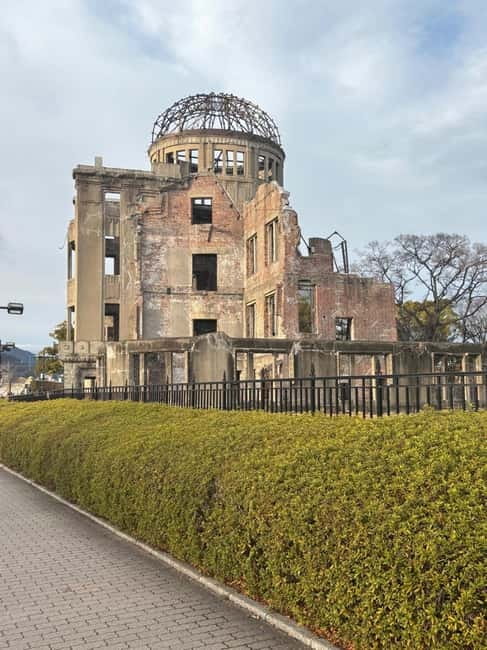
The Atomic Bomb Dome is the best-known image in Hiroshima. Its damaged structure is a direct reminder of the bombing and the city’s destruction.
Seeing it after the memorials gives the walk a strong final section. By this point, you have heard about victims, survivors, medical aid, children, Korean victims, and the call for a nuclear-free world. The Dome brings those themes back to a physical building that remained in the city after the blast.
The tour then includes the Hypocenter Monument, where you pause at the point connected to the moment the bomb exploded. This is a particularly serious stop. It is not simply a photo opportunity, and you should treat it with the same care as the cenotaphs and memorials.
The combination of the Dome and Hypocenter helps you understand both the visible and invisible sides of the event. The Dome shows what happened to the city. The Hypocenter marks the location at the center of the blast.
What the two-hour pace feels like
The route lists roughly ten minutes at each stop. That creates a steady walk, but it also means the experience is an introduction rather than an exhaustive study of Hiroshima Peace Park.
You will cover a lot in two hours. The benefit is structure. You do not need to work out which monuments matter or how to connect them. Adina takes you from international peace symbols to personal memorials, then toward the Dome and Hypocenter.
The trade-off is limited time for quiet reflection and museum viewing. If you stop often for photographs or want to read every plaque, the schedule may feel tight. I would keep the first visit focused on listening and save extra museum time for afterward.
Comfortable shoes matter. Bring water and sunscreen, especially in warm weather. A camera is welcome for outdoor sites, but remember that this is a place of remembrance. Thoughtful photography is more appropriate than treating every stop as a standard sightseeing backdrop.
Guide, languages, and value at $21
At $21 per person, this is an inexpensive way to add structure and explanation to a visit that can otherwise feel overwhelming. You are not paying for transportation or a meal. You are paying for a two-hour guided route, museum entry, and help understanding the meaning behind the sites.
The strongest reason to book is Adina’s style. He is described as kind, patient, enthusiastic, and willing to explain details that are easy to miss. His ability to discuss nuclear reactions may appeal to you if you want the science behind the history, not just a general account of the bombing.
The tour is offered in English, Urdu, and Hindi. That makes it useful for a wider range of visitors, but confirm your preferred language when checking available times.
There is conflicting mobility information in the supplied details. The activity is marked wheelchair accessible in one section, while another says it is not suitable for people with mobility impairments or wheelchair users. If access is important to you, contact the provider before booking rather than relying on the label alone.
Cancellation is flexible, with a full refund available when you cancel at least 24 hours ahead. You can also reserve now and pay later, which helps if your Hiroshima plans are still shifting.
Who should book this Hiroshima walk?
I would choose this tour if you are visiting Hiroshima for the first time and want a clear introduction to the Peace Park. It suits anyone who wants the major memorials explained in plain language, especially visitors interested in the human stories behind the monuments.
It is also a good fit if you want to learn about less obvious parts of the park, including Dr. Marcel Junod and the Korean Victims Memorial. The tour gives you a fuller picture than a quick walk to the Dome and back.
I would be more cautious if you want several hours inside the Peace Memorial Museum, a slow photography walk, or a private period of reflection at every monument. Two hours moves along, and the museum stop is short.
Should you book it?
Book this Hiroshima Peace Park tour if you want an affordable, serious, well-organized introduction with a guide who can explain both the history and the science. Adina’s patient style and attention to details are the main reasons to choose it.
Skip it if you already know the park well or plan to spend most of your day at the museum alone. For a first visit, though, the route covers the essential memorials and several important stops you could easily miss. At $21, it is a sensible way to begin your Hiroshima visit, then return on your own for more time at the museum and the sites that affected you most.
FAQ
How long does the Hiroshima Peace Park tour last?
The tour lasts two hours.
How much does the experience cost?
The price is $21 per person.
Where is the meeting point?
Meet by the Gates of Peace in front of an Italian restaurant. The coordinates are 34.3906308, 132.4516662.
Which languages are available?
The live guide service is available in English, Urdu, and Hindi.
Is entry to the Peace Memorial Museum included?
Yes. Peace Memorial Museum entry is included, although the guided stop there is listed as about ten minutes.
What should I bring?
Bring comfortable walking shoes, a camera, sunscreen, and water. Food and drinks are not allowed inside the museum.
Just added around Hiroshima
- Full Day Hiroshima and Miyajima Tour by Bullet Train from Kyoto★ 4.5 · 120 reviews
- Hiroshima Saijo Sake Tasting Tour with visit to 7 Breweries★ 5.0 · 104 reviews
- The Peace Memorial to Miyajima : Icons of Peace and Beauty★ 4.5 · 31 reviews
- Shore Excursion from Hiroshima Port : Private Tour in Hiroshima★ 5.0 · 17 reviews
- Okunoshima Rabbit Island Cycling Tour with Local Guide★ 4.5 · 17 reviews
- Hiroshima & Miyajima All-Inclusive Tour w/Licensed guide Pancho★ 5.0 · 54 reviews
- Private Full Day Hiroshima Tour★ 4.5 · 29 reviews
- Hiroshima Private Tour with a Local – Highlights & Hidden Gems★ 4.5 · 24 reviews
Peace Memorial Tours, compared.
Hiroshima Historical Walking Tour – Why A-Bomb was Dropped
Our verdict →
Hiroshima: Miyajima Peace Memorial Icons of Peace and Beauty
Our verdict →Browse the lists this tour appears in