Reviewed · KYOTO TOURS
Explore Hidden Alleyway with a Local Expert (Afternoon Tour)
Kyoto’s best moments often happen between the famous sights. This three-hour afternoon bike tour takes you through narrow lanes, wooden townhouses, geisha districts, riverside paths, and quiet corners that are easy to miss from a bus or taxi. I like the route’s contrast: old Miyagawacho and Gion give you classic Kyoto, while the backstreets show how the city feels away from postcard views.
I especially like the small private groups, limited to six people per guide, and the mix of culture with gentle exercise. Guide Yuichi has been praised for being funny, warm, and informative, which matters when you are riding in a new city. The main consideration is price: at $102.47 per person, this is not a cheap way to get around, and a three-hour ride may feel short if you want long visits at each stop.
Key points to know before you book
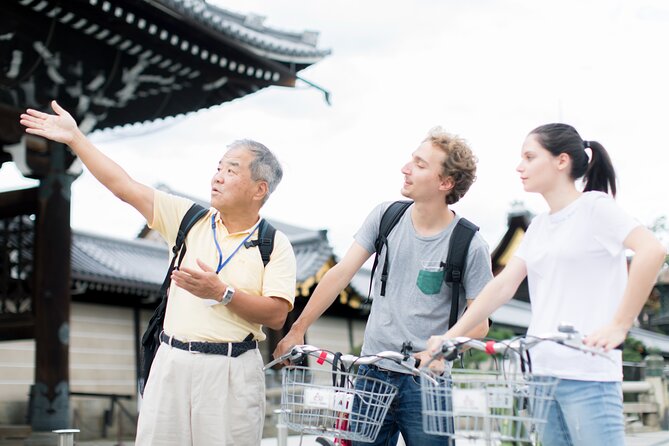
- Quiet lanes are the main attraction: You ride through narrow backstreets and traditional residential areas, not just Kyoto’s headline sights.
- Five distinct stops: The route includes Miyagawacho, Gion, Tatsumi Bridge, Kyoto Imperial Palace, and the Kamo River.
- Private groups stay small: Two to six people ride with one guide, helping the tour feel personal and easier to manage.
- E-bikes make the route more approachable: The experience has been praised as an e-bike ride, though you should confirm the exact bicycle type when booking.
- Rain does not automatically cancel the outing: You can ride with a free rain poncho or switch to a walking tour using public transportation.
- Children must meet clear requirements: Riders must be at least 10 years old, at least 145 centimeters tall, and able to cycle safely on roads without help.
Why a bicycle reveals a different Kyoto
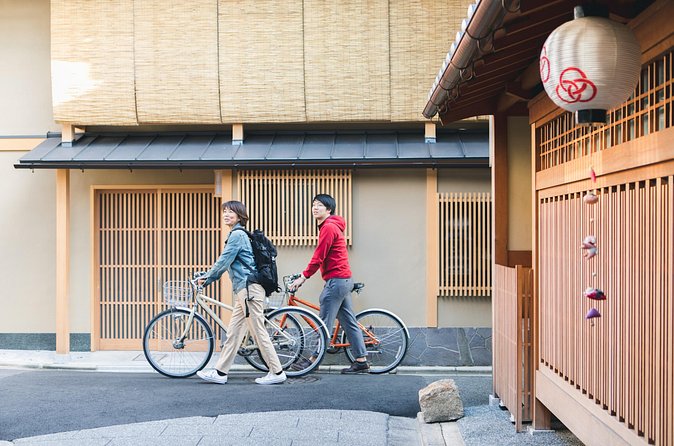
Kyoto is easy to admire from a temple courtyard. It is harder to understand from behind a bus window. On a bicycle, you notice the changes from one street to the next: a quiet wooden lane gives way to a main road, a small stream appears beside the pavement, and a residential corner opens toward a major public garden.
That change in mood is the heart of this tour. You are not spending three hours at one major attraction. Instead, you are linking several parts of central Kyoto by bicycle, with a guide explaining what you are seeing as the route unfolds.
The afternoon start at 2:00 p.m. works well if you want a slower morning. You can visit a temple, have lunch, or simply recover from jet lag before meeting the group. The tradeoff is that some stops may feel brief. Most listed visits last 15 to 20 minutes, so this is a city orientation with cultural context, not a full sightseeing visit at each location.
The tour begins at 552-13 Higashiaburanokōjichō in Shimogyo Ward and returns there at the end. Since the route is private to your group, you are not being folded into a large procession of cyclists. That makes a difference in Kyoto’s narrow lanes, where a smaller group is easier to keep together and less disruptive to residents.
A few more Kyoto half-days worth comparing
- PERFECT KYOTO 1-Day Bus Tour
★ 5.0 · 13,518 reviews - Kyoto: Fushimi Inari, Kinkakuji, Bamboo Grove 1 Day Bus Tour
★ 4.8 · 4,316 reviews - Kyoto: Tea Ceremony in a Traditional Tea House in Kiyomizu
★ 4.9 · 3,519 reviews
Miyagawacho, wooden houses and a quiet geisha district
The first stop is Miyagawacho Kaburenjo, in Miyagawacho, one of Kyoto’s five traditional geisha districts. It is the second largest of those districts, and its lanes are lined with traditional wooden houses.
This is a good opening stop because it sets the tone for the rest of the ride. The architecture is low, close to the street, and more subdued than the grand facades found around major tourist sites. You get a sense of the old city through the arrangement of buildings and lanes rather than through a formal museum display.
You have about 15 minutes here, with no admission charge. That time is enough to look closely at the street, take photographs where appropriate, and hear how the district fits into Kyoto’s entertainment culture. It is not enough for an extended visit or a performance, and no such performance is included.
I would treat this as a visual and cultural introduction. Keep your eyes on details such as doorways, rooflines, and the narrow scale of the street. Also remember that these are working neighborhoods, not open-air sets. Your guide’s local etiquette training should be useful here, particularly in an area associated with geiko and maiko culture.
Gion, the Kyoto you already recognize
From Miyagawacho, the route continues to Gion. This is the Kyoto of old wooden townhouses, refined streets, and the city’s famous geiko and maiko traditions.
Gion can feel very different depending on the time of day and the exact street you enter. Some lanes are quiet and residential. Others are filled with visitors hoping to see the district’s traditional atmosphere. A bicycle allows you to cover more ground than walking, but you should still expect to slow down and follow the guide’s instructions closely.
The stop lasts about 15 minutes and is free. That makes it a quick look rather than a full exploration. If Gion is high on your priority list, you may want to return on foot at another time. The value here is that you see it as part of a wider route, linked to Miyagawacho and the river instead of treated as an isolated photo stop.
I like the way these first two stops work together. Miyagawacho gives you a quieter introduction, while Gion connects the old districts to the Kyoto most people picture before arriving. You get both without spending the whole afternoon in one crowded zone.
Tatsumi Bridge and the streamside pause
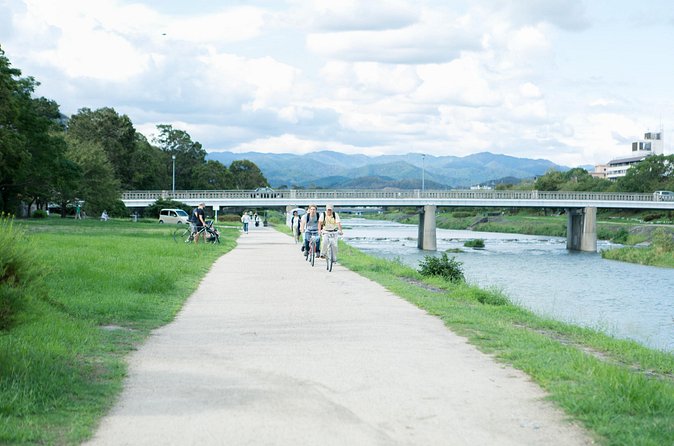
Tatsumi Bridge brings a change of pace. The route follows a small stream, with willow trees moving in the breeze and a more relaxed feel along the water.
You have about 15 minutes here. This is the kind of stop that benefits from being outdoors. Instead of looking at a large monument, you are paying attention to the sound of water, the narrow path, and the way the buildings meet the stream. It offers a welcome pause after riding through city streets.
The description of this stop emphasizes the feeling of the path rather than a long historical explanation. That is worth understanding before you book. If you want a guide to spend several minutes discussing dates and architectural details, the time here may seem limited. If you like short pauses that let you take in Kyoto’s atmosphere, it is a pleasant part of the route.
This is also where the bicycle format makes practical sense. You can arrive from Gion without arranging another transfer, stop briefly, and continue toward the Imperial Palace. On foot, covering this many separate areas in three hours would be more tiring and less efficient.
Same trip, a completely different kind of day:
- Kyoto Geisha Walking Tour: Gion District & Hidden Gems
★ 4.7 · 3,273 reviews - Kyoto: Tea Ceremony Ju-An at Jotokuji Temple
★ 4.9 · 3,207 reviews - Kyoto: Gion Magical Night Walking Tour with Geisha Trivia
★ 4.9 · 2,393 reviews - Kyoto: 45-Minute Tea Ceremony Lesson Experience
★ 4.3 · 2,378 reviews
Kyoto Imperial Palace and the wide-open garden
The route then reaches Kyoto Imperial Palace, once the residence of Japan’s Imperial Family. Today, the palace grounds are open to the public as a national garden with seasonal flowers.
You spend about 20 minutes cycling along gravel paths. That gives you a broader setting after the enclosed lanes of Miyagawacho and Gion. The change is noticeable: the streets feel more open, the riding surface changes, and the garden provides room to breathe.
Because the route uses gravel paths, this is one place where your riding comfort matters. If you are used only to smooth pavement, you may want to take the surface slowly and follow the guide’s pace. The tour is designed around group cycling and traffic safety, so the guide’s instructions are part of the experience rather than an interruption.
The Imperial Palace grounds are free to enter, but this tour does not appear to include a long palace interior visit or an extended garden walk. You are seeing the area as one section of a larger city ride. For a first afternoon in Kyoto, I think that is a sensible use of time. You get a major historic setting without giving up the quiet streets and riverside stops that make this experience different from a standard palace visit.
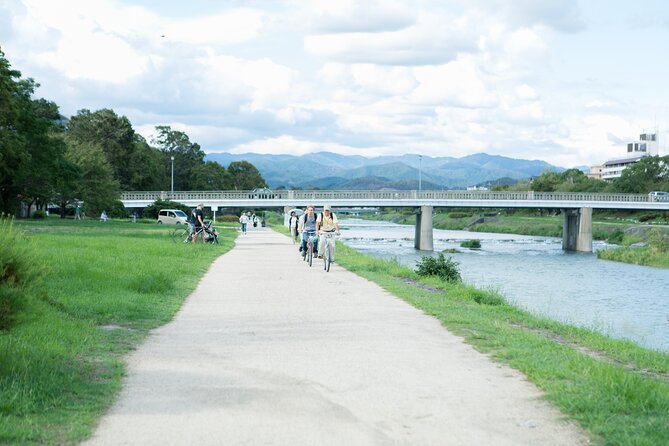
Kashiwayacho and the Kamo River
The final listed stop is Kashiwayacho, where you can relax beside the Kamo River, a favorite river area for local residents. The stop lasts about 20 minutes and admission is included.
This is a useful ending because it leaves room for the city to feel ordinary. The river is not presented only as a famous sight. It is a place where people come to sit, pause, and enjoy the water. After several historic districts, the river offers a calmer look at daily Kyoto.
You may find this stop especially appealing if you prefer open space to another temple or shop-lined street. The route’s strongest feature is its range: traditional entertainment districts, a streamside lane, a former imperial garden, and a public riverfront all appear in one afternoon.
After Kashiwayacho, you return to the original meeting point. No separate transportation is needed to get back to the start, which simplifies the end of the day.
What the guide adds to the ride
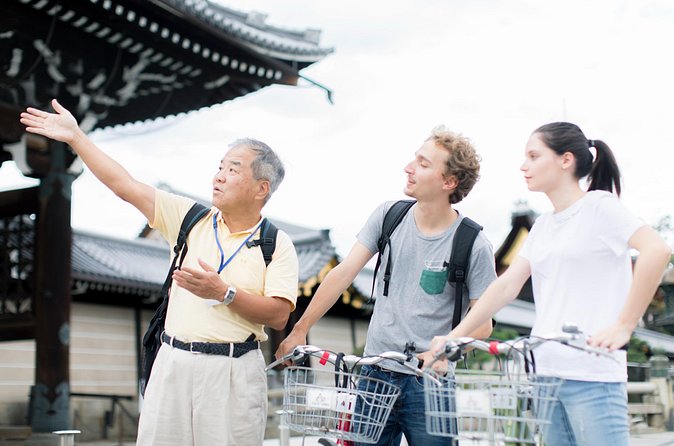
A bicycle tour depends heavily on its guide. The route itself is useful, but the person leading you controls the pace, explains local customs, and helps the group move through traffic without stress.
The guides are trained in Kyoto’s culture, road safety, group cycling, and local etiquette. That training is important in a city where lanes can be tight and the difference between a quiet residential street and a busy road can arrive quickly.
Yuichi is one guide associated with this experience, and his style has been described as personable, funny, and informative. Those qualities suit a short ride. You want clear instructions while cycling, but you also want someone who can make the stops feel connected rather than turning the afternoon into a list of facts.
The small group size helps here. One guide can pay closer attention to the riders, answer questions, and adjust the pace more easily than on a large group outing. A solo booking is not accepted, but groups of two to six can ride with one guide. Groups of seven to 12 can arrange an additional guide.
Is $102.47 a fair price?
At $102.47 per person, this tour costs more than renting a bicycle and exploring independently. You are paying for the guide, route planning, safety support, cultural explanation, and a private group rather than simply for the bicycle itself.
The value is strongest if you have limited time in Kyoto or prefer not to work out a route through unfamiliar streets. You can cover five distinct areas in three hours, with the guide handling navigation and transitions. For a family, the private format can also make the outing feel more manageable.
The price is harder to justify if you are an experienced cyclist who already knows Kyoto and enjoys stopping wherever you please. You will not have long visits at each location, and the route is not built around extensive museum or temple admissions.
I see it as a good orientation tour, especially early in a Kyoto stay. It helps you identify neighborhoods and river areas you may want to revisit on foot. The e-bike feature is another point in its favor for riders who want help with the city’s distances, though I would confirm the exact bike provided before payment.
Rain, age limits, and the practical details
The tour operates in rain. You can continue by bicycle with a free rain poncho, or choose a walking tour that uses buses or the metro, with public transportation included in the tour fee. That flexibility is useful during Kyoto’s changeable weather, though the walking option will naturally alter the feel of the outing.
Children must be at least 10 years old, 145 centimeters or taller, and able to ride safely on the road without assistance. This is not a ride for a child who is still learning to balance or follow road instructions.
Confirmation is sent within 48 hours, subject to availability. The published booking information gives two different cancellation messages: one says a refund is available if you notify the operator at least three days before the tour by 6:00 p.m. Japan time, while another states that the experience is non-refundable and cannot be changed. I would confirm the exact terms before booking rather than assume a refund will be available.
The tour requires at least two participants. If the minimum is not met and the activity is canceled, you are offered another date or experience, or a full refund. Since the experience is booked about 13 days ahead on average, reserving early is sensible if your Kyoto schedule is fixed.
Who should book this Kyoto bike tour?
I would choose this tour if you want a compact introduction to central Kyoto and like seeing a city through its side streets. It suits couples, families with older children, and small groups who prefer a private outing to a large scheduled tour.
It is also a smart choice if you are short on time. In one afternoon, you reach five different areas without spending the day changing between buses and taxis. The route gives you enough context to decide where you want to return later.
I would be more cautious if you dislike cycling in traffic, want long visits at major attractions, or prefer to set your own pace. The 15-minute stops are brief, and the tour is still a road ride, even with safety-focused guides.
Should you book it?
Book it if you want Kyoto’s famous districts paired with quieter lanes, a small private group, and a guide who can connect the sights as you ride. The route is varied, the afternoon timing is convenient, and the rain plan reduces the risk of losing the outing to bad weather.
Skip it if $102.47 feels high for a three-hour introduction or if you would rather spend that time inside temples and palace buildings. For most people who want an efficient first look at Kyoto beyond the main tourist paths, this is a well-planned choice. Just confirm the bicycle type and cancellation terms before you commit.
FAQ
Where does the Kyoto bike tour start?
The tour starts at 552-13 Higashiaburanokōjichō, Shimogyo Ward, Kyoto, 600-8235, Japan.
What time does the tour begin?
The tour begins at 2:00 p.m.
How long does the tour last?
The tour lasts approximately three hours.
Which places are included on the route?
The route includes Miyagawacho Kaburenjo, Gion, Tatsumi Bridge, Kyoto Imperial Palace, and Kashiwayacho beside the Kamo River.
Can the tour operate in rainy weather?
Yes. You can continue by bicycle with a free rain poncho or switch to a walking tour using public transportation. Bus or metro costs are included in the tour fee.
Are there age and group-size requirements?
Children must be at least 10 years old, 145 centimeters or taller, and able to ride safely on the road without assistance. The tour accepts two to six people per guide. Groups of seven to 12 can arrange an additional guide, but one-person bookings are not accepted.
Just added around Kyoto
- Sekka Cotton Furoshiki Class★ 5.0 · 19 reviews
- Scenic Green Tea Fields of Hidden Kyoto & Local Tea Exp (Private)★ 5.0 · 32 reviews
- Secret Eastern Kyoto Biking Adventure★ 5.0 · 44 reviews
- Kyoto Sword Experience – includes Museum Ticket/Ninja Experience★ 4.5 · 149 reviews
- Private Sake Tasting in Central Kyoto with Sake Sommelier★ 5.0 · 32 reviews
- Samurai School in Kyoto: Samurai for a Day★ 5.0 · 202 reviews
- SHIRAKAWA Japanese Culture Experiences with private English staff★ 5.0 · 16 reviews
- A Privately Guided Photoshoot in Beautiful Kyoto by a Pro★ 5.0 · 18 reviews
Kyoto Tours, compared.

Tea Ceremony in a Traditional Tea House in Kiyomizu
Our verdict →
Kyoto Geisha Walking Tour: Gion District & Hidden Gems
Our verdict →
Fushimi Inari Hidden Hiking Tour (Private Option Available)
Our verdict →