
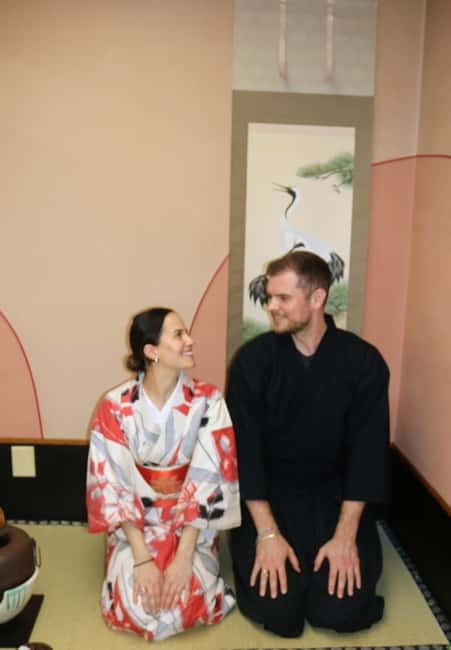
Reviewed · TEA CEREMONY EXPERIENCES
Learn Zen in a class of making Matcha tea near Osaka Castle
Passing through the small entrance to this tea ceremony room is the heart of the experience. For one hour, status, age, and nationality are set aside, and you learn how to sit, bow, move, serve tea, and receive it with care. It is a thoughtful way to meet traditional Japan without committing to a long formal ceremony.
I especially like the chance to prepare matcha for one another, rather than simply watching an instructor perform. The kimono and hakama costumes are also a strong part of the value, particularly because a photographer takes pictures while you focus on the class. English guidance from instructors such as Kaori helps explain the meaning behind each gesture.
The main consideration is time. At just one hour, this is an introduction, not a full study of chanoyu. You also need to arrive 30 minutes early for changing, and hair styling, outdoor photography, and some costume options may cost extra.
Key points to know before booking
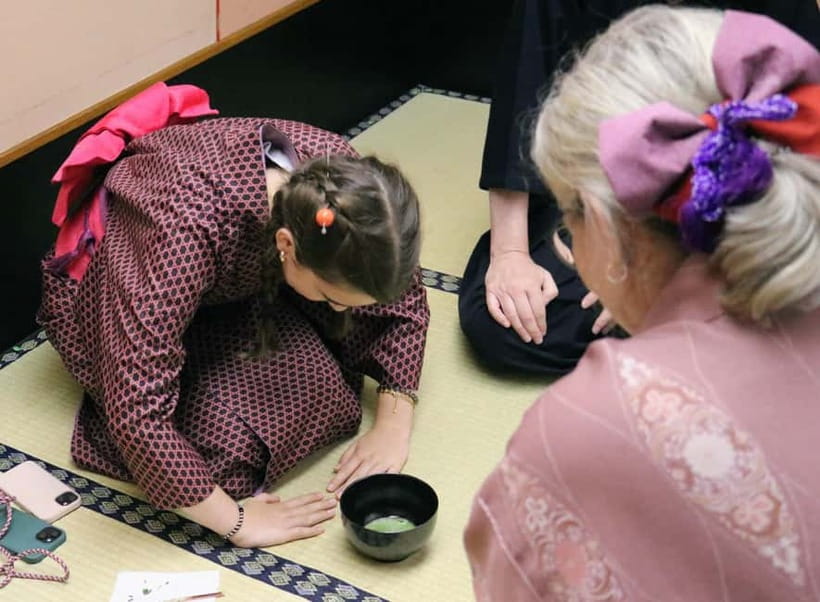
- You dress as part of the lesson: Women wear kimono, while men wear hakama and dogi, becoming a samurai for the ceremony.
- You make matcha for another person: This hands-on step gives the class more purpose than a simple demonstration.
- Wagashi adds a seasonal lesson: The handmade sweet introduces Japanese ideas about the four seasons, wabi, sabi, and visual beauty.
- The group is capped at six: That matters in a class where everyone needs a turn and personal help with manners.
- Photos are sent by email: A photographer records the ceremony so you can concentrate on the experience.
- Arrive early at the correct address: Use Google Maps for Bushi no Homare, since the Apple Maps address is reported to be incorrect.
A one-hour introduction to chanoyu near Osaka Castle
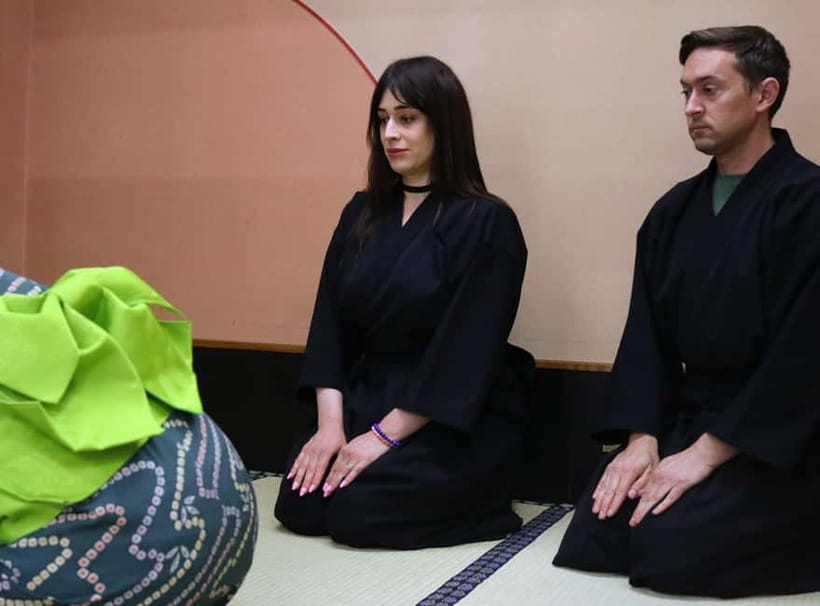
This is not a sightseeing stop at Osaka Castle itself. The class takes place at Bushi no Homare, also called Samurai Honor, at Excellence Takayama 1F, 2-3-19 Shiginonishi, Joto-ku, Osaka-shi, Osaka 536-0014.
The experience is built around chanoyu, the Japanese tea ceremony. You will not simply drink powdered green tea. You will learn the behavior expected from both the person serving tea and the person receiving it. That distinction matters because Japanese tea ceremony is based on shared attention. The host offers hospitality, but the guest responds with respect and awareness.
The session lasts one hour, with a maximum of six participants. That is a useful group size for this kind of activity. You can see what the instructor is doing, receive help with clothing and movements, and get your own turn without waiting behind a large crowd.
The language support is English and Japanese. Kaori is one instructor named in the experience, and the teaching includes historical and cultural explanation as well as the practical steps. Other language interpreters may be available in Italian, Spanish, French, Chinese, Thai, or Indonesian, but you must ask about staff availability before booking.
More Castle Tours in Osaka
- Osaka Castle: Museum and Tower Entry Ticket
★ 4.5 · 2,380 reviews - Ultimate Osaka Walking Tour: Castle, Dotonbori & Hidden Gems
★ 5.0 · 862 reviews - Osaka Castle Walking Tour and Castle Tower Admission
★ 5.0 · 561 reviews
Changing into kimono or hakama
Arrive 30 minutes before your reserved starting time. That extra half-hour is used for instructions and changing, so arriving at the official start time would leave you rushed.
Women are dressed in kimono. Men wear hakama, the traditional pleated trousers associated with formal Japanese clothing, along with dogi, a traditional robe. The costume is not just a photo prop. It changes how you move, sit, and think about the ceremony. You become more aware of posture because the clothing makes casual movement less natural.
Bring a T-shirt. The supplied information does not list a full packing list, but this is the one requested item. Pets, alcohol, drugs, and nudity are not allowed.
Hair styling needs careful attention when you book. Wagami, meaning collected hair with a kanzashi ornament, is listed as a paid option. A booking account also describes hair being arranged and decorated with flowers at no extra cost, so do not assume the same arrangement applies to every reservation. Ask before paying if an elegant Japanese hairstyle is important to you.
Women can also ask about a paid package with kimono, obi, tabi socks, zori sandals, a basket bag, and outdoor photography. A corresponding men’s option includes kimono, obi, tabi, geta wooden clogs, and outdoor photography. The basic experience includes kimono clothing, but confirm exactly which accessories and photo setting are included in your chosen package.
Entering the tea room as an equal
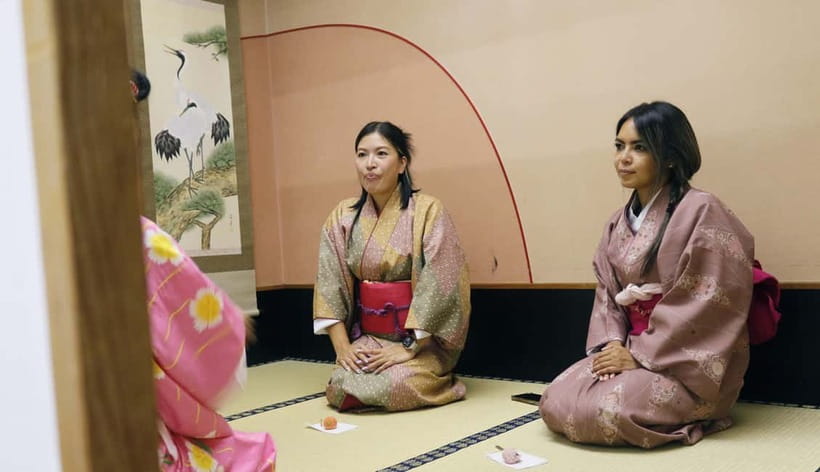
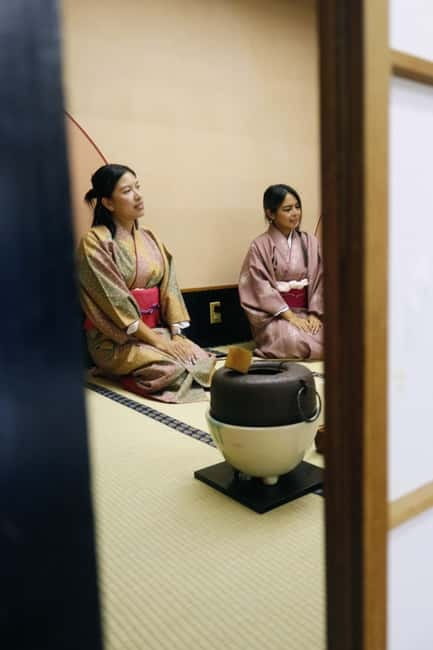
The most meaningful idea in the class comes with the entrance to the tea room. The traditional low entrance, called a nijiriguchi, represents a change in social position. Once you pass through, everyone is treated equally, no matter their nationality, age, gender, or status.
That can sound grand for a one-hour activity, but the lesson is easy to understand in practice. You leave ordinary habits at the door. You sit in the prescribed way, bow at the right moments, walk carefully, and pay attention to the person serving you.
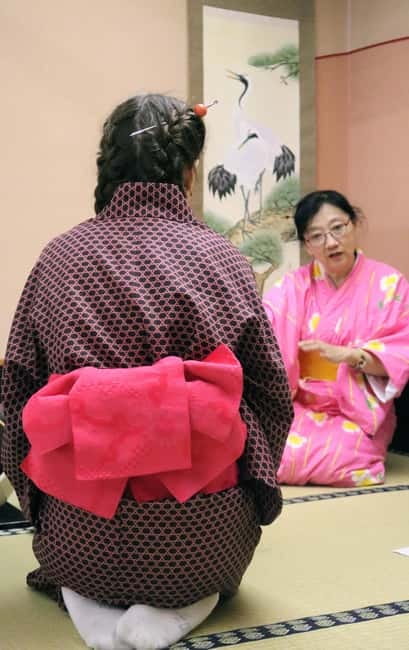
The instructor explains how to stand, sit, bow, walk, and receive tea. These movements are taught as etiquette rather than as a stage performance. You will practice them, then use them during the ceremony.
The rules may feel exacting at first. That is part of the point. Tea ceremony asks you to slow down and notice details that are easy to ignore in ordinary life. The angle of a bow, the way a bowl is handled, and the timing of a response all show consideration.
You should not expect to master the rules in one visit. Instead, you will come away with a clear sense of why the rules exist. The class gives you a manageable first look at a tradition that normally takes much longer to study.
Preparing and receiving matcha
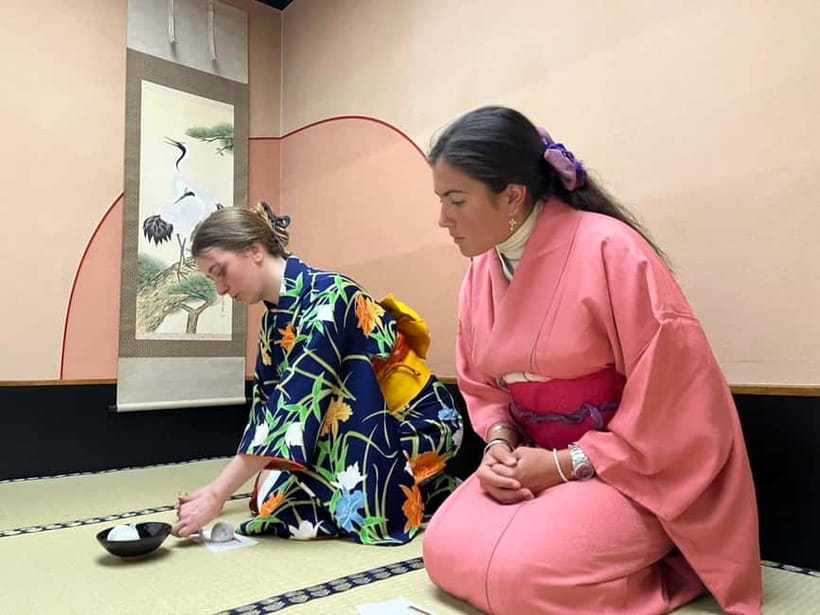
The master prepares matcha, the powdered green tea used in the ceremony, and serves it according to traditional manners. You will then have the chance to prepare tea for another participant. That hands-on exchange is one of the best reasons to choose this activity instead of a presentation where you only watch.
The physical process is simple enough to follow, but the surrounding etiquette gives it weight. You learn how to approach the tea, how to receive it, and how to respond to the person who prepared it. The instructor explains the steps in English, allowing you to focus on getting the movements right rather than guessing what comes next.
The tea itself has a strong, grassy taste that may surprise anyone used to sweetened green tea. The experience information does not describe added sweetener, so expect traditional matcha rather than a café-style matcha drink.
This is also where the idea of hospitality becomes more balanced. The host is not the only person responsible for creating a good experience. The guest must pay attention, show gratitude, and follow the form. That two-way exchange is central to the lesson.
If you are bringing children, note the minimum age is 10. Older children who can sit, listen, and take part in formal gestures may enjoy the costume and practical elements. Younger children cannot join this activity.
More Tea Ceremony Experiences in Osaka
- Osaka: Tea Ceremony Experience
★ 4.9 · 1,426 reviews - Tea Ceremony Experience in Osaka Doutonbori
★ 5.0 · 754 reviews - Matcha Making Class in Osaka with Authentic Japanese Sweets Set
★ 5.0 · 509 reviews - Osaka: Matcha Making Experience with Japanese Sweets
★ 5.0 · 146 reviews
Wagashi, the edible lesson in Japanese beauty
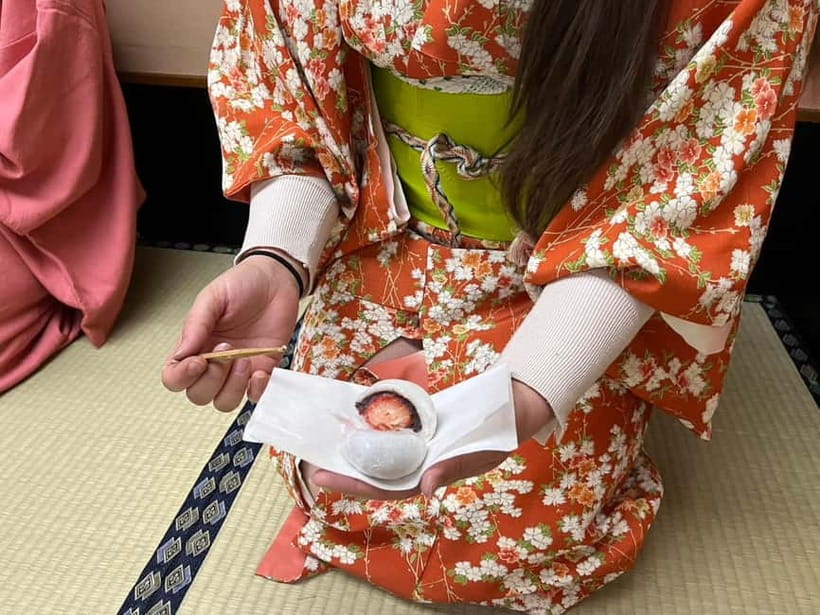
A wagashi sweet accompanies the tea. These traditional Japanese confections developed alongside tea culture and are valued for both flavor and appearance.
The class uses wagashi to explain wabi and sabi, Japanese ideas connected with simplicity, imperfection, age, and quiet beauty. You will also learn how sweets reflect the seasons. Their shapes, colors, and decoration may suggest spring, summer, autumn, or winter.
This is one of the more interesting parts of the class because the sweet is treated as part of the lesson, not as a quick snack. Handmade wagashi often has delicate forms and colors that make it look almost too fine to eat. The point is not only that it is attractive. The design shows how strongly Japanese food culture is tied to season and presentation.
The information provided describes wagashi as being made one at a time by craftspeople. In the class, you learn about this food culture and its connection to Japanese history. The activity does not state that you make the wagashi yourself, so expect to taste and study it rather than take a confectionery workshop.
If you enjoy learning through small details, wagashi gives the tea ceremony more context. You can see how the bowl, sweet, clothing, and gestures work together to create a complete setting.
Photos without losing your attention
Photography is included, with the finished images sent to a designated email address. This is useful because traditional clothing and formal gestures are difficult to document when you are also trying to follow instructions.
A photographer takes pictures during the ceremony, and the supplied experience details say the data is sent by email. One account describes receiving the photos on the same day. That timing may vary, so treat same-day delivery as possible rather than guaranteed.
The photo coverage is especially valuable for couples, families, and friends. You can concentrate on preparing tea and responding properly instead of handing a phone to someone and hoping for a good picture.
Outdoor photography is a paid option. The basic class should therefore be understood as an indoor tea ceremony with included photo shooting. If you want images around Osaka Castle or outside the venue, ask about the relevant package before booking. The activity details do not promise that Osaka Castle itself is used as a photo location.
What the $40 price includes
At $40 per person, the experience offers more than a cup of tea. The price includes kimono clothing, an English interpreter guide staff member, matcha, wagashi, a certified professional instructor, tax, tips, and photo shooting with the data sent by email.
For a short cultural class, that is fair value if you want several elements in one booking: dressing up, instruction, food, tea preparation, and photography. Paying separately for a costume rental, a tea tasting, and a professional photo session could easily take more time and planning.
The value depends on what you want from Osaka. If your priority is a long, highly formal tea ceremony with extensive history and silent observation, this one-hour class may feel brief. If you want an accessible introduction with a chance to participate, the cost is easier to justify.
Remember that transportation is not included. There is no hotel or train-station pickup, and personal expenses are extra. Hair styling, outdoor photography, and the listed expanded kimono packages may also require additional payment.
You can reserve now and pay later, and cancellation is free up to 24 hours before the activity for a full refund. Those terms help if your Osaka schedule is still changing, but you should still check the selected date and time before finalizing your plans.
Finding Bushi no Homare in Osaka
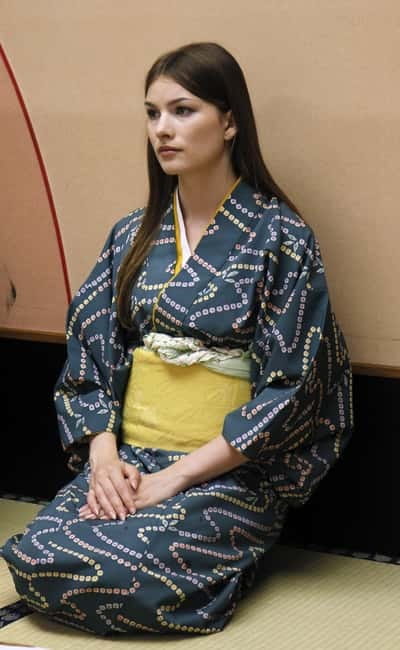
Use Google Maps for the venue. The stated address is Excellence Takayama 1F, 2-3-19 Shiginonishi, Joto-ku, Osaka-shi, Osaka 536-0014. The supplied information warns that the Apple Maps address is incorrect.
Look for the wooden sign reading Honor of the Samurai. The storefront has activity pamphlets in a rack, and kimonos and hakama may be hanging outside to dry. Those are useful clues if you are walking through the neighborhood and do not immediately recognize the entrance.
The activity is described as being near Osaka Castle, but no transportation service is provided. Plan your own route and allow enough time to arrive 30 minutes early. The class schedule has several possible starting times, so check availability for the date you want.
Who will enjoy this class most
I would recommend this to you if you want a cultural activity that is active but not physically demanding. You will dress in traditional clothing, learn formal movements, handle matcha, taste wagashi, and leave with photographs.
It works particularly well for:
- Couples who want a shared activity and keepsake photos
- Families with children aged 10 and older
- First-time visitors looking for a gentle introduction to tea ceremony
- People interested in Japanese clothing, food culture, and etiquette
- Small groups who prefer personal instruction
You should think twice if you dislike formal sitting, careful gestures, or costume changes. The class is not designed as a casual green tea tasting. You are expected to follow manners and take part.
It may also be less suitable if you want a long outdoor session. The standard activity is indoors, while outdoor photography is listed as a paid option. And if you need an interpreter in a language other than English or Japanese, confirm availability before you reserve.
Should you book the matcha class?
Book it if you want to do more than look at Japanese culture from the outside. The chance to dress in kimono or hakama, make matcha for another person, taste seasonal wagashi, and learn why the etiquette matters gives the hour real substance.
The best parts are the small group size, the personal instruction, and the included photography. Kaori and the other instructors explain the historical and cultural setting, while the practical steps keep the class from becoming a lecture.
Skip it if you want a lengthy, highly traditional ceremony or a full outdoor costume shoot included in the base price. For everyone else, $40 is a reasonable price for a compact Osaka experience that combines clothing, tea, food, manners, and a useful set of photographs.
FAQ
Where does the tea ceremony class take place?
It takes place at Bushi no Homare, also called Samurai Honor, at Excellence Takayama 1F, 2-3-19 Shiginonishi, Joto-ku, Osaka-shi, Osaka 536-0014.
Is the class held inside Osaka Castle?
No. It is described as being near Osaka Castle, but the class takes place at the Bushi no Homare venue.
How long does the experience last?
The tea ceremony class lasts one hour. You should arrive 30 minutes before your reserved time for instructions and changing clothes.
What clothing is provided?
Women wear kimono. Men wear hakama and dogi. Expanded clothing packages with accessories such as obi, tabi, zori, geta, and outdoor photography may be paid options.
Is hair styling included?
Wagami, meaning collected hair with a kanzashi ornament, is listed as a paid option. Ask the provider to confirm the hair arrangement included with your booking.
Is the class available in English?
Yes. English and Japanese are available. Other languages may be possible, but you must check staff availability before booking.
How many people can join?
The class is limited to six participants.
Is matcha included?
Yes. Matcha and wagashi are included in the listed price.
Are photographs included?
Photo shooting is included, and the data is sent to a designated email address. Outdoor photography is listed as a paid option.
Can children join?
Children under 10 are not suitable for this activity. Children aged 10 or older may join if they can take part in the formal instructions and ceremony.
Is transportation included?
No. Pickup and drop-off at a train station or hotel, transportation, and other personal expenses are not included.
What should I bring?
Bring a T-shirt. The activity also requires you to arrive early for changing clothes.
Can I cancel for a refund?
You can cancel up to 24 hours in advance for a full refund. You can also reserve now and pay later.
Just added around Osaka
- Exclusive Sushi Making Experience with a Master Chef – Osaka Area★ 5.0 · 25 reviews
- Private Home-Style Cooking Class in Osaka with Local Mom Yoshiko★ 5.0 · 46 reviews
- Hidden Osaka – Yukaku Red Light Tour & Culinary Adventure★ 4.8 · 96 reviews
- Osaka: Walking Tour and Top Highlights★ 4.8 · 104 reviews
- Osaka: Private Ceramic Painting Workshop★ 5.0 · 13 reviews
- Pickleball in Osaka, Kobe & Kyoto with Locals!★ 4.7 · 80 reviews
- Eat Like a Local in Osaka – Private Custom Street Food Tour★ 4.3 · 33 reviews
- Osaka:SUMO BEATS SHOWCASE: Taiko Drum and Wagyu burger!★ 4.2 · 37 reviews
Tea Ceremony Experiences, compared.

Tea Ceremony in a Traditional Tea House in Kiyomizu
Our verdict →


World Heritage Kyoto & Nara Uji Authentic Matcha Experience
Our verdict →

Arashiyama Bamboo Forest, Monkeys, Matcha & Temple Tour
Our verdict →
Browse the lists this tour appears in