
Reviewed · CYCLING TOURS
Tokyo Great Cycling Tour
Tokyo makes far more sense from a bicycle than from behind a bus window. You can slip through streets, reach pockets that large vehicles cannot, and connect major sights without spending half the day underground. This six-hour ride links Tsukiji Jogai Market, Zojo-ji Temple, Meiji Jingu Shrine, and the Imperial Palace in one well-packed morning and afternoon.
I like the maximum group size of 12, which keeps the ride personal and makes it easier to hear the guide. I also like the mix of famous sights and less obvious city scenes, from expensive apartment districts to a cemetery tucked among fashionable neighborhoods. The main drawback is physical: you need a moderate level of fitness, and six hours on a bike can feel long in hot weather.
Key points to know before you book
- See four major Tokyo sights by bicycle: The route covers Tsukiji Jogai Market, Zojo-ji, Meiji Jingu, and the Imperial Palace.
- Ride with a small group: The tour accepts no more than 12 people, a useful size for city streets and guide attention.
- Expect a full six-hour outing: This is not a quick spin around one neighborhood.
- Learn as you pedal: Guides explain Japanese history and culture while you move between districts.
- Prepare for real exercise: A moderate fitness level is required, with weather affecting the day’s plans.
- Know the starting point: Meet at Tokyo Great Tours, 1-chome-3-2 Shinkawa, Chuo City, at 9:00 am, then return there at the end.
Why a bicycle works so well in Tokyo
Tokyo is huge, but its most interesting areas are often close enough to connect by bike and too scattered to cover comfortably on foot. A train can move you quickly from one district to another, but it gives you little sense of how the city changes between those stops.
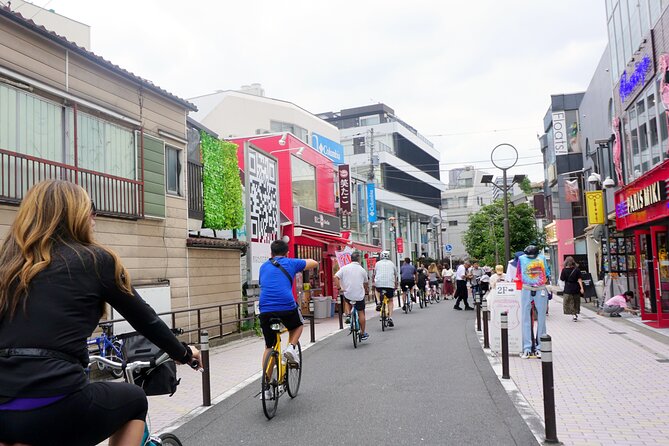
On this tour, you ride through the spaces between the sights. That matters. You see the contrast between old religious buildings, modern office towers, high-priced apartments, shopping streets, and quiet burial grounds. The city becomes a sequence of neighborhoods rather than a checklist of attractions.
The bike also gives the guide more flexibility than a bus. The route can use streets and passages that large vehicles cannot reach, while the small group makes stops easier. You are not simply driven to a temple, shown a gate, and sent back to a vehicle. You move through Tokyo under your own power, with the guide explaining what you are seeing along the way.
The tradeoff is that this is an active city tour, not a sightseeing ride where you sit back. You should be comfortable cycling for much of a day and paying attention to the route. The tour calls for a moderate physical fitness level, and Tokyo’s heat can make the effort more demanding.
More Bike Tours in Tokyo
- Tokyo Guided Small-Group Biking Tour
★ 5.0 · 1,250 reviews - Tokyo Top Highlights 3h Guided E-bike Tour
★ 5.0 · 714 reviews - 3h Tokyo E-Bike Tour: Hidden Gems, and Local Life with guide
★ 5.0 · 670 reviews
Starting at Tsukiji Jogai Market
The morning begins at the meeting point in Shinkawa at 9:00 am. From there, the route heads toward Tsukiji Jogai Market, the outer market area that remains active even after the inner wholesale market moved to Toyosu.
You get about 15 minutes here, with no admission charge. That is enough time to take in the market atmosphere and see local shoppers and tourists moving through the area, but not enough for a long, leisurely food crawl. Think of this as a lively first stop and a taste of the district rather than a full market visit.
Tsukiji works well at the start of a cycling tour because it immediately shows you one of Tokyo’s contrasts. The area carries an old market identity, yet it sits within one of the world’s most modern cities. You can notice that change more clearly when arriving by bike, passing through ordinary streets before reaching the food stalls and market lanes.
If you want to buy something here, keep the short stop in mind. The group needs to stay together, and the tour has several major sights still ahead. This is a place to look, listen, and get your bearings rather than plan a full meal.
Zojo-ji Temple and Tokyo Tower
Next comes Zojo-ji, an old Buddhist temple with one of Tokyo’s most striking backdrops. The traditional temple buildings sit with Tokyo Tower rising behind them, giving you a compact picture of old and new Japan in one frame.
The stop lasts about 15 minutes and is free to enter. That short visit is well suited to the tour’s larger purpose. You can see the temple, hear about its cultural setting, and take in the contrast with the tower without losing the day to a single attraction.
Zojo-ji is also a good reminder that Tokyo’s historic places do not sit apart from modern life. High-rise buildings and major roads are close by. The temple does not pretend the city has not changed. Instead, the old structure and the tower share the same view.
Your guide can help make this more than a photo stop by explaining the temple’s place in Japanese Buddhism and Tokyo’s past. Since the tour is designed around movement, do not expect a long guided visit inside every building. The value comes from the setting, the comparison, and the way the stop fits into the broader ride.
The modern districts between the sights
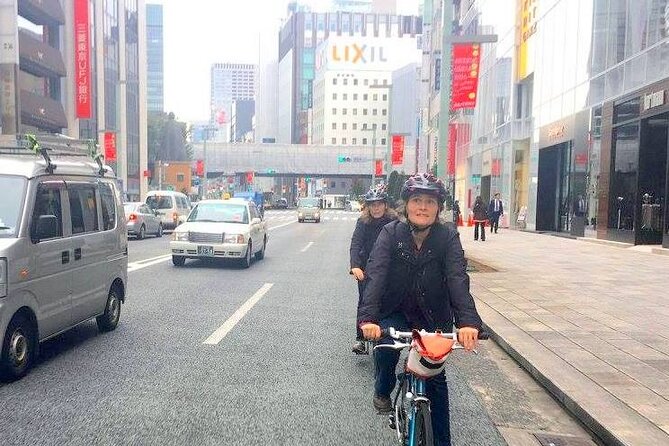
Some of the most useful parts of the ride come between the named stops. The route passes areas filled with tall, expensive apartment buildings, shops, and offices. These districts may not be famous sights, but they help you see how Tokyo works as a place to live and work.
You might notice how quickly the city shifts from temple grounds to polished commercial streets. A short ride can take you from a quiet religious site into a district shaped by property prices, business, and shopping. That change is hard to understand when you only move between stations.
The tour also passes a cemetery set in the middle of fashionable areas. This is the kind of detail that gives a city tour some character. The cemetery is not presented as a separate major attraction, but its location helps show how older layers of Tokyo remain surrounded by newer development.
I especially like this part of the route because it is not built only around postcard views. Tokyo’s identity comes from these juxtapositions. You see the grand, the expensive, the sacred, and the ordinary in the same ride.
Same trip, a completely different kind of day:
- 1-Day Tokyo Bus Tour
★ 5.0 · 14,250 reviews - Tokyo: TOKYO SKYTREE® Admission ticket
★ 4.5 · 11,192 reviews - Tokyo: teamLab Planets TOKYO Digital Art Museum Entry Ticket
★ 4.6 · 9,779 reviews - Tokyo: Sumo Show Experience with Chicken Hot Pot and a Photo
★ 4.8 · 6,678 reviews
Meiji Jingu Shrine in the forested city center
Meiji Jingu is one of Tokyo’s most popular Shinto shrines, and the tour allows about 20 minutes here. There is no admission charge, so the stop gives you a chance to visit one of the city’s best-known religious sites without adding another ticket to the day’s cost.
The shrine offers a different mood from Zojo-ji. Instead of the Buddhist temple and Tokyo Tower pairing, you get a Shinto setting with a calmer feel inside one of the busiest parts of the capital. The point is not just to see a famous gate or building. It is to understand how religious spaces remain part of daily city life.
Twenty minutes is enough for a first visit and some explanation, but you should keep your expectations realistic. You will not have time to explore every path or linger over every detail. If Meiji Jingu is a top priority for you, you may want to return on another day for a slower visit.
For a first introduction, though, the stop is useful. The guide can explain basic elements of Japanese history and culture while you see the shrine in person. You also get a clear contrast between the commercial districts passed by bicycle and the quieter grounds around the shrine.
The Imperial Palace as the final major stop
The route then reaches the Imperial Palace, where Japan’s Emperor and Empress live. You spend about 15 minutes here, with no admission fee listed for the stop.
The palace area gives the tour another kind of contrast. Tokyo’s central business districts can feel crowded with offices and apartments, yet the Imperial Palace occupies a major place at the center of the city. The stop provides context for Japan’s modern state and imperial institution while keeping the focus on the city around it.
Do not book this ride expecting a long palace interior visit. The supplied details describe a stop at the palace area, not an extended tour of private or restricted sections. The value is in seeing the setting, learning from the guide, and understanding where the Imperial family lives.
Because this is near the end of a six-hour ride, your energy may matter. You will have already cycled through several districts and stopped at multiple sites. The small group and guide support help, but you still need to pace yourself from the start.
What the guide adds to the ride
A good cycling guide does two jobs: keep the group safe and give meaning to the streets between attractions. This experience is built around both roles. Guides including Toshi, Nick, and Naoko have been named by the operator, and the feedback highlights careful attention to rider safety and welfare.
That matters in Tokyo. Even if you can ride a bicycle comfortably at home, city cycling asks you to stay alert, follow the guide, and manage a long day of movement. A guide who checks on the group can make the experience feel much less stressful.
The ride also works because the explanations happen while you travel. You are not waiting for a long lecture at every stop. Instead, the guide can point out changes in neighborhoods, explain cultural details, and connect the sights as one story.
One participant described being looked after carefully during very hot weather. On that day, a planned picnic changed to lunch at an izakaya. That detail is useful because it shows that the day may adapt to conditions, although you should not assume a particular lunch arrangement unless it is confirmed when you book.
Is $99.49 a fair price?
At $99.49 per person, this is not the cheapest way to see Tokyo. You can visit most of these areas independently for far less in admission fees, since the listed stops are free. The price is paying for the bicycle outing, guide service, route planning, group management, and the ability to connect several distant districts in one day.
For me, the value depends on how you normally travel. If you are comfortable with Tokyo’s trains and enjoy planning your own route, you may prefer independent sightseeing. If you have only limited time and want a structured overview without piecing together several train journeys, the tour makes a stronger case.
The small group also matters. A maximum of 12 is intimate enough for questions and quick regrouping, while still keeping the price below many private tours. You get a guided experience without paying for a one-to-one escort.
The route is especially good value for a first Tokyo visit when you want orientation. After six hours, you will have seen several important areas and gained a better sense of how they connect. You may still want to return to Meiji Jingu, Tsukiji, or the palace for longer visits, but the ride helps you decide where to spend that extra time.
Who should book this cycling tour?
I would recommend it most strongly to people who can ride comfortably for several hours and want to cover a lot of ground. It suits first-time visitors, active couples, families with older children who can manage the physical effort, and anyone who finds train-based sightseeing a little too disconnected.
It also suits you if you enjoy learning while moving. The tour is not only about checking off four famous places. The sections through apartment districts, office areas, shopping zones, and the cemetery give the day a more local sense of Tokyo.
You should think twice if you dislike group schedules, tire quickly on a bicycle, or want long visits at each attraction. The stops are fairly brief, with 15 minutes at Tsukiji, Zojo-ji, and the Imperial Palace, and 20 minutes at Meiji Jingu. The tour favors breadth over deep exploration of any one site.
Weather is another key factor. The experience requires good weather, and hot conditions can affect comfort. Wear clothing suited to cycling and plan for a full active day, though the supplied details do not specify equipment or clothing requirements.
Booking, cancellation, and meeting details
The tour begins at 9:00 am at Tokyo Great Tours, 1-chome-3-2 Shinkawa, Chuo City, Tokyo 104-0033, Japan. It ends back at the same meeting point, and the location is near public transportation.
Confirmation is sent within 48 hours of booking, subject to availability. The tour accepts a maximum of 12 riders, and it may require a minimum number to operate.
You can cancel for a full refund up to 24 hours before the local start time. Cancellations or changes made less than 24 hours before departure are not accepted for a refund. If poor weather or an insufficient number of riders causes the tour to be canceled, you are offered another date or experience, or a full refund.
Should you book the Tokyo Great Cycling Tour?
Book it if you want to understand Tokyo through its streets, not just its stations. The route covers major sights, but its real strength is the connection between them: market lanes, temple grounds, high-rise districts, fashionable neighborhoods, and quiet older spaces.
The strongest reasons to choose it are the small 12-person group, the broad six-hour route, and the chance to see much more than you could comfortably walk between. The main question is your stamina. If you can handle a moderate physical challenge and accept short visits at each stop, $99.49 is a reasonable price for a guided first look at Tokyo.
If you want slow temple visits, extended market browsing, or a relaxed day indoors, choose independent sightseeing instead. If you want a safe, active introduction with guides such as Toshi, Nick, and Naoko helping you connect the city’s history and neighborhoods, this is a smart way to spend one Tokyo day.
FAQ
How long is the Tokyo Great Cycling Tour?
The experience lasts approximately six hours.
What time and where does the tour begin?
It begins at 9:00 am at Tokyo Great Tours, 1-chome-3-2 Shinkawa, Chuo City, Tokyo 104-0033, Japan.
Where does the tour end?
The tour ends back at the starting meeting point.
How many people can join the tour?
The maximum group size is 12 people.
What fitness level is needed?
You should have a moderate level of physical fitness because the experience involves cycling for about six hours.
Can I cancel for a full refund?
Yes. You can cancel at least 24 hours before the local start time for a full refund. Cancellations or changes made less than 24 hours before the start are not accepted for a refund.
Just added around Tokyo
- Kawagoe Japanese Food Tour : Unagi Kaiseki and Sake near Tokyo★ 5.0 · 30 reviews
- Kawagoe 4hr Private Tour with Licensed Guide (Kawagoe Dep)★ 5.0 · 13 reviews
- Little EDO Sushi Making workshop in Kawagoe★ 5.0 · 18 reviews
- 【R34】Tokyo:Private Daikoku tour in Modified R34★ 4.9 · 92 reviews
- :Tokyo,Shibuya/ Pro Photography in Kimono / English-Friendly★ 5.0 · 26 reviews
- Tokyo:Celebrate Unique Japanese New Year Tradition Festivity★ 3.9 · 20 reviews
- Tokyo: Allstar Food Tour★ 4.7 · 29 reviews
- Tokyo: West-Side Cycling and Food Tour with Guide★ 5.0 · 37 reviews
Cycling Tours, compared.
Arashiyama Bamboo Forest & Hidden Gems Bike Tour (Early Bird)
Our verdict →
5-Hour Osaka Bike Tour to the Neighborhood of Osaka Castle
Our verdict →Browse the lists this tour appears in