
Reviewed · KIMONO & YUKATA EXPERIENCES
Learning Zen of Japanese Calligraphy in kimono near Osaka Castle
Japanese calligraphy becomes much more memorable when you are sitting on tatami in a kimono, brush in hand, trying to make one clean line. This one-hour class near Osaka Castle combines shodo instruction with traditional dress, name translation, and a small photo session.
I like the patient, hands-on teaching and the chance to choose a kanji character with a meaning that matters to you. I also like the practical souvenir: your foreign name is written in kanji on a wooden tag, while photos are sent to your email. The main caution is that the small storefront can be hard to spot, and a few bookings have been spoiled by serious communication and closure problems, so confirm the venue before setting out.
Key points to know before booking
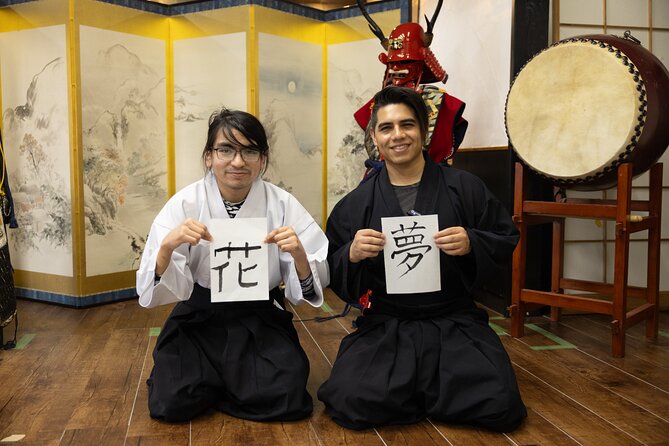
- You dress first: The class begins with help changing into a kimono, hakama, or another traditional outfit, so use the restroom beforehand.
- You learn real brush basics: Practice holding the brush and the three core movements, tome, hane, and harai.
- Your name gets a Japanese treatment: Choose kanji and receive a wooden tag bearing your name in those characters.
- The class suits beginners and children: You do not need Japanese or previous calligraphy experience, though English is the default teaching language.
- Photos are included: Staff photograph your outfit and artwork, then send the digital files to your designated email address.
- Plan for a small-group setting: The maximum is 10 people, but the exact feel can vary depending on the booking.
Changing into a kimono near Osaka Castle
The activity starts with preparation, not a brush stroke. Staff help you put on traditional Japanese clothing such as a kimono or hakama. Several layers and ties can take a few minutes, so do not arrive expecting to walk straight into the lesson.
This opening gives the class its strongest sense of occasion. You are not simply sitting at a desk with an ink brush. You are learning in clothing associated with formal Japanese culture, and the outfit changes how you hold yourself and move. The setting is part of the lesson.
Use the restroom before changing. The instructions specifically ask you to do so, and that is sensible because a fitted kimono or hakama is not something you want to adjust repeatedly. The clothing can also feel warm, especially while practicing. Arrive in comfortable clothes underneath and avoid anything that makes changing difficult.
Hair styling with collected hair and kanzashi is available for an additional ¥3,300 per person. That is optional, not part of the basic price. If you want the most polished portrait, it may appeal to you, but the standard kimono experience already includes the central idea.
More Calligraphy Classes in Osaka
- Osaka: Private Japanese Calligraphy Experience
★ 5.0 · 66 reviews - Calligraphy Workshop in Namba, Dotonbori
★ 5.0 · 57 reviews - Osaka: Private Tea Ceremony and Calligraphy Experience
★ 5.0 · 50 reviews
What shodo teaches beyond pretty writing
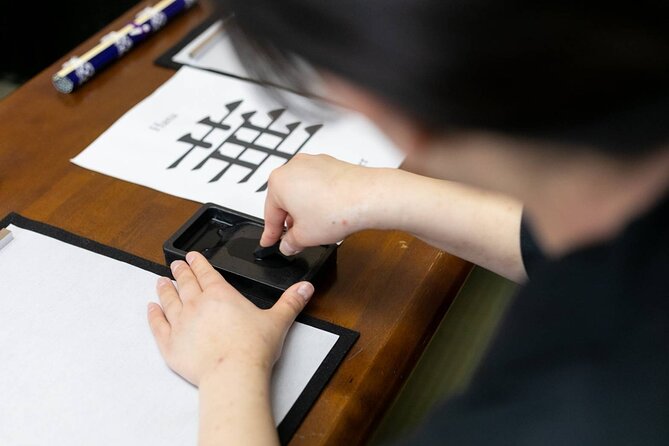
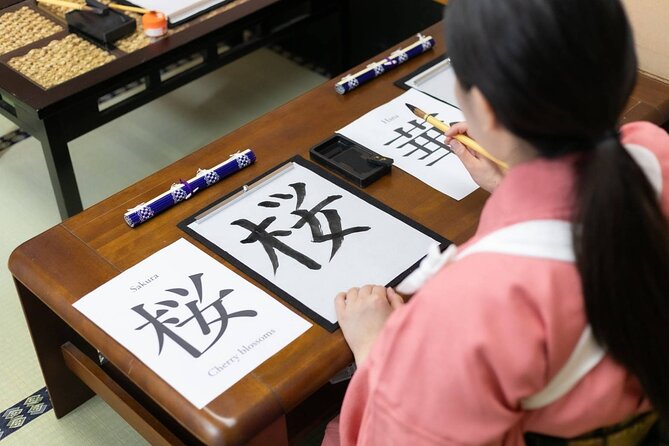
Before choosing a character, the teacher explains how Japanese shodo differs from decorative lettering found elsewhere. That distinction matters. Shodo is not just about making attractive symbols. Brush pressure, speed, pauses, posture, and stroke order all shape the result.
You learn how to hold the brush and use the basic tools. Then you practice three core movements:
- Tome: stopping the brush firmly at the end of a stroke
- Hane: lifting or flicking the brush to create a hooked finish
- Harai: sweeping the brush away in a controlled release
These names give you a simple framework for reading what your hand is doing. You are not expected to become an expert in an hour. The useful goal is to feel the difference between dragging ink across paper and making a deliberate brush stroke.
The class also places value on posture, concentration, and etiquette. That makes the session calmer than a quick costume photo stop. You spend time repeating lines, watching demonstrations, and correcting your hand position. Several people have described the mood as peaceful and relaxing, which fits the quiet focus of the exercise.
The teaching is aimed at beginners, and children can take part. English is the standard language. An English-Japanese or Chinese-Japanese translator may assist, and other languages including Italian, Spanish, French, Thai, Indonesian, and Chinese can be requested. The operator warns that staffing is limited, so you should not assume every language request can be filled.
Choosing a kanji character with a real meaning
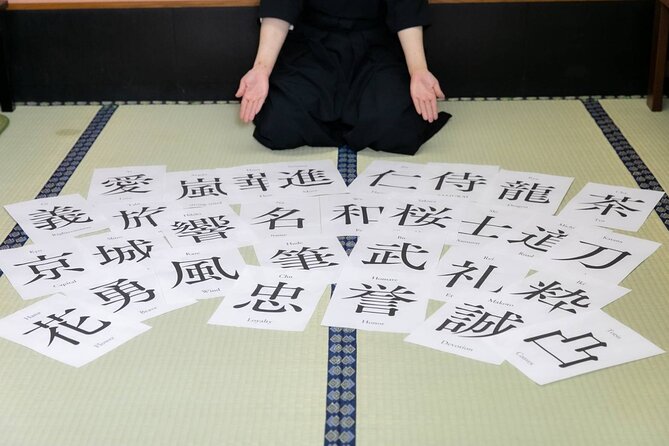
The most personal part comes when you select a kanji character. Each character carries meaning, and the teacher guides you through the stroke order and shape. This is more interesting than copying a random symbol because you leave with some idea of what you wrote.
Kanji can be hard for a first-time student. A single character may carry different shades of meaning depending on its context, and the balance of its parts matters. The teacher breaks the character into strokes and lets you practice before asking for a final draft.
Take your time at this stage. You may be tempted to choose the most complicated-looking character, but a simpler one can be more satisfying if you can control its form. Ask for the meaning and pronunciation before you commit. The point is not to produce museum-quality calligraphy. It is to understand why each mark goes where it does.
The teacher also writes the foreign names of participants in kanji on wooden tags. This is one of the class’s nicest personal touches. Your name becomes a small piece of Japanese calligraphy rather than a generic souvenir, though the chosen characters represent sound and meaning rather than a direct translation in the Western sense.
Practice sheets, final artwork, and the photo session
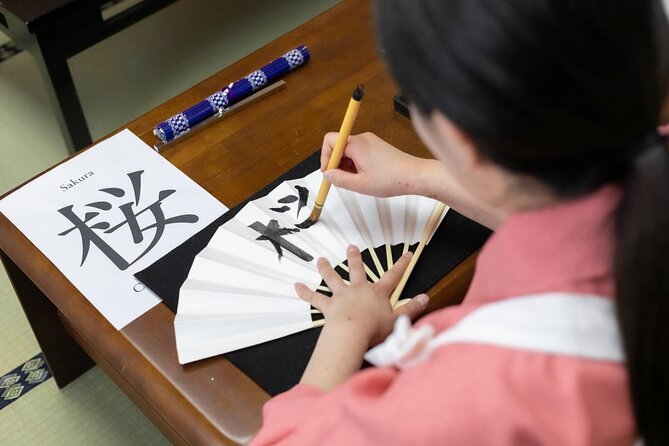
You get repeated practice before the final draft. That matters because the first attempt at a kanji character often feels stiff. By the time you reach the finished piece, you have had a chance to absorb the stroke order and adjust your pressure.
The final work may be made on a fan or scroll, depending on the session. A teacher souvenir is also included, and the name tag is part of the personal memento. Ask what format is planned when you arrive if the final object matters to you.
The photo session follows the writing. Staff photograph you in your traditional clothing with your artwork, and the digital images are sent to the email address you provide. Personal smartphone photography is allowed, but you may not take selfies or photograph other people. Fixed tripods and video recording are not allowed because they can disturb the class.
This is a useful arrangement for families and couples. You can concentrate on the activity instead of asking one person to document every stage. Still, the photography is not a professional portrait session with a stated number of edited images, so keep your expectations practical. You are receiving a record of the experience, not a studio package.
More Castle Tours in Osaka
- Osaka Castle: Museum and Tower Entry Ticket
★ 4.5 · 2,380 reviews - Ultimate Osaka Walking Tour: Castle, Dotonbori & Hidden Gems
★ 5.0 · 862 reviews - Osaka Castle Walking Tour and Castle Tower Admission
★ 5.0 · 561 reviews - From Osaka: Himeji Castle, Arima Onsen & Mt. Rokko Day Tour
★ 4.6 · 339 reviews
The value of a $43.59, one-hour class
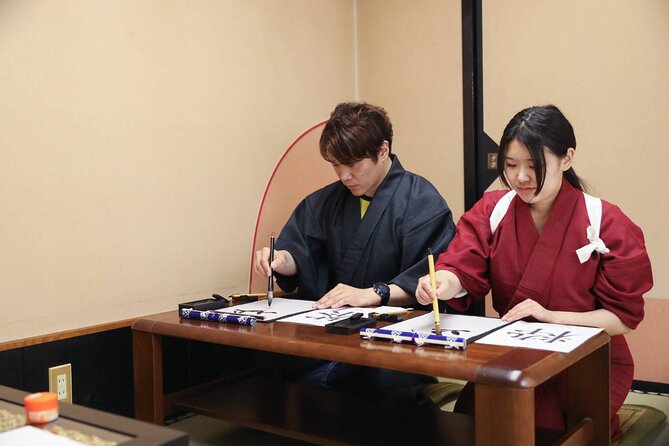
At $43.59 per person, this is not the cheapest way to try a brush and ink. Its value comes from combining several elements in one short appointment: traditional clothing, instruction, kanji selection, a personalized name tag, and digital photos.
If you only want to learn basic calligraphy, a plain workshop could cost less. If you want a cultural activity that photographs well and fits beside a visit to Osaka Castle, the price is easier to justify. You are paying for staff help with dressing as well as the lesson, and the maximum group size is 10 people.
The one-hour length is both a strength and a limit. It works well in a busy Osaka schedule, especially after walking around the castle grounds. You get an introduction rather than a full course. The class can show you the discipline behind shodo, but it cannot take you far beyond basic strokes and one chosen character.
Some people have found the instruction friendly, patient, and engaging. One person noted that there was not quite enough explanation of the different Japanese writing systems. That is a fair point. If you want a full lesson on hiragana, katakana, kanji, and their historical development, this class may feel light. If you want to learn how to hold the brush and write one meaningful character, it fits better.
Finding the small storefront in Joto Ward
The meeting point is listed at 2-chome 3-19 Shiginonishi, Joto Ward, Osaka 536-0014. The activity returns to the same place. It is described as close to Osaka Castle Park Station, with the operator stating that the facility is about a one-minute walk from the station.
Allow extra time to locate the entrance. The storefront is small, and the address can lead you to a residential-looking building or an area that does not immediately look like a cultural studio. Use the supplied map carefully and arrive well before the start time.
The late policy is strict. If you are more than 30 minutes late, entry may be refused even if you have contacted the operator. That is especially important in Osaka, where train connections, station exits, and castle-area walking routes can add unexpected minutes.
The location works best as part of a castle-area plan. You can visit Osaka Castle and then take a short walk to the class, or schedule the class before exploring the park. Do not treat it as a venue you can casually find at the last second.
A small-group class with a recent reliability concern
The maximum group size is 10, which keeps the activity more personal than a large cultural demonstration. The teacher can watch your hand position and offer corrections, and staff can help with the clothing and photos.
The operator has also acknowledged a serious closure problem affecting bookings from June 9 through June 29, 2025. During that period, the on-site staff were unable to work or contact some people with reservations. Full refunds were offered through the booking channels, and the manager said the operator and contracts had changed afterward.
That explanation does not erase the inconvenience. Some people arrived at the address and found no working activity, while others could not reach the host. Because this experience is booked, on average, 36 days ahead, you may be building other Osaka plans around it. I would confirm the appointment, venue, and contact method shortly before the day, especially if you are visiting during a period affected by recent operational changes.
The current overall score is 4.7 from 53 ratings, with 92 percent recommending it. That points to a very strong experience when the session operates as planned, while the small number of one-star accounts shows why basic confirmation is worth your time.
Who will enjoy this most
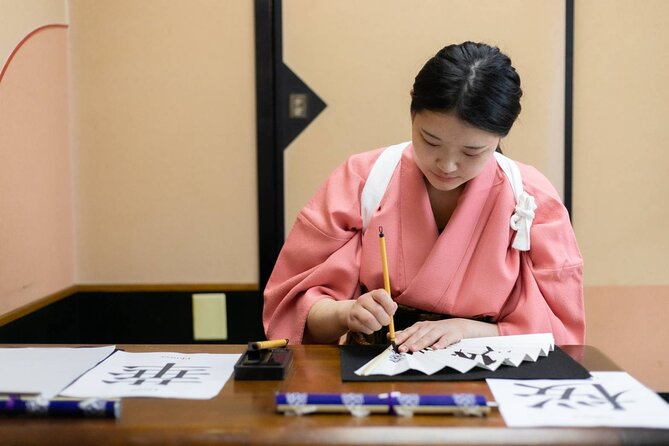
I would choose this for you if you want a short, hands-on cultural activity rather than a lecture. It suits first-time visitors, families with children, couples, and solo visitors who like making something personal. You do not need Japanese language skills or calligraphy experience.
It is also a good match after a long walk around Osaka Castle. Sitting on tatami, changing pace, and focusing on a brush can provide a welcome quiet hour. The kimono and photo element gives children a clear focus, while the kanji name tag gives adults a more thoughtful souvenir.
I would be more cautious if you have back problems or a heart condition, since the activity is not recommended for those conditions. It is not stroller accessible, pets are not suitable, and service animals are allowed. You must sign a liability waiver.
If your priority is advanced calligraphy, a long historical explanation, or a broad lesson in all Japanese scripts, this is not the right format. It is a beginner class built around one character, one finished draft, and a memorable setting.
Booking advice and cancellation terms
Free cancellation is available up to 24 hours before the start time for a full refund. Changes or cancellations inside 24 hours are not accepted and are not refunded, based on the stated policy.
I would book only after checking that your email address is correct, since the photos are sent digitally. I would also keep the booking confirmation and contact details easy to find on the day. Gratuities and taxes are included, but the optional hair styling costs extra, and transportation to the venue is not included.
Should you book this Osaka calligraphy class?
Book it if you want to wear a kimono, learn the basics of shodo, choose a kanji character, and leave with photographs plus a personalized name tag. The patient instruction, intimate scale, and calm brush practice give the hour more substance than a costume photo stop.
Skip it if you want serious calligraphy training, cannot sit comfortably for the activity, or prefer a fully dependable walk-in attraction. Confirm the location before leaving, allow extra time for the small entrance, and remember that the class is an introduction, not mastery.
For most visitors who want one personal connection with Japanese culture near Osaka Castle, the $43.59 cost is reasonable. Just make the booking with practical caution, then enjoy the quiet challenge of getting one bold black character onto paper.
FAQ
How long does the Japanese calligraphy experience last?
The activity lasts approximately one hour.
How much does the experience cost?
The listed price is $43.59 per person.
Where does the class meet?
The meeting point is Japan, 536-0014 Osaka, Joto Ward, Shiginonishi, 2-chome 3-19, at the Samurai Honor location.
Is the class conducted in English?
English is the default language. English-Japanese or Chinese-Japanese translation may be available, and other language requests can be made, but availability is limited.
Do I need previous calligraphy experience?
No. The class is open to all skill levels, including children.
What clothing is provided?
Traditional Japanese clothing such as a kimono or hakama is provided for the activity.
Are photos included?
Yes. Staff take photographs, and digital data is sent to the email address you provide.
Is hair styling included?
No. Collected hair and kanzashi are an optional paid extra costing ¥3,300 per person.
What happens if I am late or need to cancel?
You may be refused entry if you arrive more than 30 minutes late. You can cancel up to 24 hours before the start time for a full refund, but cancellations or changes made within 24 hours are not refunded.
More Kimono Experiences in Osaka
- Osaka: Sumo Show & Experience w/ Optional Kimono & Hot Pot
★ 4.5 · 609 reviews - Osaka: Kimono or Yukata Rental &Photos Service Options
★ 4.9 · 25 reviews - Kimono photoshoot-Includes 100 photo data
★ 5.0 · 21 reviews - Kimono Tea Ceremony at Kyoto Maikoya, NISHIKI
★ 5.0 · 911 reviews
Just added around Osaka
- Exclusive Sushi Making Experience with a Master Chef – Osaka Area★ 5.0 · 25 reviews
- Private Home-Style Cooking Class in Osaka with Local Mom Yoshiko★ 5.0 · 46 reviews
- Hidden Osaka – Yukaku Red Light Tour & Culinary Adventure★ 4.8 · 96 reviews
- Osaka: Walking Tour and Top Highlights★ 4.8 · 104 reviews
- Osaka: Private Ceramic Painting Workshop★ 5.0 · 13 reviews
- Pickleball in Osaka, Kobe & Kyoto with Locals!★ 4.7 · 80 reviews
- Eat Like a Local in Osaka – Private Custom Street Food Tour★ 4.3 · 33 reviews
- Osaka:SUMO BEATS SHOWCASE: Taiko Drum and Wagyu burger!★ 4.2 · 37 reviews
Kimono & Yukata Experiences, compared.

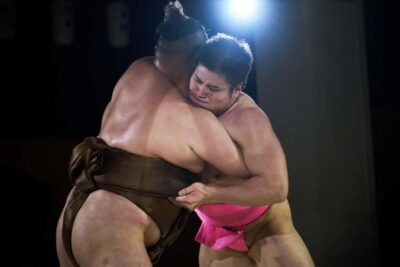
Sumo Show & Experience w/ Optional Kimono & Hot Pot
Our verdict →
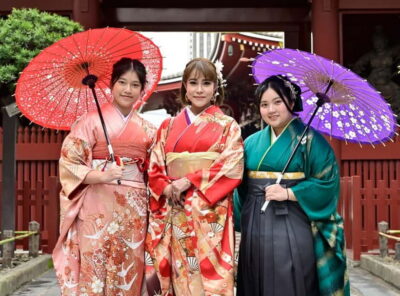
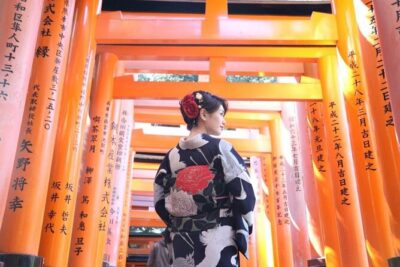
Family-Friendly Kimono & Yukata Experience at WARGO
Our verdict →
Browse the lists this tour appears in