
Reviewed · BUS TOURS
Tokyo: 60min Panoramic Open Top Bus Tour with Audio Guide
Tokyo looks different from the upper deck of a moving bus. You get a broad view of Tokyo Tower, Rainbow Bridge, and Tokyo Bay without ducking behind shop signs or waiting for traffic lights at street level. For a first look at the city, this one-hour ride packs in a useful amount.
I like the route for two reasons: it gives you several angles on Tokyo Tower, and the open air makes the crossing toward Rainbow Bridge feel like a real change of scene. The main drawback is just as clear: this is a continuous sightseeing loop, not a hop-on hop-off bus, so you cannot get off at the places that catch your eye.
Key points to know before boarding
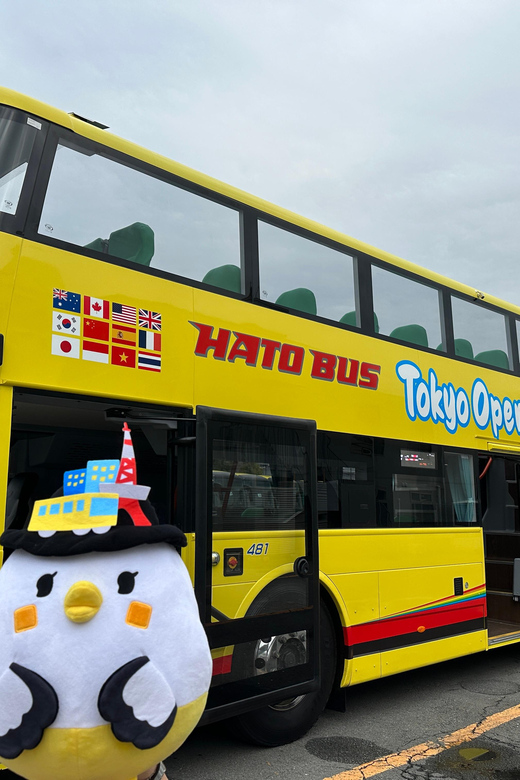
- The route begins and ends near Tokyo Station: The Hato Bus Tokyo Office is about two minutes from the Marunouchi South Exit.
- Rainbow Bridge is the outdoor highlight: The ride brings Tokyo Bay, Odaiba, and the city skyline into one long view.
- The upper deck is weather dependent: Rain can mean a closed roof, and heavy rain or poor weather can cancel the trip.
- Audio guidance covers eight languages: English, Chinese, Korean, Spanish, French, Thai, Indonesian, and Vietnamese are available through GPS guidance.
- You need your own equipment: Bring a smartphone that works in Japan and your own earphones. Neither is supplied.
- The price is modest for a quick orientation: At $14 per person, it is best judged as a city overview, not a full sightseeing day.
Why this one-hour bus ride works well in Tokyo
Tokyo can feel hard to read when you first arrive. The city spreads in every direction, and its major districts are not arranged like a simple old-town center. A bus ride gives you a quick visual map: the government district, Tokyo Tower, the bay, the market area, Kabuki-za, and Ginza all appear in a single circuit.
I especially like the open-top format because it changes the pace from ordinary city transport. You are not simply moving between attractions. You are watching the city pass overhead and beside you, with fewer obstructions than you would have at street level.
The ride lasts only 60 minutes, so you should set your expectations properly. You will pass the sights rather than visit them. There is no time to tour the National Diet Building, browse Tsukiji Outer Market, or explore Odaiba during the ride.
That limitation is also the point. If your schedule is tight, this is a low-cost way to see how Tokyo’s central districts connect. I would use it near the start of a longer stay, then return later to the places that deserve more time.
More Bus Tours in Tokyo
- 1-Day Tokyo Bus Tour
★ 5.0 · 14,250 reviews - Tokyo: Hop-On Hop-Off Sightseeing Bus Ticket
★ 3.9 · 4,207 reviews - Tokyo: Meiji Shrine, Asakusa, Skytree Bus Tour and Cruise
★ 4.7 · 1,986 reviews
Starting at Tokyo Station and Hibiya Park
The meeting point is the Hato Bus Tokyo Office near Tokyo Station’s Marunouchi South Exit. After leaving the station, turn left and walk straight for about two minutes. Look for the yellow Hato Bus stop, and allow a little extra time if Tokyo Station is unfamiliar to you.
The route first passes Hibiya Park. This gives you an early contrast between Tokyo’s grand central roads and a calmer patch of greenery. You will not stop, so treat it as a quick visual introduction rather than a park visit.
From there, the bus continues toward the National Diet Building. The building is Japan’s parliamentary center, and its formal architecture reads well from the upper deck. You get a passing view, not an interior tour, so this section is mainly useful for placing Japan’s government district on your mental map.
Toranomon and the view toward Tokyo Tower
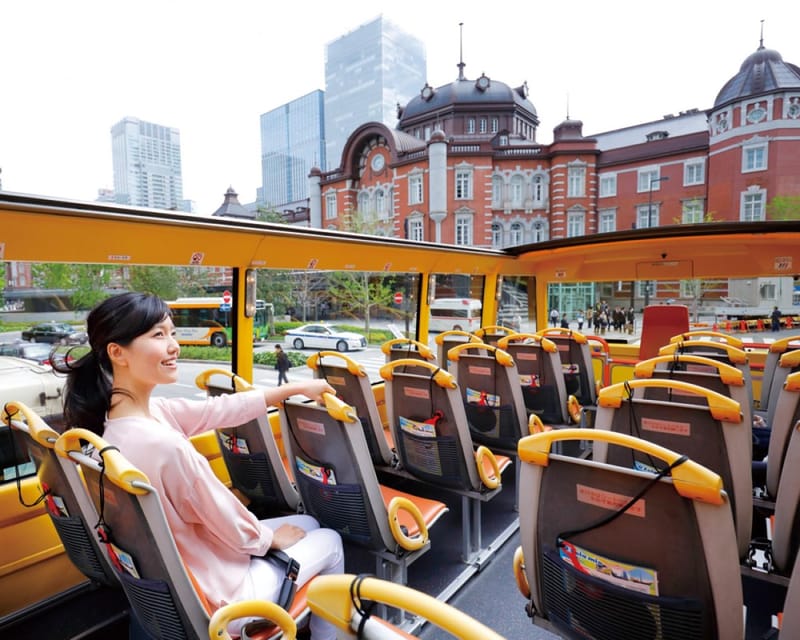
The bus passes through Toranomon, an important central business area, before reaching Tokyo Tower. This is one of the strongest parts of the route because the tower does not appear only once from one fixed viewpoint.
From a moving open-top bus, you can see Tokyo Tower from changing angles as streets and buildings shift around it. That makes the view more interesting than a single photo stop, especially if you want a quick sense of how the tower fits into central Tokyo.
A practical point: passing a landmark is not the same as stopping beside it. You should have your camera ready, but do not expect a long pause or time to visit the observation decks.
Crossing Rainbow Bridge toward Odaiba

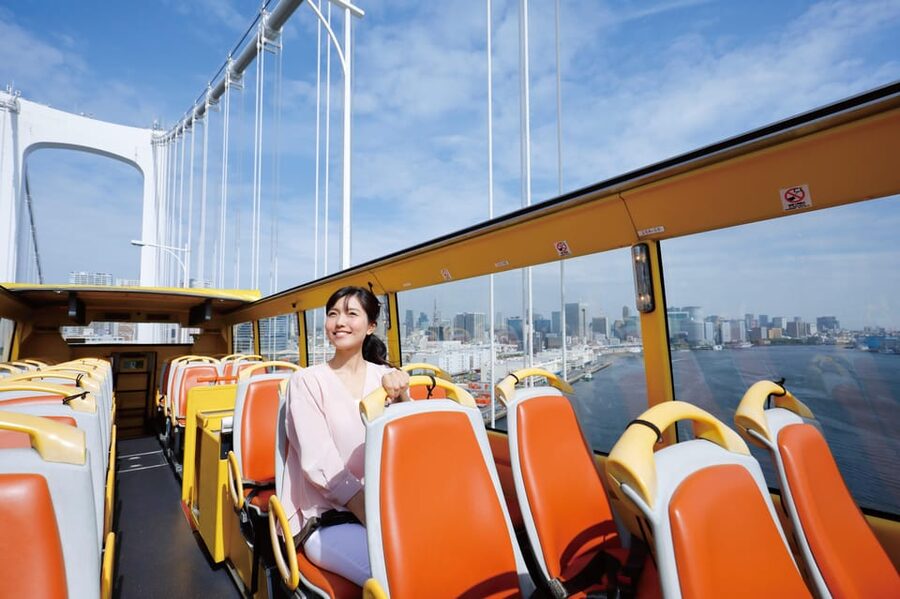
The ride’s biggest change of scenery comes as the bus heads toward Rainbow Bridge. The open deck lets you feel Tokyo’s breeze, and the view expands from dense central streets to the bay and wide stretches of sky.
Rainbow Bridge is more than a photo backdrop here. It links the central Tokyo side with Odaiba and gives you a clear view of the city from above the water. Weather matters greatly at this point. On a clear day, the open deck helps make the crossing feel spacious and memorable. In rain, the roof may be closed, which changes the experience considerably.
Odaiba follows the bridge crossing. The area is known for its bay setting and modern development, and it provides a different face of Tokyo from the older commercial districts. You pass through rather than stop, so think of this as a quick look at the waterfront rather than an Odaiba visit.
The bus then continues through Toyosu. This section keeps the bay-area portion of the route moving before the bus turns back toward central Tokyo.
Same trip, a completely different kind of day:
- Tokyo: TOKYO SKYTREE® Admission ticket
★ 4.5 · 11,192 reviews - Tokyo: teamLab Planets TOKYO Digital Art Museum Entry Ticket
★ 4.6 · 9,779 reviews - Tokyo: Sumo Show Experience with Chicken Hot Pot and a Photo
★ 4.8 · 6,678 reviews - Tokyo: Shinjuku Food Tour (13 Dishes at 4 Local Eateries)
★ 5.0 · 6,603 reviews
Tsukiji, Kabuki-za, and Ginza on the return
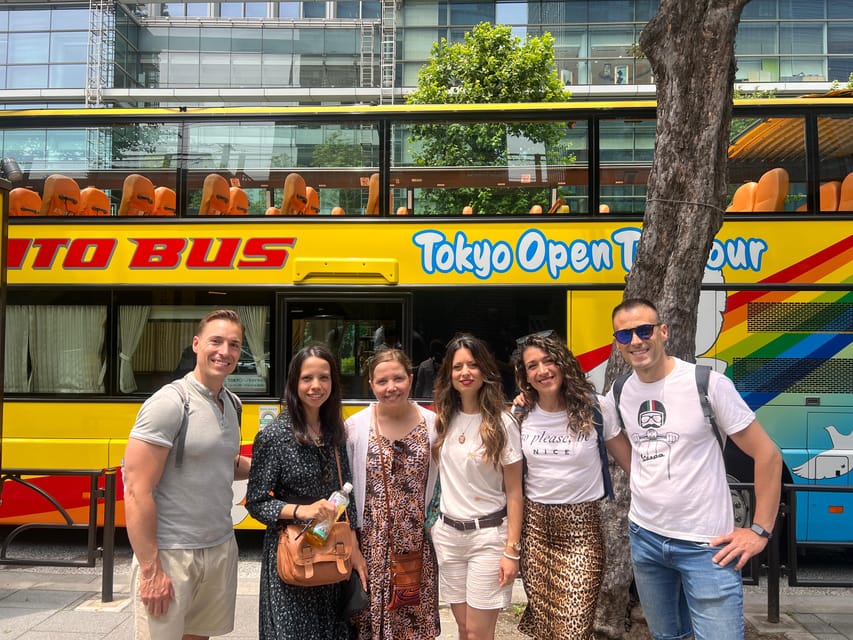
Tsukiji Outer Market appears later in the circuit. The market is a place you would normally explore on foot, but from the bus you only receive a passing glimpse of the surrounding area. I see this as a useful reminder to add Tsukiji to a separate morning plan if food and market streets interest you.
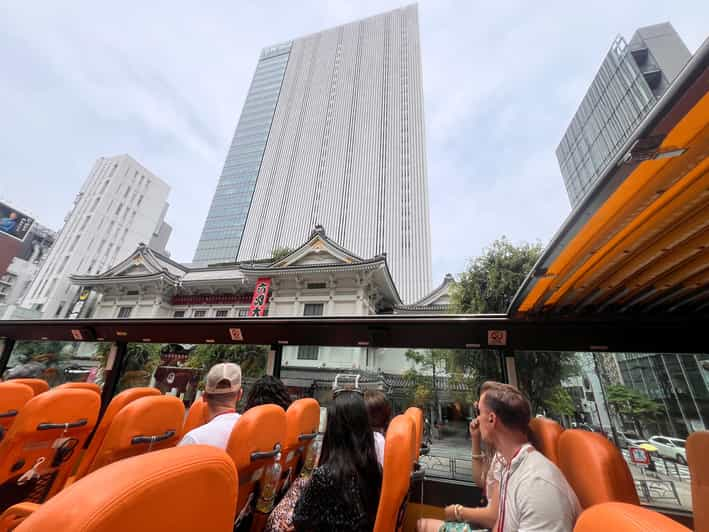
Next comes Kabuki-za, the famous theater in Ginza. Its distinctive exterior makes it easy to recognize from the road, even during a short pass. You will not attend a performance or tour the theater, but the sight adds a strong cultural marker to the final part of the route.
Ginza completes the central-city portion of the ride. Its broad avenues and polished storefronts offer a sharp contrast to the bay views earlier in the hour. Passing through Ginza also helps you connect several places that can otherwise seem scattered when you explore Tokyo by train.
The bus then returns to the Hato Bus Tokyo Office near Tokyo Station. Since the ride ends where it starts, you can continue sightseeing from the station without arranging a separate return transfer.
The audio guide and what you need to bring
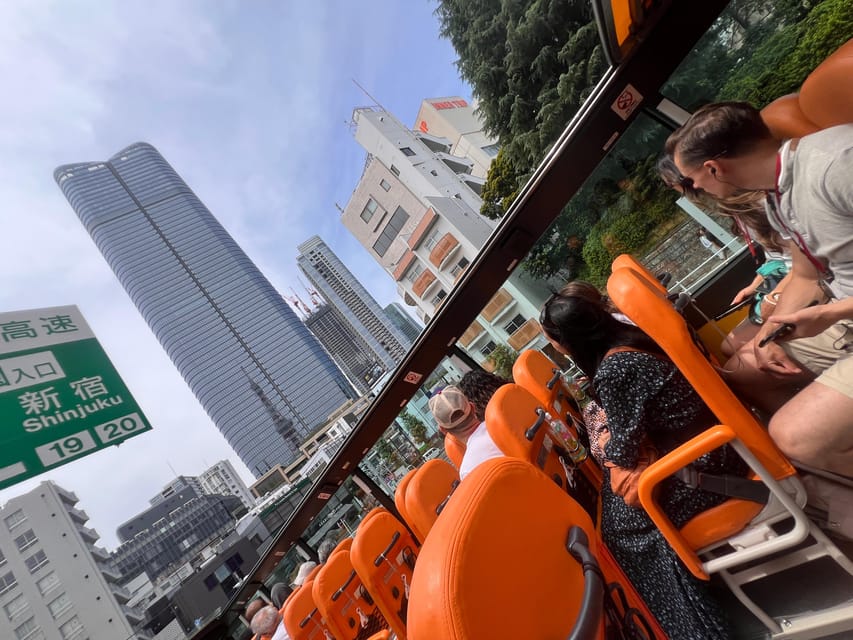
The live guide speaks Japanese. For other languages, the bus uses GPS-based automated guidance in English, Chinese, Korean, Spanish, French, Thai, Indonesian, and Vietnamese.
This is a useful arrangement if you do not speak Japanese, but it does require preparation. Bring:
- A smartphone that can be used in Japan
- Your own earphones
- Enough battery for the one-hour ride
The GPS system is provided free of charge, but the operator does not provide rental devices or earphones. There are also no refunds for technical problems or malfunctioning earphones, so test your phone and earphones before boarding.
I would not treat the audio as a substitute for a personal guide. Its value is practical: it helps you identify what you are passing while you focus on the view. The Japanese-speaking guide handles the tour, while the GPS system gives you language support.
Weather, seating, and comfort
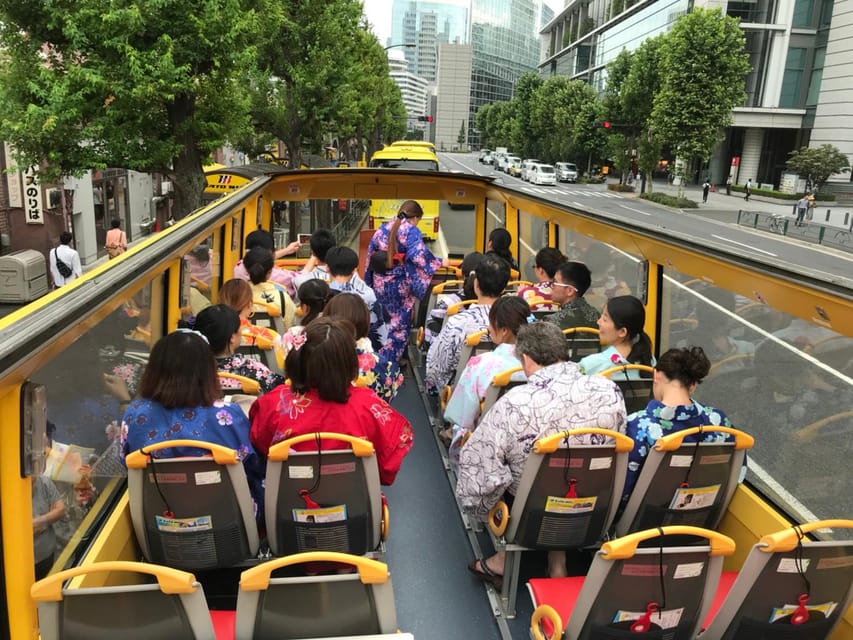
The open-top deck is the reason to book this ride, but it is also the part most affected by weather. Rain may lead to the roof being closed, and bad weather or heavy rain can cancel the tour.
That means the experience is strongest on a dry day with decent visibility. If seeing the skyline and feeling the breeze is your main goal, check the forecast before committing to this as a major highlight.
Eating is not allowed on the bus. Drinks in plastic bottles are permitted, so carry water if needed, but leave meals and snacks for before or after the ride.
Children under six can join free without a seat, with one child allowed per adult. If a young child needs a seat, the standard booking rules may apply, so check the available arrangements when you reserve.
The bus is not a hop-on hop-off service. Everyone follows the full route, and there is no opportunity to leave at Tokyo Tower, Odaiba, Tsukiji, or Ginza. That makes the ride simple, but it also means you should not use it as local transportation.
Is $14 good value?
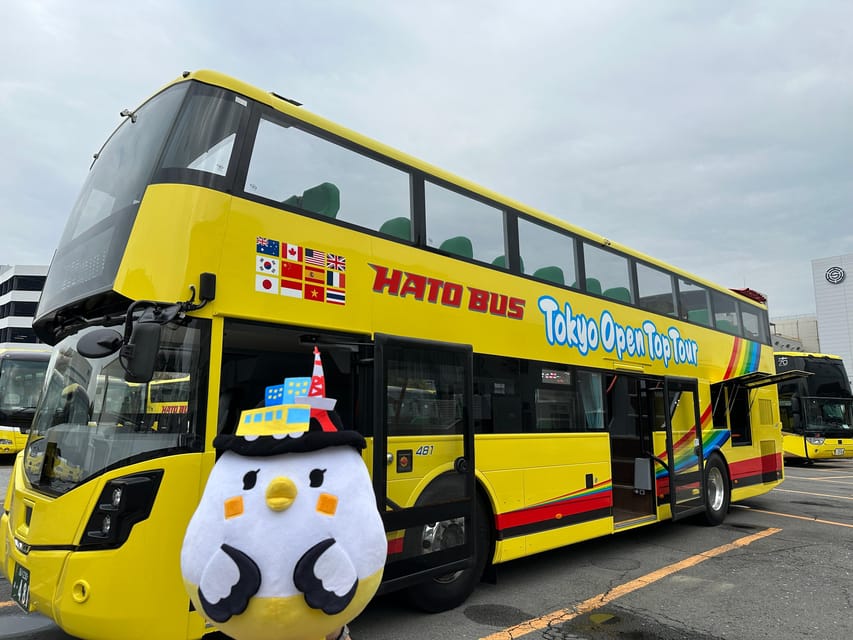
At $14 per person, I consider this a fair price for a one-hour overview of Tokyo. You are paying for the open-top double-decker bus, the route, the guide service, and the chance to see central Tokyo and the bay without planning several train connections.
The value is strongest for three types of visitors:
- You are visiting Tokyo for the first time and want a quick orientation.
- You have a short stay and want to see several districts in one hour.
- You enjoy city views and photography more than stopping at every landmark.
The value is weaker if you want detailed history, long photo stops, or entry to attractions. The ride does not include hotel pickup, meals, or admission to any sight. You also need to arrange your own way to Tokyo Station.
Still, the low cost makes the limitations easy to understand. This is not trying to replace a full-day city tour. It is a compact introduction that lets you decide where to spend your time afterward.
How to fit the bus into your Tokyo plans

I would book this early in your Tokyo stay if you want help understanding the city’s layout. After the ride, you will have seen where Ginza, Tokyo Tower, the bay, Odaiba, Toyosu, and Tsukiji sit in relation to one another.
You could pair the ride with a separate visit to one of the passing areas. For example, explore Ginza after returning to Tokyo Station, or plan Tsukiji for another morning. Just leave enough time for those visits because the bus itself offers no stopover.
The departure time matters less than the weather and your wider schedule. Since the tour lasts one hour and returns to its starting point, it is easy to place between other Tokyo activities. Availability and starting times vary, so check the schedule before building your day around it.
For photography, keep your phone or camera ready before reaching Tokyo Tower and Rainbow Bridge. The bus keeps moving, and the best angle may last only a few seconds. An open upper deck also means wind can affect your shots and comfort.
Who should book this tour?
I would recommend it to first-time visitors, families seeking an easy overview, and anyone who wants a short break from Tokyo’s underground trains. It also suits people who like architecture and city photography but do not want a long walking tour.
It may not suit you if you need wheelchair-specific arrangements, although no accessibility details are provided here. It is also a poor match if rain is likely and your main reason for booking is the open-air view.
The tour is conducted in Japanese, with automated audio in eight languages. If you want a personal English-speaking guide, this is not that kind of experience. If you are comfortable using your own phone for GPS audio, the language support is a helpful alternative.
Should you book the Tokyo open-top bus?
Book it if you want a cheap, efficient first look at Tokyo and you can accept passing the sights without stopping. The Tokyo Tower views, Rainbow Bridge crossing, and return through Tsukiji, Kabuki-za, and Ginza give the hour a good mix of city, bay, shopping, and culture.
Skip it if you want in-depth commentary, attraction admissions, or the freedom to get off whenever you wish. Also check the weather carefully, since a closed roof can take away much of the tour’s appeal.
For $14, I see it as a useful orientation ride rather than a centerpiece experience. It gives you a moving sketch of Tokyo, then leaves you to choose which parts deserve a closer look.
FAQ
Where does the bus tour begin and end?
It begins and ends at the Hato Bus Tokyo Office near Tokyo Station. The office is close to the JR Tokyo Station Marunouchi South Exit, about a two-minute walk after turning left and continuing straight. The stop is marked by a yellow Hato Bus.
How long does the tour last?
The tour lasts one hour.
Is this a hop-on hop-off bus?
No. The bus follows one continuous route and returns to the Hato Bus Tokyo Office. You cannot get off at the sights along the way.
What languages are available?
The live guide speaks Japanese. GPS automated guidance is available in English, Chinese, Korean, Spanish, French, Thai, Indonesian, and Vietnamese.
Do I need to bring anything for the audio guide?
Yes. Bring a smartphone that can be used in Japan and your own earphones. GPS devices and earphones are not provided for rental.
Can I eat or drink on the bus?
Eating is not allowed. Drinks in plastic bottles are permitted.
What happens if it rains?
The bus roof may be closed in rain. The tour may also be canceled because of bad weather or heavy rain.
More Audio Tours in Tokyo
- Tokyo: Open Top Panoramic Sightseeing Bus with Audio Guide
★ 3.8 · 254 reviews
Just added around Tokyo
- Kawagoe Japanese Food Tour : Unagi Kaiseki and Sake near Tokyo★ 5.0 · 30 reviews
- Kawagoe 4hr Private Tour with Licensed Guide (Kawagoe Dep)★ 5.0 · 13 reviews
- Little EDO Sushi Making workshop in Kawagoe★ 5.0 · 18 reviews
- 【R34】Tokyo:Private Daikoku tour in Modified R34★ 4.9 · 92 reviews
- :Tokyo,Shibuya/ Pro Photography in Kimono / English-Friendly★ 5.0 · 26 reviews
- Tokyo:Celebrate Unique Japanese New Year Tradition Festivity★ 3.9 · 20 reviews
- Tokyo: Allstar Food Tour★ 4.7 · 29 reviews
- Tokyo: West-Side Cycling and Food Tour with Guide★ 5.0 · 37 reviews
Bus Tours, compared.
Mt Fuji and Hakone 1-Day Bus Tour Return by Bullet Train
Our verdict →
Peaceful Hiroshima & Miyajima UNESCO 1 Day Bus Tour
Our verdict →
Meiji Shrine, Asakusa, Skytree Bus Tour and Cruise
Our verdict →
Kyoto/Osaka: Nara, Fushimi Inari Taisha, Arashiyama Bus Tour
Our verdict →
Mt.Fuji & Lake Kawaguchiko 1-Day Bus Tour w/Optional Lunch
Our verdict →
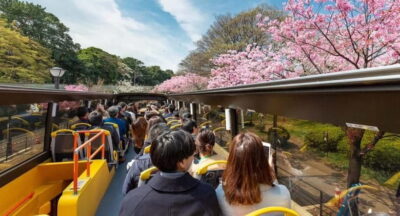
Open Top Panoramic Sightseeing Bus with Audio Guide
Our verdict →
[One-day bus tour departing from Kanazawa Station] Shirakawa-go and Gokayama – Two World Heritage Villages Enjoyable Bus Tour
Our verdict →Browse the lists this tour appears in