
Reviewed · GO-KARTS
Tokyo: Guided Go Kart Tour from Harajuku to Shibuya Crossing
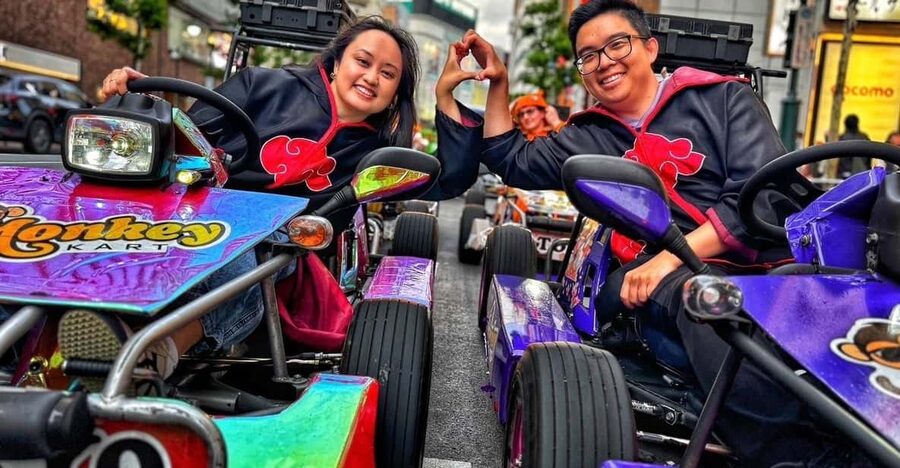
The best part of this Tokyo tour is simple: you drive through the city rather than only looking at it from a train window or sidewalk. In a street-legal kart, you follow a guide through Harajuku, Shibuya Crossing, and Shinjuku, with Tokyo’s signs and traffic passing close by.
I like the small groups, limited to five drivers, and the guide-led format. I also like that your guide takes photos along the route, then sends them by AirDrop or email, with one hard-copy photo included. The main drawback is price: at $103 per person, it is a fun extra rather than an essential way to see Tokyo.
Key points
- Drive through Shibuya Crossing: You see one of Tokyo’s most famous places from the road, not from the usual pedestrian viewpoint.
- Small groups of up to five: Guides can give clearer signals and more personal help than a large convoy.
- Costumes are included: Pick from costumes, masks, and funky glasses before setting off.
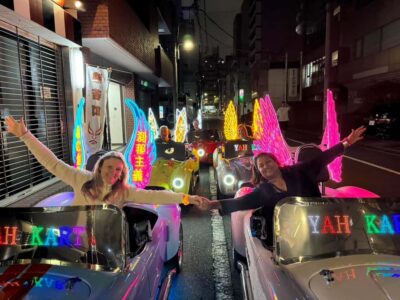
- Night rides add city lights: Evening departures create a different mood, though daytime rides may make landmarks easier to see.
- Photos are part of the package: You receive digital images and one printed photo without arranging your own photographer.
- Your driving permit matters: Japan requires a hardcopy 1949 Geneva Convention International Driving Permit, or an accepted Japanese translation for certain countries.
What the 75-minute Tokyo kart ride is really like
This is not a go-kart track hidden away from traffic. You drive a custom-built, street-legal kart on Tokyo roads, following an English-speaking guide. That makes the experience more exciting, but it also means you need to take road rules, signals, and your own confidence seriously.
The tour begins with instructions and a safety briefing. You learn how to operate the kart and how to follow the guide’s signals before entering the traffic. Several people specifically valued the clear briefing and steady hand signals, which matter more here than a quick explanation at a standard amusement park.
The group limit is five participants. That is a useful size for a road-based activity. You can still enjoy the shared energy of a small convoy, while the guide has a reasonable chance of keeping track of each driver. Guides named in feedback include Gas, Lewis, Ayrton, Rakesh, Mirko, Juani, Kevin, Chris, Shin, Matthias, and Martinez. The consistent point is not a particular guide, since staffing can change, but the role they play: setting the pace, checking on drivers, and keeping the group together.
You need to be over 18, and you must bring the right driving document. This is the detail most likely to spoil your plans if ignored. A digital permit, photocopy, or card-style license is not valid for this activity.
More Go-Kart Tours in Tokyo
- Flagship 2-Hours Official Street Go-Kart Tour – Tokyo Bay Shop
★ 5.0 · 4,974 reviews - Official Street Go-Kart in Shibuya
★ 5.0 · 3,435 reviews - Official Street Go-Kart Tour – Akihabara
★ 5.0 · 1,578 reviews
Starting near Shibuya Station
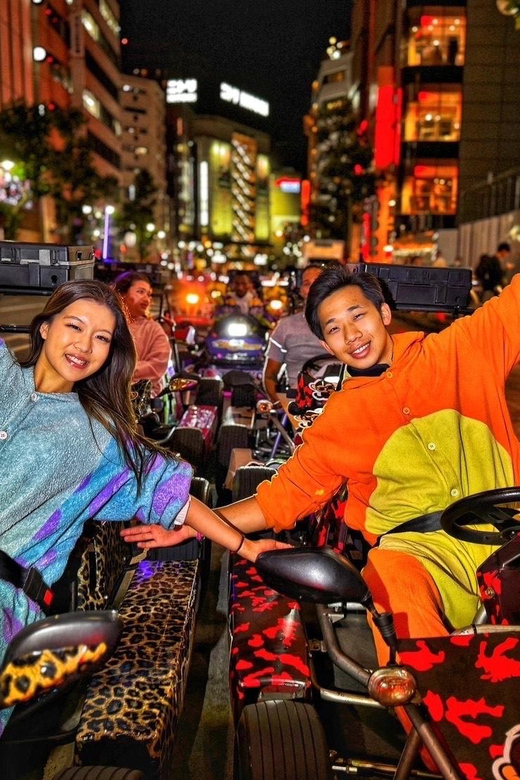
The meeting point is on the main big street by Family Mart at 3-chome-17-3 Shibuya, Shibuya City. It is about a two-minute walk from Shibuya Station Exit C2 and the central gate area.
Give yourself enough time to locate the shop and check in. The activity does not include hotel pickup or drop-off, so you handle your own trip to and from the meeting point. One participant reported waiting about 30 minutes, so I would avoid scheduling a tight restaurant booking or train connection right after the ride.
At the starting point, you can choose from costumes, masks, and colorful glasses. The dress-up option is not required, but it changes the feel of the experience. A unicorn outfit or comic-style costume makes the photos more playful, while a regular jacket keeps things simple if you prefer not to draw attention.
Remember that you are still driving on public roads. Pick something that does not interfere with your view, hands, or ability to operate the kart. The supplied information does not specify the full costume range, but the selection includes costumes, masks, and funky glasses.
Leaving Harajuku behind the guide
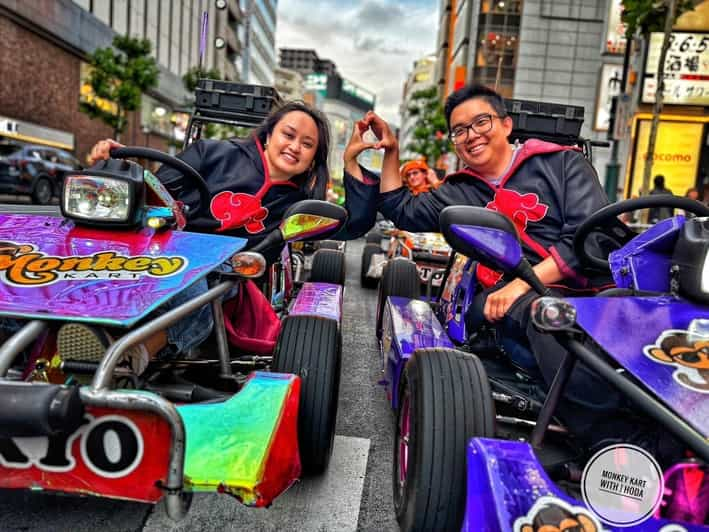
Harajuku brings the first strong change of scenery. This is one of Tokyo’s best-known areas for youth culture, fashion, and colorful streets, and the kart gives you a moving view rather than a stop-by-stop walking tour.
You will not be getting out to visit shops or shrines during the ride. The value here is the sensation of passing through the district as part of Tokyo’s normal road activity. You get a quick look at the streets, buildings, signs, and traffic patterns while concentrating on the guide ahead.
That distinction matters. If you want detailed background on Harajuku or time to browse, book a walking tour separately. This activity gives you a lively overview and a memorable way to connect several districts, but it is not designed for long sightseeing stops.
The guide also takes photos at selected points. That lets you focus on driving instead of trying to hold up a phone. Guides have been praised for acting as both road leaders and photographers, with some making a special effort to take plenty of pictures.
Crossing Shibuya in a go-kart
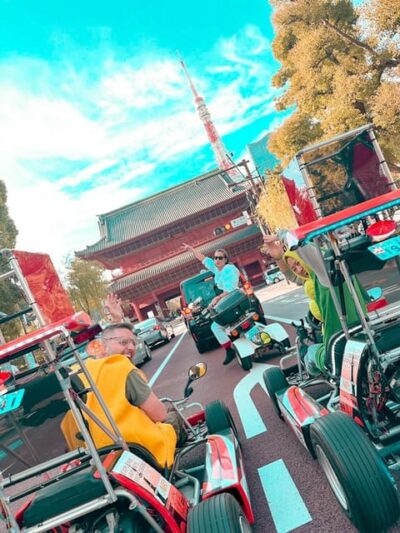
The main prize is Shibuya Crossing. You likely know the familiar pedestrian view, with people moving in several directions when the traffic stops. Here, you approach and pass through the crossing from a low kart, surrounded by Tokyo’s central city activity.
That is the moment that makes this tour different from a regular city drive. You are not simply being carried past the sight. You are operating the vehicle, watching the guide, and taking in the scene at road level.
You should keep your attention on driving rather than expecting a photo stop in the middle of the crossing. The guide controls the route, and your job is to follow safely. The crossing can be exciting, but the tour is still an organized road activity, not a free-form race.
Several participants described feeling safe because the guide gave clear signals and maintained a manageable pace. That reassurance is important, especially if this is your first time driving in Japan. Other road users were described as mindful of the karts, but you should still expect normal city traffic and remain alert.
Same trip, a completely different kind of day:
- 1-Day Tokyo Bus Tour
★ 5.0 · 14,250 reviews - Tokyo: TOKYO SKYTREE® Admission ticket
★ 4.5 · 11,192 reviews - Tokyo: teamLab Planets TOKYO Digital Art Museum Entry Ticket
★ 4.6 · 9,779 reviews - Tokyo: Sumo Show Experience with Chicken Hot Pot and a Photo
★ 4.8 · 6,678 reviews
Shinjuku, tunnels, and the faster stretches
After Shibuya and Harajuku, the route continues toward Shinjuku and nearby central Tokyo neighborhoods. The exact sequence can vary with traffic, weather, and road conditions, so treat the route as a guided circuit rather than a fixed sightseeing timetable.
Shinjuku adds another side of central Tokyo, with large buildings, bright signs, and heavy city energy. The tour gives you a broad sense of how close these districts are when connected by road, something that can be less obvious when you move around underground.
Some rides include a more open stretch or a tunnel. One participant described a tunnel section with little traffic as exhilarating, while another appreciated the speed of the karts. The karts can feel faster than expected, so listen closely during the briefing and leave enough space around you.
This is also where expectations matter. You are not signing up for a racing session. You follow the guide, maintain the group’s pace, and drive within Japanese road rules. The fun comes from being in the city, not from competing with the other participants.
Daytime or night: choosing your departure
Night rides are especially appealing if you want city lights in your photos. The signs and illuminated streets give the ride a more dramatic look, and one participant described finishing a night drive still buzzing from the experience.
A daytime departure has its own advantages. You may find it easier to see the districts and surrounding buildings, and natural light can help with general sightseeing. The activity description specifically allows for day or night rides, but it does not promise a particular view or route at every departure time.
If photography is your top concern, ask yourself what kind of images you want. Night gives you glowing signs and a stronger city-at-night mood. Daylight may provide clearer detail. In either case, the guide handles photos at key points and sends the images afterward.
Weather can affect the schedule. The tour may be rescheduled because of rain. Plan with some flexibility, particularly during a trip where every day already has fixed reservations.
Why the small group matters
A maximum of five participants is one of the stronger practical features. A guide can watch a small line of karts more easily than a large group, and instructions are less likely to get lost.
The small format also gives the activity a more personal feel. One participant happened to be the only person booked on a morning departure and enjoyed the extra interaction with the guide. You cannot count on having a private ride, but a small group leaves room for more direct help and conversation.
Guides have also been praised for checking in with drivers, adjusting the pace, and making the experience comfortable for first-time participants. That does not remove the need for caution. You still need to be comfortable operating a vehicle among traffic and following instructions promptly.
The guide’s photography is another benefit of the small format. You are more likely to receive attention at photo points, rather than being one driver in a long line. The package includes digital photos through AirDrop or email and one printed picture.
Is $103 worth it?
At $103 per person, this is not a cheap sightseeing ride. The price pays for the kart, guide, costumes, water, photo service, digital pictures, one hard-copy photo, and the unusual chance to drive through central Tokyo.
I think the value depends on what you want from a city activity. If you want an efficient introduction to Tokyo’s history, this is not the best use of your budget. A train ride, walking tour, or observation deck will give you more conventional sightseeing for less money.
If you want a story to take home, the price becomes easier to justify. Driving through Shibuya Crossing, wearing a costume, and receiving photos of the experience is hard to duplicate with ordinary transport. Several participants felt the 75-minute ride was worth the cost, while one called it somewhat expensive and nonessential.
There is one timing point to keep in mind. The advertised duration is 75 minutes, but one participant reported 57 minutes of actual driving. The information does not explain the difference, so I would regard the 75 minutes as the scheduled activity window rather than a guaranteed 75 minutes behind the wheel.
What to bring, and who should skip it
Bring the physical, correct driving permit before leaving your home country. Japan requires the hardcopy paper booklet of a 1949 Geneva Convention International Driving Permit issued by an official agency such as AAA, AA, CAA, or an equivalent agency in your country.
Japan does not recognize 1968 Vienna Convention permits, or permits issued by IDA or IAA. Licenses from France, Switzerland, Taiwan, Germany, Monaco, and Belgium require a Japanese translation from the Japan Automobile Federation.
Driving permits from Indonesia, Pakistan, Saudi Arabia, Mexico, Brazil, Costa Rica, Colombia, Kuwait, Qatar, and some other countries may not be accepted. Check your eligibility before booking, not at the meeting point.
You cannot bring alcoholic drinks into the vehicle. The activity is not suitable for pregnant women, people over 95, or drivers under 18.
This tour suits adults who want a playful, active way to see several districts and who are comfortable following road instructions. It is less suitable if you dislike traffic, want a quiet sightseeing experience, or need frequent stops.
Cancellation and weather flexibility
You can cancel up to 24 hours in advance for a full refund, and the reserve-now, pay-later option keeps your plans open. These terms are useful when you are building a Tokyo schedule around weather and other timed bookings.
Rain may cause the tour to be rescheduled. Keep a spare time slot available if possible, especially during a short visit. The activity does not include transportation from your hotel, so you also need to allow time for reaching the Shibuya meeting point.
Should you book the Tokyo go-kart tour?
I would book this if you want a memorable novelty, enjoy driving, and are prepared to handle the permit requirements. The combination of Shibuya Crossing, Harajuku, Shinjuku, costumes, a small group, and guide-taken photos gives you more than a standard kart track session.
I would skip it if your budget is tight or your main goal is learning about Tokyo’s culture and history. At $103, it is a premium amusement-style outing, not a basic sightseeing necessity.
For the best chance of enjoying it, arrange the proper IDP before your trip, choose a departure time that matches your preferred photos, and leave room in your schedule in case of rain or a delay. If those details work for you, Monkey Adventure Kart offers a lively and unusual look at central Tokyo from behind the wheel.
FAQ
How long does the Tokyo go-kart tour last?
The scheduled duration is 75 minutes. One participant reported 57 minutes of actual driving time, so the full activity window may include the briefing and other preparation.
Where is the meeting point?
Meet by the Family Mart on the main big street at 3-chome-17-3 Shibuya, Shibuya City, Tokyo. It is about a two-minute walk from Shibuya Station Exit C2 and the central gate area.
Is hotel pickup included?
No. You must make your own way to the meeting point, and hotel pickup and drop-off are not included.
What driving permit do I need?
You need a hardcopy paper booklet of a 1949 Geneva Convention International Driving Permit issued by an official agency in your country. Online copies, photocopies, and card-style licenses are not valid.
Do some countries require a Japanese license translation?
Yes. Drivers with licenses from France, Switzerland, Taiwan, Germany, Monaco, and Belgium need a Japanese translation from the Japan Automobile Federation.
How many people can join the group?
The group is limited to five participants. This gives the English-speaking guide a smaller line of drivers to manage.
Can I wear a costume?
Yes. Costumes, masks, and funky glasses are included, and you can choose to dress up before the ride.
Are photos included?
Yes. The guide takes photos during the tour, and the images are sent by AirDrop or email. One hard-copy photo is also included.
Can the tour be canceled because of rain?
Yes. The tour may be rescheduled due to rain. You can cancel up to 24 hours in advance for a full refund.
Just added around Tokyo
- Kawagoe Japanese Food Tour : Unagi Kaiseki and Sake near Tokyo★ 5.0 · 30 reviews
- Kawagoe 4hr Private Tour with Licensed Guide (Kawagoe Dep)★ 5.0 · 13 reviews
- Little EDO Sushi Making workshop in Kawagoe★ 5.0 · 18 reviews
- 【R34】Tokyo:Private Daikoku tour in Modified R34★ 4.9 · 92 reviews
- :Tokyo,Shibuya/ Pro Photography in Kimono / English-Friendly★ 5.0 · 26 reviews
- Tokyo:Celebrate Unique Japanese New Year Tradition Festivity★ 3.9 · 20 reviews
- Tokyo: Allstar Food Tour★ 4.7 · 29 reviews
- Tokyo: West-Side Cycling and Food Tour with Guide★ 5.0 · 37 reviews
Go-Karts, compared.
Flagship 2-Hours Official Street Go-Kart Tour – Tokyo Bay Shop
Our verdict →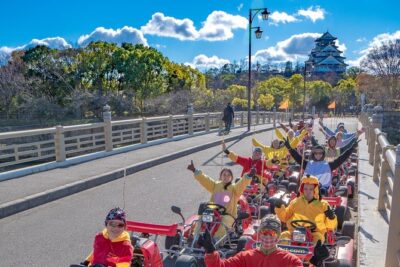
Asakusa, Skytree & Akhihabara Go-Kart City Experience
Our verdict →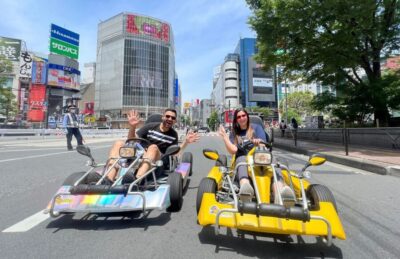
Premium Go-Kart Tour with Tower & Shibuya Crossing
Our verdict →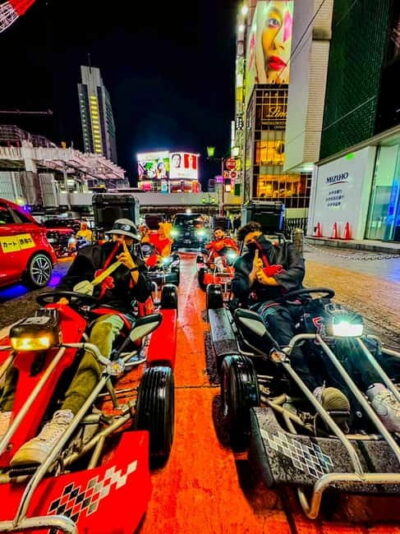
Shibuya and Shinjuku Streets Guided Go-Karting Tour
Our verdict →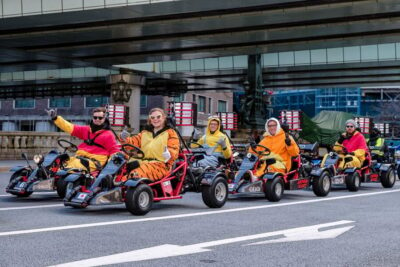
Browse the lists this tour appears in