
Reviewed · NIGHT TOURS
Osaka Nighttime tour
Osaka’s Tenma district is at its best after dark, when a short walk can take you from a traditional street-food stall to a cozy okonomiyaki shop, then on to a yakiniku table. This tour gives you that local-food rhythm without asking you to decode every menu or choose between dozens of small restaurants.
I like the small group of no more than eight, which makes restaurant seating and conversation much easier. I also like the mix of Osaka classics and wagyu yakiniku, since you get both familiar local dishes and the special treat of grilling premium beef yourself.
The main consideration is the price: $198 per person is a serious spend for a three-hour food walk. It includes food and various drinks at three restaurants, but it does not include transport, hotel pickup, or drop-off. The tour is also non-refundable, so book only when your evening plans are firm.
Key points at a glance
- Three Tenma-area restaurants: Move from traditional street food to okonomiyaki, kushikatsu, and wagyu yakiniku.
- Wagyu cooked at your table: Try different cuts and grill them yourself, with a Japanese cocktail alongside.
- Guides with different strengths: Guides have included Kaori, Mayura Kai, and Akiko, with experience explaining food, ingredients, and local customs.
- A compact Osaka night: The tour lasts about three hours and ten minutes and ends where it begins.
- Maximum of eight people: A useful size for shared dishes, restaurant seating, and questions.
- Food-first value: Various foods and drinks are included, but getting to and from the meeting point is your responsibility.
Why Tenma is a smart place for an Osaka food tour
Tenma, in Osaka’s Kita Ward, is a good setting for a food walk because the experience stays close to everyday local dining. You are not simply being taken to one famous restaurant for one famous dish. Instead, the evening moves through several kinds of eating places in the same general district.
That matters in Osaka, where a meal often works best as a series of small stops. You might begin with something from a traditional vendor, sit down for okonomiyaki, share fried skewers at a kushikatsu restaurant, and finish with grilled beef. This tour follows that pattern in a neat, guided format.
You meet at Shichifukujin Temma Station, at 4-chōme-12-1 Tenjinbashi, Kita Ward. The tour returns to the same meeting point, which keeps the route simple. Since hotel pickup and transport are not included, I would plan your route to the station before the evening begins and allow extra time if you are unfamiliar with Osaka’s rail system.
The tour is generally accessible to most people, and the meeting point is near public transport. Still, you should expect an evening of eating at several stops rather than a seated dinner in one place. Comfortable shoes and an appetite make more sense here than dressing for a formal restaurant.
More Night Tours in Osaka
- Osaka After Dark: Small-Group Night Food Tour (Max 6)
★ 4.5 · 245 reviews - Osaka: Bar-Hopping Night Tour in Namba
★ 4.7 · 117 reviews - Osaka: Private Vibrant Nighttime Photoshoot (Dotonbori)
★ 4.9 · 80 reviews
Stop one: traditional food along Tenjinbashi
The first half-hour is devoted to traditional vendor food on a local street in Tenjinbashi. The exact items can change, but this opening stop is useful because it starts the evening with Osaka’s casual side.
Street food gives you a quick sense of how the city eats. Portions are often smaller than a full meal, so you can sample something without using up your appetite too soon. Your guide can also help explain what you are looking at, how it is normally eaten, and which flavors are typical of the area.
This is a short stop, listed at about 30 minutes, so you should not expect a long market visit. Think of it as an introduction to the district and a first taste before the main restaurant stops.
Because the restaurants may change according to the schedule, the exact street-food selection is not fixed. That flexibility can be useful, since it lets the guide work with the evening’s restaurant arrangements. It also means you should book this tour for the overall food route, not for one guaranteed vendor or dish.
Stop two: okonomiyaki in a cozy restaurant
Next comes okonomiyaki, one of Osaka’s best-known comfort foods. The dish is often described as a savory pancake, but that simple label does not say much about the experience. It is filling, social, and closely linked with Osaka’s food culture.
The planned stop lasts about 30 minutes in a cozy restaurant. That is enough time to eat a portion and learn about the ingredients, but it is not a leisurely hour-long meal. If okonomiyaki is high on your Osaka wish list, this stop gives you a reliable chance to try it as part of a larger evening rather than spending an entire night on one dish.
Guides such as Mayura Kai have been praised for explaining ingredients, dishes, and Osaka food customs in clear detail. Mayura is also described as a former chef, which may add useful insight into how the food is prepared. Kaori and Akiko have also led evenings, with Akiko noted for helping people try dishes they might not have chosen on their own.
That is one of the practical benefits of a guide here. You do not need to know which toppings to choose or how the meal fits into Osaka’s wider food culture. You can ask questions as you go, then make better choices later in the trip.
Stop three: kushikatsu and drinks
The third stop is the longest restaurant visit, at about one hour. Here you try kushikatsu, a classic Osaka food of breaded and fried skewers, along with drinks.
Kushikatsu works well in a group because you can sample several items instead of committing to one large plate. The fried coating makes it hearty, so pacing matters. You will already have eaten street food and okonomiyaki by this point, and the wagyu stop still lies ahead.
Drinks are included, with a range of options listed for the experience. The information does not specify every drink or how many you receive, so I would treat the beverage selection as part of the meal rather than plan the evening around unlimited alcohol. If you do not drink, clarify your preference with the guide at the start.
The one-hour stop also gives you more time for conversation. The small group size should help here, especially if your guide is able to explain the dishes while they arrive. Food tours are often at their best when the guide does more than point at a plate. The strong feedback for this experience repeatedly focuses on friendly hosting, useful food explanations, and a fun evening with dishes people might not have found alone.
Same trip, a completely different kind of day:
- Osaka Go Karting Tour with Funny Costume
★ 5.0 · 2,658 reviews - Osaka Castle: Museum and Tower Entry Ticket
★ 4.5 · 2,380 reviews - Osaka: Shinsekai Food Tour with 13-15 Dishes at 5 Eateries
★ 4.8 · 2,204 reviews - Osaka Food Tour: 13 Dishes at 5 Local Eateries
★ 5.0 · 2,149 reviews
Stop four: wagyu yakiniku with a Japanese cocktail
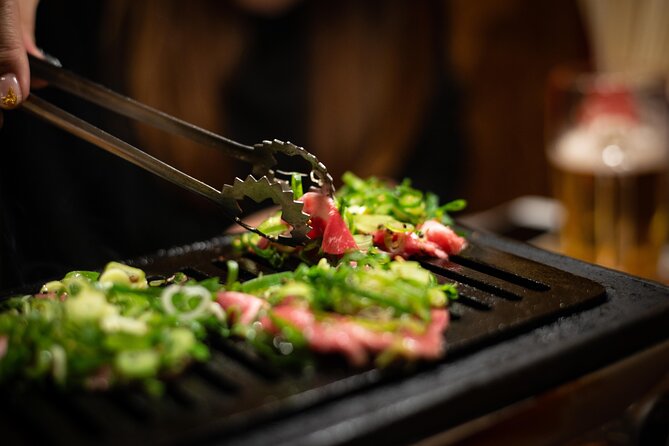
The final stop is the tour’s most distinctive feature. You try different parts of wagyu beef and grill them yourself at a yakiniku restaurant, with a refreshing Japanese cocktail.
Yakiniku is hands-on food. Instead of receiving a finished steak, you cook small pieces at the table, which lets you compare cuts and decide how much each piece should be cooked. For many people, this will be the most memorable part of the night, especially if it is your first time preparing wagyu this way.
The stop is scheduled for about one hour, giving you more room than the okonomiyaki visit. That is sensible. Wagyu deserves a slower pace, and the cooking process makes it less of a quick plate-and-go meal.
The wording promises premium wagyu and different parts of the beef, but it does not identify the grade, producer, or specific cuts. I would not book this expecting a formal steak tasting with detailed sourcing information. Instead, expect an enjoyable table-grilling experience that adds a special finish to a broad Osaka food tour.
The cocktail pairing is another nice touch, but the exact recipe is not provided. If you do not drink alcohol, ask what alternatives are available. The tour includes various drinks, though the details depend on the restaurants and schedule.
What the guides add to the evening
The guide is a major part of this experience because the food stops are only half the story. Names associated with the tour include Kaori, Mayura Kai, and Akiko. Your assigned guide may be different, and the restaurant order can also change.
Kaori has been described as warm and engaging, with an evening built around three restaurants near Temma Station. Mayura Kai has hosted several food walks and is noted for explaining ingredients, food customs, and Osaka itself. Her background as a former chef can be especially helpful if you want more than a quick dish description.
Akiko has been praised for making good recommendations and encouraging people to try food outside their normal choices. That is a useful quality on a tour with several stops, since you may encounter dishes you would otherwise skip.
Dietary needs require care. One private booking was adapted to accommodate preferences, but the standard information specifically says the tour is not recommended for people with serious food allergies. Do not assume that every dish can be changed safely. Contact the provider before booking if your diet is restrictive, and tell the guide about preferences at the start.
Is $198 good value for this Osaka evening?
At $198 per person, this is not a cheap food walk. You are paying for three restaurant visits, a local guide, food, drinks, the small group format, and the convenience of a planned route. You are not paying only for the cost of the dishes.
The value is strongest if you want guidance in Osaka’s food scene and would otherwise spend time guessing where to eat. The evening gives you several distinct foods, not just one tasting. It also lets you compare casual vendor food, okonomiyaki, fried kushikatsu, and wagyu in a single outing.
The price is harder to justify if you already know Tenma well, speak Japanese comfortably, or prefer choosing restaurants on your own. Osaka has many affordable places to eat, and a self-guided night can cost far less.
Group size helps support the cost. With a maximum of eight people, you are less likely to feel lost in a large tour group, and the guide can answer more questions. The exact restaurant lineup can change, so the value comes from the structure and hosting rather than a fixed menu.
The tour is booked, on average, 23 days ahead. That suggests you should not leave it until the last minute if your dates are fixed. Since the booking is non-refundable and cannot be changed, check your schedule carefully before paying.
Timing, meeting point, and practical planning
The full experience lasts about three hours and ten minutes. The itinerary adds up to roughly three hours, so the remaining time likely covers walking, ordering, and moving between stops. Keep the evening open rather than scheduling a show immediately afterward.
You meet at Shichifukujin Temma Station. The activity ends back at that meeting point, which is convenient if you plan to continue your night nearby or return to your accommodation by train.
Transportation to and from the attractions is not included. The stops are in Tenjinbashi, but the tour information does not promise that every restaurant is directly beside the station. Wear shoes you can walk in and arrive ready to start on time.
A mobile ticket is provided, and confirmation is received when you book. The small group cap is a benefit, but it does not mean the tour is private. If you want a private arrangement for dietary reasons, ask the provider rather than assuming it is part of the standard booking.
Who will enjoy this most?
I would recommend this tour to you if you want an organized introduction to Osaka food and prefer tasting several dishes over sitting down to one long dinner. It is also a strong fit for a first evening in Osaka, when a guide can help you get comfortable with local restaurant customs and food names.
It suits curious eaters who like trying dishes they may not choose alone. The combination of kushikatsu, okonomiyaki, and wagyu gives you a broad sample of Osaka dining in one night.
It is less suitable if you have a serious food allergy, want a strictly fixed menu, or need a fully refundable booking. It may also feel expensive if your main goal is simply to eat cheaply.
The experience can work for couples, friends, and solo diners who enjoy small-group conversation. The maximum of eight keeps the group manageable, and the restaurant format gives you natural chances to talk with the guide and other people.
Should you book this Tenma food tour?
Book it if you want a guided, food-heavy evening with three local restaurant stops, included drinks, and a hands-on wagyu yakiniku finish. The strongest reasons are the small group, the range of Osaka dishes, and the chance to get practical help from guides such as Kaori, Mayura Kai, or Akiko.
Skip it if $198 feels too high for dinner, if you need firm restaurant names before booking, or if your food allergies make shared restaurant menus risky. The restaurants may change, and the experience is non-refundable.
For the right person, this is a convenient way to eat across Tenma without spending your first Osaka nights guessing where to go. Come hungry, keep your schedule clear for the full three hours and ten minutes, and treat the tour as a guided tasting of Osaka rather than a bargain meal.
FAQ
Where does the Osaka nighttime food tour begin?
It begins at Shichifukujin Temma Station, at 4-chōme-12-1 Tenjinbashi, Kita Ward, Osaka, 530-0041, Japan.
Where does the tour end?
The activity ends back at the meeting point.
How long does the experience last?
It lasts approximately three hours and ten minutes.
How many restaurants do you visit?
You visit three local restaurants. The stops include okonomiyaki, kushikatsu, and wagyu yakiniku, along with traditional vendor food during the route.
Is wagyu beef included?
Yes. The final restaurant stop includes wagyu beef, different parts of the beef, and a Japanese cocktail. You grill the beef yourself.
Are drinks included?
Yes. Various types of drinks are included as part of the experience.
Is transportation included?
No. Transportation to and from the attractions, as well as hotel pickup and drop-off, is not included.
How large is the group?
The tour has a maximum of eight travelers.
Is the tour suitable for serious food allergies?
It is not recommended for people with serious food allergies. You should contact the provider before booking if you have important dietary restrictions.
Can I cancel or change the booking?
No. The experience is non-refundable and cannot be changed for any reason.
Just added around Osaka
- Exclusive Sushi Making Experience with a Master Chef – Osaka Area★ 5.0 · 25 reviews
- Private Home-Style Cooking Class in Osaka with Local Mom Yoshiko★ 5.0 · 46 reviews
- Hidden Osaka – Yukaku Red Light Tour & Culinary Adventure★ 4.8 · 96 reviews
- Osaka: Walking Tour and Top Highlights★ 4.8 · 104 reviews
- Osaka: Private Ceramic Painting Workshop★ 5.0 · 13 reviews
- Pickleball in Osaka, Kobe & Kyoto with Locals!★ 4.7 · 80 reviews
- Eat Like a Local in Osaka – Private Custom Street Food Tour★ 4.3 · 33 reviews
- Osaka:SUMO BEATS SHOWCASE: Taiko Drum and Wagyu burger!★ 4.2 · 37 reviews
Night Tours, compared.
Tokyo After 5: Authentic Japanese Food & Drink Night Tour
Our verdict →
EVO, WRX, Skyline – JDM Night Run to Daikoku Car Meet
Our verdict →
Okinawa Ishigaki Island Night Starry sky and Jungle night tour
Our verdict →
All-inclusive Hiroshima Nighttime Food and Cultural Immersion
Our verdict →Browse the lists this tour appears in