

Reviewed · CYCLING TOURS
Okunoshima Rabbit Island Cycling Tour with Local Guide
Okunoshima is famous for its rabbits, but the island’s most important story is much darker. On this two-hour cycling tour, local guide Junko leads you past wartime ruins and explains why this peaceful island was once removed from maps.
I like two things here: you see the island at an easy pace by bicycle, and the small group, capped at five people, gives the guide room to explain what you are seeing. The main drawback is that the 360-yen ferry fare is extra, and the tour needs at least two participants plus suitable weather.
Key points to know before booking
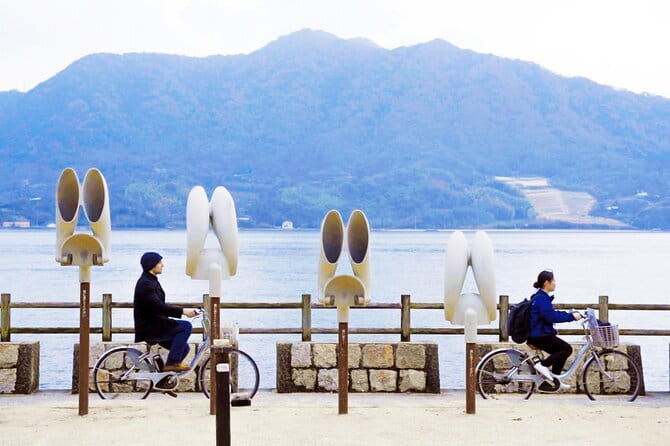
- Rabbits and wartime history share the same island: You get the cute encounters, but also a serious look at poison gas storage and production sites.
- Local guide Junko leads the experience: Her warm, passionate approach adds context that you would miss by simply riding around alone.
- Six short stops fit into about two hours: Expect a steady route around the roughly 4-kilometre island.
- The group is limited to five people: This is a more personal outing than a large sightseeing bus tour.
- The ferry and food are not included: Bring money for the 360-yen crossing from Tadanoumi and plan your own drinks or snacks.
- Some ruins can only be viewed from outside: Safety rules prevent entry to the lighthouse, poison gas storage site, and power plant.
Why Okunoshima is more than a rabbit stop

The rabbits are the easy reason to visit Okunoshima. They are wild, friendly-looking, and often close to the roads and paths. But if you only come to feed them and take pictures, you miss the island’s real weight.
Okunoshima was once linked to the secret production and storage of poison gas. Its wartime role was kept quiet, and the island was even left off maps. Today, the same quiet setting feels almost gentle: sea views, small roads, green hills, and rabbits moving through the scene.
That contrast gives this tour its purpose. You are not simply pedaling around a cute animal attraction. You are seeing how a place can carry two very different identities at once. Junko’s job is to connect the peaceful island you see today with the troubling events that happened here.
I especially like that the tour does not treat the history as a quick footnote. The stops at the storage ruins, power plant, and cannon battery give you physical reminders of the past. The rabbits remain part of the experience, but they do not erase the difficult story.
More Bike Tours in Hiroshima
- Hiroshima in a Nutshell: Morning Bike Adventure
★ 5.0 · 524 reviews - Hiroshima 2hr Peace Cycling Tour with Local Guide
★ 5.0 · 321 reviews - Hiroshima: Peace Cycling Tour with Local Guide
★ 4.8 · 286 reviews
A small-group ride with Junko
The tour is shared with other participants, but the maximum group size is five people. That matters on a compact island. A small group can stop without creating a crowd, and you have a better chance to hear the guide clearly at each site.
Junko is the guide named in the tour information and guest feedback. Her approach is described as kind and deeply committed to explaining the island’s past. That personal connection is one of the strongest reasons to choose a guided ride instead of renting a bicycle and exploring on your own.
You should expect a guide who talks about both the rabbits and the island’s difficult wartime role. The experience is not designed as a silent scenic ride. If you want only photographs and animal encounters, you may find the historical sections heavier than expected. If you want to understand Okunoshima, that balance is the point.
The tour lasts about two hours. That is enough time for the listed stops, but it is not a full-day island visit. You will want to allow extra time for the ferry, getting to the meeting point, and any time you spend looking around on your own.
Riding the 4-kilometre island route
Okunoshima has a circumference of about 4 kilometres, so the bicycle is a practical way to cover ground without turning the outing into a long hike. The route includes six stops, with most visits lasting 10 to 15 minutes.
The bicycle also suits the character of the island. You can move between quiet sites without rushing from one point to the next, and the ride helps you see the island as a whole rather than as a single rabbit area.
The tour includes bicycle use, all fees and taxes connected with the activity, and travel insurance. Food and drinks are not included. You should also be ready for a moderate level of physical activity, as the tour involves cycling between stops rather than sitting in one place.
Okunoshima Lighthouse and the first sea views

The lighthouse is a short opening stop, lasting about 10 minutes. You cannot enter it, so the appeal is the view from nearby rather than an interior visit.
This is a useful first look at the island’s setting. Okunoshima sits in the Seto Inland Sea, among more than 700 islands. From the lighthouse area, you can take in the water and surrounding scenery before the tour turns toward the island’s more difficult history.
Do not expect a long lighthouse visit. The structure is viewed from a short distance, and the stop works best as a scenic introduction. If you are hoping to climb the tower, this tour will not provide that opportunity.
Same trip, a completely different kind of day:
- Peaceful Hiroshima & Miyajima UNESCO 1 Day Bus Tour
★ 5.0 · 5,309 reviews - Hiroshima: Hiroshima and Miyajima UNESCO Sites 1-Day Tour
★ 4.9 · 2,330 reviews - Hiroshima / Miyajima Full-day Private Tour with Government Licensed Guide
★ 5.0 · 1,298 reviews - Osaka/Kyoto: Hiroshima Miyajima Bus Tour & Shinkansen Ticket
★ 4.7 · 919 reviews
The main island ride and its wild rabbits
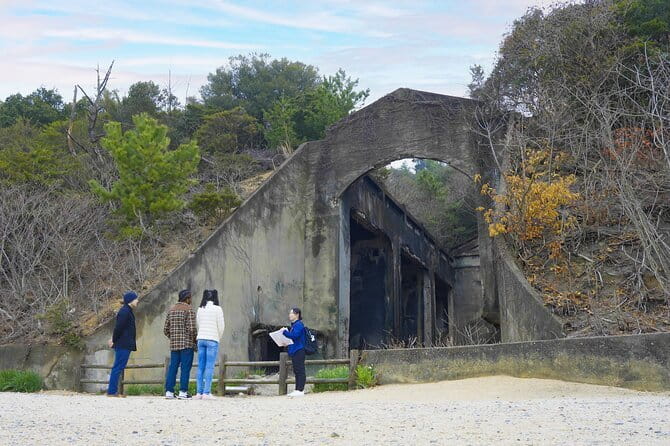
The longest part of the tour is the general ride around Okunoshima, with about an hour set aside for the island itself. This is where the rabbits become a natural part of the outing rather than a single scheduled attraction.
The animals are wild, so you should not expect a staged encounter or a guaranteed pattern of behavior. You may see rabbits near the paths and around the island’s buildings, but the experience depends on where they happen to be during your visit.
That unpredictability is part of the charm. The rabbits are not performing for you. They are simply part of modern Okunoshima, living around a place with a painful past.
The island setting also gives you time to notice the contrast between the soft, quiet present and the stark wartime remains. I like this middle section because it gives the ride breathing room. You are not moving from one historical fact to the next. You are pedaling through the place itself.
Okuno Shrine, where rabbits share a quiet sacred site
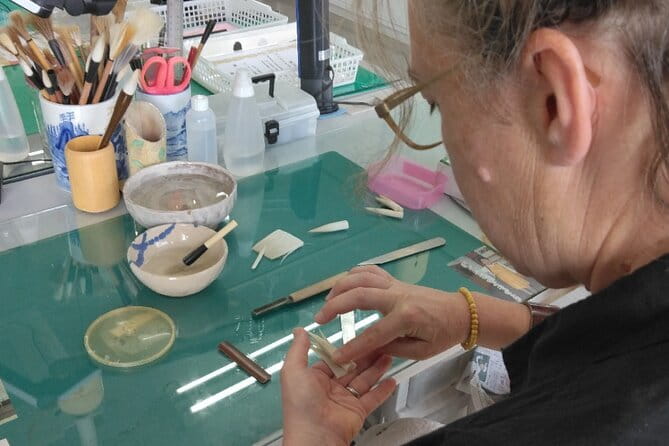
Okuno Shrine is the only shrine on the island, and the stop lasts around 10 minutes. Rabbits now live around the shrine, creating one of the clearest images of Okunoshima’s present-day character.
The shrine adds a cultural detail that is easy to overlook if you come only for the animals. It is not a large sightseeing complex, and the visit is brief, but it gives the island another layer beyond its military remains and sea views.
This is also a good place to slow down. The rabbits may draw your eye first, yet the shrine helps show how ordinary and peaceful the island appears today. That calm setting makes the later wartime stops feel even more striking.
Nagaura Poison Gas Storage Ruins
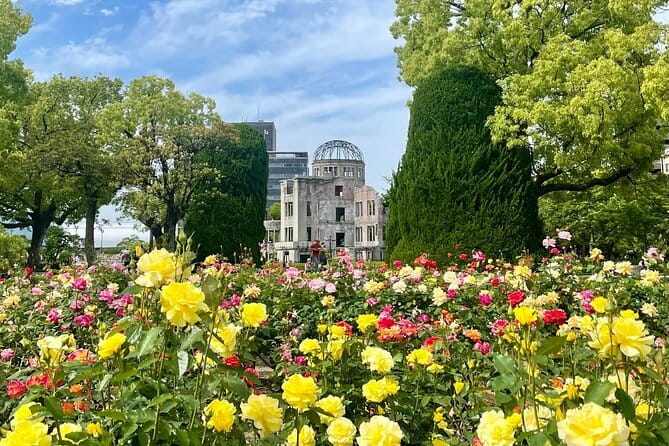
The Nagaura Poison Gas Storage Ruins are among the tour’s most serious stops. The building was used to store tanks filled with poison gas. For safety reasons, you cannot enter, so you view the structure from a short distance.
That limit is important to understand before booking. This is an outdoor explanation of the site, not an interior museum visit. The value comes from seeing the actual remains in their island setting and hearing Junko explain what they represent.
The short 10-minute stop may feel brief, but the subject carries more weight than the timing suggests. You are looking at a place connected to secret wartime manufacturing, not just an old abandoned building. A guide helps make that distinction clear.
Power Plant Ruins and the island’s secret production

The power plant is another 10-minute stop. It supplied power when poison gas was secretly made on Okunoshima. As with the storage ruins, safety rules keep you outside.
The power plant helps you understand the scale and organization of the wartime operation. The storage site shows where dangerous material was kept. The plant points to the systems needed to produce it.
You will not enter the building, and the tour does not present it as a dramatic ruin you can freely explore. Instead, you view it from outside and learn why it matters. That approach is more restrained, but it fits the subject.
I appreciate that the tour places these sites alongside the island’s scenic and animal-focused stops. It prevents Okunoshima from becoming either a grim memorial visit or a lighthearted rabbit outing. You get both, and the tension between them is what makes the island memorable.
Northern Cannon Battery Remnants
The northern cannon battery remnants are the final listed stop, with about 15 minutes to look around. Unlike the lighthouse, storage facility, and power plant, you can see these remains more closely.
The battery adds a military dimension to the route. After hearing about poison gas storage and production, you get another reminder that Okunoshima was part of a defended wartime zone.
This stop also gives you a little more direct contact with the ruins. You are not limited to viewing every site from a distance, although the tour still remains a guided outdoor visit rather than a free-form exploration of every structure.
What the $59.12 price includes
At $59.12 per person, this is not the cheapest way to see Okunoshima. The price makes better sense when you count what is bundled in: a bicycle, a local guide, travel insurance, and the taxes and activity fees.
The strongest part of the value is the interpretation. You can ride around the island independently, but the ruins will not explain themselves. The tour gives you a route, a bicycle, and a person who can connect the sites to the island’s past.
The price does not include the 360-yen ferry from Tadanoumi to Okunoshima. Food and drinks are also your responsibility, and private transportation is not included. These are modest extra costs, but you should know about them when working out your day’s budget.
The tour is best value for someone who wants context. If you only want to see rabbits, a self-guided visit may be enough. If you want the island’s story explained in a small group, the fee is easier to justify.
Ferry timing and the meeting point
The meeting and finishing point is in front of Kyukamura Ohkunoshima, located at 5476-4 Tadanoumicho, Takehara, Hiroshima. The tour begins and ends there.
The ferry fee listed for the Tadanoumi to Okunoshima crossing is 360 yen, and it is not included. Since the tour starts on the island at the hotel, you need to plan your arrival across the water before the scheduled start.
The activity is near public transportation, but private transportation is not provided. Your confirmation is sent within 48 hours of booking, subject to availability. Because the tour is normally booked about 27 days ahead, booking early is sensible if your Japan schedule is fixed.
The tour ends where it begins, in front of Kyukamura Ohkunoshima. That makes the return simple, but you should still allow enough time after the ride if you have a ferry or mainland connection to catch.
Weather, minimum numbers, and cancellation terms
This is an outdoor cycling activity, so weather matters. If the Japan Meteorological Agency forecasts a 60 percent or higher chance of rain by noon on the day before the tour, the departure will be canceled without cancellation fees.
If poor weather cancels the experience, you can choose another date or receive a full refund. The tour also requires at least two participants. If that minimum is not met, you will be offered another date or experience, or a full refund.
For your own cancellation, you can receive a full refund if you cancel at least 24 hours before the start time. Cancellations or changes made within 24 hours are not accepted for a refund.
These rules are fair for a bicycle tour, but they make it wise to avoid placing this activity on the final, tightly timed day of your Japan trip. Keep some flexibility if Okunoshima is important to you.
Who will enjoy this tour most
I would choose this tour if you want three things in one outing: wild rabbits, sea scenery, and a serious historical lesson. It suits visitors who prefer a small group and want to ask questions while moving around the island.
It is also a good match for anyone who finds abandoned wartime sites more meaningful when a local guide explains them. Junko’s personal passion for the island is a major part of the experience, especially if you want more than surface-level facts.
You should think twice if you dislike cycling, need a fully indoor activity, or want to enter every ruin. Several important sites can only be viewed from outside, and the tour requires moderate physical fitness.
Families and animal lovers may enjoy the rabbits, but the subject matter is not purely light. The poison gas sites give the tour a serious tone. You should decide if that mix fits your group before booking.
Should you book the Okunoshima cycling tour?
I would book it if you want to understand Okunoshima rather than simply photograph its rabbits. The small group, bicycle access, and guide Junko give the island a clear shape: peaceful scenery, wild animals, and a wartime past that should not be forgotten.
The 94 percent recommendation rate and 4.7 rating from 17 ratings point to a consistently strong experience, with particular praise for Junko’s kindness and passion. The main tradeoffs are the extra ferry fare, the weather and minimum-group conditions, and the fact that some ruins are viewing-only.
Book this tour when the history matters as much as the rabbits. Skip it only if you want a quick animal stop with no serious historical focus, or if a two-hour outdoor ride does not fit your day.
FAQ
How long does the Okunoshima cycling tour last?
The tour lasts approximately two hours.
What is the tour price?
The listed price is $59.12 per person.
Is the ferry fare included?
No. The ferry from Tadanoumi to Okunoshima costs 360 yen and is not included.
Where does the tour start?
The tour starts at Kyukamura Ohkunoshima, at 5476-4 Tadanoumicho, Takehara, Hiroshima 729-2311, Japan.
Where does the tour end?
The tour ends in front of Kyukamura Ohkunoshima, the same place where it starts.
Is bicycle use included?
Yes. Bicycle use is included in the tour price.
Are food and drinks included?
No. Food and beverages are not included.
What wartime sites are visited?
The route includes the Nagaura Poison Gas Storage Ruins, Power Plant Ruins, and Northern Cannon Battery Remnants.
Can you enter the lighthouse and wartime ruins?
The lighthouse, Nagaura Poison Gas Storage Ruins, and Power Plant Ruins cannot be entered. You view them from outside or from a short distance. The northern cannon battery remnants can be seen closely.
How many people can join the tour?
The tour has a maximum of five participants and requires at least two participants to operate.
What happens if the weather is poor?
If the Japan Meteorological Agency forecasts a 60 percent or higher chance of rain by noon on the day before the tour, it may be canceled without cancellation fees. You will be offered another date or a full refund.
Can I cancel for a full refund?
Yes. You can cancel at least 24 hours before the start time for a full refund. Cancellations made less than 24 hours before the start time are not refundable.
Just added around Hiroshima
- Full Day Hiroshima and Miyajima Tour by Bullet Train from Kyoto★ 4.5 · 120 reviews
- Hiroshima Saijo Sake Tasting Tour with visit to 7 Breweries★ 5.0 · 104 reviews
- The Peace Memorial to Miyajima : Icons of Peace and Beauty★ 4.5 · 31 reviews
- Shore Excursion from Hiroshima Port : Private Tour in Hiroshima★ 5.0 · 17 reviews
- Hiroshima & Miyajima All-Inclusive Tour w/Licensed guide Pancho★ 5.0 · 54 reviews
- Private Full Day Hiroshima Tour★ 4.5 · 29 reviews
- Hiroshima Private Tour with a Local – Highlights & Hidden Gems★ 4.5 · 24 reviews
- Miyajima Guided Tour and Fresh Oyster Farm Tour★ 5.0 · 20 reviews
Cycling Tours, compared.

Arashiyama Bamboo Forest & Hidden Gems Bike Tour (Early Bird)
Our verdict →

Browse the lists this tour appears in