
Reviewed · NARA TOURS
Nara 8hr Private Tour – Kyoto DEP. with Licensed Guide
Nara’s greatest surprise is how much history fits into one walk: enormous Tōdaiji, bowing deer, lantern-lined Kasuga Taisha, and old merchant streets can all become part of a single day. I like the private, custom-built plan, and I like having a licensed guide explain the difference between Buddhist temples and Shinto shrines instead of leaving you to guess. The guide can also help with trains, lunch, and the best order for your stops.
The main catch is simple: this is not a chauffeured tour. Transport, entry fees, lunch, and personal costs are extra, and pickup means meeting your guide on foot within the designated Kyoto area. Eight hours of walking can feel long in summer heat, and the four-stop limit means you must choose carefully.
Key points to know before booking
- Pick three or four sights: Build the day around Tōdaiji, Nara Park, Kasuga Taisha, Naramachi, Hōryūji, gardens, museums, or other listed sites.
- Private guiding makes the difference: Your guide can adjust the pace and explain Japanese history, religion, architecture, and local customs in clear context.
- Deer are part of the experience: Nara Park gives you close contact with free-roaming deer, but you still need to follow local feeding rules.
- Walking is the real transportation: The tour does not include a private vehicle, and transport fees are separate.
- Allow for entrance costs: Several temples, museums, gardens, and hills charge admission, while Nara Park, Kasuga Taisha, and Naramachi are listed as free stops.
- Guide quality can vary: Strong guides such as Junichi, Taku, Ken, Yuka, Haru, and Masaaki have received especially warm praise, but English ability may not feel equally polished with every assigned guide.
Why Nara deserves a full day from Kyoto
Kyoto gives you a grand introduction to Japan’s temples and gardens. Nara gives you a different feeling: it was an early capital, its sacred sites are spread through open parkland, and the city’s deer wander right beside the monuments.
I like Nara as a day trip because the experience is not limited to one famous building. You can begin with the huge bronze Buddha at Tōdaiji, walk beneath old trees with deer nearby, follow stone lanterns to Kasuga Taisha, and finish among wooden merchant houses in Naramachi.
A private guide is especially useful here because Nara’s sights are connected by history as much as by roads. The guide can explain why Buddhism and Shinto appear side by side, how Nara became a center of Japanese culture, and how the Fujiwara family shaped Kofukuji and the old capital.
The price is listed at $201.51 per person. That is not a budget walking tour, especially once you add rail fares and admission charges. I see the value in it for a small group that wants a personal day, efficient routing, and cultural explanation. If you are happy reading signs and navigating on your own, a self-guided Nara visit will cost less.
A few more Nara half-days worth comparing
- World Heritage Kyoto & Nara Uji Authentic Matcha Experience
★ 5.0 · 1,573 reviews - Kyoto/Osaka: Nara, Fushimi Inari Taisha, Arashiyama Bus Tour
★ 4.7 · 1,275 reviews - Nara Half Day Trip Walking Tour (Private Option Available)
★ 5.0 · 937 reviews
Meeting your guide and starting the walk
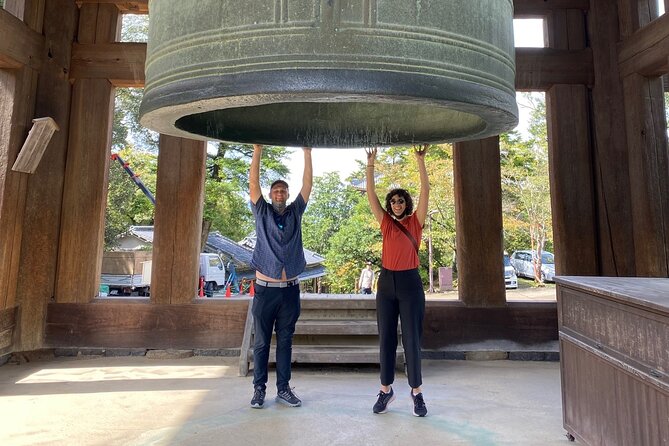
The experience includes an English-speaking, government-licensed local guide and a meeting on foot within a designated area of Kyoto. The description also refers to day trips from Osaka or Kyoto, but the included pickup information is specifically for Kyoto. Confirm the meeting point and starting city carefully before booking.
Your guide is assigned after booking. Past guide names connected with this experience include Junichi, Taku, Ken, Yuka, Haru, Hiro, Masaaki, Rie, Naomi, Kazuo, Momoyo, and others. A number of these guides are based in or closely connected with Nara, which can add local detail to the day.
I would email your interests before the tour. Tell the guide if your priority is architecture, Buddhist art, gardens, deer, shopping, traditional streets, family activities, or less visited temples. One family’s itinerary was shaped around a teenager’s interests, while another group added Yakushiji and Hōryūji even though those sites sit away from the main park area.
The more specific you are, the better the day can work. You can also mention mobility concerns, food preferences, and how much walking your group is comfortable with. The plan is private, so you are not tied to another group’s pace.
Tōdaiji and the Great Buddha
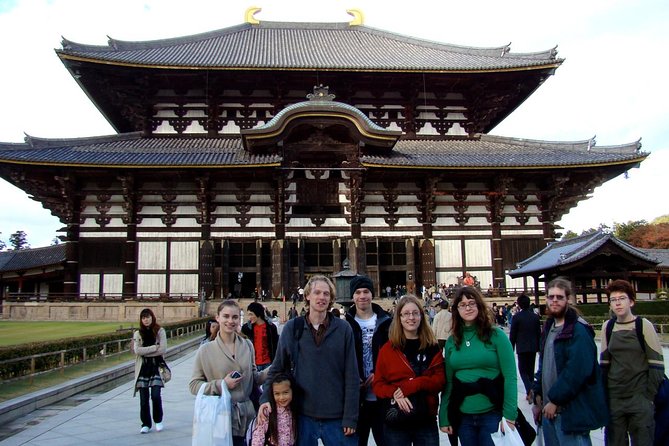
Tōdaiji is the essential first choice for most visitors. Founded in 752 as the head temple of Japan’s provincial temples, it remains one of Nara’s most important Buddhist sites.
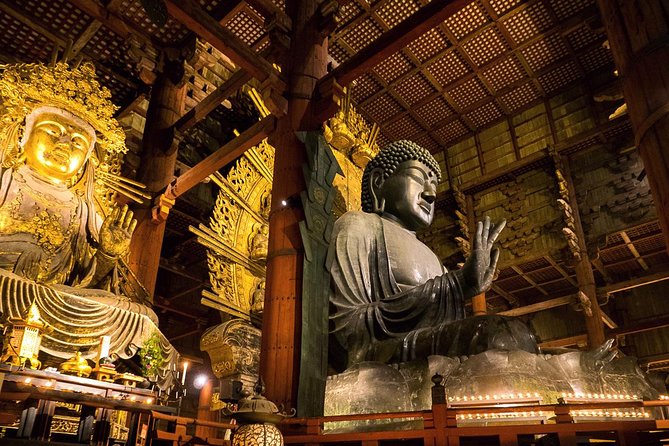
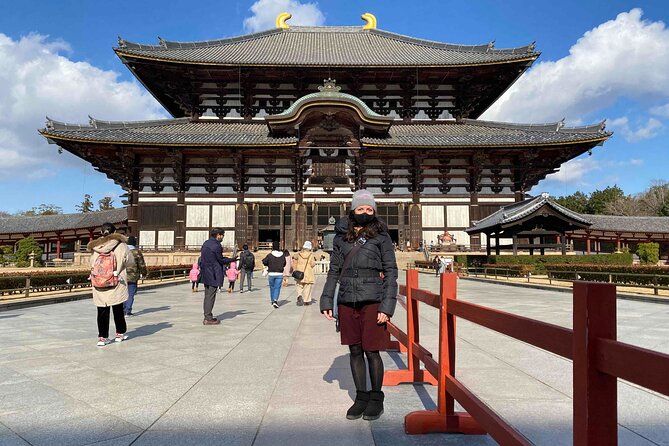
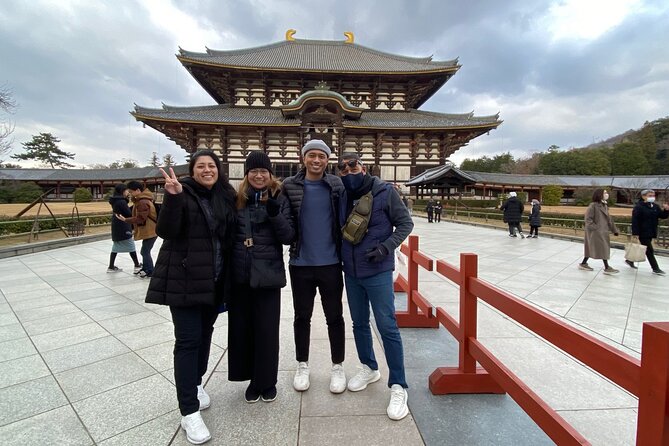
The scale is the point. You approach through the Nandaimon Gate, then enter the Great Buddha Hall, known as Daibutsuden. Inside is the enormous bronze Vairocana Buddha, an image built to represent universal Buddhist illumination. Even if you are not deeply interested in religion, the size of the hall and statue make this a powerful stop.
A good guide gives the building a human and historical setting. You can learn why the temple was built, how it relates to the Nara capital, and what the sculpture means rather than simply taking a photograph and moving on.
The listed stop time is 30 minutes, but that is tight if you want to enter the hall, study the Buddha, and deal with crowds. Admission is not included. School groups can make the interior particularly busy, so ask your guide about the best order for the morning.
Some visitors also include Nigatsudo Hall, which sits higher in the Tōdaiji complex and offers broad views toward Nara. Tamukeyama Hachiman Shrine is another possible nearby addition, giving you a useful example of the old relationship between Buddhist temples and Shinto shrines.
Nara Park and the famous deer
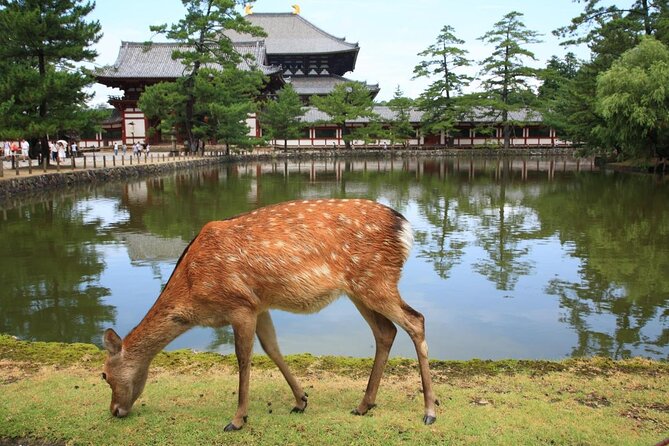
Nara Park is free to enter and contains many of the city’s major sights. It was established in 1880, but the park feels less like a formal garden than a large green setting for temples, shrines, paths, and deer.
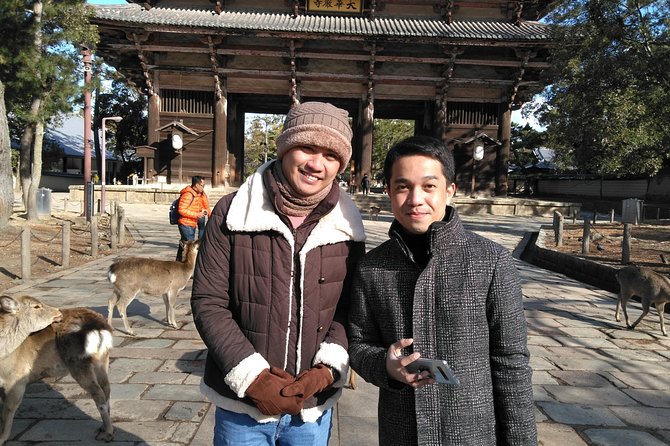
The deer are the lighthearted part of the day. They wander freely and often approach visitors who carry special deer crackers. You may also see them bowing, a behavior encouraged when they expect food. Feed carefully, keep the crackers moving, and follow your guide’s instructions. The animals are accustomed to people, but they are still animals.
I like this stop because it gives the day a welcome change of pace. After listening to temple history, you can watch a child greet a deer or pause beneath the trees. It is also a good place for family groups, though younger children should stay close when feeding.
Nara Park can become hot, crowded, and tiring. The 30-minute listing is enough for a quick encounter, but not for a slow walk through the park and several nearby monuments. If deer are your main reason for coming, tell the guide so the schedule does not spend too much time inside paid sites.
More Private-Only Departures in Nara:
- Kyoto/Osaka: Kyoto and Nara Customized Private Guided Tour
★ 4.6 · 258 reviews - Nara 6hr Private Tour with Government-Licensed Guide
★ 5.0 · 219 reviews - Kyoto Private Car Tour – Full Day with Local Guide & Nara Option
★ 5.0 · 169 reviews - From Osaka/Kyoto: Private Kyoto & Nara Day Trip with Pickup
★ 4.7 · 122 reviews
Kasuga Taisha and the lantern-lined approach
Kasuga Taisha is Nara’s best-known Shinto shrine. It was founded when the capital was established and is dedicated to the deity associated with protecting the city.
The approach through the wooded park is part of the visit. Stone lanterns line the paths, and the shrine’s connection to deer gives the walk a strong sense of place. Inside, you can look for the shrine’s distinctive vermilion structures, hanging lanterns, and quiet worship spaces.
This is where a guide can clarify the difference between Shinto practice and Buddhism. Nara’s religious sites are not isolated museum pieces. They reflect centuries of shared customs, changing political power, and later periods when the two traditions were separated more sharply.
The stop is listed as free, though some portions or special areas may have separate charges depending on the current arrangements. Confirm with your guide if you want to enter every available section.
Choosing between the old town, a hill, and a garden
You will not fit every attraction into this tour. Your guide helps you choose the combination that makes sense.
Naramachi
Naramachi was the old merchant district. Traditional houses, storehouses, small shops, cafes, and preserved residences line its narrow streets. I recommend it if you want to see how ordinary urban life looked beyond the major temples.
Naramachi also gives you a better chance to browse local shops or stop for a snack. Nigiwai-no-Ie, a traditional house with tatami rooms, alcoves, and staggered shelves, offers a close look at domestic architecture.
Isuien Garden
Isuien is a carefully designed Japanese garden near Tōdaiji. Its use of borrowed scenery is the key idea: the garden frames features such as Tōdaiji’s Nandaimon Gate and Mount Wakakusayama.
Choose Isuien if you want stillness and design after the crowds around the Great Buddha. Admission is extra, and the 30-minute allotment may feel short for anyone who enjoys gardens.
Yoshikien Garden
Yoshikien is another central garden, named for the nearby Yoshikigawa River. It is a pleasant option for a quieter stop and can suit visitors who want plants, water, and traditional garden forms rather than another large temple.
Wakakusayama Hill
Mount Wakakusayama rises behind Nara Park between Tōdaiji and Kasuga Taisha. From its slopes, you get open views toward Nara. The hill is a good choice if you want scenery and exercise, but admission is extra and the climb adds work to an already long walking day.
Hōryūji, Yakushiji, and the deeper history options
The main Nara Park sights make the easiest walking day. Hōryūji and Yakushiji offer more specialized experiences, but they require more planning because they are outside the central cluster.
Hōryūji was founded in 607 by Prince Shōtoku and is one of Japan’s oldest temples. It contains some of the oldest wooden buildings in the world. If early Buddhist architecture and art interest you, this may be the strongest choice on the entire menu.
One guide organized a tightly timed day in which Hōryūji became the highlight. That kind of visit works best for people who would rather study old buildings and artworks than spend a relaxed morning feeding deer.
Yakushiji was built in the late seventh century for the recovery of Emperor Tenmu’s sick wife. Its strict symmetry and East Pagoda, first built more than 1,300 years ago, make it a rewarding stop for anyone interested in architectural detail.
Toshodaiji, founded in 759 by the Chinese priest Ganjin, offers another window into the development of Japanese Buddhism. Shin-Yakushiji, founded during the Nara Period and dedicated to Yakushi Buddha, focuses on healing and religious devotion.
These choices show why the customization matters. You can create a classic first visit, or build a day for someone who already knows the major sights and wants older, quieter temple art.
Kofukuji, the museum, and the former capital
Kofukuji was the family temple of the Fujiwara clan, one of the strongest aristocratic families of the Nara and Heian periods. Its five-story pagoda and historic halls make it an easy addition near central Nara.
The Nara National Museum focuses mainly on Japanese Buddhist art. Choose it if you want statues and objects presented indoors, especially on a hot or rainy day. Admission is extra, and a museum visit can consume time that might otherwise go toward streets or gardens.
The Heijō Palace Site Historical Park marks the former capital of Heijō-kyo, where Nara served as Japan’s capital from 710 to 794. The palace once covered roughly one kilometer by one kilometer. This is a useful choice if you want political history and the story of how the early capital was organized.
Because the tour allows only three or four sites, you need to decide if you prefer a broad introduction or a focused theme. Trying to squeeze in Tōdaiji, Kasuga Taisha, Hōryūji, Yakushiji, Naramachi, and the museum would make the day rushed.
What the strongest guides add
The best part of this format is not simply getting from one gate to another. It is the conversation along the way.
Junichi has been praised for prompt planning, local knowledge, and a friendly approach. He has helped groups with food choices, public transport, and a personalized route. Taku has been especially effective for visitors who want both historic sites and modern Nara, including cafes, sake tasting, shaved ice, and local stories.
Ken is a strong fit for visitors who want historical explanation and a carefully organized day. Masaaki suits people focused on architecture, Buddhist art, and the old capital. Yuka has adapted routes for families and for visitors determined to see Yakushiji.
Haru, Rie, Naomi, Hiro, Kazuo, and Momoyo have also guided groups through different versions of the experience. Several guides have helped with lunch, vegetarian food, train directions, and communication in shops.
There is one important caution. One participant found the assigned guide’s English difficult and said Google Translate was used often. The provider states that guides hold Japanese government tour guide interpreter certification, but certification does not guarantee the same speaking style or ease of conversation for every guide. If clear English explanation is central to your plans, contact the agency after assignment and share your expectations.
Walking, costs, weather, and timing
The tour lasts about eight hours and is designed as a walking experience. A private vehicle is not included. Transportation fees, admission fees, lunch, and personal expenses are separate, so budget beyond the advertised $201.51 per person.
Entry is listed as free for Nara Park, Kasuga Taisha, and Naramachi. Tōdaiji, Wakakusayama, Hōryūji, Kofukuji, Yakushiji, Shin-Yakushiji, the National Museum, Heijō Palace Site, Toshodaiji, Isuien, and Yoshikien are listed without included admission, so ask which tickets you will need for your chosen route.
Wear comfortable shoes and bring water. Summer can be hot and humid, and rain can slow the day. One rainy outing still worked well because the guide kept the group moving, but bad weather makes a hill or long outdoor route less appealing.
The tour is private, so only your group participates. Most people can take part, and service animals are allowed. The practical limitation is not group size but stamina. If your group includes children, older adults, or anyone with sore feet, ask for fewer sites and more time at each one.
Is this private Nara tour worth booking?
I would book it if you want Nara explained rather than simply photographed. The strongest reasons are the private format, the ability to choose three or four sites, and the chance to spend a day with a guide who can connect temples, shrines, deer, architecture, and Japanese history.
I would be more cautious if you want a low-cost day, a private car, or complete control over the guide’s English style. You will pay extra for trains and admission, and the walking can be demanding.
For a first visit, I would choose Tōdaiji, Nara Park, Kasuga Taisha, and Naramachi. For an architecture-focused day, I would ask about Hōryūji, Yakushiji, Tōdaiji, or Toshodaiji. Send your priorities before the tour, confirm the Kyoto meeting arrangement, and treat the four-stop limit as a benefit rather than a problem. A focused day in Nara is far better than racing through ten sites.
FAQ
How long is the Nara private tour?
The tour lasts approximately eight hours.
Where does the tour begin?
The included meeting arrangement is on foot within a designated area of Kyoto. The experience also describes day trips from Osaka or Kyoto, so you should confirm the exact starting location after booking.
Is transportation included?
No. Transportation fees are not included, and the tour does not provide a private vehicle.
How many sights can I visit?
You can choose three to four sites from the listed attractions. Your guide customizes the route around your interests.
Are entrance fees included?
Most entrance fees are not included. Nara Park, Kasuga Taisha, and Naramachi are listed as free stops, while several temples, gardens, museums, and Wakakusayama list admission as extra.
Is lunch included?
No. Lunch is not included. Your guide may help you choose a restaurant based on your preferences, but you pay for your meal.
Is this a private group activity?
Yes. Only your group participates, and you cannot combine multiple tour groups.
Can I cancel for a full refund?
You can cancel at least 24 hours before the experience start time for a full refund. Cancellations or changes made less than 24 hours before the start time are not accepted for a refund.
Just added around Nara
- Private Kyoto Tour by Car with Optional Nara or Osaka Add-Ons★ 5.0 · 36 reviews
- Kyoto, Osaka, Nara Private Tour by Car English Driver Guide★ 4.0 · 63 reviews
- From Kyoto: Nara History Guided Half Day Bus Tour with lunch★ 5.0 · 23 reviews
- Nara Todaiji Kasuga Taisha Private Full Day Tour From Kyoto★ 5.0 · 13 reviews
- Arashiyama & Nara Highlights: One-Day Private Tour Adventure★ 5.0 · 16 reviews
- Kyoto Private Car Tour – Full Day with Local Guide & Nara Option★ 5.0 · 169 reviews
- Kyoto & Nara Private Tour from Osaka Kyoto Hotel Pick-up★ 4.5 · 32 reviews
- Kyoto Private Tour Full Day with Local Guide&Nara Option(PerGroup★ 5.0 · 20 reviews
Nara Tours, compared.

World Heritage Kyoto & Nara Uji Authentic Matcha Experience
Our verdict →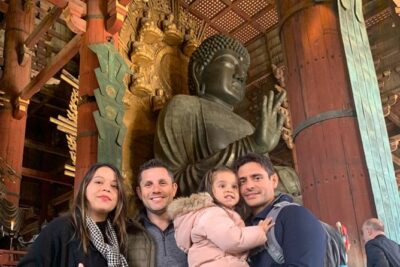
Nara Half Day Trip Walking Tour (Private Option Available)
Our verdict →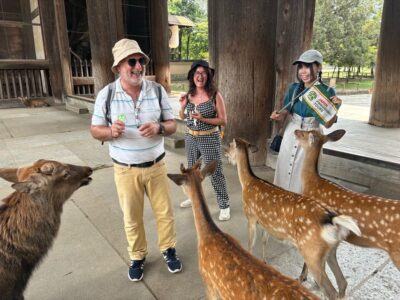
Nara and Uji Day Trip with Deer Park and Hot Spring
Our verdict →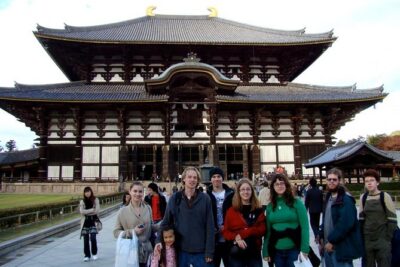
Nara 6hr Private Tour with Government-Licensed Guide
Our verdict →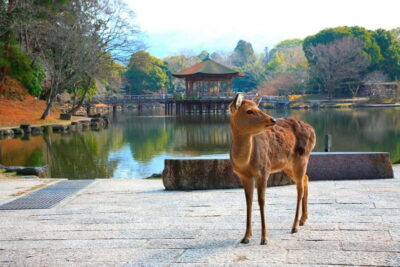
Browse the lists this tour appears in