
Reviewed · NARA TOURS
Nara 6hr Private Tour with Government-Licensed Guide
Nara’s best feature is its flexibility. Instead of following one fixed route, you choose three or four places from a long list, then explore with a private, government-licensed English-speaking guide. That works especially well here, where a Giant Buddha, a Shinto shrine, friendly deer, old merchant homes, and quiet gardens can all fit into one day.
I like the personal itinerary and the chance to ask real questions about Buddhism, Shinto, Japanese history, and daily life. I also like the human touch: guides such as Junichi, Ken, Toshi, Rie, Hiro, Haru, and Yoshii have helped families adjust plans, find udon or sushi, explain local customs, and make ancient sites easier to understand.
The catch is simple: this is a walking day, and a serious one. Transport, admission fees, lunch, and personal purchases are extra, and one poorly paced day showed how important it is to agree on walking distance and priorities before you start.
What makes this Nara tour worth considering
- Choose three or four sites: Build your day around temples, shrines, gardens, museums, old neighborhoods, or Nara’s deer-filled park.
- Meet at Nara Station: The tour begins on foot, with no private vehicle included.
- Get a private guide: Only your group participates, so you can ask questions and adjust the pace.
- See more than deer: The route can connect Nara’s ancient capital, Buddhist art, Shinto traditions, gardens, and merchant history.
- Plan for a full walking day: Six hours can include stairs, hills, broad park paths, and walks between sites.
- Pay extras separately: Admission, meals, public transport, taxis, and other personal costs are not included.
A private day in Japan’s first great capital
Nara rewards visitors who want context. Its temples and shrines are not isolated monuments. They connect to the city’s role as Japan’s capital during the Nara Period, from 710 to 794, when Buddhism, government, writing, art, and ideas from the Asian mainland helped shape the country.
A guide turns those connections into a story you can follow. You might ask why a Buddhist temple sits near a Shinto shrine, how deer became tied to the city, or how Japanese religious practice blends old and imported traditions. The strongest guides use the sites as illustrations rather than rushing you from one photo stop to another.
This is a private activity, so you are not sharing the guide with another group. That matters for families and small groups with different interests. A teenager may want a sword or katana stop, one person may prefer gardens, and another may want architectural details. Past guide experiences have included mochi, sake tasting, traditional merchant houses, and small local restaurants when time and interests allowed.
Do not assume every extra stop is included. The prepared choices are broad, but the tour is built around three or four selected sites. Discuss additions early so a surprise stop does not take time from a place you care about most.
A few more Nara half-days worth comparing
- World Heritage Kyoto & Nara Uji Authentic Matcha Experience
★ 5.0 · 1,573 reviews - Kyoto/Osaka: Nara, Fushimi Inari Taisha, Arashiyama Bus Tour
★ 4.7 · 1,275 reviews - Nara Half Day Trip Walking Tour (Private Option Available)
★ 5.0 · 937 reviews
Todai-ji and Nara Park: the essential opening
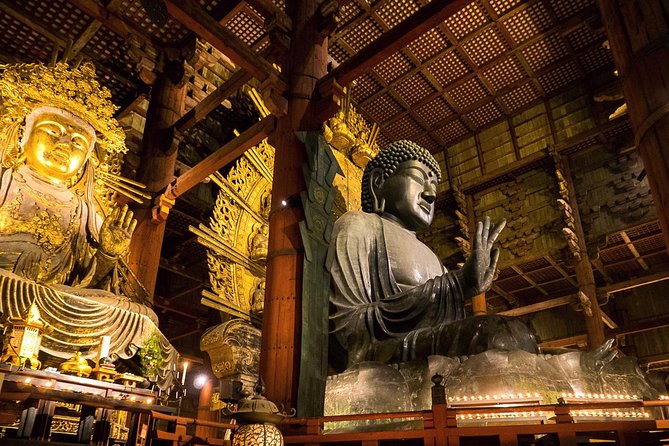
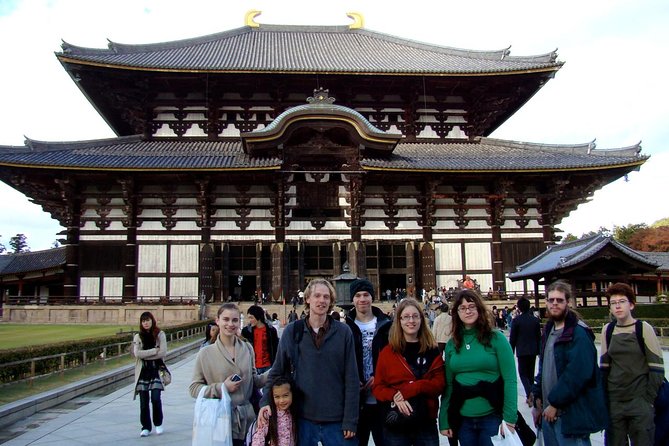
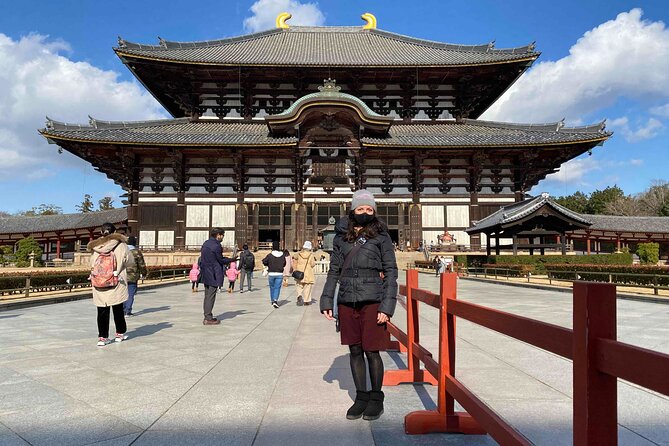
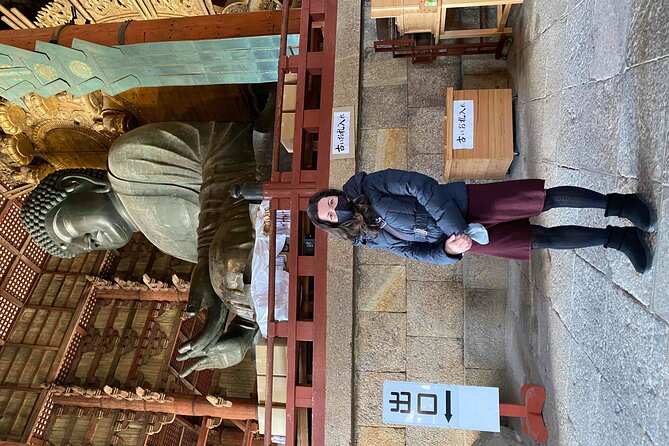
Todai-ji is the strongest choice for a first visit. Founded in 752, the Great Eastern Temple is one of Japan’s major Buddhist monuments and home to its famous Giant Buddha. The building, scale, and religious importance make this more than a quick temple visit.
The listed time for Todai-ji is 30 minutes, but that is a planning estimate, not a promise that you should rush through. Admission is not included, and the guide’s admission is covered only for sights listed in the tour details. Confirm the current entrance arrangement when you finalize the plan.
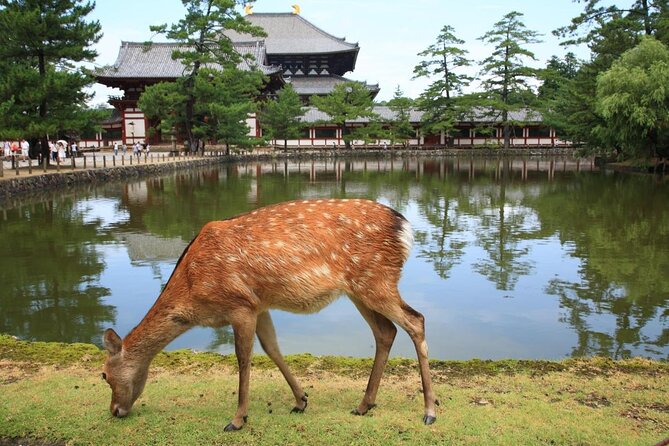
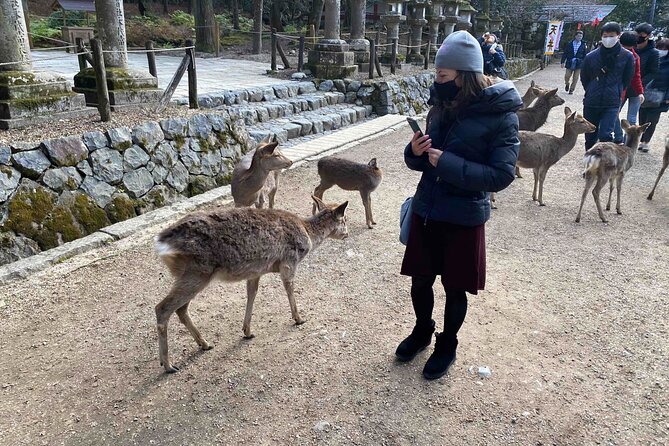
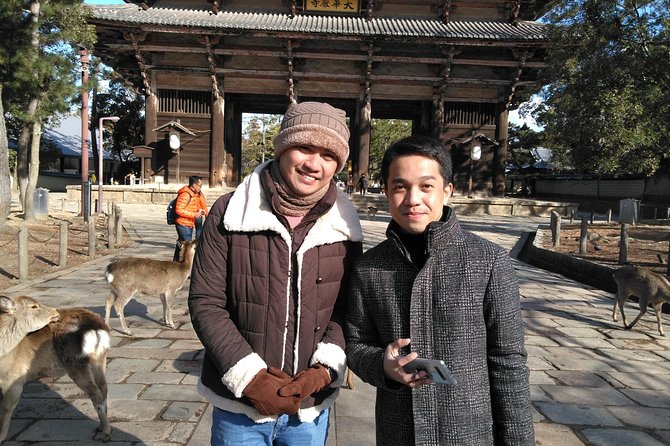
Nara Park is free and gives the day its most recognizable setting. Deer roam through the park beside temples, paths, and open lawns. They are appealing, but they are still animals, and one guide specifically warned that they can be aggressive. Follow local feeding instructions and keep your attention on the deer instead of treating them like tame pets.
Combining Todai-ji with Nara Park makes sense. The park provides breathing room after the temple’s crowded interior, while the temple gives the deer experience a strong historical setting. In busy seasons, a guide can also help you move through the area with less confusion, though no guide can remove crowds entirely.
Kasuga Taisha and Wakakusayama for nature and ritual
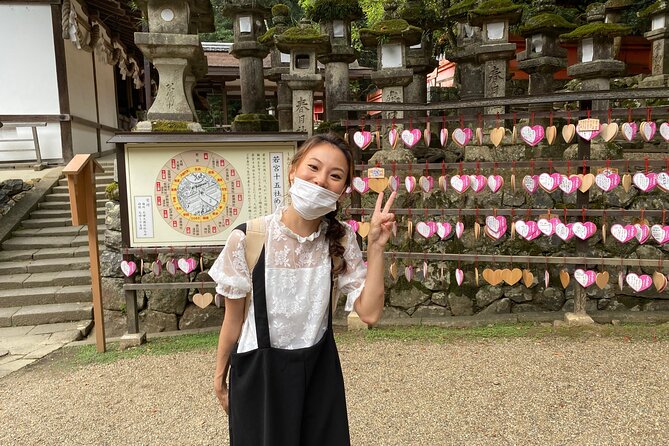
Kasuga Taisha is Nara’s best-known Shinto shrine. It was founded around the time Nara became the capital and is linked to the deity responsible for protecting the city. Its religious setting differs from Todai-ji, making the pair useful if you want to understand the relationship between Shinto and Buddhism in Japan.
The shrine is listed as a free stop, but the full experience may involve walking through the park and along paths rather than simply arriving at a single building. Ask your guide to explain the shrine’s role, symbols, and connection with the surrounding deer and forest.
Wakakusayama is the physical challenge on the menu. This grass-covered hill rises behind Nara Park and offers broad views over the city. Admission is not included, and the climb adds stairs and exertion to an already active day.
I would choose Wakakusayama only if you genuinely want a hill walk and a viewpoint. One person described the route as involving a lot of climbing and walking, but also found it worthwhile. In hot weather, cold wind, or high humidity, it may be smarter to choose a garden, museum, or old neighborhood instead.
Naramachi and Kofuku-ji for a closer look at old Nara
Naramachi was once the city’s merchant district. Preserved homes and storehouses now sit alongside small shops, cafés, and boutiques. It is a useful change of pace after monumental religious sites because you see how people lived and worked in historic Nara.
Naramachi is listed as free, though purchases and food are your responsibility. If you want a meal, tell the guide before the final part of the route. Guides have recommended udon and sushi places, but lunch is not part of the tour price.
Kofuku-ji was the family temple of the powerful Fujiwara clan and was founded in Nara during the same period as the capital. It offers another way to understand how religion and political power worked together in early Japan.
Admission is not included. The stop is a good fit for anyone interested in temple architecture, aristocratic history, or the rise of Nara as a center of government. If your main interest is street life and food, Naramachi may give you more of what you want.
More Private-Only Departures in Nara:
- Kyoto/Osaka: Kyoto and Nara Customized Private Guided Tour
★ 4.6 · 258 reviews - Kyoto Private Car Tour – Full Day with Local Guide & Nara Option
★ 5.0 · 169 reviews - From Osaka/Kyoto: Private Kyoto & Nara Day Trip with Pickup
★ 4.7 · 122 reviews - Nara 8hr Private Tour – Kyoto DEP. with Licensed Guide
★ 5.0 · 115 reviews
Horyu-ji, Yakushiji, and Toshodai-ji for serious history
Horyu-ji is the choice for visitors who want to go beyond central Nara. Founded in 607 by Prince Shotoku, it is one of Japan’s oldest temples and contains some of the oldest surviving wooden structures in the world. The significance is enormous, but the extra distance and admission fee mean it should be one of your main priorities, not an afterthought.
One guide, Ken, was praised for planning trains, buses, and walking so a group could reach Horyu-ji, Toshodai-ji, the Nara Palace site, and Todai-ji in one day. That kind of routing requires care. Public transport costs extra, and four major sites in six hours leaves little room for lingering.
Yakushiji was built in the late seventh century for the recovery of Emperor Tenmu’s sick wife. Its strict symmetry and paired pagodas make it attractive to visitors who enjoy design and formal temple layouts. Toshodai-ji, founded in 759 by the Chinese priest Ganjin, offers another important link between Japan and the mainland.
Both are outside the simplest Nara Park circuit. Choose them for their historical and architectural value, and accept that you may give up deer time, Naramachi, or a relaxed lunch. The tour has no private vehicle, so the guide must work with trains, buses, walking, or taxis paid by you.
Nara National Museum and the palace site
The Nara National Museum focuses mainly on Japanese Buddhist art. It was established in 1889 and sits inside Nara Park, making it an efficient choice if you want indoor time, visual detail, and a break from walking outside.
Admission is not included. A museum works best when you want to slow down and examine sculpture, ritual objects, and artistic traditions rather than collect another landmark photograph. Tell the guide if the museum matters to you, since a short stop may not be enough for a serious art visit.
Heijo Palace Site Historical Park marks the capital of the Nara Period. The palace once covered roughly one kilometer by one kilometer, and the site helps you picture Nara as an organized imperial capital rather than simply a park with temples.
The listed time here is only 15 minutes, so expectations matter. This is a historical stop for orientation and scale. It is not the same kind of concentrated visit as entering Todai-ji.
Isuien and Yoshikien: the quietest choices
Isuien is one of the best options if you want a pause from crowds. The garden uses Todai-ji’s Nandaimon Gate and Wakakusayama as borrowed scenery, a classic Japanese garden idea in which views beyond the garden become part of the design.
The listed visit is 15 minutes, though you may want more if gardens are a main reason for booking a private guide. One guide remembered a guest quietly listening to a stream here, which captures the appeal: this is a place for attention, not speed.
Yoshikien is another garden in central Nara, named for the Yoshikigawa River beside it. It occupies the site of a former Kofuku-ji priest’s residence and gives you a smaller, calmer alternative to the main temple circuit.
Both gardens have admission fees. I would choose one garden instead of trying to squeeze in both, unless your group strongly prefers gardens and is happy to skip a larger monument. These stops also provide useful relief if the weather is hot or the deer park feels crowded.
The guides make the format work
The tour’s strongest feature is not a single monument. It is the guide’s ability to connect places and respond to your interests.
Junichi has been especially praised for excellent English, energy, humor, and preparation. His past tours have included historical explanations, mochi, katana collections, sake tasting, local food, and practical Japan advice such as transit cards, taxi apps, and cash exchange. His background as an English professor and teacher helps explain why guests found his communication easy to follow.
Ken is a strong match for history-focused groups. He has prepared handouts, linked Nara to events outside Japan, and planned complicated transport routes. Toshi has been praised for clear answers, patience, and stamina on long walks. Rie has helped visitors see both the main sights and smaller local stops, while Hiro has adjusted well to changing requests from families with teenagers.
These names come from individual guide experiences, not a guarantee that you will receive a particular person. If you have a preference, ask the Japan Guide Agency before booking, but treat the request as a question rather than a promise.
What $155.86 per person really buys
At $155.86 per person, this is not the cheapest way to see Nara. You still pay for admission, lunch, and transport, and there is no private vehicle.
The value comes from private attention and planning. If you want to compare Buddhist and Shinto traditions, adjust the day for children, fit in a particular garden, or use limited time efficiently, a good guide can save you from guessing at every turn. The benefit grows with a small group because you share the guide cost while keeping a private experience. Group discounts are offered, though the exact saving is not stated.
The price is harder to justify if you only want Todai-ji, Nara Park, and a quick look at the deer. Those places can be visited independently, and Nara’s central sights are close enough to connect without a private guide.
I see the tour as a planning and interpretation service, not an admission package. Book it when the meaning behind the sites matters to you, or when your group has mixed priorities. Skip it if you prefer wandering alone and do not need explanations.
How to prepare for six hours on foot
Agree on your top three choices before meeting the guide. Then name one backup in case weather, energy, or transport changes the plan.
Wear comfortable shoes and bring water. The route may include long paths, stairs, hills, and transfers. If you want Wakakusayama, say so at the start. If you need a taxi at the end, make that clear before everyone is tired.
Remember that pickup means meeting on foot within the designated Nara area. No private vehicle is provided. The tour is near public transport, but transportation fees are yours to pay.
Most people can participate, and service animals are allowed. The free cancellation deadline is 24 hours before the start time. After that, the amount paid is not refunded, and changes are not accepted.
Who should book this Nara experience?
Book it if you want a flexible day with a local English-speaking guide, especially if your interests include history, religion, architecture, gardens, or Japanese food. Families may like the private format because the guide can respond to different ages and attention spans.
It also suits first-time visitors who want Nara explained rather than simply photographed. The best results come from active participation: ask questions, state your pace, and tell the guide what you do not want to miss.
Think twice if your group dislikes walking, wants a fixed cost with admissions included, or prefers to move at its own pace without a guide. Six hours can feel long if the itinerary is not matched to your energy.
FAQ
How long is the Nara private tour?
The tour lasts approximately six hours.
How many sites can I choose?
You can customize the experience by selecting three or four sites from the prepared list.
Where do I meet the guide?
You meet the guide at Nara Station or within the designated Nara area, with the meeting and tour conducted on foot.
Is a private vehicle included?
No. The experience does not include a private vehicle, and transportation fees are not included.
Are entrance fees included?
No. Entrance fees are generally your responsibility. The guide’s entrance fees are covered only for sights listed under the tour’s included attractions.
Is lunch included?
No. Lunch and other personal expenses are not included.
Is Nara Park free to enter?
Yes. Nara Park is listed as a free stop, though nearby attractions may charge admission.
Can I visit Horyu-ji on this tour?
Yes. Horyu-ji is one of the available choices, but admission and transportation are not included.
Is this tour suitable for children?
Most people can participate, and the private format can work well for families. You should still plan for substantial walking, stairs, and possible hills.
Can I cancel for a full refund?
Yes, if you cancel at least 24 hours before the experience start time. Cancellations or changes made less than 24 hours in advance are not refunded or accepted.
Should you book it?
Book this tour if you want Nara’s temples, deer, gardens, and old streets tied into a clear story, with the freedom to shape the day. Before you pay, choose your three priorities, ask about the guide assigned to your date, and confirm the expected walking and transport.
For history lovers, families, and visitors who want more than a quick deer photo, the private format can be worth the added cost. For independent walkers focused only on Todai-ji and Nara Park, save the money and explore those central sights on your own.
Just added around Nara
- Private Kyoto Tour by Car with Optional Nara or Osaka Add-Ons★ 5.0 · 36 reviews
- Kyoto, Osaka, Nara Private Tour by Car English Driver Guide★ 4.0 · 63 reviews
- Nara Todaiji Kasuga Taisha Private Full Day Tour From Kyoto★ 5.0 · 13 reviews
- From Kyoto: Nara History Guided Half Day Bus Tour with lunch★ 5.0 · 23 reviews
- Nara 8hr Private Tour – Kyoto DEP. with Licensed Guide★ 5.0 · 115 reviews
- Arashiyama & Nara Highlights: One-Day Private Tour Adventure★ 5.0 · 16 reviews
- Kyoto Private Car Tour – Full Day with Local Guide & Nara Option★ 5.0 · 169 reviews
- Kyoto & Nara Private Tour from Osaka Kyoto Hotel Pick-up★ 4.5 · 32 reviews
Nara Tours, compared.

World Heritage Kyoto & Nara Uji Authentic Matcha Experience
Our verdict →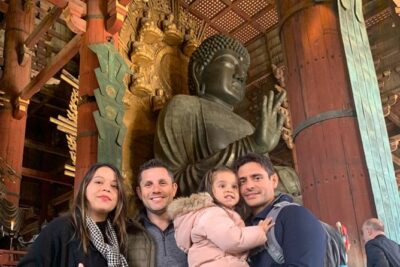
Nara Half Day Trip Walking Tour (Private Option Available)
Our verdict →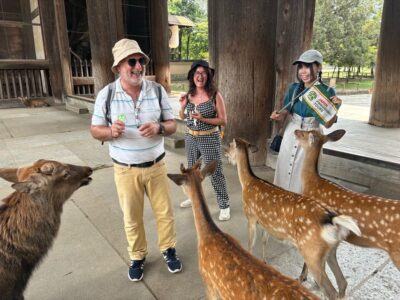
Nara and Uji Day Trip with Deer Park and Hot Spring
Our verdict →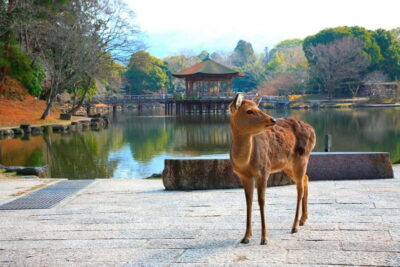
Browse the lists this tour appears in